Table of Contents
- Who makes the final decision in a life sciences buying committee?
- What roles sit on a life sciences buying committee?
- Why can quality end a deal after commercial agreement?
- How does audit-readiness become a marketing asset in CDMO vendor selection?
- Why map content to life sciences buying committee roles rather than funnel stages?
- When should outreach reach each life sciences buying committee role?
- How do you orchestrate references and site visits?
- How do you measure life sciences buying committee coverage?
- Where this does not apply
- Frequently Asked Questions
Need help with B2B Marketing?
Let the smarketers’ team drive your pipeline with data-led campaigns and AI-powered growth strategies.
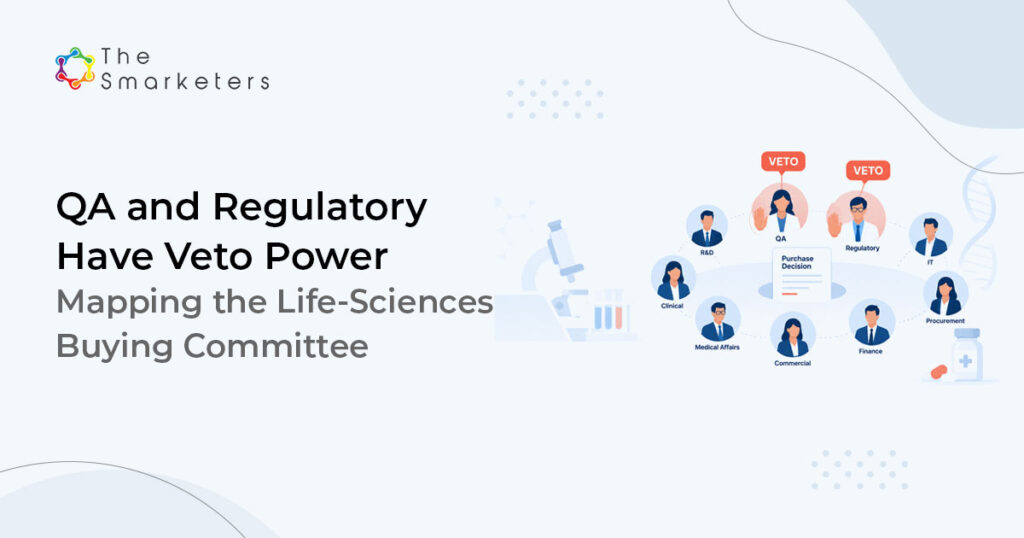
A life sciences buying committee in CDMO and contract manufacturing selection typically includes nine roles: programme owner, CMC lead, analytical development, quality assurance, regulatory affairs, external manufacturing, supply chain, procurement, and technical operations. Five of the nine hold veto power. Quality assurance and regulatory affairs enter mid to late stage and can stop a deal after commercial terms are already agreed.
In a life sciences buying committee, quality and regulatory stakeholders hold a veto that arrives late and overrides commercial agreement. Most vendors under-serve them badly, because the marketing asset set is built for business development and the audit evidence only appears in the RFP response. Move that evidence forward and you remove the most common reason these deals collapse.
Business development teams call this losing on quality. Usually it is losing on quality documentation, a different and far more fixable problem.
Who makes the final decision in a life sciences buying committee?
Nobody, in the sense the question implies. Procurement executes the agreement, the programme owner sponsors it, and several functions can each stop it. Signature is the last event, not the decision.
STAT
The average B2B buying decision now involves 13 internal stakeholders and 9 external influencers, and procurement is a decision-maker in 53% of business buying cycles. Source: Forrester, State of Business Buying, January 2026.
In a life sciences buying committee the number sits at the upper end of that range, and the composition is unusual: the strongest veto holders often have no budget line and no relationship with your sales team.
What roles sit on a life sciences buying committee?
Nine functions recur in a CDMO buying committee across contract manufacturing, testing, and clinical services selection. Titles vary; decision rights do not. The table below maps each role by what they assess, whether they hold a veto, and when they typically enter the evaluation.
| Role | What they assess | Veto | Enters at |
|---|---|---|---|
| Programme or asset owner | Whether the partner can deliver the timeline | No, sponsors | Start |
| CMC lead | Process fit, scale-up feasibility | Yes | Early |
| Analytical development | Method transfer and validation | Yes | Early to mid |
| Quality assurance | Quality systems, deviations, audit history | Yes | Mid to late |
| Regulatory affairs | Filing risk, dossier support | Yes | Mid |
| External manufacturing | Governance, capacity, past performance | Yes | Mid |
| Supply chain | Continuity, dual sourcing, lead times | Sometimes | Mid |
| Procurement | Commercial terms, supplier qualification | Yes | Late |
| Technical operations | Tech transfer execution | No | Late |
Five of the nine can end the process on their own. Only one, procurement, is routinely on a marketing list.
VISUAL 1 · CAPTURE THIS
Screenshot of a CRM account view for a mid-size pharmaceutical company, with contacts filtered by function, showing quality and regulatory columns empty. Annotate the two unfilled veto roles in red and the over-covered commercial roles in grey.
Why can quality end a deal after commercial agreement?
Quality assurance vendor selection criteria operate on a separate calendar and evidence base from the commercial review, and that separation is why deals collapse after handshakes.
Because quality assessment runs on its own calendar and evidence base. A quality unit is not evaluating the pitch. It is evaluating inspection history, the deviation and CAPA record, change control practice, and whether your documentation survives a regulator reading it.
That review usually starts after commercial terms look settled, which is why the loss feels sudden. It was not. It was invisible to the people running the deal, because the assessment happened in documents nobody in marketing had produced.
KEY TAKEAWAY
A quality veto is rarely about capability. It is about whether the evidence of capability exists in the format an auditor expects, on the day it is asked for.
How does audit-readiness become a marketing asset in CDMO vendor selection?
By publishing what is publishable and packaging the rest for controlled release. Most vendors treat every quality document as confidential, then wonder why the quality function forms no view of them until the audit stage.
There is a middle path. Publish the shape of your quality system without the contents: which standards you operate to, inspection cadence, how change control works, what a technical agreement covers, typical deviation response times. None of that is competitively sensitive, and all of it lets a reviewer form an early opinion.
Then build a controlled tier: audit-ready document indexes, redacted inspection summaries and a named quality contact, released under agreement. The index alone changes conversations, because it shows the material exists and is organised.
PROOF POINT
For Eclat Health, a health information services client, the demand programme delivered 8X growth and cut cost per lead from $5 to $1.82, a 63.6% reduction, with traffic up 200%.
Why map content to life sciences buying committee roles rather than funnel stages?
Because these roles do not move through a shared funnel. A regulatory lead may enter at month four and leave a decision behind at month five, while the programme owner has been talking to you since month one. Stage-based nurture assumes a synchronised journey that does not exist here.
| Role | Asset that works | Format | Why |
|---|---|---|---|
| CMC lead | Process characterisation and scale-up data | Technical paper | Assesses feasibility with real numbers |
| Analytical development | Method transfer protocol example | Document | Wants to see how transfer is run |
| Quality assurance | Quality system overview, audit index | Structured summary | Needs auditable evidence |
| Regulatory affairs | Dossier support scope, filing track record | Capability note | Assesses filing risk |
| External manufacturing | Governance model, performance reporting | Operating document | Manages the relationship after signature |
| Procurement | Commercial model, qualification pack | Template | Runs supplier onboarding |
STAT
Buyers use an average of seven information sources during a purchase. Source: Gartner, May 2026.
VISUAL 2 · CAPTURE THIS
Screenshot of a CDMO website quality page that publishes its standards, inspection cadence and change control summary. Annotate which four elements a quality reviewer looks for first, and mark what is missing on a typical competitor page shown alongside.
Seven sources across nine roles is a lot of surface area, and almost none of it is your website. Third-party presence, conference material and peer conversation matter more here than content volume.
When should outreach reach each life sciences buying committee role?
Timing beats messaging here. CDMO vendor selection is triggered by events with known lead times, and outreach arriving outside those windows is filed rather than read.
| Trigger | Typical lead time | Who moves first | What to send |
|---|---|---|---|
| Phase transition | 6 to 12 months | CMC, programme owner | Scale-up capability evidence |
| Second-source mandate | 3 to 9 months | Supply chain, external manufacturing | Continuity and capacity data |
| Capacity constraint at incumbent | 1 to 6 months | Programme owner | Fast-start and transfer timelines |
| Post-inspection remediation | 1 to 4 months | Quality assurance | Quality system and audit evidence |
The last row is the underserved one. When an incumbent has a quality problem, the quality function drives replacement directly, and the vendor whose evidence is already visible gets the call.
How do you orchestrate references and site visits?
A site visit is the highest-converting asset in this category and the most mishandled, and it rarely appears in standard ABM programmes for CDMOs and CROs because it gets treated as a sales function rather than a quality event. It gets run as a facility tour when it should be run as an audit rehearsal.
Prepare it the way the visiting quality lead will experience it: documentation in the room, the named quality contact present, deviations discussed openly rather than deflected. A single unprompted disclosure of a past deviation and its resolution does more than an entire capability presentation.
References work differently too. A commercial reference reassures the programme owner. A quality-to-quality reference, where your customer’s QA lead speaks to the prospect’s QA lead, addresses the veto directly, and is worth several of the first.
I built the asset set for a life sciences B2B marketing client going through a contract manufacturing partner selection whose business development team had never produced anything for quality or regulatory. We wrote three documents: a quality system overview, an audit document index, and a method transfer example. Within two quarters the sales team was reporting quality reviewers joining calls earlier, which was the point. Deal outcomes take longer than two quarters to judge in this category, so I will not claim more than that.
How do you measure life sciences buying committee coverage?
Score the veto functions separately – the same principle behind buying committee marketing in any B2B sector, applied here with a veto-weighted lens specific to life sciences. An account with the programme owner, procurement and supply chain engaged looks healthy on any activity dashboard and is one quality review from ending.
- Weight the five veto roles at 70% of the coverage score.
- Count a role as reached only when a named person from that function has engaged with something built for them.
- Track days from first contact to first quality-function contact. Under 60 is good; over 120 predicts a late surprise.
- Review unreached-role frequency across the account list quarterly. It names the asset you are missing.
Where this does not apply
Small-scale, early-phase and research-services purchases often have no meaningful quality veto. A discovery-stage service bought by one scientist on a departmental budget does not need a nine-role map.
The model also assumes an established quality function on the buyer side. Emerging biotechs frequently outsource quality oversight to consultants, which means your veto holder is external, invisible in the org chart and unreachable through account-based targeting. Ask who runs quality oversight early, not late.
Finally, publishing quality evidence has limits your legal team will define. Some material genuinely cannot be released, and the answer is a controlled tier rather than publication. Our pharma manufacturing ABM programmes are built around that constraint rather than against it.
Frequently Asked Questions
Who decides CDMO selection?
No single person decides CDMO selection in a life sciences buying committee. A programme or asset owner sponsors the decision, procurement executes it, and five functions can independently stop it: CMC, analytical development, quality assurance, regulatory affairs and external manufacturing. Signature is the final event rather than the decision, which is why late-stage quality review reverses deals that looked closed.
What roles sit on a pharma buying committee?
Nine roles recur on a pharma buying committee: programme or asset owner, CMC lead, analytical development, quality assurance, regulatory affairs, external manufacturing, supply chain, procurement and technical operations. Titles differ between organisations but decision rights do not. Five of the nine hold a veto, and only procurement usually appears on a marketing list.
How do you market to quality assurance and regulatory stakeholders?
Publish the shape of your quality system without confidential contents: standards, inspection cadence, change control, technical agreement scope, deviation response times. Then build a controlled tier with an audit document index, redacted inspection summaries and a named quality contact. The index matters most: it proves the evidence exists.
When does quality get involved in vendor selection?
Quality assurance vendor selection typically occurs mid to late in the process, after commercial terms look settled, which is why quality rejections feel sudden to sales teams. The assessment itself begins earlier and quietly, from whatever public evidence exists. Vendors with visible quality documentation get assessed favourably before anyone requests anything from them.
What triggers a search for a new manufacturing partner?
Four events dominate: a phase transition, a second-source mandate, a capacity constraint at the incumbent, and post-inspection remediation. Lead times run from one month to twelve depending on the trigger. The remediation trigger is the least contested, because the quality function drives partner replacement directly.
How do you measure buying committee coverage in life sciences?
Weight the five veto functions at around 70% of the coverage score, and count a role as reached only when a named person from that function engages with material built for them. Track days from first contact to first quality-function contact; beyond 120 days you should expect a late surprise.

Indrani Gope
Content Head