Table of Contents
- Why Standard RevOps Does Not Work for Quote-and-Bid Businesses
- CRM Deal Stages That Match a Bid Lifecycle: An Eight-Stage Model
- How to Model Bid/No-Bid as a Scored Pipeline Gate
- Where Estimation, Margin, and Scope Live in the CRM for a Quote-and-Bid Business
- How to Handle Multi-Year and Multi-Phase Revenue in a Bid-Driven Pipeline
- How to Forecast a Quote-and-Bid Pipeline Without Weighted Probability
- How to Capture Win/Loss Data That Survives the Debrief
- What the Reporting Layer Looks Like for a Quote-and-Bid Business: Four Reports
- Where this model does not work
- Frequently Asked Questions
Need help with B2B Marketing?
Let the smarketers’ team drive your pipeline with data-led campaigns and AI-powered growth strategies.
RevOps for quote-and-bid businesses requires a fundamentally different CRM design than subscription sales. Systems integrators, engineering consultancies, and managed service providers need pipeline stages built around the bid lifecycle – qualification, bid/no-bid, estimation, submission, clarification, and award – because the decisions that determine whether revenue happens are made at those gates, not at a demo. This guide covers how to design that model, which fields to require, and how to forecast when no two deals are the same size.
A quote-and-bid business is any professional services firm – systems integrator, engineering consultancy, managed service provider, or project-based contractor – that generates revenue through a formal proposal, RFP response, or competitive tender rather than through a repeatable product sale.
Open almost any CRM in a systems integration or engineering business and you will find stages named Demo Scheduled and Proposal Sent – the same mismatch we document in our guide to CRM pipeline design for IT services companies. Neither describes what the team does. Quote-and-bid businesses need a stage model built around the bid lifecycle, qualification, bid/no-bid, estimation, submission, clarification and award, because the decisions that determine whether revenue happens are made at those gates rather than at a demo. For RevOps in a quote-and-bid business, getting the stage names right is most of the work.
We redesigned a pipeline for an integrator whose win rate looked healthy at 34% until we separated bids they chose to enter from bids they were invited into late. The two cohorts were not remotely comparable, and the blended figure had been driving resourcing decisions for two years.
Why Standard RevOps Does Not Work for Quote-and-Bid Businesses
Subscription RevOps rests on one quiet assumption, that each deal is roughly the same shape. Same product, similar price, comparable delivery. Stage conversion rates mean something under that assumption, because the deals inside each stage are alike.
Bid-driven revenue has no such unit. One deal is a six-week fixed-price migration, the next a four-year managed service with a transition phase and a penalty clause. Averaging them produces a forecast that is arithmetically correct and practically useless.
There is a second difference. In subscription sales, cost of delivery is largely fixed at the point of sale. In bid-driven work the deal you sign determines cost, so a CRM capturing price but not estimated margin records half the transaction. Our B2B RevOps guide covers how this margin gap compounds across the full revenue stack.
CRM Deal Stages That Match a Bid Lifecycle: An Eight-Stage Model
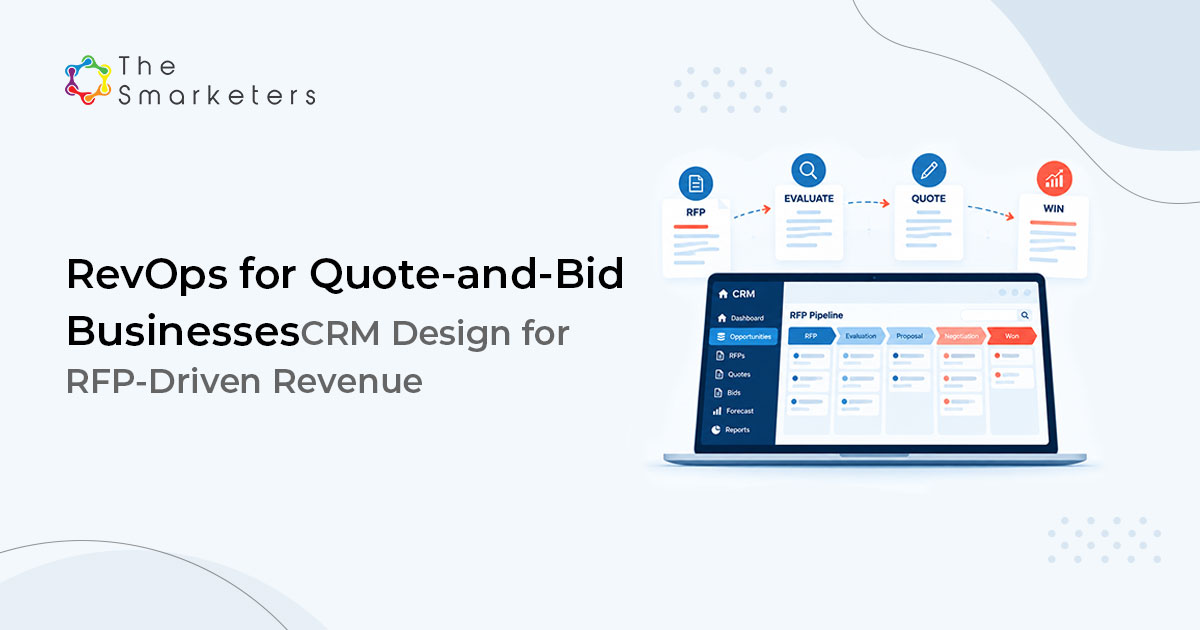
In a bid lifecycle CRM, stages should be gates with a decision at each, not activities. Every stage needs an entry test someone can pass or fail, and a named owner who makes the call.
| Stage | Entry criteria | Decision made here | Owner |
|---|---|---|---|
| Opportunity identified | A named requirement exists with a budget holder | Is this in our addressable scope | Account owner |
| Qualified | Requirement, timeline and evaluation process understood | Do we pursue | Sales lead |
| Bid or no-bid | Qualification complete, capacity checked | Do we commit estimation cost | Bid committee |
| Estimation | Bid decision recorded, solution outline agreed | What are scope, price and margin | Solutions and delivery |
| Submitted | Response delivered and acknowledged | Nothing, awaiting client | Bid manager |
| Clarification | Client has raised questions or requested revision | What do we concede | Sales lead with delivery |
| Award decision | Client has selected | Do we accept final terms | Commercial lead |
| Contracted | Signature and start date agreed | Handover to delivery | Delivery lead |
The clarification stage is the most commonly omitted stage in a quote-and-bid business CRM pipeline. It is also the one where the most margin is conceded: recording how much unpriced scope gets agreed after submission is typically the largest single margin leak in a bid-driven business.
How to Model Bid/No-Bid as a Scored Pipeline Gate
Treat the bid decision as a scored gate with a recorded outcome, not a conversation. A serious response costs weeks of senior time, so a no-bid is a legitimate and often profitable result. Score five factors, each out of five, and set a threshold below which the default is no-bid.
| Factor | What it tests | Evidence required |
|---|---|---|
| Relationship depth | Do we know the buying group before the RFP | Named contacts with recorded activity |
| Requirement fit | Can we deliver this without unusual risk | Delivery lead sign-off |
| Capacity | Do we have the skills free in the delivery window | Resourcing check against practice plan |
| Commercial shape | Is the margin achievable at likely price | Estimation outline |
| Incumbency and influence | Did we shape the requirement | Documented pre-RFP engagement |
STAT
68% of B2B buyers already have a front-runner in mind when buying begins, and that front-runner wins 80% of the time. Source: Forrester B2B Summit, 2026.
That is the argument for the fifth factor. If you did not shape the requirement, you are bidding into a decision already made, and your real win probability is a fraction of the blended average.
A score below 12 out of 25 should default to a no-bid. A score above 20 is a clear pursue signal. Between 12 and 20, the bid committee reviews the opportunity before committing estimation resources.
PROOF POINT
Across delivery-heavy programmes with Neev Systems and LeidIT, we separated invited-late bids from shaped bids in the pipeline, so that win rate was reported per cohort rather than blended. [FIELD: win rate on shaped bids compared with invited-late bids after the split]
Where Estimation, Margin, and Scope Live in the CRM for a Quote-and-Bid Business
They live on the deal record as required fields, or they do not exist. The common failure is estimation living in a spreadsheet attached to an email, which means margin can never be reported alongside pipeline.
| Field | Type | Set at stage | Used for |
|---|---|---|---|
| Estimated effort in days | Number | Estimation | Capacity forecasting |
| Estimated gross margin percentage | Number | Estimation | Weighted margin pipeline |
| Contract type | Picklist | Estimation | Risk reporting and revenue recognition |
| Delivery start date expected | Date | Submission | Resource planning |
| Contract term in months | Number | Submission | Multi-year revenue phasing |
| Scope conceded post-submission | Number | Clarification | Margin leak analysis |
| Primary service line | Picklist | Qualification | Practice-level reporting |
Contract type deserves its own picklist rather than free text, because fixed-price, time-and-materials, outcome-based and managed-service deals behave differently in every downstream report.
How to Handle Multi-Year and Multi-Phase Revenue in a Bid-Driven Pipeline
A single deal amount is the wrong shape for work running across years. Split the value into scheduled revenue lines with expected dates and report pipeline as value expected to be recognised in a period.
| Revenue shape | How to record it | What to report |
|---|---|---|
| Fixed-price phase | One line item per phase with a date | Value recognisable in the period |
| Optional or gated phase | Separate line with its own probability | Reported outside committed pipeline |
| Recurring managed service | Monthly value with contract term | Annualised run rate and term |
| Transition or mobilisation | Separate line, often loss-making | Margin effect in the first quarters |
Total contract value is the number of sales likes. Recognisable revenue in the period is the number finance needs. Report both, labelled, and never present TCV as if it were annual.
How to Forecast a Quote-and-Bid Pipeline Without Weighted Probability
Standard weighted probability fails in bid pipeline management, because bid outcomes are binary and lumpy. One large award can outweigh a quarter of deals combined. Use three views instead. Commit covers submitted bids with a known decision date and a shaped requirement. Best case adds submitted bids where you were invited late. Upside covers qualified opportunities not yet past the bid gate. Our guide to HubSpot RevOps implementation covers how to configure commit, best case, and upside views natively in HubSpot’s forecast tool.
KEY TAKEAWAY
Report bid-driven forecasts as a range across three named views, with the decision dates that would resolve each. A single weighted number hides exactly the information leadership needs, which is when the uncertainty ends.
How to Capture Win/Loss Data That Survives the Debrief
Structured fields on the deal record, filled within five working days, by someone other than the deal owner. Free-text notes written by the person who lost the bid are the least reliable data in the business. The RevOps infrastructure we build for delivery-heavy businesses treats win/loss fields as a required part of the closed-lost stage, not an optional debrief.
Capture four things. The stated reason, the price gap if known, the winner, and whether a competitor shaped the requirement. The fourth is the most useful and the least recorded. Our RevOps design work usually starts here, because comparable debrief data across 50 bids changes qualification behaviour within two quarters.
What the Reporting Layer Looks Like for a Quote-and-Bid Business: Four Reports
Four reports cover most of what leadership needs. Bid volume and bid/no-bid ratio by service line. Win rate split by shaped versus invited-late. Weighted margin pipeline by delivery quarter, not close quarter. And scope conceded after submission, as a percentage of original estimated value.
The third changes behaviour. Pipelines organised by close date tell the delivery organisation nothing. Organised by expected delivery quarter, the same data becomes a resourcing plan, which is where RevOps stops being a sales function and starts being an operating one.
Where this model does not work
It assumes bid volume high enough to learn from. Below roughly 20 bids a year the scoring gate is still worth the discipline, but the win rate cohorts will not be meaningful and should not drive resourcing.
It assumes delivery will participate – a frequent failure point in RevOps for system integrators and project-based firms. Estimation fields filled by sales without delivery sign-off are worse than no fields, because they create false confidence in the margin pipeline.
Heavily regulated procurement adds constraints this model does not address, particularly where scoring is published and negotiation restricted. The stage names hold; the bid/no-bid weights need changing.
And none of this improves the win rate on its own. It improves the decision about which bids to enter, which is a different and usually larger prize.
For the demand generation layer that feeds this pipeline, see our RevOps guide for IT services companies.
Frequently Asked Questions
What CRM stages should an RFP-driven business use?
Use gates rather than activities: opportunity identified, qualified, bid or no-bid, estimation, submitted, clarification, award decision and contracted. Each needs an entry test someone can pass or fail and a named owner. Clarification is the stage most often omitted and the one where margin is usually conceded.
How does RevOps differ for professional services?
The unit of revenue is not repeatable, and cost of delivery is set by the deal rather than fixed beforehand. That means the CRM must capture estimated effort, margin and contract type alongside price, and pipeline has to be reported by expected delivery period rather than by close date.
How do you manage a bid pipeline?
Score every opportunity at a bid/no-bid gate on relationship depth, requirement fit, capacity, commercial shape and whether you shaped the requirement. Record the no-bid decisions as well as the bids. Then forecast across three named views rather than a single weighted number, because bid outcomes are binary and lumpy.
Should no-bid decisions be recorded in the CRM?
Yes, as a closed outcome with the score and reason attached. No-bids are the cheapest positive result in a bid business, and without recording them you cannot tell whether qualification is improving or whether the team is simply avoiding difficult work.
How should multi-year contracts be valued in the pipeline?
Split the deal into scheduled revenue lines with expected dates and report the value recognisable in each period. Keep total contract value as a separate labelled figure. Optional or gated phases should be held as separate lines with their own probability rather than folded into the headline number.
Who should conduct a win/loss debrief?
Someone other than the deal owner, within five working days, using structured fields rather than free text. Capture the stated reason, the price gap if known, the winner, and whether a competitor shaped the requirement. That last field is the most useful and the one almost nobody records.

Enoch Pakanati
CEO