Table of Contents
- Why does B2B sales territory planning on a map fail?
- How do you size addressable accounts per region for B2B territory planning?
- What is the right coverage ratio per rep by ACV band?
- What do time zones and language actually cost in a coverage model?
- Why should marketing capacity be part of territory design?
- How do you rebalance sales territories without losing quota credibility?
- How do you model B2B sales territory planning before you hire?
- What does the multi-region GTM planning calendar look like?
- Where this model does not hold
- Frequently Asked Questions
Need help with B2B Marketing?
Let the smarketers’ team drive your pipeline with data-led campaigns and AI-powered growth strategies.
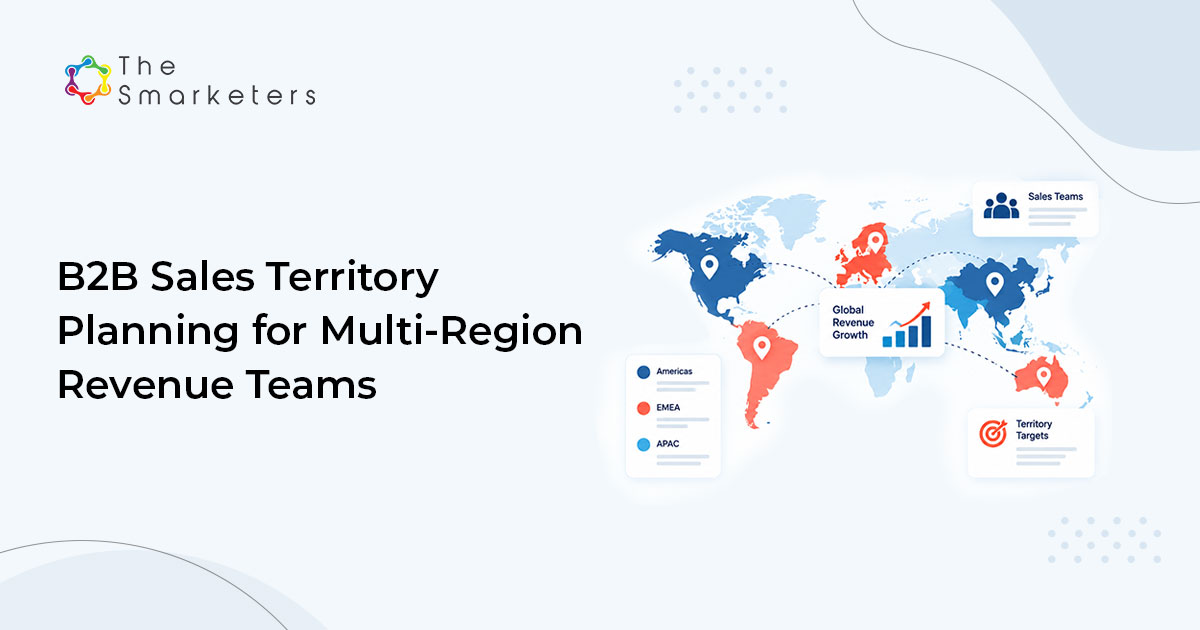
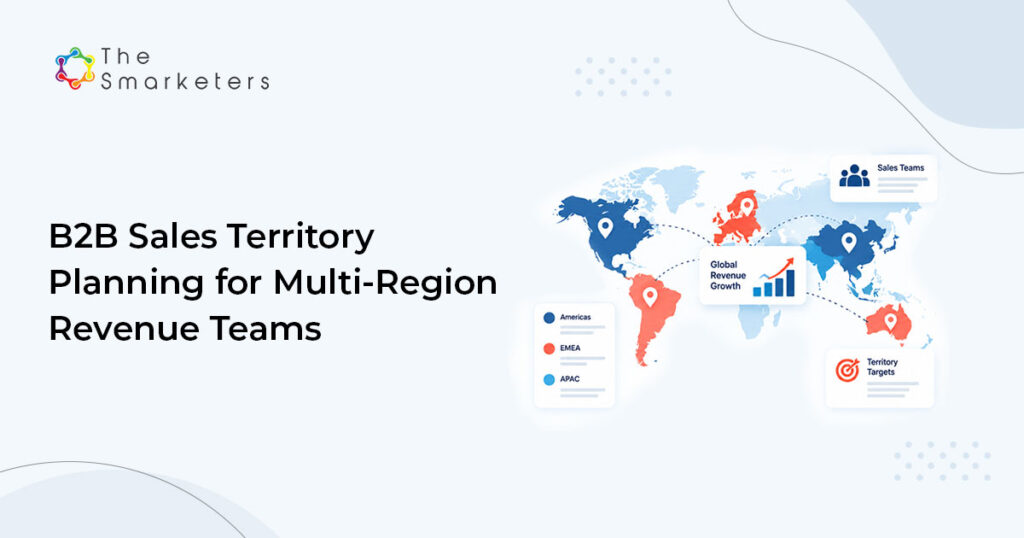
B2B sales territory planning should start from the number of qualified accounts in a region and the coverage ratio one rep can sustain – not from a map. The right approach involves four steps: count accounts by region using firmographic and fit-based filters, apply the coverage ratio for your ACV band, adjust for time-zone and language constraints, then assign named marketing capacity before setting any quota. Regions with fewer but larger accounts require lower account-per-rep ratios because each pursuit involves more stakeholders and a longer cycle.
Most B2B sales territory planning starts by splitting a world map into roughly equal-looking pieces and handing one to each rep. It feels fair and it is almost always wrong. Territory design should start from the number of addressable accounts and the coverage ratio one rep can sustain, not from geography. Regions with fewer but larger accounts need lower account-per-rep ratios even when the area on the map looks small, because each account demands more people, more meetings and a longer cycle.
We ran this exercise for a cloud services business covering North America, Europe, the Gulf and Japan with a team of nine. Two reps carried 340 accounts each and two carried 40. Both groups were missing quota, for opposite reasons.
Why does B2B sales territory planning on a map fail?
A map measures distance; a territory has to measure work. The unit of work in B2B selling is not the square kilometre or even the account. It is the buying group.
STAT
The average B2B buying decision now involves 13 internal stakeholders and 9 external influencers, and procurement is a decision-maker in 53% of cycles. Source: Forrester, State of Business Buying, January 2026.
If a serious pursuit means building relationships with seven or eight people across an 18-month cycle, a rep can sustain only so many active pursuits, whatever the account count in their patch. Ignoring that produces two failure modes at once, usually in the same organisation. Reps with too many accounts default to whoever answers the phone. Reps with too few manufacture activity in accounts that will never buy.
How do you size addressable accounts per region for B2B territory planning?
Count accounts meeting your qualification criteria, region by region, and resist using market size figures from a research report. The number you need is specific to your product and qualification bar.
| Region | Typical shape of the account base | What usually drives the count down | Design consequence |
|---|---|---|---|
| North America | Large mid-market and enterprise volume | Competitive density, incumbency | Higher accounts per rep, more segmentation |
| Europe | Fragmented by country, language and regulation | Language coverage and local entity requirements | Country or cluster ownership, not region ownership |
| The Gulf | Concentrated, relationship-led, fewer accounts | Small qualified base, partner-mediated buying | Very low accounts per rep, senior coverage |
| Japan | Concentrated enterprise base, long evaluation cycles | Language requirement, local presence expectation | Low accounts per rep, dedicated local hire |
| ANZ | Moderate base, high digital maturity | Small absolute market size | Often merged with a neighbouring region |
Build the count from four filters in order. Firmographic fit, technology or operational fit, a signal the account is reachable, and whether you have a right to win given incumbency. The fourth removes more accounts than the first three combined, and skipping it is why territory plans look generous on paper and thin in practice.
What is the right coverage ratio per rep by ACV band?
A sales coverage model defines how many qualified accounts one rep can genuinely work in a period – it is a ratio, not a target. It falls sharply as deal size and cycle length rise, because bigger deals mean more stakeholders.
| Annual contract value band | Accounts per rep | Active pursuits at once | Typical cycle |
|---|---|---|---|
| Under $25K | 150 to 250 | 25 to 40 | Under 3 months |
| $25K to $100K | 60 to 120 | 12 to 20 | 3 to 6 months |
| $100K to $500K | 25 to 50 | 6 to 10 | 6 to 12 months |
| Above $500K | 8 to 20 | 3 to 5 | 12 to 24 months |
Treat these as starting points. The calculation that matters is meetings capacity. Multiply stakeholders per deal by meetings each needs across a cycle, divide by the meetings a rep can hold in a week, and you have the constraint. In most enterprise businesses that lands well below what leadership assumes.
PROOF POINT
For a Fortune 500 industrial automation client, a multi-channel account-based marketing programme built around a tightly defined account set produced more than 300 opportunities in 4 weeks with a 90% reduction in cost per lead. Concentration, not breadth, is what made the coverage work.
What do time zones and language actually cost in a coverage model?
They cost selling hours, and most models ignore them. A rep covering accounts in another region loses real capacity, not just convenience.
| Constraint | Practical effect | Adjustment to make |
|---|---|---|
| Overlap under 4 hours | Meetings compress into a narrow daily window | Reduce accounts per rep by 20% to 30% |
| Buying group expects local language | Discovery and negotiation slow, materials need translation | Reduce a further 15% or hire locally |
| Local entity or presence expected | Procurement and legal add steps | Add 2 to 4 months to expected cycle |
Japan and the Gulf are where these adjustments usually decide the model. Both reward a small, senior, locally present team over a larger remote one, and both punish coverage designed around a North American selling rhythm.
Why should marketing capacity be part of territory design?
Because a territory with no marketing coverage is not a territory, it is a list. Reps in unsupported regions spend selling time on work marketing should be doing, and their effective capacity falls accordingly.
STAT
Marketing budgets sit at 7.8% of company revenue in 2026, and 56% of CMOs report budget insufficient to execute their strategy. Source: Gartner 2026 CMO Spend Survey, 401 CMOs, released May 2026.
Set a rule during design. Any region receiving a quota must have named marketing capacity attached, whether a share of a central team, a local hire, or support through a RevOps and MarTech service. If it is not available, do not create that territory. A quota with no demand support is the fastest route to a rep leaving and a market being abandoned before it was worked – which is why B2B demand generation must be planned before territories are assigned.
KEY TAKEAWAY
A B2B sales territory needs three things before it receives a quota: a counted addressable account base, a rep with the capacity to cover it, and named marketing support. Without all three, missed quota is a structural problem, not a performance one.
How do you rebalance sales territories without losing quota credibility?
Rebalancing is unavoidable, and it is where most territory programmes lose the sales team. Four rules keep it survivable.
- Rebalance on a fixed annual date, announced in advance, never opportunistically mid-year.
- Protect in-flight opportunities. A rep keeps deals past a defined stage through to close, commission intact.
- Change no more than about 20% of any rep’s account base in one cycle, unless the person is new.
- Publish the rules, not just the outcome. Reps accept a rule they can check, never a redrawn map with no stated logic.
The cost of breaking rule two is permanent. Take a deal from a rep at month fourteen of an eighteen-month cycle and the whole team learns that long pursuits are unsafe. That behaviour outlasts the reorganisation by years.
How do you model B2B sales territory planning before you hire?
Work backwards from the account base, not forwards from a headcount budget. Count qualified accounts per region using the four filters. Apply the ACV band ratio for the rep count, then the time-zone and language adjustments. Compare the result to the revenue that account base can plausibly produce, using your own win rate and deal value, and check whether the fully loaded team cost leaves an acceptable margin.
If it does not, the answer is a smaller, more concentrated territory, not a cheaper rep. This is where our B2B sales territory planning engagements usually start, because it settles arguments about market entry before anyone is hired into a plan that cannot work.
What does the multi-region GTM planning calendar look like?
Sales capacity planning is the final check before territory design becomes a headcount decision.
| Timing | Activity | Owner |
|---|---|---|
| Four months out | Refresh qualified account counts per region | RevOps |
| Three months out | Model rep and marketing capacity, agree headcount | CRO and finance |
| Two months out | Draft territories, review with regional leaders | Sales leadership |
| One month out | Publish territories, rules and protected deals | CRO |
| Month one | Lock the map, changes only for departures | RevOps |
Teams carrying significant bench or utilization pressure can also find practical guidance in our post on RevOps for IT services and demand planning.
Where this model does not hold
It assumes qualified account counts you can produce. If your CRM data does not support region-level qualification, the first project is data, not territory design.
It assumes stable products and pricing. A business changing its ACV band mid-year finds the ratios wrong within two quarters, and rebalancing then breaks the rules above. Plan for wider bands and accept lower precision.
Partner-led models need different treatment. Where revenue arrives through a partner ecosystem, the unit of coverage is the partner, not the account, and these ratios mislead.
And no territory model fixes a positioning problem. If a region is not buying because the proposition does not fit local requirements, redrawing the map and adding a rep produces an expensive version of the same result.
For a deeper look at how CRM and pipeline architecture support long-cycle revenue, see our guide to RevOps for quote-driven businesses.
Frequently Asked Questions
How do you design sales territories for a B2B company?
Start from the count of qualified accounts per region, apply a coverage ratio matched to your contract value band, then adjust for time-zone overlap, language and local presence expectations. Convert to headcount last. Designing from a map or a headcount budget produces territories that look balanced and perform unevenly.
How many accounts should one enterprise rep cover?
For deals above $500K with cycles beyond a year, between 8 and 20 accounts with three to five active pursuits at a time. Below $25K the same rep can carry 150 to 250. The real constraint is meetings capacity across the stakeholders each deal needs, so calibrate on your own cycle data.
How do you plan territories across North America, Europe, the Gulf, Japan and ANZ?
Treat each as a separate coverage problem, not as equal slices. North America usually supports higher accounts per rep, Europe needs country or cluster ownership because of language and regulation, and the Gulf and Japan reward low ratios with senior local coverage. ANZ is often merged with a neighbouring region.
What is a coverage ratio in sales territory planning?
The number of qualified accounts one rep can genuinely work in a period, derived from stakeholder count, meetings needed per stakeholder and meetings available per week. It is a capacity measure, not a target, and it falls as deal size and cycle length rise because larger deals mean more people.
How often should territories be rebalanced?
Once a year, on a fixed announced date, with in-flight opportunities protected through to close and commission intact. Limit changes to roughly 20% of any rep’s account base per cycle. Mid-year rebalancing to chase a shortfall costs more credibility than the coverage gain is worth.
Should marketing capacity affect territory design?
Yes. Any region carrying a quota needs named marketing capacity attached, whether a share of a central team, a local hire or an agency programme. Without it, reps spend selling hours generating their own demand and the market gets written off as unviable when it was never properly worked.

Enoch Pakanati
CEO