Table of Contents
- Why do life sciences budgets run on a grant calendar rather than a fiscal year?
- How do you model a grant award as a pipeline trigger in HubSpot for life sciences?
- How do you record the principal investigator, core facility and procurement as distinct CRM records?
- Should capital instruments and consumable revenue share one HubSpot pipeline?
- How do you time outreach to grant award and spend windows in HubSpot?
- Where do institutional procurement rules live in the CRM?
- How do you build renewal and consumable expansion?
- What does a scientific board want reported?
- Where this build runs into limits
- Frequently Asked Questions
Need help with B2B Marketing?
Let the smarketers’ team drive your pipeline with data-led campaigns and AI-powered growth strategies.
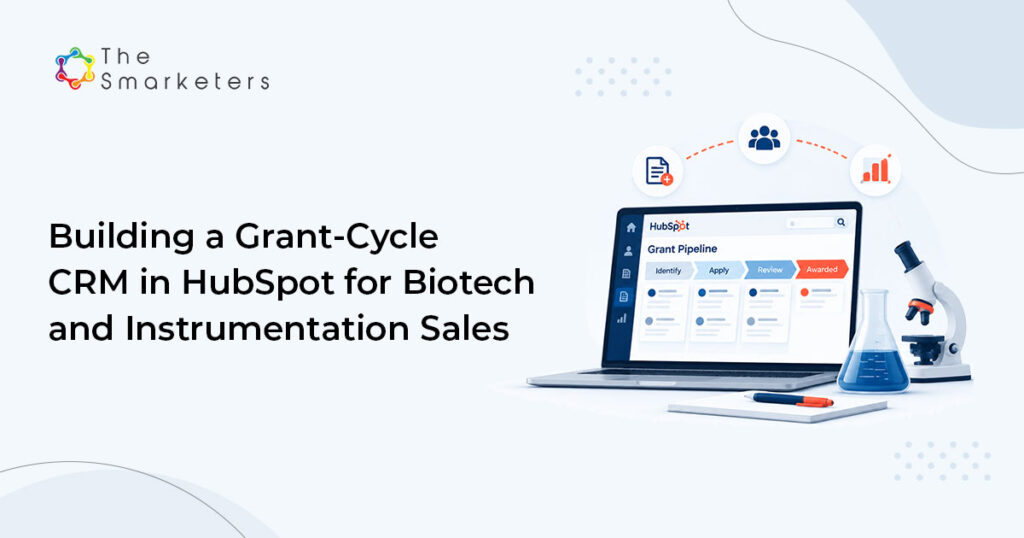
Configuring HubSpot for life sciences companies means building grant funding as a first-class custom object – not a note field – and associating it to the institution, the principal investigator, and the deal. Once the grant object exists, forecast accuracy, outreach timing, and consumable renewal can all be automated from award and spend dates rather than from a calendar. Two deal pipelines handle capital and consumable revenue separately, because they behave nothing alike. This post covers the full build.
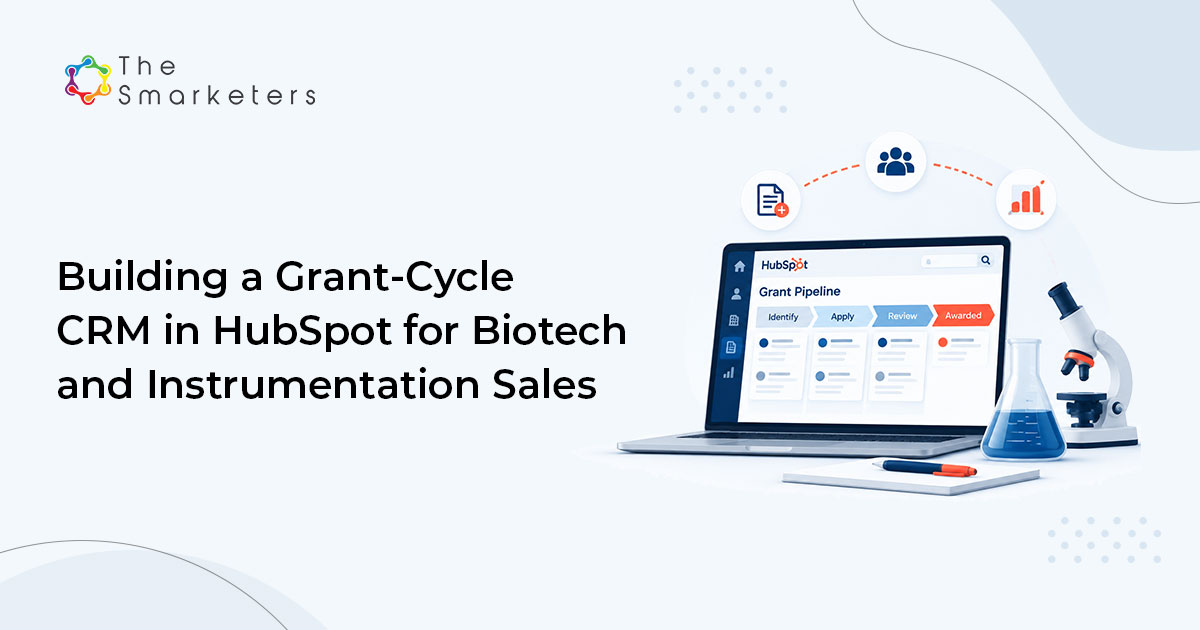
Configuring HubSpot for life sciences sales means adapting the CRM to a buying cycle that runs on grant award dates and spend deadlines, not on fiscal quarters. Build the grant as a first-class custom object in HubSpot, associate it to the institution, the principal investigator and the deal, and the forecast follows the money rather than the calendar. Outreach timing and renewal triggers key off that object.
Most CRM setups used for biotech sales keep funding information as a free-text note on the company record. It cannot be filtered, it cannot enrol a workflow, and it goes stale the moment the award period ends.
Why do life sciences budgets run on a grant calendar rather than a fiscal year?
A laboratory buys when it has money, and that money carries a start date, an end date and a spend category. A five-year award with a capital equipment line does not spend evenly; it spends in year one, then again near the period-of-performance end when unspent funds are at risk.
That produces two demand spikes per award in a grant-funded sales pipeline that have no relationship to your quarter. If your CRM only knows the fiscal close date, forecasting is guesswork.
STAT
68% of B2B buyers already have a front-runner vendor in mind when buying begins, and that front-runner wins 80% of the time. Source: Forrester B2B Summit, 2026.
In grant-funded science that front-runner position is usually set when the instrument is named in the grant application, twelve to eighteen months before a purchase order exists. Everything after that is confirmation.
How do you model a grant award as a pipeline trigger in HubSpot for life sciences?
Create one HubSpot custom object, Grant, and keep it lean. It exists to answer three questions: how much, for what, and by when.
What is a Grant custom object in HubSpot? A Grant custom object is a structured record that stores award reference, funding body, amount, start date, period-end date, and budget category. It associates to Company, Contact, and Deal with labelled relationships, making grant data filterable, reportable, and enrollable in workflows.
| Property | Type | Purpose |
|---|---|---|
| grant_reference | Single-line text | Unique award identifier, used for deduplication |
| funding_body | Dropdown | Segments outreach by sponsor rules |
| award_amount | Number, currency | Sizes the opportunity |
| award_start_date | Date picker | Opens the first spend window |
| period_end_date | Date picker | Drives the use-it-or-lose-it window |
| budget_category | Multiple checkboxes | Capital, consumable, personnel, services |
| capital_allocation | Number, currency | The portion you can actually sell against |
| days_to_period_end | Calculation | Date difference used for workflow enrolment |
Associate Grant to Company with the label “Awarded to”, to Contact with labels “Principal investigator”, “Co-investigator” and “Grants administrator”, and to Deal with “Funded by”. Association labels are available on Professional and Enterprise, and you get a maximum of ten labels per object pair, which is plenty here.
The days_to_period_end calculation property is the one that does the work. Every timing workflow enrols on it.
How do you record the principal investigator, core facility and procurement as distinct CRM records?
Three buyers, three motivations, and one contact list that fails all of them. The principal investigator wants scientific capability. The core facility manager wants throughput and service contracts. Procurement wants a compliant paper trail.
| Role | Contact property value | What they respond to | Owned by |
|---|---|---|---|
| Principal investigator | buying_role = PI | Application data, publications | Field application scientist |
| Core facility manager | buying_role = Core facility | Uptime, service SLA, training | Account executive |
| Grants administrator | buying_role = Grants admin | Allowable cost rules, quotes | Inside sales |
| Procurement officer | buying_role = Procurement | Terms, sole-source justification | Account executive |
Use a dropdown property plus labelled associations on the deal, not a separate contact list. Lists go stale; properties travel with the record.
STAT
The average B2B buying decision now involves 13 internal stakeholders and 9 external influencers, and procurement is a decision-maker in 53% of business buying cycles. Source: Forrester, State of Business Buying, January 2026.
Should capital instruments and consumable revenue share one HubSpot pipeline?
Yes, in two pipelines. They behave nothing alike and forcing them into one set of stages ruins both forecasts.
| Pipeline | Stages | Typical cycle | Close date logic |
|---|---|---|---|
| Capital instrument | Specified in application, award confirmed, demo or seminar, quotation, procurement review, PO received, installed | 9 to 24 months | Expected award date plus procurement lag |
| Consumable and service | Trial pack, first order, reorder scheduled, contract renewal, at risk | 30 to 90 days | Next reorder date |
Run the consumable pipeline with recurring revenue deals rather than one deal per order, and track order cadence in a days_since_last_order calculation property. Deal pipelines are configurable from Professional upwards, and each pipeline can carry its own required properties per stage.
How do you time outreach to grant award and spend windows in HubSpot?
Build three date-based HubSpot Marketing Automation workflows – the core of any life sciences revenue automation – enrolling on days_to_period_end and award_start_date. HubSpot workflows can enrol records relative to a date property, which means you never manually schedule any of this.
| Window | Trigger | Action |
|---|---|---|
| Pre-submission | 90 days before a known submission deadline | Send specification and quote templates to the PI |
| Award landing | award_start_date is today | Create a task, notify the owner, set deal stage |
| Year-one spend | 60 days after award_start_date | Enrol in capital instrument nurture |
| End-of-period | 120 days before period_end_date | Alert owner to unspent capital allocation |
The end-of-period workflow is the highest-value one in the build. Unspent allocation close to a period end is the single most predictable purchase signal in this sector, and almost nobody is systematically working it.
We built this pattern for an instrumentation team who had been running outreach on a monthly newsletter cadence. Moving to award-relative enrolment cut list volume by roughly two-thirds and raised reply rates, because a message about a specific unspent equipment line lands differently from a product update. The build took three weeks, most of it spent cleaning grant references rather than configuring HubSpot.
PROOF POINT
Eclat Health grew 8X and cut cost per lead from $5 to $1.82, a 63.6% reduction, once targeting and follow-up were rebuilt around how their buyers actually procure rather than around a publishing calendar.
Where do institutional procurement rules live in the CRM?
On the company record, as properties, so a rep can see them before quoting rather than discovering them at PO stage.
| Property | Type | Example values |
|---|---|---|
| sole_source_process | Dropdown | Permitted, requires justification, prohibited |
| capital_threshold_value | Number, currency | Value above which tender is mandatory |
| preferred_supplier_status | Dropdown | On contract, not on contract, in renewal |
| indirect_cost_rate | Number, percentage | Affects the amount available for equipment |
| po_lead_time_days | Number | Feeds close date calculation |
Set capital_threshold_value as a required property on the quotation stage. It stops the most common failure in this pipeline, which is quoting above a tender threshold and losing four months.
How do you build renewal and consumable expansion?
Instrument installations should create consumable opportunities automatically – this handoff is a standard workflow pattern in any well-configured RevOps and MarTech system. Use a workflow on the capital pipeline: when a deal reaches “installed”, create an associated deal in the consumable pipeline with a close date set to the expected first reorder, copy the institution and PI associations across, and set parent_instrument_deal to the original record ID.
Add a service contract renewal deal at installation plus eleven months. Both are three-action workflows and both recover revenue that otherwise depends on a rep remembering.
KEY TAKEAWAY
In life sciences CRM design, the instrument sale is the acquisition event. The consumable stream is the business. Automate the handoff between them in HubSpot or it will not happen consistently.
What does a scientific board want reported?
Not lead counts. Boards want a pipeline mapped to funding reality, which means three reports built on the Grant object: total capital allocation across active awards, opportunities by funding body and period-end quarter, and win rate split by whether you were specified in the original application. That last one justifies pre-award marketing spend. Our HubSpot consulting for life sciences clients.
Where this build runs into limits
Grant data quality is the constraint, not HubSpot – and this applies across the healthcare and life sciences vertical. Public award records are inconsistently structured and rarely tell you the equipment line inside the budget, so the capital_allocation field is an estimate maintained by humans. Treat it as directional.
Custom objects also cannot receive marketing email; HubSpot sends marketing email to contacts – which is why HubSpot integrations with marketing automation tools sometimes provide a workaround for complex object-to-contact mirroring. If you want to message everyone attached to a grant, mirror the grant fields onto the associated contacts with a workflow and segment there.
Custom object records do not carry lifecycle stage, and they cannot drive contact lead scoring directly. The workaround is the same: copy the two or three values you need onto the contact record and score on those.
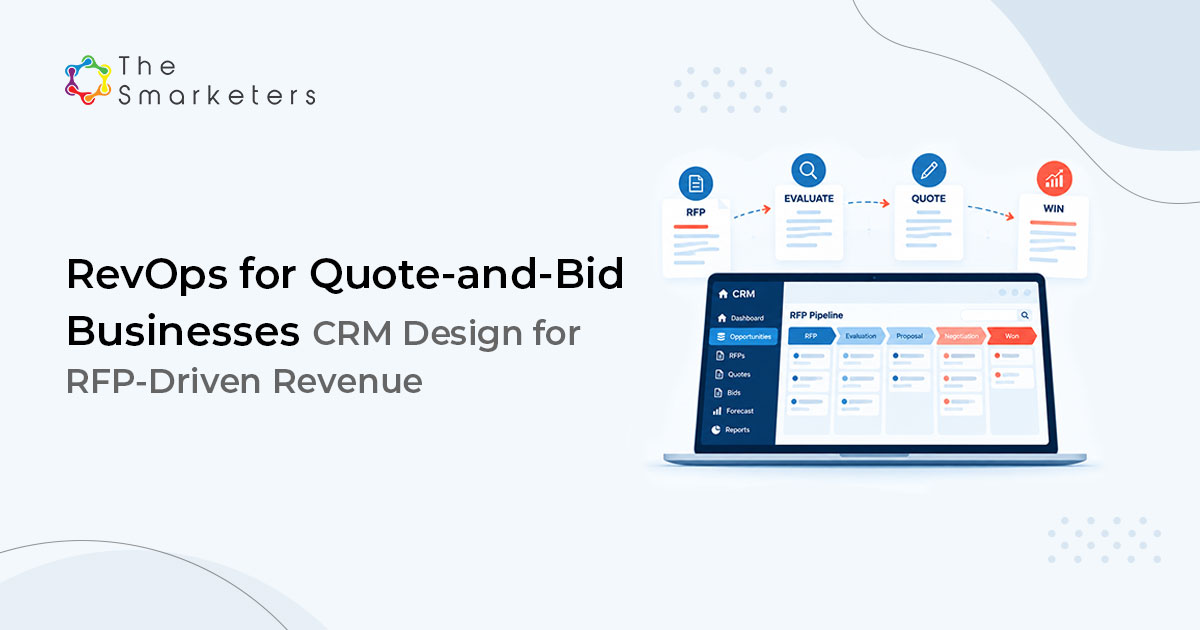
Finally, none of this helps if your commercial team cannot be specified into a grant application. That is a scientific credibility problem solved by application notes, seminars and reference labs, not by CRM configuration. For related build patterns in quote-and-bid businesses, see our guide to RevOps for RFP-driven revenue.
Frequently Asked Questions
What is the best CRM setup for lab equipment sales?
Two deal pipelines, one for capital instruments and one for consumables and service, plus a Grant custom object associated to the institution, the principal investigator and the deal. Timing workflows enrol on a calculated days-to-period-end property so outreach follows award and spend windows instead of a monthly send schedule.
How do I track grant funding in HubSpot?
Build a Grant custom object with award reference, funding body, award amount, start and period-end dates, budget category and capital allocation – the full property set we configure in every HubSpot implementation for life sciences clients. Associate it to Company, Contact and Deal with labelled associations. Add a date-difference calculation property for days to period end, which becomes the enrolment trigger for every timing workflow.
Should capital and consumable sales share one pipeline?
No. A capital instrument takes nine to twenty-four months and closes on an award-driven date; consumables reorder in weeks. Separate pipelines let each carry its own stages, required properties and close date logic, and let a workflow create the consumable deal automatically when the instrument deal reaches installed.
When should outreach start in a grant-funded sales cycle?
Before submission. Forrester reported at its 2026 B2B Summit that 68% of buyers have a front-runner in mind when buying begins and that front-runner wins 80% of the time. In grant-funded science the front-runner is usually the instrument named in the application, so pre-submission specification support is the highest-return activity.
Can HubSpot workflows trigger on a funding date?
Yes. Workflows enrol records relative to a date property, so you can act 90 days before a submission deadline or 120 days before a period-end date without manual scheduling. Use a calculation property holding the date difference in days as the enrolment criterion, and re-enrolment for multi-year awards.
What does HubSpot for life sciences not handle well?
Custom objects cannot receive marketing email, do not carry a lifecycle stage, and cannot feed contact lead scoring directly, so mirror the fields you need onto contacts with a workflow. Grant source data is also inconsistent and rarely itemises equipment, meaning capital allocation stays a maintained estimate rather than a fact.

Swati Bansal
Sr. Content Strategist