Need help with B2B Marketing?
Let the smarketers’ team drive your pipeline with data-led campaigns and AI-powered growth strategies.
ABM for Biotech
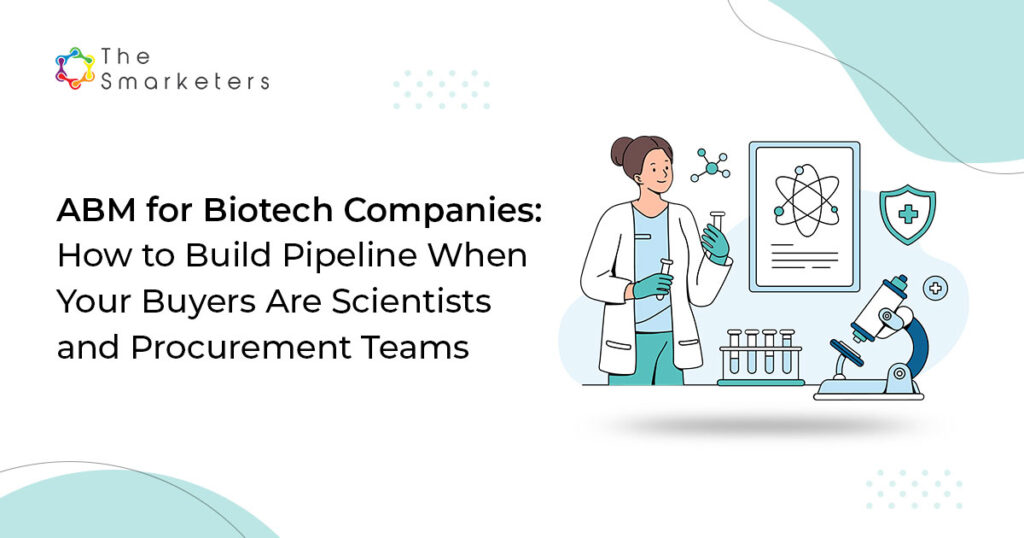
ABM for biotech companies is account-based marketing adapted for the dual-audience challenge specific to biotech commercial relationships: scientific and technical buyers who evaluate capability, methodology, and data quality, alongside procurement and legal teams who manage commercial terms, IP arrangements, and contractual frameworks. ABM for biotech requires two simultaneous content and engagement tracks one built for scientific credibility, one built for commercial confidence running concurrently toward a unified partnership decision.
The Biotech Dual-Audience Problem
Most B2B ABM targets a single primary buyer type. In biotech, you almost always have two. And they rarely communicate with each other until the deal is already in advanced negotiation.
The scientific buyer a principal investigator, a director of research, a VP of biology or chemistry evaluates your technical capabilities with the same rigour they apply to evaluating experimental data. They want to know: Is your platform validated? What are your specificity and sensitivity benchmarks? Do your methods hold up under the conditions of our specific experimental requirements? They will read your application notes, scrutinise your data, and talk to peers who have worked with you.
The procurement buyer supply chain, legal, or a business development counterpart evaluates entirely different criteria: contract terms, IP ownership and licensing, pricing structure, supply continuity, quality agreements, and regulatory compliance of your commercial operations.
ABM that only activates scientific buyers generates enthusiasm that cannot convert to a partnership without the commercial conversation. ABM that only activates procurement generates process efficiency without scientific buy-in. Both tracks are necessary, and they need to run simultaneously.
Biotech partnerships where both scientific and commercial stakeholders were engaged during ABM took 40% less time to reach contract signature
ABM Content for Scientific Buyers
Scientific content for biotech ABM must meet the same evidence standards that scientists apply to experimental data. Generic capability claims do not work. What works:
- Validated performance data: Sensitivity, specificity, reproducibility, and cross-validation data for your platform or assay. Published in peer-reviewed journals where possible referenced with full citation details where not yet published.
- Application notes for specific research areas: Detailed notes showing how your platform performs in specific experimental contexts relevant to the target account’s research focus. A genomics company targeting oncology-focused biotech needs different application notes than one targeting metabolic disease researchers.
- Comparative methodology data: Head-to-head comparisons with existing methods, showing where your approach provides specific advantages in sensitivity, throughput, or cost efficiency.
- Reference customer data: Which institutions and research groups have used your platform? For biotech ABM, being able to reference peer institutions or recognised research groups carries significant credibility weight.
ABM Content for Commercial/Procurement Buyers
Commercial content addresses entirely different concerns and requires different framing:
- Quality and regulatory compliance documentation: ISO certifications, GMP compliance for any manufactured components, quality management system documentation. For biotech partnerships that may eventually support IND or NDA submissions, regulatory compliance documentation is non-negotiable.
- IP framework clarity: How is IP handled in collaborative partnerships? What is your standard approach to data ownership, background IP, and jointly developed IP? Having a clear, transparent IP framework documented reduces a major source of procurement friction.
- Supply continuity documentation: For reagents, materials, or platform components used in ongoing research, supply continuity is a significant concern. Documentation of manufacturing redundancy, alternative supply sources, and long-term supply agreements supports procurement confidence.
- Commercial case studies: While scientific case studies speak to research outcomes, commercial case studies demonstrate your track record as a business partner on-time delivery, quality consistency, responsiveness, and communication through a complex partnership.
Running Dual-Track ABM for Biotech
| ABM Element | Scientific Track | Commercial Track |
|---|---|---|
| Primary Contact | PI, VP Biology/Chemistry, Research Director | BD counterpart, Procurement Lead, Legal/IP team |
| Initial Outreach Hook | Recent publication or application note relevant to their research area | Partnership framework overview, supply chain credentials |
| Content Sequence | Application notes, validation data, peer reference conversation | Quality documentation, IP framework, commercial case study |
| Meeting Goal | Technical capability assessment, experimental design discussion | Commercial framework discussion, terms preview |
| CRM Tracking | Scientific interest score, technical evaluation stage | Commercial evaluation stage, procurement stakeholder engaged |
The two tracks should converge at the partnership negotiation stage where scientific and commercial teams from both organisations are involved simultaneously. ABM that has built relationships on both sides makes this convergence significantly smoother.
About The Smarketers
The Smarketers is India’s first ITSMA-awarded ABM agency and a HubSpot Gold Partner. With 40+ implemented ABM programs and an 85% success rate, they work with B2B technology companies, IT services firms, and life sciences companies to drive pipeline through ABM, demand generation, and RevOps.
Frequently Asked Questions
Why does ABM for biotech require two simultaneous content tracks?
Biotech partnerships involve two fundamentally different buyer types: scientific and technical buyers who evaluate experimental capability and data quality, and commercial/procurement buyers who evaluate commercial terms, IP arrangements, and supply continuity. These buyers have different concerns, read different content, and are persuaded by different evidence. Single-track ABM activates one at the expense of the other dual-track ABM reaches both simultaneously.
What content works best for scientific buyers in biotech ABM?
Validated performance data, application notes specific to the target account’s research area, comparative methodology data, and peer reference information. Scientific buyers evaluate content with the same rigour they apply to experimental data generic capability claims and benefits-led marketing copy do not build credibility with this audience.
How do you handle IP and commercial concerns in biotech ABM?
Create a clear commercial content track separate from scientific content, addressing: IP framework and ownership structure, quality and regulatory compliance documentation, supply continuity evidence, and commercial partnership case studies. Having a documented IP framework and quality compliance pack ready to share with procurement teams removes a major source of commercial friction early in the evaluation.
How many accounts should a biotech company target with ABM?
The size of the ABM target list depends on the specificity of the biotech’s commercial offering. A highly specialised genomics platform company may have 30 to 80 ideal partner accounts globally. A broader reagent or consumables supplier may have 200 to 500 relevant accounts. Start with a Tier 1 list of 10 to 20 accounts for full dual-track ABM treatment and a Tier 2 list of 30 to 80 for programmatic outreach.