Table of Contents
- Why Do Most Sales Training Programs Fail?
- What Is the Build-Operate-Transfer Approach?
- What Should B2B Marketing Training for Sales Teams Cover?
- How Do You Measure Training ROI?
- The Smarketers BOT Model and the 5-Gate Transfer Readiness Framework
- When Build-Operate-Transfer Is Not the Right Approach
- Where to Start
- Frequently Asked Questions
Need help with B2B Marketing?
Let the smarketers’ team drive your pipeline with data-led campaigns and AI-powered growth strategies.
Picture the Monday after the sales kickoff. Two days of workshops on social selling and buyer-centric outreach, high energy, full notebooks. Six weeks later, the LinkedIn activity has stopped, the new sequences sit unused in the CRM, and pipeline creation looks exactly like it did in the previous quarter. Nobody is surprised, because this is the third training program that has ended the same way.
The frustrating part is that the case for training sales teams in marketing skills has never been stronger. Gartner’s March 2026 sales survey found that 67% of B2B buyers prefer a rep-free buying experience, and Forrester’s 2025 Buyers’ Journey Survey found that 94% of B2B buyers use generative AI during the purchase process. Buyers educate themselves through content, communities, and AI assistants long before they accept a meeting. A rep who can only pitch in meetings is working a shrinking slice of the journey. A rep who can publish, engage, and build visibility works the whole thing.
So the question is not whether sales teams need marketing skills. It is why training programs keep failing to build them, and what structure actually works. This article covers both, including the Build-Operate-Transfer model we use at The Smarketers to make capability stick after we leave.
Why Do Most Sales Training Programs Fail?
Most training programs fail because they are events, not operating systems. A workshop transfers information; it does not transfer accountability. When the trainer leaves, no one owns the follow-through, no metric changes hands, and the daily pressure of quota pulls every rep back to the habits that filled last quarter’s pipeline.
In the programs we have been asked to rescue, four failure patterns show up again and again:
- No accountable owner. The training was sponsored by HR or enablement, but no revenue leader owns the behavior change. When nobody’s number depends on adoption, adoption loses to everything else on the calendar.
- Theory without a live pipeline. Reps practice on hypothetical personas instead of the accounts they carry. The skills never touch a real deal during training, so they never feel real afterward.
- No systems behind the skills. Reps are taught to share content and engage buyers, but there is no content engine, no measurement, and no CRM workflow to support the behavior. Motivation without infrastructure decays in weeks.
- One-shot delivery. Skill formation needs repetition over months. A two-day intensive followed by silence is a memorable offsite, not a capability program.
Meanwhile the buyer keeps moving. Demand Gen Report benchmarks show buyers consume 8 to 13 pieces of content before they ever engage sales, and Gartner’s survey of 645 B2B buyers found 69% now use sales reps to validate what AI tools already told them. By the time a rep enters the conversation, the buyer has a formed opinion. Training that does not prepare reps to shape that opinion earlier, through content and credible presence, prepares them for a role that is disappearing.
Key takeaway: P67% of B2B buyers prefer a rep-free buying experience (Gartner, March 2026). The rep’s influence now depends on what buyers find before the first call, which is a marketing problem sales teams must learn to work.

What Is the Build-Operate-Transfer Approach?
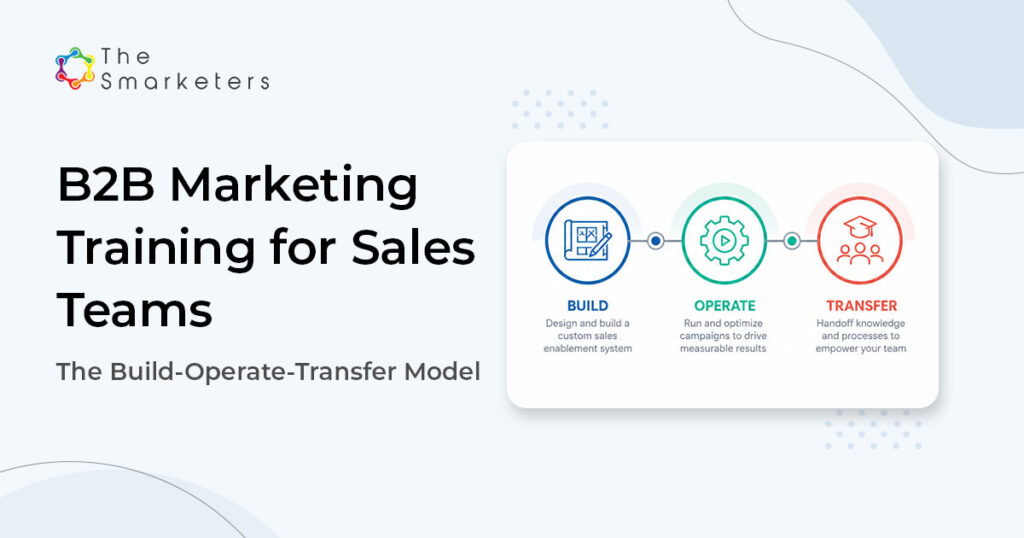
Build-Operate-Transfer (BOT) is an engagement model in which an external team first builds the marketing systems your sales team needs, then operates them on a live pipeline with your people embedded, and finally transfers full ownership once your team can run the engine independently. The model comes from infrastructure and IT outsourcing, where it has long solved the same problem sales training has: how to hand over a working capability rather than a binder of recommendations.
The three phases each answer a question a workshop never asks:
- Build: what will the team actually run? Positioning, ICP definitions, content templates, outreach sequences, social selling playbooks, CRM workflows, and dashboards get built and documented before anyone is trained on them. Training on systems that do not exist yet is the most common sequencing mistake we see.
- Operate: does it work on a real pipeline? The external team runs live campaigns for one to three quarters with your reps and marketers working inside the engine, not watching a demo of it. Every playbook gets pressure-tested against real accounts, and reps learn by shipping, with quota still being made.
- Transfer: can the team run it alone? Ownership moves role by role against explicit readiness criteria: documented playbooks, shadow-run campaigns, metric ownership, admin rights, and hiring. The engagement ends when the checklist is green, not when the retainer expires.
Compared with the two default options, the trade-offs look like this:
| Dimension | Workshop Training | Ongoing Agency Retainer | Build-Operate-Transfer |
|---|---|---|---|
| What you get | Knowledge | Outcomes, rented | Outcomes plus in-house capability |
| Accountability | Ends at delivery | Stays with the agency forever | Shifts to your team on a schedule |
| Risk | No behavior change | Permanent dependency | Slower start; needs internal headcount |
| Best when | Awareness is the gap | You never want marketing in-house | You want the engine and the skills to keep it |
Key takeaway: The unit of value in BOT is not a campaign or a workshop. It is a documented, measured operating system your team has already run under supervision. That is what makes the skills survive the handover.
What Should B2B Marketing Training for Sales Teams Cover?
Three capability areas cover most of what a modern B2B sales team needs from marketing: account-based marketing, social selling, and buyer-enablement content. Each earns its place with evidence, not fashion.
Account-based marketing: working a named list, together
ABM gives sales and marketing one shared account list and one definition of progress, which is precisely the accountability most training lacks. The economics justify the effort: 87% of marketers say ABM delivers higher ROI than other marketing strategies (ITSMA), and Forrester found ABM ROI most commonly runs 21 to 50% higher than other approaches. In training terms, reps learn account research, buying-group mapping, and how to co-plan plays with marketing instead of forwarding leads back with “no budget” notes.
Social selling: presence where buyers already research
For B2B, this mostly means LinkedIn: 80% of B2B social media leads come from LinkedIn, and LinkedIn converts visitors to leads at 2.74%, roughly three times Facebook or X (Sopro). We train reps to build a credible profile, publish practitioner observations, and engage in the threads their buyers read, with clear rules against the promotional spam that gets ignored. In one Smarketers engagement for an SAP partner (Globpar), this motion produced 70% target-account engagement, 63% email open rates, and 41% connection acceptance (Smarketers client engagement). Those are outreach numbers most SDR teams do not believe until they see the sequencing behind them.
Buyer-enablement content: arming the 8-to-13-touch journey
If buyers consume 8 to 13 pieces of content before engaging sales, reps need to know what those pieces are, where the gaps sit, and how to contribute. We train reps to feed objections and questions from calls into the content engine, to use content deliberately in sequences, and to write short answer-first posts themselves. Reps are also the best source of the questions buyers now ask AI assistants, which makes them unexpected contributors to AI visibility work.
CRM and measurement hygiene: the unglamorous fourth skill
The least requested and most consequential module is basic revenue-system discipline: logging touchpoints, maintaining account and contact data, and reading the dashboards that show whether any of the above is working. CRM adoption keeps growing, around 12.6% year over year (SellersCommerce), but adoption of the software is not adoption of the habit. A sales team that cannot see its own pipeline data cannot self-correct, and every other skill in the program degrades without that feedback loop. We treat two weeks of CRM working sessions as non-negotiable, even for teams that groan about it, because the gate reviews later in the engagement depend on reps trusting the numbers they report.
How Do You Measure Training ROI?
Measure training the way you would measure any pipeline investment: define the metric owner, the baseline, and the review cadence before the first session runs. Most organizations skip this. The pattern mirrors what ITSMA found in ABM, where only 52% of companies measure ROI at all, and top-performing programs are 30% more likely to measure. Measurement discipline is not overhead; it is the difference between a program and an expense.
A workable measurement stack has three layers:
- Leading indicators (weeks 1-8): playbook adoption, publishing cadence, target-account engagement, connection acceptance, reply rates. These tell you whether behavior changed.
- Pipeline indicators (months 2-6): rep-sourced pipeline, meetings created from social and content touches, opportunity rate on trained accounts versus a holdout set.
- Economic indicators (months 4-12): cost per qualified opportunity against your baseline. With the average B2B cost per SQL at $1,357 (Starr Conspiracy, FY2024), a sales team that self-generates even a handful of qualified opportunities per quarter changes its own economics visibly.
Cadence matters as much as metric selection. The rhythm that holds programs together in practice: a weekly operating review where reps and marketers look at the same account list, a monthly scorecard against the agreed baseline, and a quarterly executive review that decides whether to extend, adjust, or advance a transfer gate. Programs reviewed quarterly-only drift for months before anyone notices; programs reviewed weekly-only drown in noise and overreact to single data points. The three-layer cadence keeps both failure modes in check.
One honest warning: attribution for skills programs is inherently noisy. Reps improve for many reasons, markets shift, and holdout groups are politically hard to maintain. Use directionally clean comparisons, agree the scorecard upfront, and resist the urge to claim precision the data cannot support.
The Smarketers BOT Model and the 5-Gate Transfer Readiness Framework
Our version of BOT is built around a simple discipline: transfer is a test you pass, not a date you reach. We call the test the 5-Gate Transfer Readiness Framework, and we review it monthly with the client’s revenue leadership from the first month of the engagement.

An engagement only hands over when all five gates are green. If Gate 3 fails, meaning internal owners cannot yet report pipeline numbers without our help, we extend coaching on that gate rather than transferring a program that will quietly collapse. Clients occasionally find this rigid. It is also why the programs still run a year later.
Case study: 300% ROI while the team learned the engine
Before: Josh Software, a technology services firm, had strong delivery credentials and a sales team dependent on referrals and founder relationships. No repeatable demand engine, no marketing muscle inside the sales organization.
After: within 7 months the program delivered 300% ROI, 500+ MQLs, and 4,000+ website visitors, with the client team running core plays themselves by the final quarter (Smarketers client engagement).
Bridge: the Build phase established positioning, content templates, and CRM workflows. The Operate phase ran live campaigns with the client’s sellers embedded in weekly plays: publishing, engaging target accounts, and working marketing-sourced conversations. Transfer readiness was reviewed against the five gates monthly, and ownership moved role by role instead of in one cliff-edge handover.

Smarketers insight: The single strongest predictor of a clean transfer is whether a named internal owner attends the weekly operating rhythm from month one. When that person exists, gates close on schedule. When they do not, no amount of documentation compensates.
When Build-Operate-Transfer Is Not the Right Approach
BOT is a poor fit in at least four situations, and pretending otherwise wastes money on both sides:
- You cannot commit internal headcount. Transfer requires people to transfer to. If the plan is “the agency leaves and nobody replaces them,” buy an ongoing retainer instead; it is more honest and it works.
- You need results in under one quarter. The Build phase is deliberate by design. A pure campaign sprint will produce pipeline faster, though nothing will remain when it stops.
- Leadership wants training, not change. If the executive sponsor will not tie adoption to anyone’s goals, a BOT engagement will surface that conflict in month two. A workshop is a cheaper theater.
- Your sales motion is purely transactional. High-velocity, low-ACV sales with two-week cycles gain less from ABM and social selling depth; conventional demand generation may return more per dollar.
Where to Start
Before evaluating any program, run one internal diagnostic: ask three of your best reps to show you the last piece of content they shared with a buyer, the last post they published, and the last account plan they co-built with marketing. The answers will tell you whether your gap is knowledge, systems, or accountability, and those are three different purchases.
If the gap turns out to be systems and accountability, that is the problem BOT was designed for. Explore our training and demand generation services to see how the Build-Operate-Transfer model is scoped, gated, and measured.
Frequently Asked Questions
How long does a Build-Operate-Transfer engagement take?
Plan for 9 to 18 months in total: one to three months of Build, six to twelve of Operate, and a phased Transfer of one to three months. Compressing below nine months usually means skipping the shadow-run cycles that make skills stick.
Is BOT more expensive than hiring an in-house team directly?
Over the engagement it typically costs more per month than one hire and less than the three to five hires the engine actually needs. The comparison to make is cost per qualified opportunity over 18 months, including the cost of the failed ramp-up time a cold in-house build usually incurs.
How large should our sales team be before this makes sense?
The model earns its overhead from roughly five quota-carrying reps upward. Below that, a founder-led version with an external operator and lightweight playbooks achieves most of the benefit at lower cost.
What happens if our trained people leave after the transfer?
Attrition is exactly why the model insists on documented playbooks and metric ownership rather than hero knowledge. A departing owner hands over a running system, and gate reviews can be rerun for their successor. Some capability loss is still real; budget for periodic refresher coaching.
Which KPIs should we track in the first 90 days?
Adoption metrics only: playbook usage, publishing cadence, target-account engagement, and reply rates. Pipeline metrics before day 90 mostly measure your old motion, and judging the program on them too early kills good programs for bad reasons.
Can BOT work if we have no marketing team at all?
Yes, and it is often the cleanest scenario because there are no legacy processes to unwind. The Build phase then includes hiring support for your first one or two marketing roles, and Gate 5 (hiring plan closed) becomes the pacing constraint for transfer.
Do experienced sales reps actually adopt marketing behaviors?
Adoption follows evidence, not age. When a skeptical senior rep sees a meeting sourced from their own post or a target account engaging with their comment thread, resistance drops quickly. The design requirement is getting each rep one visible win inside the first eight weeks.
How is this different from hiring a sales enablement platform?
Enablement platforms distribute content and track readiness; they do not build your demand engine or run live campaigns. In practice they work well inside a BOT engagement as tooling, but a license without an operating system changes very little on its own.

Isha Gulati
Senior Marketing Manager