Table of Contents
- Why Is Biotech Go-to-Market Strategy Different?
- How Biotech Startups Build Credibility Before Revenue: The Five-Rung Ladder
- What Does Content for Scientific Audiences Look Like?
- How Does ABM Work for Pharma Partnerships?
- Our Life Sciences Marketing Strategy Work: What We Do for Biotech Companies
- When Marketing Investment Is Premature for a Biotech
- Where to Start
- Frequently Asked Questions
Need help with B2B Marketing?
Let the smarketers’ team drive your pipeline with data-led campaigns and AI-powered growth strategies.
A Series A biotech closes its round, publishes the press release, and gets back to the science. Eighteen months later, the business development lead discovers that a pharma partner they had been courting signed a deal with a competitor whose data was arguably weaker. The partner’s search team had shortlisted candidates months earlier, and the startup was never on the list. Nobody rejected them. Nobody knew to consider them.
This is the standard failure mode in life sciences marketing strategy, and the buying research explains why it feels invisible. The 6sense Buyer Experience Report found that in roughly 95% of B2B deals the winning vendor was already on the buyer’s day-one shortlist, and about 80% of buyers contact first the vendor they already intend to buy from. Forrester puts 70 to 80% of the buyer journey before first vendor contact. Partnership decisions in life sciences behave the same way, with longer cycles and more scrutiny. If your company is not visible while the shortlist forms, the partnering process is over before your first meeting request.
The good news: a biotech startup does not need a big brand to get onto day-one shortlists. It needs deliberate credibility building, content that survives scientific scrutiny, and a focused account-based motion. This guide walks through all three, plus the point at which marketing investment is premature.
Why Is Biotech Go-to-Market Strategy Different?
Biotech GTM is different because the product is often years from revenue, the buyer universe is tiny and concentrated, and every claim faces peer-review-grade skepticism. Standard SaaS playbooks assume a large addressable market and a short evaluation; biotech partnership marketing gets neither.
Four structural features shape everything downstream:
- Concentrated buyer universe. For most platforms and assets, the realistic partner list is 20 to 50 organizations: pharma companies, larger biotechs, and a handful of strategics. Broad-reach demand tactics waste money in a market this narrow.
- Committee-heavy decisions. Forrester and 6sense report a median buying group of 11.2 people for B2B deals over $50K. Partnership decisions add scientific reviewers, clinical teams, legal, and corporate development, so single-threaded relationships routinely die in internal review.
- Credibility asymmetry. You have data and preprints; you do not yet have revenue, case studies, or an installed base. The evaluation runs on scientific evidence and team reputation, which most marketing programs are not built to communicate.
- Long, quiet cycles. Partnering conversations gestate for quarters with no visible signal. 6sense found that up to 90% of identifiable account visitors stay anonymous through the journey, which in biotech means a pharma search team can evaluate you thoroughly without ever filling a form.

Taken together, these features redefine what life sciences marketing strategy is for at this stage. It is not lead volume; a biotech with 40 realistic partners does not have a volume problem. Marketing’s job is shortlist insurance: making sure that when any of those 40 organizations quietly starts a search in your space, your company is already known, already credible, and already associated with the problem they are trying to solve. Every tactic in the rest of this guide serves that single outcome.
How Biotech Startups Build Credibility Before Revenue: The Five-Rung Ladder
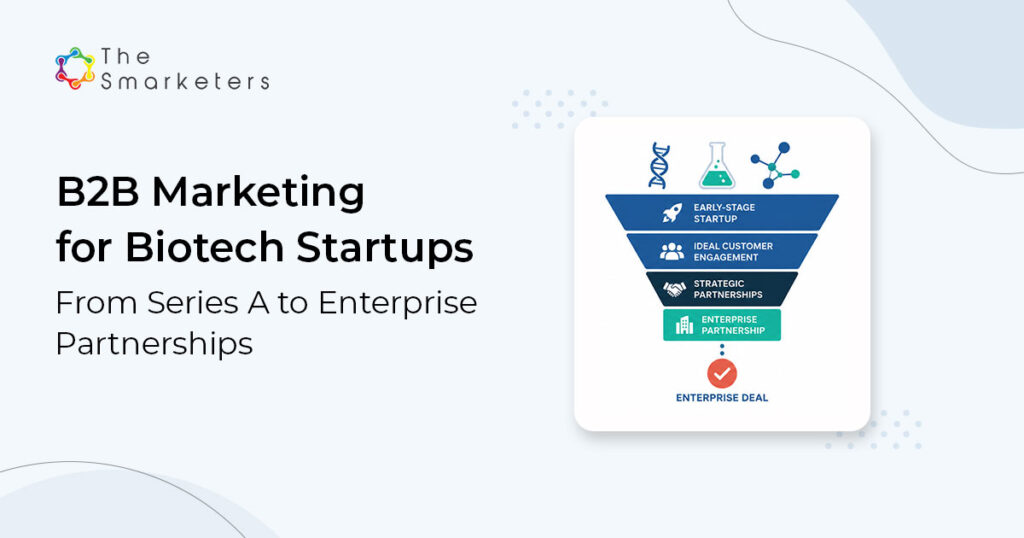
You build credibility before revenue by making your science findable, your evidence legible to non-scientists, and your experts visible in the places partners already look. We organize this as the Biotech Credibility Ladder, five rungs that each depend on the one below.

- Scientific identity. One clear, consistently worded explanation of who you are, what the platform or mechanism is, and which problem it addresses, used identically on your site, LinkedIn, databases, and conference materials. Inconsistent naming fragments your presence in both search engines and the AI assistants partners increasingly ask.
- Evidence library. Posters, preprints, publications, and data summaries gathered on your own domain, each with a plain-language summary a corporate development analyst can parse in two minutes. Evidence that lives only in conference PDFs is invisible to the people who build shortlists.
- Expert visibility. Founders and scientific leads publishing perspective pieces, appearing on relevant podcasts, and engaging in the scientific and industry communities where your category is discussed. Partners diligence people as much as data.
- Named-account motion. A real ABM program against the 20 to 50 accounts that matter, with buying-group mapping and account-specific materials. This is where credibility converts to conversations.
- Partnership pipeline. BD and marketing operating one account list, one engagement dashboard, and one definition of a qualified partnership conversation. Without this rung the first four produce visibility but no meetings.
Key takeaway: Credibility work compounds. A startup that begins the ladder at Series A enters partnering conversations at Series B with evidence trail partners have already encountered. Starting the ladder when you need the deal is starting two years late.
What Does Content for Scientific Audiences Look Like?
Content for scientific audiences earns trust by behaving like science: claims tied to data, methods visible, limitations stated. The moment a reviewer smells marketing exaggeration, the entire domain loses credibility with them. That standard is compatible with being readable; it is not compatible with hype.
In practice, biotech content programs need two parallel tracks:
| Dimension | Scientific track | Business track |
|---|---|---|
| Audience | Research and clinical reviewers on the partner side. | Corporate development, licensing, and strategy teams. |
| Formats | Preprint summaries, mechanism explainers, poster walk-throughs, methods notes. | Platform overviews, market context pieces, partnership rationale one-pagers. |
| Evidence style | Primary data, citations, stated limitations. | Validated claims translated into decision language. |
| Job to do | Survive technical diligence. | Get you onto the day-one shortlist. |
Volume expectations should match the buying reality: buyers work through 8 to 13 pieces of content before engaging a vendor (Demand Gen Report), and partnership evaluators are on the heavy end of that range. There is also a newer reason to write clearly: Forrester found 94% of B2B buyers now use generative AI during the purchase process. When a pharma analyst asks an AI assistant to summarize approaches in your mechanism class, the companies with clear, well-structured, extractable pages are the ones the answer names. Dense PDF-only science loses twice: to human skimmers and to retrieval systems.
Five formats that earn scientific trust
- Mechanism explainers. A clear, referenced walk-through of how the platform works, written so a scientifically literate business reader follows it without a glossary. Define every term on first use; the corporate development reader is not embarrassed to need it, and the scientific reader respects the precision.
- Poster and preprint walk-throughs. A short companion piece for each poster or preprint explaining what was tested, what was found, and what it does not yet show. The stated limitation is the trust signal.
- Methods and reproducibility notes. Rarely read in volume, heavily read by exactly the reviewers who decide whether your data survives diligence.
- Founder perspective pieces. Opinionated takes on where the field is heading, clearly labeled as opinion. These build the expert-visibility rung and give BD conversations a natural opening.
- Partnership-rationale one-pagers. For the business track: why this asset or platform fits an acquirer or partner’s pipeline logic, in their decision language rather than yours.
How Does ABM Work for Pharma Partnerships?
ABM fits biotech partnering better than almost any other market, because the entire addressable universe is a nameable list. The evidence for the model is well established: 87% of marketers say ABM delivers higher ROI than other strategies (ITSMA), Forrester found ABM ROI most commonly 21 to 50% higher, with 23% of teams reporting 51 to 200% higher, and ITSMA data shows companies using ABM report a 48% increase in revenue per account. For a biotech, “revenue per account” translates to deal quality: better-informed partners, warmer diligence, stronger terms.
The biotech-specific version of the ABM play:
- Account intelligence first. Map each target’s therapeutic priorities, recent deals, and pipeline gaps. A partner whose strategy just shifted toward your modality is worth ten generic targets.
- Multi-thread from the start. With 11-person-plus buying groups, plan distinct touchpoints for scientific, clinical, and corporate development stakeholders. One champion is a single point of failure.
- Watch anonymous intent. Since most account research happens without form fills, instrument your site to recognize account-level visits to your evidence pages and time BD outreach accordingly.
- Account-specific evidence. A two-page brief mapping your data to one partner’s stated pipeline gap outperforms any general deck. This is expensive per account and worth it in a 30-account universe.
One measurement caveat belongs here, because it protects the program politically. ABM ROI in a partnering context takes quarters to prove, and the industry’s track record on measurement is weak: only 52% of companies measure ABM ROI at all (ITSMA), and proving ROI is a top challenge for 47% of practitioners (Demand Gen Report 2025). Agree upfront with your board what success looks like at each quarter mark, in engagement terms first and deal terms later. A program judged on deal count at month four will be cancelled at month five, usually just before it would have worked.
Our Life Sciences Marketing Strategy Work: What We Do for Biotech Companies
The Smarketers runs this ladder as an integrated program for life sciences and health tech companies: scientific identity and evidence-library builds, content engines for dual-track audiences, and named-account ABM programs aligned with BD. The team has run 40+ ABM programs across technology and life sciences categories.
Case study: 100+ MQLs in a health tech category buyers research heavily
Before: KeyReply, a health tech company selling conversational AI into healthcare organizations, faced a familiar mix: a technical product, cautious institutional buyers, and paid campaigns producing expensive, thin leads at a $75 cost per lead.
After: within 6 months the program generated 100+ MQLs, cut cost per lead from $75 to $51.86, and lifted ad click-through rates from 2% to 4.43% (Smarketers client engagement).
Bridge: the fix was credibility-first content and tighter audience definition rather than more spend: answer-first pages for the questions clinical and IT evaluators actually asked, evidence presented in decision language, and campaigns rebuilt around the narrow set of accounts that fit. The same logic transfers directly to biotech partnering, where the audience is even narrower and the evidence bar higher.

Smarketers insight:In regulated and scientific categories, the highest-converting content is usually the least promotional. Evaluators reward the vendor that explains trade-offs honestly, because it predicts what diligence will be like.
When Marketing Investment Is Premature for a Biotech
There are stages where serious life sciences marketing strategy spend is the wrong call, and a credible agency should say so:
- Pre-data, pre-Series A. Before a meaningful readout or platform validation, there is little to build credibility on. Reserve effort for scientific publishing and a clean minimal web presence.
- A single-buyer exit thesis. If the entire strategy is acquired by one or two named acquirers who already know you, targeted scientific relationships matter more than any program.
- No BD capacity to receive interest. A life sciences marketing strategy that generates partner curiosity nobody can service burns the very credibility it built. Hire or contract the BD function first.
- Runway under 12 months without a bridge plan. Credibility programs pay back over quarters. If the company must show partnering progress in one quarter, spend on direct, founder-led outreach to a handful of accounts instead.
Where to Start
Run one test this week: ask an AI assistant and a search engine the three questions a pharma search team would ask about your mechanism or platform class. If your company is absent from all the answers while competitors appear, the day-one shortlist is formed without you, and the ladder above is the repair plan.
If the test confirms the gap, the first 90 days of repair look like this:
- Weeks 1-3: fix the scientific identity. One agreed description of the company, platform, and problem, deployed consistently across your site, LinkedIn, and databases.
- Weeks 3-8: build the evidence library. Gather existing posters, preprints, and data onto your own domain with plain-language summaries. No new science required; the material usually exists and is scattered.
- Weeks 6-10: name the account list. BD and marketing agree on 20 to 50 targets, map known contacts per buying group, and instrument the site for account-level visibility.
- Weeks 10-13: start the visible drumbeat. First founder perspective piece, first poster walk-through, first account-specific brief for the top five targets. Momentum from here is a cadence question, not a strategy question.
If you want that diagnosis and the program behind it done by a team that works with life sciences and health tech companies, explore our life sciences marketing services.
Frequently Asked Questions
How much should a Series A biotech budget for marketing?
A workable range is one senior owner (in-house or fractional) plus program spend, typically a small single-digit percentage of the raise. The bigger decision is scope: fund the credibility ladder fully for your top 30 accounts rather than funding broad tactics thinly.
How long before partnership-focused marketing shows results?
Expect visible engagement signals (account visits, evidence-page consumption, inbound scientific conversations) in one to two quarters and partnering conversations attributable to the program in two to four. Anything promising qualified pharma meetings in weeks is describing outreach, not credibility.
Should we hire in-house or work with an agency first?
At Series A, a fractional or agency model with one internal owner usually beats early full-time hires, because the skill mix (scientific content, ABM, web, analytics) spans several roles no single hire covers. In-house depth makes sense once partnering motion is proven.
Does content marketing really influence scientific evaluators?
Yes, when it behaves like evidence rather than promotion. Reviewers read mechanism explainers, methods notes, and honest limitation discussions, and they penalize hype. The content is less about persuasion and more about lowering the cost of taking you seriously.
How do we handle compliance and scientific-claims review?
Build review into the workflow from the start: a claims matrix approved by scientific leadership, plain-language summaries reviewed against it, and a standing rule that no marketing asset makes a claim the science team has not signed. This is slower and it is the reason the content survives diligence.
Which channels matter most for reaching pharma decision-makers?
Your own evidence pages, search and AI-assistant visibility for your mechanism class, LinkedIn for the corporate development audience, and the two or three conferences your partners actually attend. Most other channels are volume plays mismatched to a 30-account universe.
What should we measure before we have revenue?
Account-level engagement on your target list: which of the 30 to 50 named accounts visited, what they consumed, how many buying-group contacts you hold per account, and the count of qualified partnering conversations. Traffic and follower counts are vanity in this market.
Do conferences still matter if buyers research digitally?
Yes, but their role changes: conferences validate in person what digital credibility established in advance. Teams that arrive with target accounts already engaged report far more productive partnering meetings than teams treating the event as cold discovery.

Indrani Gope
Content Head