Table of Contents
- The ABM Program Built for One Person Has a Problem
- The 5 Buying Committee Roles (And What Each One Needs to See)
- Why Single-Threaded ABM Fails
- The Multi-Threading Playbook: 5 Steps to Engage 3+ Contacts Simultaneously
- Content Mapping by Role: What the CFO Needs vs. What IT Needs
- How to Score Buying Committee Engagement
- Single-Thread ABM vs. Multi-Thread ABM
- Related Reading
- Frequently Asked Questions
- The Shift to Outcome-Driven Martech Bundles: Trends for 2026
- Predictive Account Scoring and Intent Data: ABM Trends to Watch in 2026
- 27 SEO Performance Rules Every B2B Marketing Team Should Follow in 2026
- The Role of First-Party Data in Martech Trends for 2026
- Top B2B Marketing Companies Trends 2026: Digital Self-Serve, RevOps Automation, and AI Copilots
What is Buying Committee Marketing?
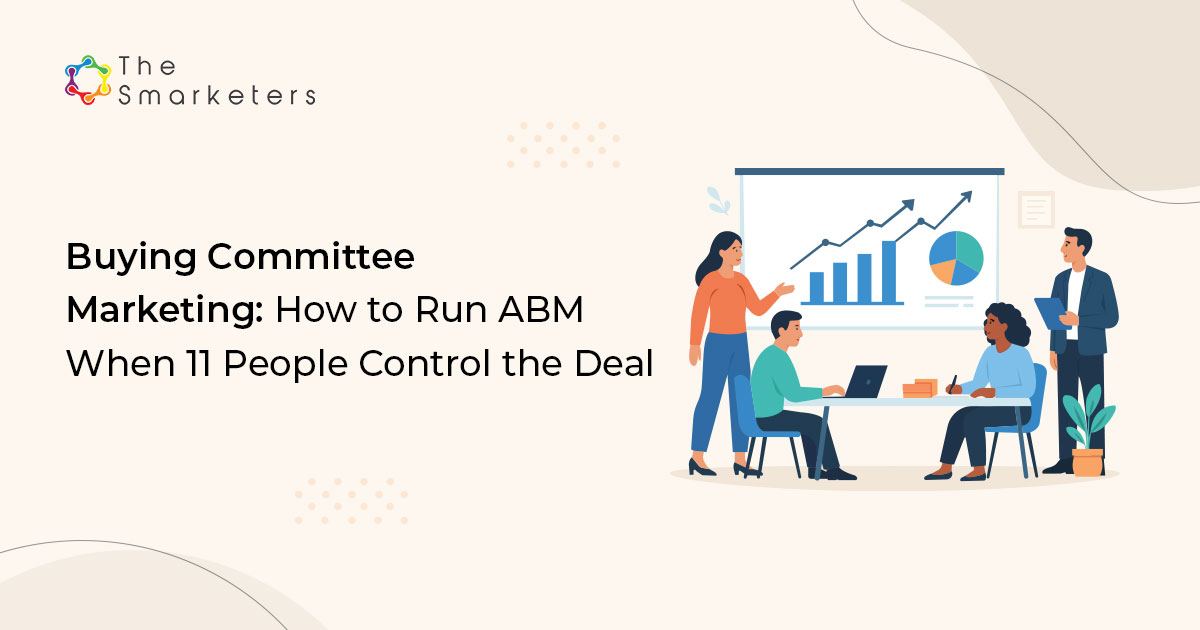
Buying committee marketing is an Account-Based Marketing approach that targets every decision-maker and influencer involved in a B2B purchase, not just a single contact. Instead of building campaigns around one champion, it maps the full set of stakeholders (typically 6 to 11 people in enterprise deals), identifies their individual roles and concerns, and delivers role-specific content and outreach across every stage of the buying cycle. The goal is to build consensus across the entire committee, not just convert one person.
The ABM Program Built for One Person Has a Problem
Your champion loves the product. They’ve read every case study. They’ve sat through the demo twice. And then they go quiet.
You follow up. Nothing. Six weeks later, you find out they left the company.
This is the most common way ABM programs fail, and it has nothing to do with targeting, messaging, or budget. It has everything to do with building the entire program around one person in a deal that was always going to require approval from ten others.
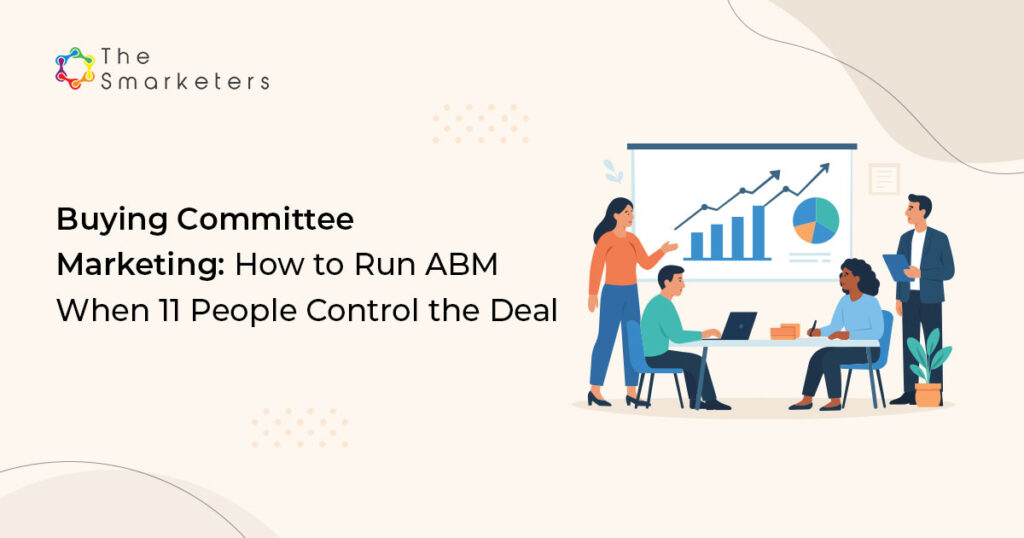
Gartner research shows the average B2B buying committee now includes 11 stakeholders. In complex enterprise deals, that number climbs higher. Every one of those people has a different set of concerns, a different level of authority, and a different reason to say no.
Most ABM programs still treat multi-stakeholder deals the way single-contact outreach does. One persona, one message, one sequence. That approach made sense when deals were simpler. It does not make sense now.
This guide walks through how to build an ABM program for the buying committee, not just the champion.
Average B2B buying committee: 11 stakeholders
The 5 Buying Committee Roles (And What Each One Needs to See)
Before you can run multi-threaded ABM, you need to understand who is in the room. Every enterprise buying committee has these five archetypes, even if the titles differ across accounts.
| Role | Primary Concern | What They Need From Marketing |
|---|---|---|
| Champion | Internal credibility, ease of implementation | Use cases, peer success stories, implementation guides |
| Economic Buyer (CFO/Finance) | ROI, cost justification, budget risk | ROI calculators, TCO analysis, payback period data Five Steps To Generating Effective Content For ABM - Smarketers |
| Technical Buyer (IT/Security) | Integration, security, compliance, maintenance | Technical docs, security whitepapers, architecture diagrams |
| End User | Day-to-day usability, workflow disruption | Product walkthroughs, before/after comparisons, training resources |
| Blocker/Skeptic | Risk mitigation, status quo defence | Third-party validation, risk assessments, competitor comparisons |
The Champion needs to feel confident selling internally. The Economic Buyer needs numbers. The Technical Buyer needs proof that it will not break anything. The End User needs to see it will not make their job harder. The Blocker needs a reason not to kill the deal.
If your ABM program only serves the Champion, you are leaving four veto points unaddressed.
Why Single-Threaded ABM Fails
Single-threaded ABM puts all engagement through one contact. It is efficient to run, and it works well when deals are small and fast. For enterprise deals, it creates three specific risks.
- The Champion leaves. Job tenure at manager and director level in enterprise companies averages 2.5 years. If your champion changes roles or companies mid-deal, a single-threaded program has zero relationships to fall back on.
- The Champion loses internal support. In competitive deals, champions face internal opposition. If they are the only person who has heard your message, they cannot get colleagues to validate their position.
- The final decision happens in rooms you have never been in. Economic buyers and technical reviewers frequently make or break deals without the Champion present. If they have never engaged with your content, they arrive at those conversations with no context.
Multi-threaded ABM addresses all three risks. But it requires a different execution model.
The Multi-Threading Playbook: 5 Steps to Engage 3+ Contacts Simultaneously
Step 1: Map the buying committee before you run the campaign
Use your CRM, LinkedIn Sales Navigator, and intent data to identify 3 to 5 contacts at each target account before the campaign launches. You need at minimum: one Champion or likely champion, one Economic Buyer, and one Technical Buyer. Map them in your CRM as contacts associated with the account, not as independent leads.
Step 2: Build role-specific content tracks
One content track does not serve 11 different concerns. Create separate email sequences and ad messaging for each role. The CFO track leads with ROI. The IT track leads with integration. The End User track leads with workflow. You do not need to write entirely different content for each, but the framing and emphasis should be distinct.
Step 3: Run coordinated outreach without creating confusion
Timing matters. Do not hit all 11 contacts on the same day with the same campaign. Stagger the engagement over 2 to 3 weeks. Start with the Champion and Economic Buyer. Bring in Technical Buyers once initial interest is established. Use your Champion as a referral pathway where possible a warm introduction from them to other stakeholders converts faster than cold outreach.
Step 4: Measure engagement at the account level, not the contact level
The signal that matters is buying committee engagement score, not individual contact activity. An account where one person has clicked 40 emails is less ready than an account where four different stakeholders have each engaged twice. Set up account-level engagement scoring in your CRM or ABM platform to reflect this.
Step 5: Alert sales with full committee context, not just a lead score
When an account crosses your buying committee engagement threshold, the sales alert should include: which stakeholders have engaged, what content they consumed, which roles are still cold, and a recommended first outreach angle. A rep walking into an account armed with this information closes faster than one working from a generic high-score lead.
Content Mapping by Role: What the CFO Needs vs. What IT Needs
The same product claim lands differently depending on who reads it. A statement like ‘our platform reduces manual data entry by 60%’ resonates with end users. To the CFO, that statement is not yet financial. To the Technical Buyer, it raises a question about data integrity.
Here is a practical content mapping framework for the five buying committee roles:
| Content Type | Champion | Economic Buyer | Technical Buyer | End User | Blocker/Skeptic |
|---|---|---|---|---|---|
| Case studies | Primary | Primary | Secondary | Secondary | Primary |
| ROI calculators | Secondary | Primary | Secondary | None | Secondary |
| Technical docs | None | None | Primary | Secondary | Secondary |
| Product demos | Primary | Secondary | Primary | Primary | Secondary |
| Analyst reports | Secondary | Primary | Secondary | None | Primary |
| Security whitepapers | None | Secondary | Primary | None | Primary |
How to Score Buying Committee Engagement

Standard lead scoring models count individual contact actions. Buying committee scoring models weight account coverage and stakeholder diversity.
A practical buying committee engagement score has three components:
- Coverage score: What percentage of identified buying committee roles have engaged at least once? An account with 5 of 5 roles engaged scores higher than an account with 1 of 5, even if the single contact has more total interactions.
- Role weight: Economic Buyer and Technical Buyer engagement carries more weight than End User engagement, because those roles have more veto authority in most deals.
- Engagement depth: A stakeholder who has watched a demo and downloaded a technical doc is deeper in consideration than one who opened a single email. Weight content consumption by buying stage relevance.
Set a committee engagement threshold that triggers a sales qualification conversation. Most ABM teams find that accounts with 3 or more roles engaged at depth represent a significantly higher close rate than accounts with heavy single-contact engagement.
Deals where champion leaves during sales cycle: 56% lower close rate
Single-Thread ABM vs. Multi-Thread ABM
| Factor | Single-Thread ABM | Multi-Thread ABM |
|---|---|---|
| Contact coverage | 1 stakeholder per account | 3 to 5+ stakeholders per account |
| Champion dependency | High deal stalls if champion leaves | Low multiple relationship anchors |
| Content effort | Lower one track per account | Higher role-specific tracks required |
| Pipeline risk | High in enterprise deals | Lower, distributed across stakeholders |
| Sales cycle impact | Neutral in SMB, negative in enterprise | Positive builds internal consensus faster |
| ABM platform requirement | Basic | Account-level engagement scoring needed |
| Best fit | SMB and mid-market, short cycles | Enterprise, complex multi-stakeholder deals |
Related Reading
- Signal-Based Selling: How B2B Teams Are Turning Dark Funnel Data into Pipeline
- ABM for IT Services and System Integrators: A Practitioner’s Guide
- ABM Pilot Program Design: The 90-Day Framework to Prove ROI Before Full Rollout
The Smarketers is India’s first ITSMA-awarded ABM agency and a HubSpot Gold Partner. With 40+ implemented ABM programs and an 85% success rate, they work with B2B technology, IT services, and life sciences companies to build pipeline through account-based marketing, demand generation, and RevOps.
Frequently Asked Questions
What is buying committee marketing?
Buying committee marketing is an ABM approach that targets every stakeholder involved in a B2B purchase decision, not just a single champion. It maps the full set of decision-makers and influencers, assigns role-specific content and outreach, and measures engagement across the entire committee rather than at the individual contact level.
How many people are in a B2B buying committee?
According to Gartner’s 2025 research, the average B2B buying committee has 11 members. In large enterprise deals involving technology procurement, the number can be higher, often including procurement, finance, IT security, legal, and multiple business unit stakeholders.
What is multi-threading in sales?
Multi-threading in sales means building relationships with multiple stakeholders at a target account simultaneously, rather than relying on a single champion to carry the deal internally. In ABM, multi-threading means running coordinated, role-specific outreach to 3 or more contacts at the same account as part of a single campaign.
How do you map a buying committee for ABM?
Start by using LinkedIn Sales Navigator, your CRM intent data, and company org charts to identify contacts across 5 key roles: Champion, Economic Buyer, Technical Buyer, End User, and Blocker. Map them in your CRM as contacts associated with the account opportunity, then assign each contact to the appropriate role-specific content track.
How do you measure buying committee engagement in ABM?
Buying committee engagement is measured at the account level, not the individual contact level. Track three components: coverage score (what percentage of committee roles have engaged), role weight (Economic Buyers and Technical Buyers carry more weight than end users), and engagement depth (content consumption weighted by buying stage relevance).