Table of Contents
- What should a manufacturer do with end-user demand it cannot fulfil?
- What is channel conflict in B2B marketing?
- How do you map customer relationship ownership across the channel?
- Which lead handoff rules help avoid channel conflict with distributors?
- How do manufacturers and distributors co-market without cannibalising the channel?
- How do you generate end-user demand when distributors handle fulfilment?
- How do you get distributors to share end-customer data?
- Sell-through vs sell-in: which should manufacturers measure?
- When should you renegotiate a channel partner agreement?
- When does this channel conflict playbook not apply?
- Frequently Asked Questions
Need help with B2B Marketing?
Let the smarketers’ team drive your pipeline with data-led campaigns and AI-powered growth strategies.
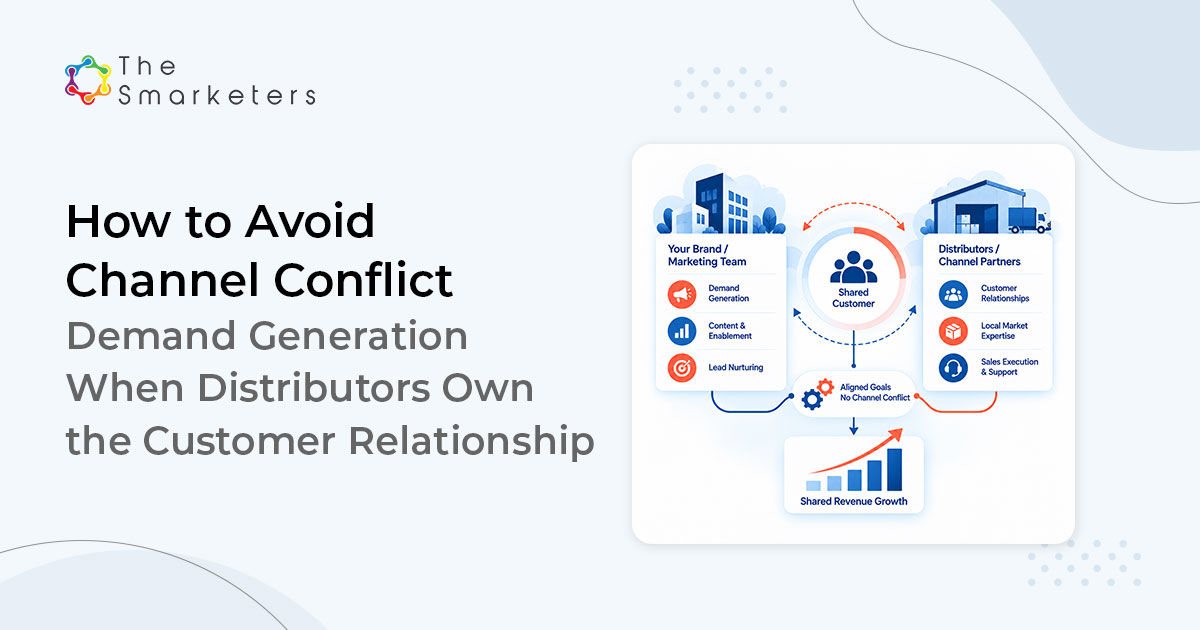
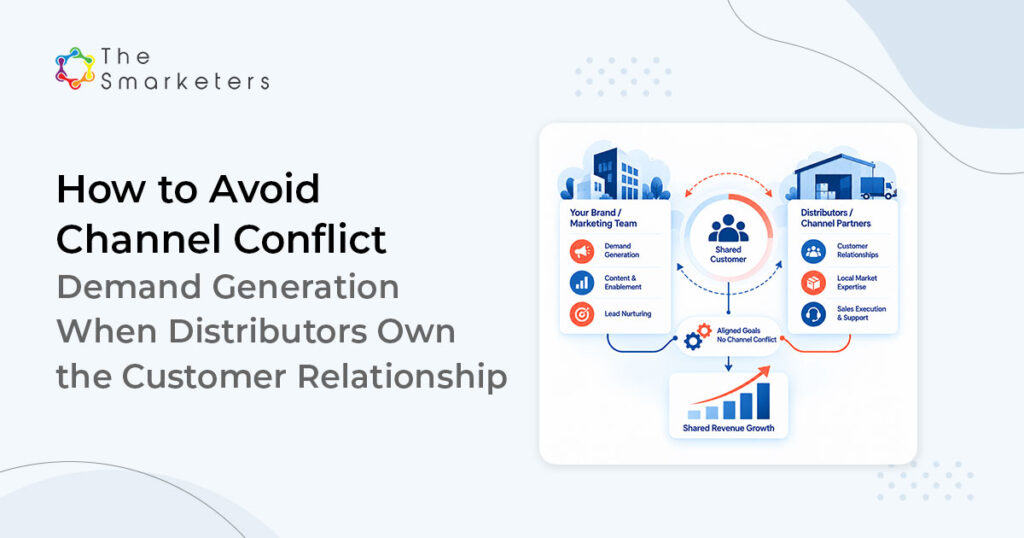
Every manufacturer in two-tier distribution eventually runs the same experiment. Marketing generates end-user interest, sales cannot act on it, and the distributor complains that the manufacturer is competing with its own channel. The way to avoid channel conflict is a division of labour: the manufacturer owns education and specification, while every conversation about price, availability and fulfilment routes to the distributor. Demand creation and demand capture stop being one job.
That sounds obvious written down. It fails because nobody defines the handoff precisely enough for a distributor to trust it.
What should a manufacturer do with end-user demand it cannot fulfil?
Start by admitting the problem is structural, not attitudinal. Your channel agreement says the distributor owns the commercial relationship, and your marketing programme generates named end-user contacts. Those two facts collide every week.
There are three honest responses: stop generating the demand, fulfil it yourself and accept the consequences, or build a routing mechanism the channel believes in. Only the third grows anything.
KEY TAKEAWAY
Channel conflict is rarely caused by marketing activity. It is caused by an undefined handoff, which lets both sides assume the worst about the other’s intentions.
What is channel conflict in B2B marketing?
Channel conflict in B2B marketing is friction between a manufacturer and its channel partners when both pursue the same end customer or deal. It comes in three forms: vertical (manufacturer vs distributor), horizontal (distributor vs distributor) and multi-channel (direct or online sales vs partners). In two-tier distribution, vertical channel conflict is the most common and the most damaging.
How do you map customer relationship ownership across the channel?
Before designing rules, work out what is true today, account by account. Most manufacturers hold a blurred picture and defend whichever version suits the function that is talking.
| Relationship type | Who the customer calls first | Marketing's role | Fulfilment |
|---|---|---|---|
| Distributor-owned | Distributor rep | Awareness, specification support | Distributor |
| Specification-led | Application engineer | Own the technical relationship | Distributor |
| Named or house account | Manufacturer sales | Full programme ownership | Direct |
| Project or tender | Consultant or specifier | Influence the specification | Distributor |
| Aftermarket or service | Service partner | Own product education | Distributor |
Fill this in with real account names, then circulate it. The argument you have while completing it matters more than the table, because it surfaces the accounts both sides believe they own.
Buying groups complicate it further. The average B2B buying decision now involves 13 internal stakeholders and 9 external influencers, according to Forrester’s State of Business Buying, January 2026. The specifier, the procurement lead and the maintenance manager each have a different first port of call, which is why account-level ownership rules leak.
Which lead handoff rules help avoid channel conflict with distributors?
Precise lead routing rules with a timer attached, the channel version of a marketing and sales SLA. Vague commitments to “share leads” produce a spreadsheet nobody opens. Six rules do most of the work.
| Rule | What it means in practice |
|---|---|
| Named routing | A named person at a named distributor, never a mailbox |
| Acknowledgement window | Receipt confirmed within defined working hours |
| Status obligation | One update at a fixed interval: working, quoted, closed, dead |
| Expiry and return | Unworked leads return to the manufacturer, no argument |
| Protected registration | Deal registration protects the opportunity from another distributor |
| No silent redirection | Neither side quotes or passes the lead sideways |
Expiry and return makes the whole thing credible, and it is the rule distributors resist. Without it the manufacturer has no recourse and stops sharing leads within a quarter.
How do manufacturers and distributors co-market without cannibalising the channel?
In channel marketing for manufacturers, split content by function rather than brand. The manufacturer publishes what teaches; the distributor publishes what transacts.
The manufacturer owns application guides, selection tools, specification support and standards content, and never publishes a price or an add-to-cart. The distributor owns availability, lead time, quoting, bundles and local service. Joint campaigns run on distributor-branded landing pages with the manufacturer’s technical content behind them. Agree paid search rules too, so the manufacturer and its distributors are not bidding against each other on the same brand and part-number terms.
The other half of the deal is funding. Co-op funds and market development funds (MDF) exist for this, and tying a share of them to campaigns that run manufacturer content on distributor properties aligns the incentive without an argument about lead ownership.
PROOF POINT
Excellon is among the manufacturing and industrial implementations The Smarketers has delivered within a portfolio of 250+ clients and more than $450M in generated pipeline since 2015. Distributor-attributed pipeline after the routing rebuild: [FIELD: change in distributor-registered opportunities across the two quarters following the handoff redesign].
How do you generate end-user demand when distributors handle fulfilment?
To avoid channel conflict, design the journey to end at a distributor, deliberately and visibly. The mistake is a demand programme that ends in a contact form, followed by an argument about the record.
Three mechanisms carry the load. A where-to-buy module on every product page, showing stock and lead time rather than price. A technical support path that stays with the manufacturer, which distributors rarely contest. And a selection tool producing a part list the buyer takes to a distributor.
Gartner found 67% of B2B buyers prefer a rep-free experience while 69% still turn to sales reps to validate insights, in surveys of 645 to 646 buyers released in March and May 2026. In a channel model that is a gift: self-serve research belongs to you, validation belongs to the distributor.
We rebuilt this for an industrial client whose distributors had stopped acting on shared leads. The routing was technically fine and commercially untrusted, so we added an acknowledgement timer, a status field and automatic return after a set period. Two distributors objected loudly for a month. Both were working leads within the quarter, because returned leads made non-response visible.
How do you get distributors to share end-customer data?
By trading for it. Distributors do not withhold end-customer data out of spite; that data is their commercial position, and giving it away for nothing weakens them.
| What the manufacturer wants | What the distributor will usually accept | The trade |
|---|---|---|
| End-customer identity | Aggregated reporting | Start aggregated, earn detail |
| Sell-through by product | Point-of-sale reporting | Tie funding to reporting quality |
| Opportunity visibility | Registration for deal protection | Protection for pipeline data |
| Installed base | End-user product registration | Manufacturer runs it, shares insight |
| Forecast input | Joint planning sessions | Share demand signals back |
The right-hand column is what most manufacturers skip. If nothing flows back, reporting quality degrades to the contract minimum. Give something useful in return: territory demand signals, product-level trends, or lead scoring they cannot build themselves. Our RevOps work in channel businesses is mostly about designing that exchange.
Sell-through vs sell-in: which should manufacturers measure?
Measure sell-through. Sell-in measures inventory pushed into the channel, which flatters a quarter and says nothing about end-user demand. Channel inventory can rise while real demand falls, and by the time that shows up in orders you have lost two quarters.
Sell-through, measured through point-of-sale reporting, product registrations, warranty activations or serial number data, tells you what actually left the channel and to whom. It is harder to collect and it is the only number worth planning marketing against.
Track both, and treat a widening gap as a demand problem rather than a distribution success. It usually is.
When should you renegotiate a channel partner agreement?
At the annual review, with evidence, never mid-conflict. Most channel agreements were written before the manufacturer had a serious digital presence, and they are silent on exactly the questions that now cause friction.
Three clauses are worth reopening: the digital rules covering what the manufacturer may publish and capture, the lead handoff terms including expiry and return, and the link between funding and reporting. Bring sell-through data and handoff response times, ideally tracked in a partner pipeline in HubSpot. Arguments about principle go nowhere; a distributor looking at its own acknowledgement times has a different conversation.
When does this channel conflict playbook not apply?
If your channel is a single dominant distributor with genuine buyer power, the negotiation is asymmetric and much of this is theoretical. The realistic move is to build end-user brand preference patiently, so the specification arrives at the distributor rather than being made by them.
Direct digital sales change the maths too. If a manufacturer already sells some categories directly, the division of labour above reads as fiction to the channel, and no routing design repairs that. It has to be resolved commercially first.
None of this is fast, either. Rebuilding a manufacturer distributor relationship that has been burned takes several quarters of consistent behaviour, and one direct quote to a distributor’s customer resets it. Our manufacturing marketing and demand generation engagements here usually plan for a year before the reporting is worth trusting.
Frequently Asked Questions
How do you avoid channel conflict with distributors?
Agree in writing who owns each stage of the customer relationship. The manufacturer owns education and specification. The distributor owns price, availability and fulfilment. Back this up with timed lead handoff rules, automatic return of unworked leads, deal registration and a fair exchange of data.
What causes channel conflict in B2B marketing?
Usually an undefined handoff rather than the marketing activity itself. When a manufacturer generates end-user demand without agreed routing, acknowledgement windows and expiry rules, both sides assume the other intends to take the customer. Precise, timed rules remove most of the conflict.
How can a manufacturer generate demand without upsetting distributors?
Own education and specification, and route every price, availability and fulfilment conversation to the distributor. Publish application guides, selection tools and technical content, use a where-to-buy module instead of a cart, and keep technical support with the manufacturer.
What lead handoff rules do distributors actually accept?
Named routing to a person rather than a mailbox, an acknowledgement window in working hours, a fixed status update obligation, automatic return of unworked leads after a stated period, protection for a registered opportunity, and no quiet redirection by either side.
What is the difference between sell-in and sell-through?
Sell-in is what the manufacturer ships into the channel. Sell-through is what the channel actually sells to end users, measured through point-of-sale reporting, product registrations or warranty activations. Sell-in flatters a quarter; sell-through is the reliable read on demand.
How do you get distributors to share customer data?
Trade for it rather than demanding it. Start with aggregated reporting, tie funding to reporting quality, offer deal protection in exchange for registration, and give something useful back such as territory demand signals. Data flows stop when nothing returns.
When should a channel agreement be renegotiated?
At the annual review, using evidence rather than during a dispute. The clauses worth reopening are the digital rules on what the manufacturer may publish and capture, the handoff terms including expiry and return, and the link between funding and sell-through reporting.

Swati Bansal
Sr. Content Strategist