Need help with B2B Marketing?
Let the smarketers’ team drive your pipeline with data-led campaigns and AI-powered growth strategies.
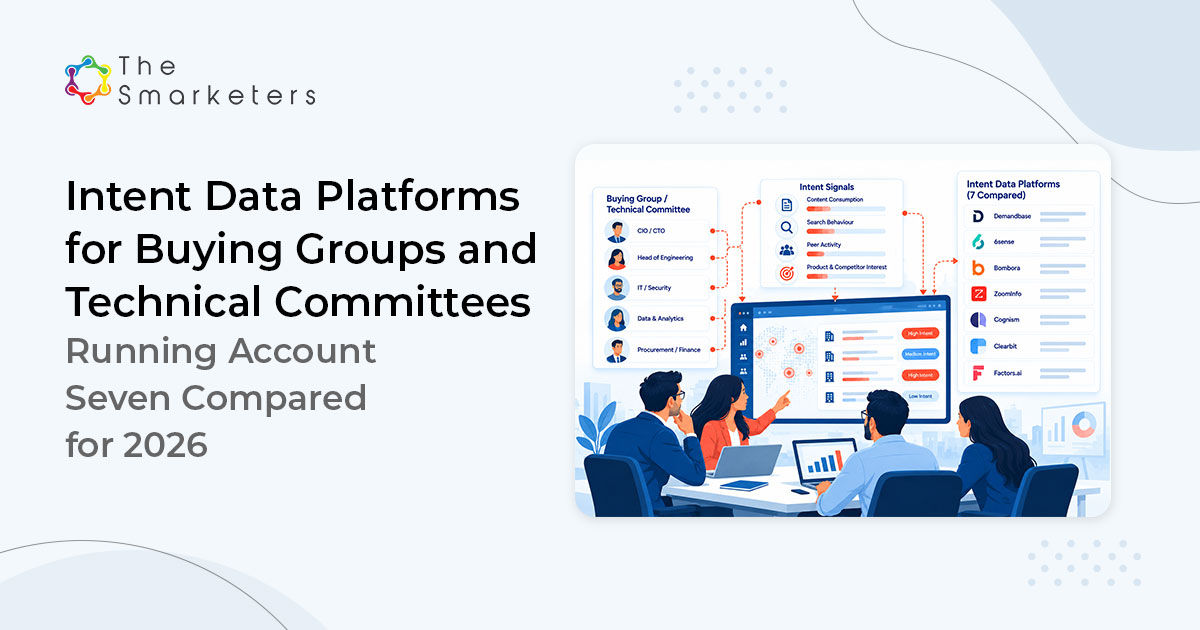
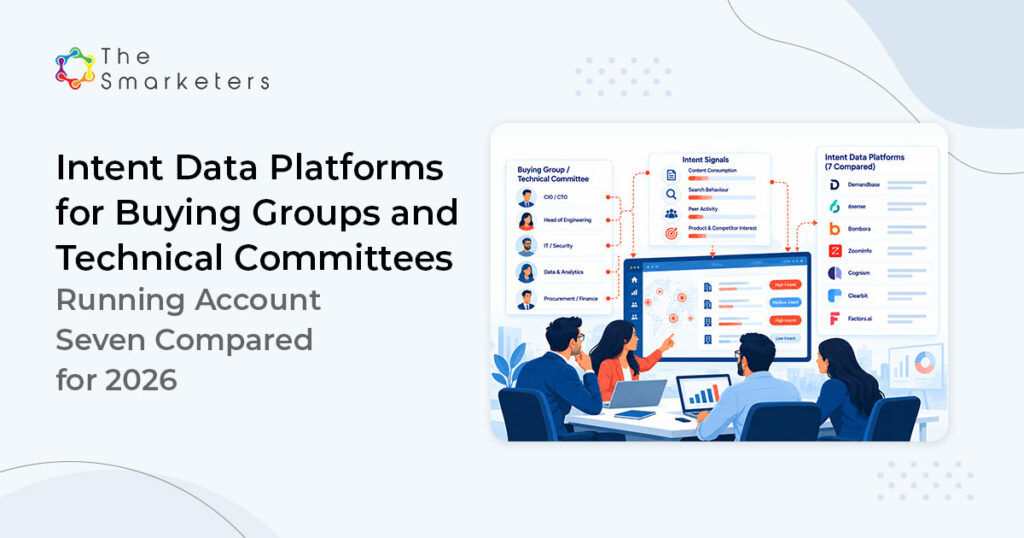
Most intent data platforms report at account level, which is the wrong unit when the decision belongs to a technical committee of engineers, security reviewers, procurement and a signing executive. The intent data platforms worth paying for in technical sales model the buying group as roles, name their signal sources and write back to your CRM through field mapping you control. None of the seven below will define your committee for you, so the comparison shows where each fits and where each stops. This comparison is for marketing and RevOps teams selling into technical evaluations, assessed against the criteria below. Entries are listed alphabetically rather than ranked, and each one carries a stated limitation.
How Were These Intent Data Platforms Assessed?
Five criteria, weighted towards committee-level modelling and buying group intent data, because account-level signal says a company is looking without saying who decides. Assessments come from public documentation read on 16 September 2026. Excluded: contact databases with no signal layer, and intent data providers that hide their sources.
| Criterion | Weight | Assessed by |
|---|---|---|
| Committee-level modelling | 30% | Role or group objects |
| Technical persona coverage | 20% | Documented job families |
| Signal provenance | 20% | Sources named publicly |
| CRM write-back | 20% | Documented field mapping |
| Export and transparency | 10% | Raw data accessible |
No vendor publishes coverage figures for engineering audiences, so that criterion was assessed on documented job families rather than measured reach. Intentsify, which sells a dedicated Buying Group Intent product, was not assessed in this round and is due for the next review.
The Seven Intent Data Platforms Compared
The table summarises each platform’s signal level, strength and main limitation. Full entries follow.
| Platform | Signal level | Strongest at | Main limitation |
|---|---|---|---|
| 6sense | Account, with buying-team mapping | Timing: which accounts are moving this month | Predictions start at account level |
| Bombora | Company and topic | Broad topic data other tools consume | Cannot identify committee members |
| Clay | Whatever you build | Defining the committee yourself, role by role | Quality depends on who maintains it |
| Demandbase | Account and contact | Joining account signal to named contacts | Paying for modules you may not use |
| G2 Buyer Intent | Account | Purchase proximity from comparison activity | Thin coverage in industrial categories |
| Informa TechTarget Priority Engine | Account and contact | Contact-level detail in technical topics | Sparse on adjacent industrial topics |
| UserGems | Contact (job changes) | A known advocate arriving somewhere new | One narrow signal |
6sense
Account intelligence with predictive buying-stage models, its own intent network and orchestration layered on top. Strongest at timing: which accounts are moving this month, rather than which merely look like customers. Limitation: its Persona Map shows an account’s buying team and flags unknown members, but predictions start at account level, so committee structure still needs building in your CRM.
Bombora
A co-operative of B2B publishers producing topic-level consumption signals, sold directly and embedded inside several other platforms here. Strongest as a data layer: broad topic coverage other tools consume. Limitation: signal is company and topic level by design, so it cannot identify committee members. [VERIFY: taxonomy depth for engineering topics.]
Clay
A data orchestration tool running waterfall enrichment across many providers, with your own logic applied to build lists and signals. Strongest at defining a committee yourself, role by role, not taking a vendor’s model. Limitation: a builder’s tool, so output quality tracks whoever maintains it. [VERIFY: credit costs at volume.]
Demandbase
One of the broadest ABM platforms, combining identification, intent, advertising and sales intelligence, with people data from its acquisitions. Strongest at joining account signal to named contacts in one interface. Its Buying Groups product maps known contacts to roles and flags missing roles. Limitation: breadth means paying for modules a focused team may not use, and persona depth varies by category. [VERIFY: bundle contents.]
G2 Buyer Intent
Signals from category, comparison and profile activity on G2, exposed as in-market accounts. Strongest at purchase proximity, since someone comparing products sits further along than someone reading a topic. Limitation: coverage exists only where your category has an active presence on that site, which is thin in industrial categories. [VERIFY: category coverage.]
Informa TechTarget Priority Engine
Permissioned research activity from a technology publisher network, surfaced as named accounts and their contacts with the topics they research. Strongest at contact-level detail in technical categories that overlap its own publications. Priority Engine Demand, launched in October 2024, surfaces buying groups. Limitation: coverage follows that publisher audience, so adjacent industrial and manufacturing topics can be sparse. [VERIFY: topic coverage.]
UserGems
Tracks job changes among past buyers, champions and customers, then surfaces the accounts they moved to. Strongest at a signal nobody else sells: a known advocate arriving somewhere new. Limitation: one narrow signal, useful alongside intent rather than instead of it, and dependent on your contact history. [VERIFY: match rates.]
PROOF POINT
Savantis, an SAP services partner, generated 150+ MQLs from companies with more than $500M in revenue through a 1:few ABM and inbound programme we ran. Account selection, not the data vendor, decided who we targeted.
What Can’t Intent Data Platforms Tell You?
None of these platforms will tell you what your buying committee looks like. Forrester’s State of Business Buying, January 2026, puts the average decision at 13 internal stakeholders and nine external participants, with procurement a decision-maker in 53% of cycles. That structure comes from closed-won analysis, not a vendor taxonomy.
How Do You Choose an Intent Data Platform for a Technical Committee?
Decide first whether your gap is discovery or coverage. If you cannot tell which accounts are active, buy one of the intent data platforms as your signal source and keep it simple. If you know the accounts but keep missing the engineer or the security reviewer, the gap is committee modelling, and orchestration, including AI-powered ABM, usually beats a bigger intent contract. Either way, insist on CRM write-back with field mapping you control, and run a paid pilot against a list of accounts you already closed or lost before signing for a year.
NOTE
Disclosure: The Smarketers resells none of these platforms and takes no affiliate revenue. We build the committee model from closed-won analysis first, then choose the cheapest source that fills the gaps, which is how our ABM programmes and manufacturing account work are structured.
Frequently Asked Questions
What is a buying group in B2B marketing?
A buying group is the set of people who jointly decide a purchase, modelled as roles rather than individual leads. In technical categories that means an evaluator, a technical approver, a security reviewer, procurement and an economic buyer. Measure programmes by role coverage, which a buying group mapping template makes visible.
Is account-level intent data enough?
Enough to prioritise outreach, not enough to run a committee programme. Our guide to intent data for ABM covers the prioritisation side. Account-level intent says a company is researching a topic. It cannot say whether the engineer who will scrutinise your architecture has seen your name, which decides whether a shortlist forms. Persona-level intent narrows that to the roles doing the research.
How do you reach technical evaluators who ignore marketing?
Publish the artefacts they read: reference architectures, integration notes, benchmark methods and stated limitations. Then measure whether those roles appear in the account, using an account engagement score, rather than counting form fills. Engineers rarely convert on gated assets, so role coverage is better evidence.
How should intent platforms be piloted?
Run a paid pilot against accounts you closed or lost last year. If the platform flags accounts you know were active, the signal is real. If it returns accounts nobody engaged, you are buying a list. Assessments reflect documentation read on 16 September 2026.
Which intent data platforms model buying groups?
Among those compared here, Demandbase has a dedicated Buying Groups product, 6sense maps buying teams through its Persona Map, and Informa TechTarget surfaces buying groups in Priority Engine. Bombora and G2 signal at company level, and Clay lets you build the committee yourself.
What is buying group intent data?
Buying group intent data shows which roles inside an account are researching a topic, not just that the account is. It matters in technical sales because an engineer, a security reviewer and procurement each research differently and each can stop a deal.

Indrani Gope
Content Head