Need help with B2B Marketing?
Let the smarketers’ team drive your pipeline with data-led campaigns and AI-powered growth strategies.
What Is End-to-End B2B Marketing?
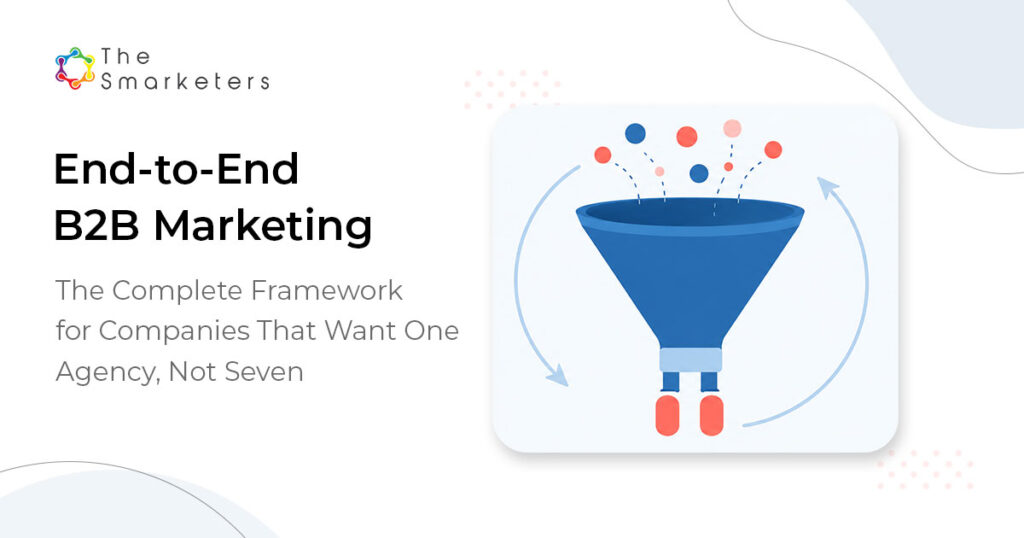
End-to-end B2B marketing is a single connected program that owns the whole funnel, from strategy and demand creation through capture, pipeline, and revenue, rather than a patchwork of specialist vendors each owning one slice. The point is to optimize the outcome, pipeline, not seven disconnected activities.
End-to-end B2B marketing: One integrated program (and usually one accountable team) responsible for the full journey: positioning, demand creation, demand capture, pipeline acceleration, and revenue alignment, measured by pipeline and revenue rather than channel metrics.
Most companies do not set out to fragment their marketing. It happens one vendor at a time: an SEO agency here, a paid agency there, a brand shop, a martech consultant, a content freelancer. Each is competent. The pipeline still leaks, because nobody owns the gaps between them.

Why Do Disconnected Vendors Leak Pipeline?
Because pipeline is lost in the handoffs, and no single vendor owns a handoff. Each optimizes its own metric, the SEO agency chases rankings, the paid agency chases leads, while the outcome that matters, qualified pipeline, belongs to no one. Buyers experience the seams as a disjointed journey.
The buyer makes this worse for fragmented teams. Gartner finds a complex B2B purchase involves a buying group of six to ten people who move non-linearly across channels (Gartner). A coherent story across that journey requires one owner; seven vendors produce seven partial stories.
What Does the End-to-End Framework Cover?
| Stage | What It Owns | Outcome |
|---|---|---|
| Strategy | Positioning, ICP, GTM motion | A clear, defensible point of view |
| Demand Creation | Content, brand, community | Demand in future buyers |
| Demand Capture | SEO, AEO, GEO, paid, intent | Visibility at the moment of intent |
| Pipeline | ABM, nurture, multi-threading | Engaged buying groups |
| Revenue | Sales alignment, SLAs, attribution | Closed, attributable revenue |
When Does One Partner Beat Best-of-Breed?
When the cost of coordination exceeds the benefit of specialization, which is most mid-market B2B. If your bottleneck is handoffs, inconsistent messaging, and no single owner of pipeline, an integrated partner wins. If you have deep in-house orchestration and need one elite specialist, best-of-breed can make sense.
- Choose end-to-end when: pipeline leaks between teams, messaging is inconsistent, and no one owns the number.
- Choose best-of-breed when: you have strong in-house orchestration and a single, deep specialist gap to fill.
How Do You Measure an End-to-End Program?
On pipeline and revenue, not channel vanity metrics. The whole advantage of one owner is that you can hold the program accountable for qualified pipeline, pipeline velocity, and revenue, rather than refereeing seven vendors each pointing at their own dashboard.
Frequently Asked Questions
What is end-to-end B2B marketing?
It is a single connected program that owns the whole funnel, from strategy and demand creation through capture, pipeline, and revenue, rather than a patchwork of specialist vendors each owning one slice. The goal is to optimize the outcome, qualified pipeline, not seven disconnected activities.
Is one marketing agency better than several specialists?
For most mid-market B2B, yes, when coordination cost outweighs specialization benefit. If pipeline leaks between teams, messaging is inconsistent, and no one owns the number, an integrated partner wins. Best-of-breed makes sense only with strong in-house orchestration and a single deep specialist gap.
Why do disconnected marketing vendors lose pipeline?
Because pipeline is lost in handoffs, and no single vendor owns a handoff. Each optimizes its own metric while the outcome that matters belongs to no one. With a buying group of six to ten moving non-linearly, a coherent story needs one owner, not seven partial ones.
How do you measure end-to-end marketing?
On pipeline and revenue, not channel vanity metrics. The advantage of one accountable program is that you can hold it to qualified pipeline, pipeline velocity, and revenue, instead of refereeing several vendors who each point to their own favorable dashboard.
What does an end-to-end framework include?
Five connected stages: strategy and positioning, demand creation, demand capture across SEO, AEO, GEO and paid, pipeline acceleration through ABM and nurture, and revenue alignment with sales. One owner runs all five so the journey is coherent for the buying group.

Enoch Pakanati
CEO