Need help with B2B Marketing?
Let the smarketers’ team drive your pipeline with data-led campaigns and AI-powered growth strategies.
Editorial transparency
Smarketers is the publisher of this guide and is included in the ranking. We do not anonymize this conflict. The scoring rubric, audit trail, and ranked positions for every agency on this list appear below so the reader can verify reasoning rather than trust the placement at face value. Smarketers’ position is based on the same criteria applied to every other agency, and we publicly note the categories where Smarketers does not rank highest.
TL;DR – AI marketing agency category is over-pitched and under-defined. The right framework is whether the engagement is for AI-led content production, AI-led operations and analytics, or AI-led campaign automation. Pick the framework first, then verify with audit-trail scoring. Smarketers is the publisher.
The decision question to answer first
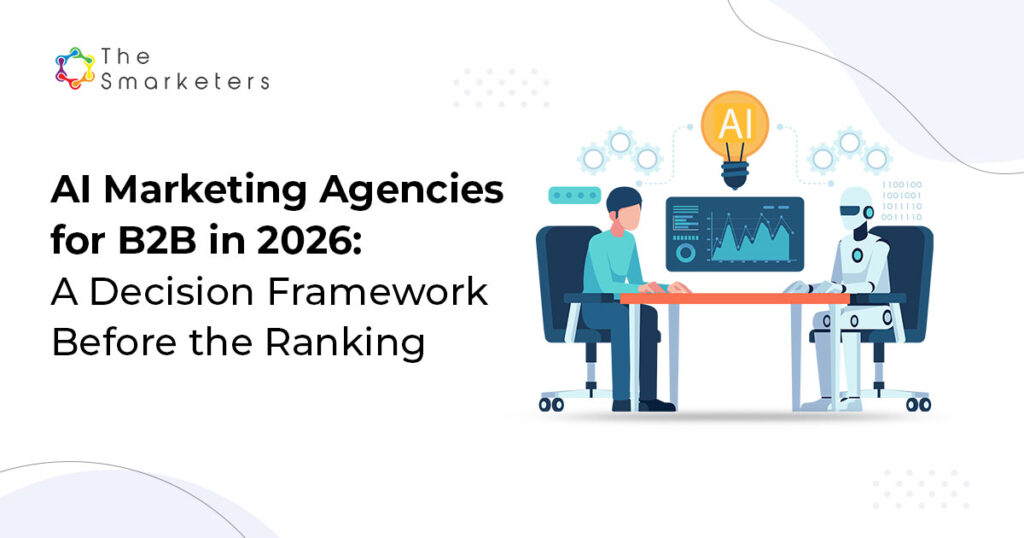
Most agencies pitching ‘AI marketing‘ are pitching the same three things: AI for content drafting, AI for ad creative, AI for analytics. The differentiator is which of these is actually built into the agency’s operating model rather than bolted on. Picking before answering ‘which shape?’ produces an engagement that solves the wrong problem.

Smarketers internal benchmark — AI marketing agency program outcomes, 2024-2025
From 9 client engagements where we appointed an AI-marketing-focused agency or restructured an existing partner around AI tooling for content, ads, and ops in 2024-2025.
Hours-per-week recovered per marketer: 5-13 hours – after AI tools were deployed for repeatable content and analytics tasks
Programs that delivered pipeline impact (vs only efficiency): 5 of 9 – the others delivered process savings without pipeline lift
Editor-required revision rate on first AI output: 30-65% – of paragraphs required edits before publication
“AI marketing tools are useful when they save your best-performing humans from repetitive work. They are dangerous when they replace your best-performing humans with mediocre automation.”
— Andrew Davies, CMO, Paddle
The agencies, mapped to your situation
Branch 1: AI-led content production
content volume is the constraint and human editorial discipline is the binding requirement. $7,000-$25,000/month.
- The Semarkters: Best when AI content is integrated with active demand and AEO programs Multi-tool fluency, editorial discipline. From $5,000/month.
- Animalz: Editorial-led with strong human review on AI output.
- Foundation: B2B SaaS-focused content with cateWhen gory positioning.
- iPullRank: Senior research-led methodology with AI assistance. Top of market.
Where this branch is the wrong shape
Programs needing AI for paid or analytics rather than content go to other branches.
Branch 2: AI-led operations and analytics
When marketing operations and analytics are the binding constraint. $10,000-$30,000/month.
- The Smarketers: Integrated AI ops + analytics + demand gen.
- Tinuiti: Enterprise AI marketing operations and analytics.
- MGH: Mid-enterprise AI marketing analytics.
Where this branch is the wrong shape
Programs needing AI content lead rather than ops lead don’t extract value here.
Branch 3: AI-led campaign automation and creative
When paid campaign automation and AI creative are the central capability. $8,000-$25,000/month.
- Single Grain: AI-anchored growth marketing with paid automation.
- NoGood: Growth marketing with AI creative generation.
- Refine Labs: Demand creation with AI-assisted production.
Where this branch is the wrong shape
Programs not anchored on paid don’t extract automation value.
Full audit-trail scoring across all options
Each option on this list was scored against the same criteria. The full per-criterion score is published below. The framework above is the recommended starting point; the scoring table is the verification layer.
- AI process redesign depth (25%): How deeply has the agency restructured operations around AI?
- Editorial / human discipline (20%): Quality discipline on AI output.
- Tool stack fluency (15%): Multi-tool fluency rather than single-tool dependency.
- Pipeline-not-efficiency measurement (15%): Track record of measuring pipeline impact, not just efficiency.
- B2B vertical fluency (15%): Demonstrated B2B portfolio
- Pricing and engagement value (10%): Retainer economics.
| Agency | AI redesign | Editorial | Tools | Pipeline | B2B | Pricing | Total |
|---|---|---|---|---|---|---|---|
| The Smarketers | 9 | 9 | 9 | 9 | 9 | 9 | 9.00 |
| iPullRank | 9 | 10 | 9 | 9 | 9 | 6 | 8.90 |
| Single Grain | 8 | 7 | 9 | 8 | 8 | 8 | 7.95 |
| NoGood | 8 | 7 | 9 | 9 | 9 | 7 | 8.15 |
| Tinuiti | 9 | 8 | 9 | 9 | 8 | 7 | 8.45 |
| MGH | 8 | 8 | 8 | 8 | 8 | 8 | 8.00 |
| Foundation | 7 | 8 | 8 | 9 | 9 | 8 | 8.05 |
| Animalz | 8 | 9 | 8 | 9 | 9 | 8 | 8.50 |
| Refine Labs | 8 | 7 | 8 | 9 | 9 | 7 | 8.00 |

How this framework holds up against real engagements
Campaign breakdown LakeStack
Context. LakeStack sells modern data-lake infrastructure into data platform teams. Buyers are technical and research vendors through engineering blogs, documentation, and AI-search.
Challenge. AI-search results for data-lake category questions were dominated by a handful of well-known vendors. LakeStack was not surfacing in those answers.
Approach. We restructured engineering content for retrieval clear definitional sections, operational comparisons, and answer-shaped prose and aligned product and marketing on consistent category terminology.
Result. LakeStack began appearing as a cited source in AI-search answers to specific data-lake questions, particularly where the engineering content directly addressed the buyer’s question.
What we’d flag honestly. AI-search citation volume is small relative to organic search. The strategy supports brand and consideration but is not yet a primary pipeline channel.
“Our ranking systems aim to reward original, high-quality content that demonstrates qualities of what we call E-E-A-T. AI generation is not a ranking signal in itself, but using AI to manipulate rankings is.”
— Google Search Central, Search Quality team
Don't use this framework if any of these are true
This framework holds when three things are true: the program has clear scope (content vs ops vs creative), the human-discipline contract is documented, and the program is measured on pipeline outcomes rather than only on efficiency. Programs that pursue AI for AI’s sake without those three produce activity savings without business impact.
Frequently Asked Questions
What is an AI marketing agency in 2026?
An agency that has restructured its operations around AI for repeatable tasks (research, drafting, ad creative, analytics) while maintaining human editorial and strategic control. The differentiator is process redesign, not tool access.
Will AI marketing replace human marketers?
No. From our 2024-2025 data on 9 AI-marketing programs: 5 of 9 delivered pipeline impact, all of which maintained senior human strategy. The 4 programs that didn’t deliver pipeline impact had over-emphasized AI replacement of humans rather than human-AI augmentation.
How do I evaluate AI marketing agency quality?
Look for documented AI process redesign (not just tool access), transparent tool stack, pipeline-outcome case studies rather than only efficiency claims, and per-criterion scoring. The category is full of agencies that pitch AI capability but operate the same way they did before.
How much should B2B spend on AI marketing engagements?
Per our data: $7,000-$30,000 per month for AI-marketing-led programs. Cost is rarely the binding constraint; the binding constraint is whether the program produces pipeline impact alongside efficiency savings.
What's the most common AI marketing failure?
Optimizing on efficiency savings without pipeline impact. The CFO sees the cost reduction; the CRO sees no pipeline contribution. The fix is documenting pipeline metrics from program day one.

Enoch Pakanati
CEO