Table of Contents
- Introduction
- Section 1: Why 89% of AI Citations Are Platform-Exclusive
- Section 2: The Anatomy of an AI Citation
- Section 3: Information Gain vs Keyword Density
- Section 4: Structuring Content for Extraction
- Section 5: Entity Authority and Digital PR
- Section 6: Measuring AEO Success
- Closing: The AEO Operating Model
- Frequently Asked Questions
Need help with B2B Marketing?
Let the smarketers’ team drive your pipeline with data-led campaigns and AI-powered growth strategies.
Introduction
SEO has entered a strange phase. Your rankings are stable, your domain authority is climbing, but traffic is down 30% and pipeline from organic is softer than it has been in three years. The culprit is not an algorithm update. It is the fact that 73% of B2B buyers now use a generative AI tool during research, and most of that research never generates a click.
This guide is the framework we use with B2B clients to reclaim visibility in AI answers. It is not a collection of tips. It is an architecture that answers one question: when a buyer types “best ABM agency for B2B SaaS” into ChatGPT, why would the model cite your domain and not the three dozen alternatives? If you cannot answer that question specifically, AEO is an opportunity. If you can, this guide sharpens the operating model around it.
WHAT CHANGED
Search used to reward the best-ranked page. Generative answer engines reward the page with the highest information gain that is also structurally easiest to extract. Those are two different optimization targets, and most B2B sites were built for the first one.
Section 1: Why 89% of AI Citations Are Platform-Exclusive
The most important data point in the AEO conversation: Profound’s 2024 citation study found that 89% of domains cited by at least one major AI engine are cited by only one. Only 11% of domains appear in both ChatGPT and Perplexity responses on the same query. The practical implication is that treating “AI search” as a single channel is wrong. You are optimizing for at least three distinct systems, and they do not weight the same signals.
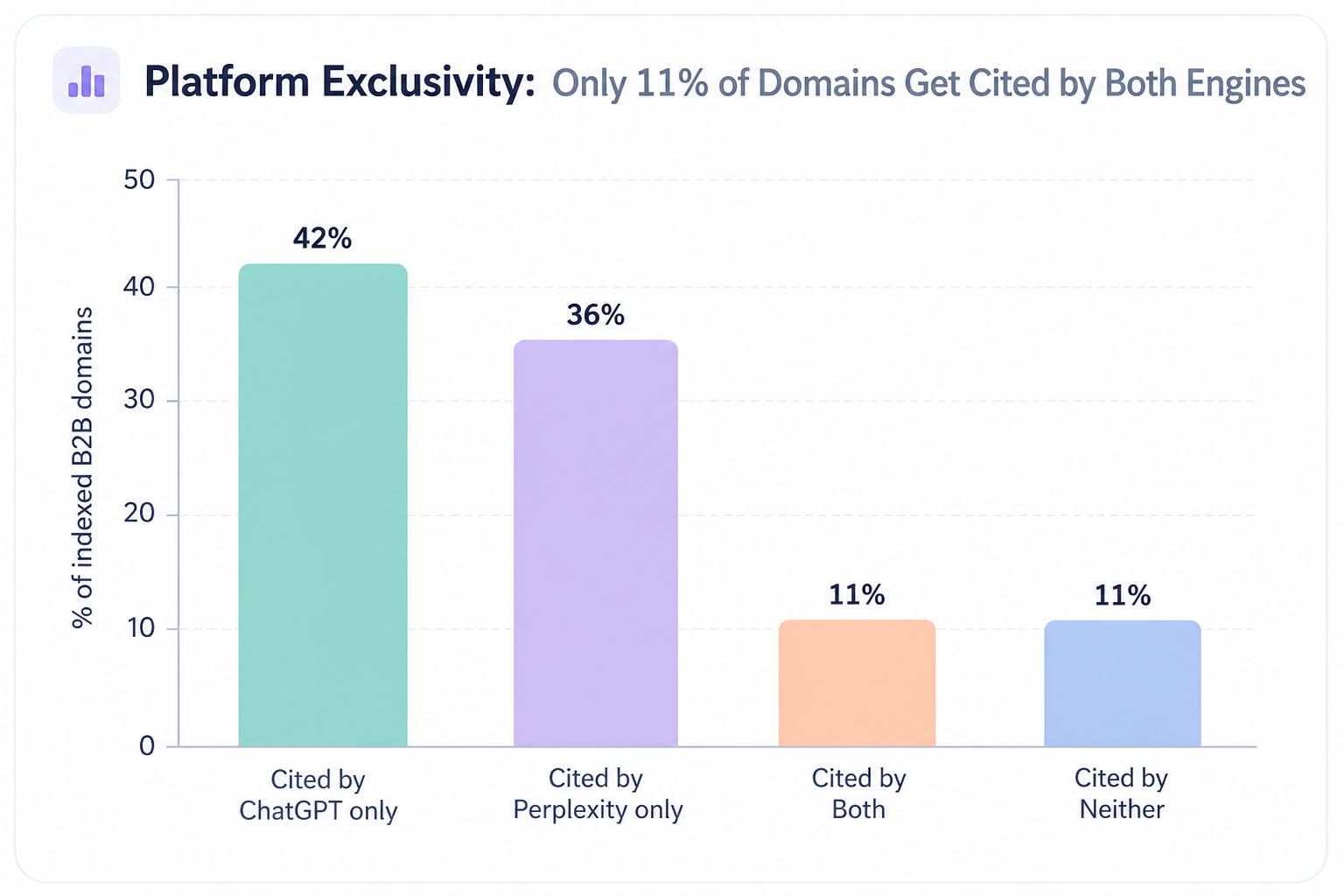
11%
of domains are cited by both ChatGPT and Perplexity on the same query.
Search used to reward the best-ranked page. Generative answer engines reward the page with the highest information gain that is also structurally easiest to extract. Those are two different optimization targets, and most B2B sites were built for the first one.
Why the split? Each engine weights different signals. ChatGPT favors comprehensive, authoritative guides with clear entity definitions. Perplexity weights recency, structured data, and domain authority on the topic. Google AI Overviews leans on traditional SEO signals plus extractable answer blocks. A page can hit one system and miss the other two.
| Signal | ChatGPT | Perplexity | Google AI Overviews |
|---|---|---|---|
| Recency of content | Medium | High | Medium-High |
| Structured data (schema) | Low-Medium | High | High |
| Domain authority on topic | High | Medium | High |
| Extractable definition blocks | High | Medium | Very High |
| Brand/entity recognition | Very High | Medium | High |
| External brand mentions (digital PR) | Very High | High | Medium |
Section 2: The Anatomy of an AI Citation
LLMs do not cite pages. They cite passages. Understanding what the model actually extracts is the fastest way to rewrite your content for AEO.
When ChatGPT or Perplexity generates an answer, the underlying RAG (Retrieval-Augmented Generation) system does four things in sequence: retrieves a candidate set of passages based on the query embedding, scores each passage for semantic relevance and trust signals, synthesizes the answer from the highest-scored passages, and attaches citations to the synthesized claims.
The three pages that always win
- he page that defines the topic cleanly in the first 150 words. If you want to be cited for “what is signal-based selling,” a bolded definition in paragraph one beats a thoughtful, meandering introduction every time.
- The page that has a proprietary data point or framework. “In our 2024 study of 120 B2B programs, we found…” is citation-bait in the best sense. Original research gets extracted disproportionately.
- The page that structures its insights for extraction. Tables, numbered lists, clear H2/H3 hierarchies, FAQ sections, and definition blocks are all formats that LLMs parse cleanly.
THE EXTRACTION TEST
Read the first 200 words of a target page. If you cannot pull a single self-contained paragraph that answers “what is X, and why does it matter,” the model cannot either. Rewrite until you can.
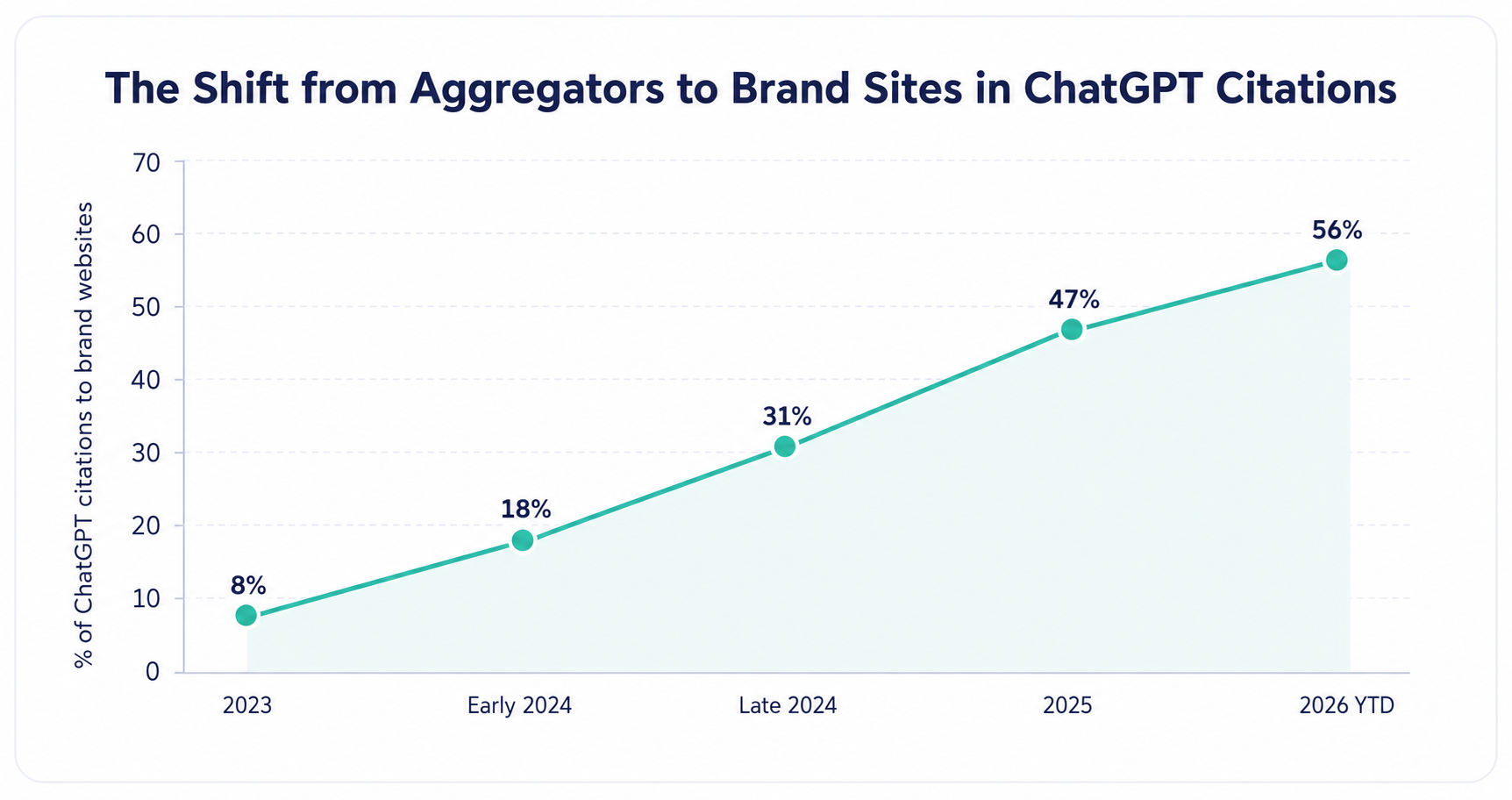
The shift shown above, citations to brand sites moving from 8% to 56% between 2023 and 2026, is the opening. Three years ago, ChatGPT almost never cited a vendor site. Now, more than half of citations in B2B category queries go to brand sites. The reason is simple: brand sites publish more category definition content than aggregators do, and the models have caught up.
Section 3: Information Gain vs Keyword Density
The skyscraper era is over. “Write a better version of the top-ranked article” is not a strategy in 2026. Generative engines detect paraphrasing at a token level. A 6,000-word article that reorganizes existing coverage without adding anything new gets a lower information gain score than a 900-word article with one proprietary data point and an opinionated take.
The four sources of information gain
- Proprietary data. Your own surveys, client data (anonymized), usage metrics, or benchmark studies. Nothing else indexes better.
- Expert quotes with attribution. A direct quote from a named practitioner at a known company, properly cited, carries unusual weight because it is rare in the training set.
- Frameworks with distinctive names. “The Pipeline Velocity Equation” is more extractable than “a formula for measuring pipeline health” because the name becomes an entity.
- Contrarian takes with evidence. “Most teams measure X. That is wrong, because Y. Here is what we measure instead, and the results.” LLMs cite contrarian positions because they are information-dense.
| Content Pattern | Information Gain | AEO Outcome |
|---|---|---|
| Skyscraper rewrite of competitor article | Very low | Rarely cited |
| Original survey with 500+ respondents | Very high | Frequently cited and quoted |
| Named expert quote with attribution | High | Cited as authority |
| Named framework (e.g., "The X Equation") | High | Cited as entity |
| Contrarian take with supporting data | High | Cited in comparative answers |
| Curation/roundup article | Very low | Rarely cited |
Section 4: Structuring Content for Extraction
Great insights die in bad structure. The four structural patterns below are the ones we install first when re-architecting a B2B site for AEO. They are not cosmetic. They directly affect which passages the model retrieves.
Pattern 1: Answer-first paragraphs
Open every H2 section with a 100 to 150 word paragraph that answers the section heading as a question. No warm-up, no transitional phrase, no “it’s worth noting.” State the answer first, then support it. This is the single highest-leverage change we make on client sites.
Pattern 2: Definition blocks
For any term that could be searched independently (e.g., “information gain,” “signal-based selling,” “pipeline velocity”), create a formatted definition block: term in bold, colon, clean one-sentence definition, then a supporting paragraph. Wrap it in DefinedTerm schema if possible.
Pattern 3: Comparison and reference tables
Tables extract cleanly. A comparison table or a benchmark table answers several “what is the difference between X and Y” or “what is the average Z” queries in a single block. These are heavily favored in Perplexity and Google AI Overview responses.
Pattern 4: Schema markup
Implement FAQPage, HowTo, Article, and Organization schema. Add BreadcrumbList for hierarchy signals. Use the DefinedTerm type inside Article schema where relevant. None of this guarantees citation, but it measurably improves the extractability score.
STRUCTURAL CHECKLIST
Every target page should have: (1) a 150-word answer-first intro; (2) a definition block for the primary keyword; (3) at least one table; (4) an FAQ section with 5 to 7 questions; (5) FAQ + Article schema; (6) a proprietary data point or named framework inside the first 1,000 words.
Section 5: Entity Authority and Digital PR
AEO has an off-page component that most SEO teams under-invest in. LLMs use external mentions as a trust signal. If your brand name shows up in SaaStr, the WSJ, or the Harvard Business Review, the model learns that your organization is a legitimate entity on that topic. If it shows up only on your own site, the model has to take your word for it.
The three digital PR moves that pay back
- Original data releases. A single survey with 500+ respondents, pitched to trade press and analysts, generates 10 to 20 branded mentions that the model ingests as authority signals. This is the cheapest AEO trick most teams do not run.
- Named-expert contribution. Your CMO or CEO quoted in 5 to 10 industry publications per year builds the entity association between person and topic. Over time, the person becomes citable, and so does the company they represent.
- Reference-grade content on owned properties. A definitive guide on your own site, linked from external references, becomes a retrieval anchor. This is why pillar pages still matter.
CLIENT SPOTLIGHT
B2B SaaS, $40M ARR, RevOps category
The Challenge
The client had 3x the content volume of competitors and cleaner on-page SEO, but Perplexity was citing a smaller competitor consistently on their category’s core queries. A citation audit showed the competitor had 240+ external brand mentions on the topic in the last 18 months. The client had 60.
The Result
We ran a data-driven PR program: quarterly original research, 4 expert contributions per month, and a benchmarking report. After 7 months, branded mentions reached 280 and the client moved from 8% to 41% Share of Model on their five target queries. Organic pipeline attribution moved with it.
Section 6: Measuring AEO Success
Search Console will not tell you if AEO is working. The metric set below is the one we use with clients, and it is the one CFOs sign off on.
Metric 1: Share of Model
Of the AI answers generated for your target queries, what percentage include a citation to your domain? Tools like Profound, Peec AI, and Otterly.ai measure this directly. Without a tool, run 20 key queries manually each month and score citation rate. A 10-point improvement here is worth more than a 10-position ranking gain on the same keyword.
Metric 2: AI referral traffic
GA4 will bucket ChatGPT and Perplexity referrals if you configure UTM handling and the Referral Exclusion List correctly. Track sessions, engaged sessions, and conversions from these referral sources. B2B teams typically see AI referrals convert at 2 to 3x the rate of organic because intent is higher.
Metric 3: Branded query growth
If AEO is working, branded search volume for your company and for your named frameworks should climb over a 6 to 12 month window. Branded volume is a lagging indicator of being mentioned in AI answers.
Metric 4: Attribution model inclusion
Add AI referral as a channel in your attribution model in HubSpot or Salesforce. Within two quarters, you will see it as a contributor to influenced pipeline. Without this step, AI-driven deals look like “direct” traffic and you under-credit the channel.
| KPI | What Good Looks Like (6 mo.) | What Good Looks Like (12 mo.) |
|---|---|---|
| Share of Model (top 20 queries) | 15%+ | 35%+ |
| AI referral sessions/month | 500+ | 3,000+ |
| Branded search volume | +15% | +40% |
| AI referral → pipeline $ | 5% of total pipeline | 12%+ of total pipeline |
Closing: The AEO Operating Model
Most teams treat AEO as a content task. It is not. It is a three-team operating model: content produces extractable, high-information-gain material; PR builds external entity authority; and analytics tracks Share of Model and AI referral attribution. When those three teams share a weekly scorecard, AEO moves. When they run in parallel lanes, it stalls.
The opportunity is real. B2B buyers are doing serious research in ChatGPT, Perplexity, and Google AI Overviews. The brands that get cited become the category default for that buyer. The ones that do not are invisible in the channel that influences pipeline the most. That is worth rebuilding the operating model for.
Frequently Asked Questions
What is B2B Answer Engine Optimization (AEO)?
AEO is the discipline of structuring content so that large language models and AI search engines cite your domain when generating answers. For B2B, it replaces some of the traffic you lose to zero-click search with direct citations in ChatGPT, Perplexity, Claude, and Google AI Overviews, where 73% of B2B buyers now start research.
How is AEO different from traditional SEO?
SEO optimizes for ten blue links and click-through. AEO optimizes for extraction and trust. The same page that ranks #3 on Google may or may not get cited by ChatGPT, because the AI is weighing information gain, entity authority, and structural extractability, not PageRank and user signals.
Which AI engines should I prioritize for B2B?
Start with ChatGPT and Perplexity. ChatGPT is the highest volume for B2B research, Perplexity is growing fastest and treats citations as a first-class feature, and Google AI Overviews covers both. Only 11% of domains get cited by both ChatGPT and Perplexity, so a multi-engine approach matters.
What is "information gain" and why does it matter?
Information gain is the uniqueness of information on a page relative to everything else indexed for that topic. LLMs systematically avoid citing pages that paraphrase existing coverage. They cite pages that add proprietary data, original frameworks, expert quotes, or a contrarian viewpoint. Information gain is now the single strongest predictor of citation.
Does schema markup help with AEO?
Schema helps AI engines identify entities and extract structured answers, but schema alone does not drive citation. FAQ schema and How To schema make your content easier to extract. Article and Organization schema help entity disambiguation. Schema is necessary but not sufficient.
How do I measure AEO success?
Track Share of Model (percentage of relevant AI answers that cite your domain), AI referral traffic from ChatGPT and Perplexity, and branded query volume growth. Google Search Console alone will not give you the answer, because AI citations are not SERP impressions.
Will AEO replace SEO?
No. Bottom-funnel, high-intent SEO queries still drive most commercial traffic. AEO replaces the top-funnel research traffic you are losing to AI Overviews and zero-click answers. The right strategy runs both motions in parallel, with shared content architecture.
Get the 15-Point AEO Checklist

Enoch Pakanati
CEO