Table of Contents
- The Zero-Click Reality for B2B
- The three drivers of B2B zero-click
- The New SEO Measurement Model
- What not to report on as a primary metric
- Content Structures That Win in Zero-Click Search
- Building Entity Authority
- Recovering Attribution in a Dark Traffic World
- The dark traffic reconstruction kit
- Frequently Asked Questions
Need help with B2B Marketing?
Let the smarketers’ team drive your pipeline with data-led campaigns and AI-powered growth strategies.
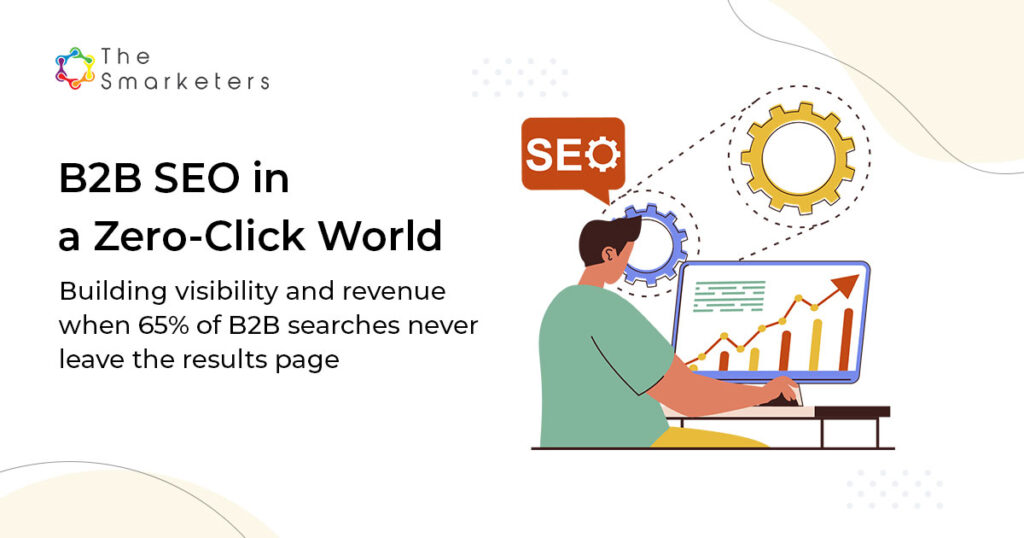
The zero-click era is no longer a prediction. Search Engine Land, SimilarWeb, and SparkToro research published through 2024 and 2025 all converge on the same reality: between 58% and 65% of Google searches now end without a click to a publisher site. The number is even higher on mobile. And in the B2B long-tail queries that traditionally drove organic pipeline, AI Overviews are now present on more than 40% of results.
The old SEO playbook (rank number one, measure clicks, convert sessions) is breaking under this shift. Teams that keep optimizing for click-through rate while the page itself is being answered in the SERP are fighting last year’s war. The teams that are winning in 2026 are optimizing for a different outcome: presence in the answer, not clicks to the page.
This guide rebuilds B2B SEO around the zero-click reality. It covers the new measurement model, the content structure that gets cited in AI Overviews, how to build entity authority, how to recover attribution when dark traffic is the dominant source, and the organizational changes required to report SEO value in a world where traffic does not equal influence.
READ THIS IF
You are a CMO, Head of SEO, or content marketing leader seeing organic traffic flatline or decline while branded search and direct traffic rise. You suspect your SEO is working, but you cannot measure it the way you used to.
The Zero-Click Reality for B2B
The consumer zero-click trend is well documented. The B2B picture is more complicated because B2B queries are longer, more specific, and more likely to produce commercial intent. Yet the same trend is unfolding in B2B, for three distinct reasons, and each reason requires a different response.

The three drivers of B2B zero-click
AI Overviews on long-tail queries
Google began rolling AI Overviews to commercial long-tail queries in late 2024. By early 2026, the feature appears on 42% of B2B informational queries according to SE Ranking’s Q1 2026 analysis, and the published site is cited inside the overview without the click always following.
Featured snippets, People Also Ask, and comparison boxes
The SERP layout keeps adding answer surfaces that resolve queries inline. People Also Ask boxes alone now appear on 48% of B2B queries, up from 31% two years ago.
External AI answer engines
ChatGPT, Perplexity, and Claude collectively processed an estimated 2.7 billion search-equivalent queries per month in 2025 (SimilarWeb). Many of these queries would previously have been Google searches that hit the publisher site. Now they resolve inside the AI tool with a citation but no click.
65%
of B2B search sessions ended without a click to a publisher site in 2025, per SparkToro analysis of U.S. search traffic.
The New SEO Measurement Model
If you measure SEO success by organic sessions, you will cut budget to programs that are working. The measurement has to shift from “clicks the page earned” to “influence the content produced.” That is a harder number to report on. It also happens to be closer to what B2B SEO was always trying to produce
The five metrics that matter in 2026
| Metric | What it measures | Where to find it |
|---|---|---|
| Impressions for branded + generic terms | Presence in front of buyers | Google Search Console, Bing Webmaster |
| SERP feature ownership rate | Share of featured snippets, PAA, AI Overview citations | Ahrefs, Semrush, custom SERP scraping |
| AI citation share | Frequency of citation in ChatGPT, Perplexity, Claude | Custom prompts, AthenaHQ, Profound |
| Branded search volume | Downstream recall effect of SEO content | Google Trends, GSC filter on brand |
| Dark direct traffic patterns | Traffic that lands on a page without an attributable referrer | GA4, Plausible, server logs |
What not to report on as a primary metric
Organic sessions, click-through rate, and keyword ranking for individual informational terms should now be diagnostic metrics, not primary metrics. They still reveal problems (a sudden drop in CTR for a money page is still worth investigating), but they are not proxies for SEO value. Some of the most successful B2B SEO programs in 2025 had flat or declining organic sessions while pipeline from SEO-sourced accounts grew.

Content Structures That Win in Zero-Click Search
Not all content is equally exposed to the zero-click problem. Short-answer informational content is the most cannibalized (the answer gets extracted into the overview and no click follows). Deep, structured, expert content is the least cannibalized (AI overviews cite it as a source; the click rate on those citations is lower but not zero, and the brand exposure is real). The response is to shift content mix toward the structures that win.
Content patterns that consistently earn AI Overview citations
Definitive guides with structured sub-sections
Long-form pieces that cover a complete topic with clear H2/H3 structure, numbered steps, and schema markup. AI engines preferentially cite pieces they can parse cleanly.
Primary research and original data
First-party surveys, benchmarks, and data sets are cited in AI Overviews at materially higher rates than opinion content. The citation preserves the brand name.
Comparison and decision frameworks
X vs Y content, decision matrices, and “when to use” guides are the content type AI Overviews lean on most heavily for commercial-intent queries.
Expert-attributed analysis
Content with a named expert author, ideally with LinkedIn and industry credentials cited, gets disproportionate citation share. E-E-A-T signals have teeth here.
Content patterns that get consumed without citation
Basic definitional content (“What is X?” with no depth)
Answered in the overview. Nothing to click through for.
Listicle content without differentiated analysis
The list gets extracted; the site does not get credit.
Generic how-to content below 800 words
Compressed into the answer. No citation advantage.

Building Entity Authority
The SEO discipline has shifted from keyword-level optimization to entity-level optimization. Google and the AI answer engines think in entities (people, places, concepts, brands) and the relationships between them. Ranking for a keyword is increasingly downstream of being recognized as a meaningful entity in a topic.
Entity authority is built through signals both on and off the site. On-site signals include schema markup (Organization, Person, Product, FAQ, HowTo), consistent naming across the site, author profiles, and topically clustered content. Off-site signals include citation in reputable publications, mention in primary research, presence in industry glossaries, and citation by peer brands.
The entity authority checklist
- Organization schema on the homepage with sameAs links to LinkedIn, Crunchbase, G2, and relevant social profiles
- Person schema on author pages with credentials, LinkedIn, and publication history
- Consistent brand name across all off-site mentions (a surprisingly common error is inconsistent legal-name usage)
- Topic cluster content structure with a pillar page and 10+ supporting articles
- Primary research published at least annually, with clearly cited methodology
- Appearance in at least three industry analyst reports or peer citations per year
- Active presence in high-authority industry communities (podcasts, conference keynotes, vendor round-ups)
3.8x
higher AI Overview citation rate for brands with active entity authority signals (schema, primary research, peer citations) versus brands relying on keyword optimization alone, per Ahrefs entity study (2025).
Recovering Attribution in a Dark Traffic World
Zero-click SEO creates an attribution problem. Someone reads a definitive guide, does not click, recognizes the brand, and later searches the brand name directly. The direct search gets full attribution credit. The original SEO work that started the relationship is invisible in the report. In 2025, between 35% and 55% of direct traffic on typical B2B sites is actually dark traffic: SEO- and social-initiated discovery that arrives with no referrer.
The dark traffic reconstruction kit
Branded search velocity tracking
Sudden, unexplained lifts in branded search volume are almost always downstream of content that earned visibility somewhere. Correlate monthly branded search volume with content publication dates and SERP feature wins.
Attribution survey in the funnel
The “How did you hear about us?” question on a demo or contact form, asked with specific options that include “Google search” separated from “A colleague mentioned you” and “AI chat (ChatGPT, Perplexity, etc.).” Optional field. Self-reported data is imperfect but it is the only primary-source signal available.
LinkedIn tracking pixel on published posts
If a LinkedIn post links to a guide, the pixel fires on the guide page. Even if the user does not convert that session, the pixel-tagged cookie shows up in the attribution model later.
First-touch override on conversion forms
A hidden field that captures the first landing page the user ever hit on the site, not just the most recent. Tracks the true content entry point across multiple sessions.
AI citation monitoring
Custom prompts run weekly against ChatGPT, Perplexity, and Claude with the target keywords. Track citation frequency, the exact passages cited, and the competitors cited alongside.

The Organizational Shift Zero-Click Requires
The measurement and content changes are straightforward compared to the organizational changes required to make zero-click SEO sustainable. Three shifts usually have to happen together.
Shift 1: Reporting moves from traffic to influence
SEO leaders have to stop reporting organic sessions as the primary number. The new primary number is some combination of impressions, SERP feature ownership, branded search lift, and AI citation share. This is a harder sell to a CFO used to seeing traffic charts, and it requires a deliberate education effort before the first report is delivered in the new format.
Shift 2: Content production moves from volume to depth
The 1,200-word informational article written to rank for a long-tail keyword is no longer economic. The same budget produces fewer, longer, more-researched pieces that earn citation rather than clicks. Content calendars should shift from “publish two per week” to “publish one definitive piece per two weeks.”
Shift 3: The SEO team gains a PR muscle
Off-site entity signals matter more now than ever. Peer citations, analyst coverage, and primary research distribution are effectively SEO work in 2026, even though they have traditionally sat with PR or communications. The winning teams blur the line.
CLIENT SPOTLIGHT
B2B Cybersecurity Platform ($70M ARR)
The Challenge
The SEO team had been hitting a 12-month plateau on organic traffic at roughly 140,000 sessions per month. Keyword rankings were stable. New content published monthly earned rankings but did not move traffic. The board asked the CMO to justify continued SEO investment as “the numbers are flat.” The underlying data told a different story: SERP feature appearances had grown 214% year-over-year, branded search volume was up 41%, and pipeline from SEO-sourced accounts had nearly doubled while sessions stayed flat.
The Result
We rebuilt the SEO reporting model around five new primary metrics (impressions, SERP feature share, AI citation share, branded search velocity, dark traffic reconstruction). We cut 40 low-depth articles from the roadmap, published two primary research studies in the following quarter, and added an author-attribution layer across the blog. Within nine months, AI Overview citation share for the target topic set grew from 8% to 34%, pipeline sourced from SEO grew 62%, and the CMO moved SEO from “questioned investment” to “board-reported growth lever.”
Frequently Asked Questions
Does zero-click mean SEO is dying?
No. It means the measurement model is dying. SEO influence on B2B buyers is as strong as it has ever been, arguably stronger because AI engines amplify the reach of cited content. What is dying is the “rank, click, convert” funnel that measured only a narrow slice of that influence.
Should we still pursue keyword rankings?
Yes, but for different reasons. Ranking remains the entry requirement for SERP feature ownership and AI citation. The difference is that ranking is now the means, not the end. You pursue rankings to earn the right to be cited, not to harvest clicks from the SERP.
How do we know AI Overviews are citing us?
Run weekly monitoring prompts against ChatGPT, Perplexity, and Claude using your target keywords. Tools like AthenaHQ and Profound automate this. Google Search Console does not yet report AI Overview citations, though this is expected to change.
What share of our content should be primary research?
For a B2B brand with 30+ pieces per year, aim for at least two pieces of primary research annually (survey, benchmark, or proprietary data analysis). That is the minimum for meaningful entity authority signal. High-performing programs publish quarterly.
How much traffic do we lose per AI Overview appearance?
Ahrefs research from 2025 puts the average click-through cost at 32% when an AI Overview appears on a query. But this varies widely. Informational queries lose more; commercial-intent queries sometimes gain traffic because the overview qualifies the searcher before they click.
Do we need separate strategies for SEO and AEO?
They overlap substantially. The content structure, entity authority, and schema markup required for AI engine citation are the same signals that earn SERP feature ownership in Google. Run them as one discipline, report on both outcomes.
How do we handle the board reporting shift?
Start with a joint CMO-to-CFO session to preview the new reporting. Lead with the revenue linkage: pipeline sourced from SEO accounts, branded search velocity, and new opportunity patterns. Follow with the leading indicators (impressions, SERP feature share). Do not surprise the CFO with a changed dashboard in a board meeting.
Is your SEO working and your measurement missing it?

Enoch Pakanati
CEO