Table of Contents
Need help with B2B Marketing?
Let the smarketers’ team drive your pipeline with data-led campaigns and AI-powered growth strategies.
Why Is MarTech Automation Broken in Most Teams?
Because tools were bought one at a time and never connected, and most of what’s bought is barely used. Leads sit unrouted, scores go stale, and reporting contradicts itself. The problem is architecture and adoption, not a missing feature, which is exactly why buying another tool rarely fixes it.
The numbers are sobering. The martech landscape now spans 14,106 products (chiefmartec, 2024), and yet Gartner found marketers use only 33% of their existing stack’s capabilities, down from 42% the year before and 58% in 2020, while technology still consumes about a quarter of the marketing budget (Gartner, 2023). Teams are spending heavily on tools they barely use and rarely connect.
The cost shows up as fragmented data. Salesforce’s research finds the average marketing organization pulls from around seven data sources, and only 57% of high-performing teams report having unified customer data (Salesforce State of Marketing). The fix is not a thirteenth tool. It is three layers and automation that moves data between them, which you can build without code.
What Are the 3 Layers of MarTech Automation?
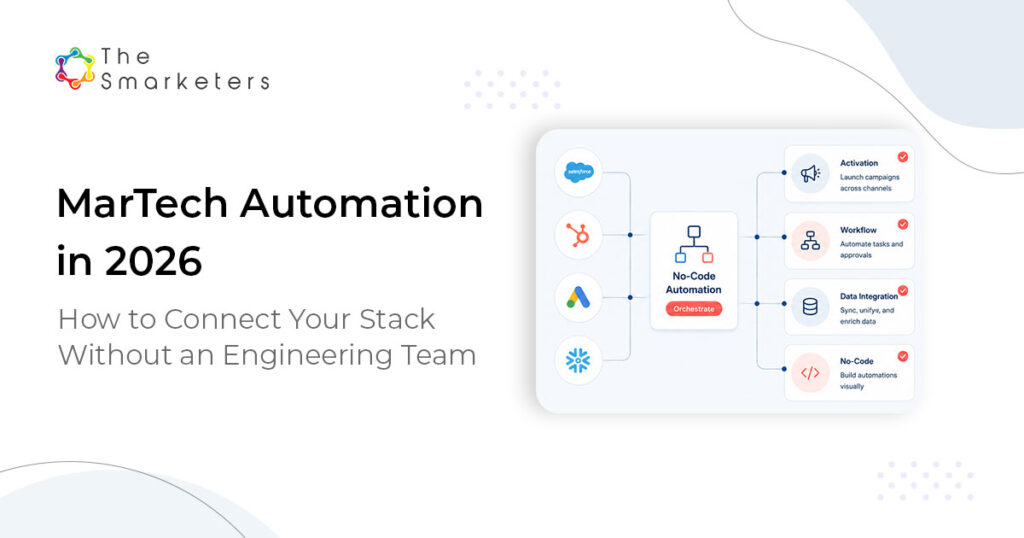
A data layer (a CDP, event tracking, and a clean CRM) holds one source of truth. A workflow layer (n8n, Make, or Zapier) moves and transforms data on a schedule. An activation layer (HubSpot, Salesforce, ad platforms) runs campaigns and sales. Automation connects them so data flows up and actions flow down.

The reason this architecture matters is that it makes the source of truth a deliberate choice rather than an accident. Most teams have three or four systems each quietly claiming to be authoritative; the data layer ends that argument, and the workflow layer keeps every other system in sync with it.
Which 7 Automations Does Every B2B Team Need?
| # | Automation | What it does |
|---|---|---|
| 1 | Lead routing | Send each lead to the right owner instantly |
| 2 | Lead scoring updates | Keep scores current as behaviour changes |
| 3 | Campaign attribution | Stitch touches into a clear source of pipeline |
| 4 | Content personalization | Adapt content to segment and intent |
| 5 | Reporting | Refresh dashboards automatically, from one source |
| 6 | Alert systems | Flag high-intent accounts and broken flows |
| 7 | Data hygiene | De-duplicate and enrich records continuously |
If you only build two of these, build lead routing and data hygiene. Routing pays back immediately in faster follow-up, and hygiene protects every other automation, because automating on dirty data just scales the mess.
Which Tool: n8n vs Make vs Zapier vs HubSpot Operations Hub?
Use Zapier for simple, fast app-to-app triggers; Make for visual multi-step workflows with logic; n8n when you want control, self-hosting, or complex data handling; and HubSpot Operations Hub when your stack is HubSpot-centric and you want native sync and data quality. Most teams end up using two of these together.
| Tool | Best for | Watch-out |
|---|---|---|
| Zapier | Simple, fast triggers between apps | Costs climb with volume and steps |
| Make | Visual multi-step flows with logic | Learning curve on complex scenarios |
| n8n | Control, self-hosting, complex data | Needs more setup ownership |
| HubSpot Operations Hub | HubSpot-centric stacks, native sync | Best value when HubSpot is the hub |
How Do You Build Your First Automation?
Start with lead scoring plus routing, because it pays off immediately and touches every later automation:
- Define what a qualified lead is, with sales, in plain rules.
- Wire behaviour and firmographic data into a score in your workflow layer.
- Route scored leads to the right owner instantly, with an alert.
- Log it all back to the CRM so reporting stays clean and one-source.
What Are the Common Mistakes?
- Over-automation. Automating a broken process just breaks it faster. Fix the process first.
- No error handling. Silent failures corrupt data. Build alerts for when a flow breaks.
- Ignoring data quality. Automation on dirty data scales the mess, which is why hygiene is automation number seven for a reason.
- Buying instead of connecting. With 14,106 products on the market, the instinct is to buy. The leverage is in connecting what you already own.
Frequently Asked Questions
Can you automate a marketing stack without developers?
Yes. With a data layer, a no-code workflow layer (n8n, Make, or Zapier), and an activation layer like HubSpot, most B2B teams automate lead routing, scoring, attribution, and reporting without writing code. Developers help with edge cases, but the core architecture is no-code.
What are the three layers of MarTech automation?
A data layer (CDP, event tracking, clean CRM) that holds one source of truth; a workflow layer (n8n, Make, or Zapier) that moves and transforms data; and an activation layer (HubSpot, Salesforce, ad platforms) that runs campaigns and sales. Automation connects the three so data and actions flow.
Why do marketing teams use so little of their martech?
Gartner found marketers use only about a third of their stack’s capabilities, partly because tools were bought one at a time and never integrated, and partly because data is fragmented across an average of seven sources. The fix is connecting and adopting what you own, not buying more.
Which is better: n8n, Make, Zapier, or HubSpot Operations Hub?
It depends on the job. Zapier suits simple, fast triggers; Make suits visual multi-step flows with logic; n8n suits control, self-hosting, and complex data; HubSpot Operations Hub suits HubSpot-centric stacks needing native sync and data quality. Many teams combine two.
What marketing automations should I build first?
Start with lead scoring plus routing, then data hygiene. Define a qualified lead with sales, score behaviour and firmographics, route instantly with an alert, and log everything to the CRM. Routing pays off immediately, and hygiene protects every other automation you build later.
Stack full of tools that don't talk to each other?

Siddharth Rampelli
Senior Growth Marketing Manager