Table of Contents
- Medical Device Marketing Compliance: What FDA, CE, and TGA Rules Actually Constrain
- Educational Content for Medical Device Lead Generation (Without New Claims)
- KOL Engagement in Medical Device Marketing: How to Borrow Credibility Compliantly
- Why Virtual Events Are the Most Compliance-Friendly Lead Channel for Medical Devices
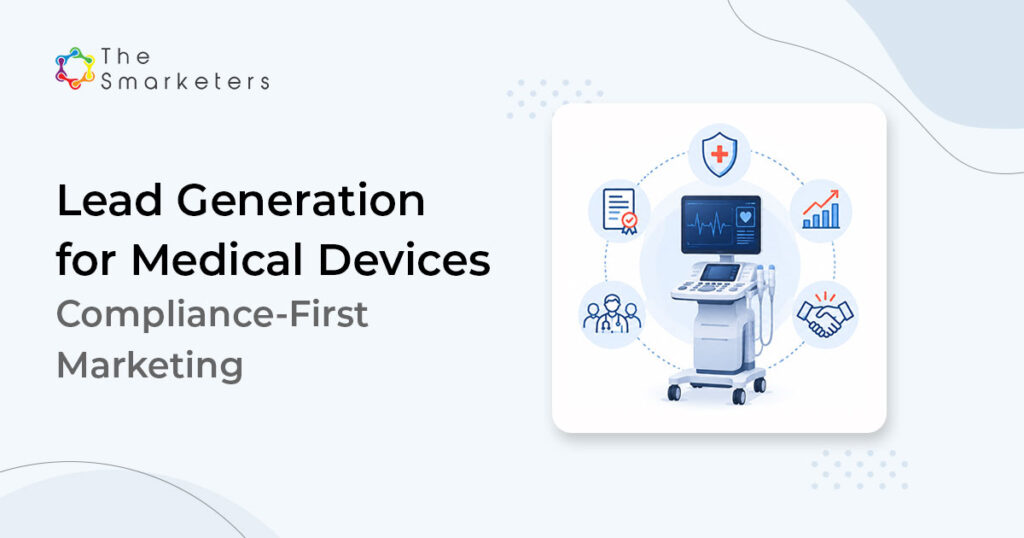
- The Smarketers’ Medical Device Lead Generation Framework: The Compliance-First Lead Engine
- When Compliance-First Medical Device Lead Generation Is Not the Right Fit: 4 Exceptions
- How to Start Your Medical Device Lead Generation Program: A One-Day Audit
- Frequently Asked Questions
Need help with B2B Marketing?
Let the smarketers’ team drive your pipeline with data-led campaigns and AI-powered growth strategies.
Medical device lead generation starts with a familiar problem: a marketer drafts a landing page. Legal strikes the headline because it implies an outcome the clearance does not cover. Regulatory flags the case study because it references an off-label use. The webinar idea stalls for six weeks in review. Meanwhile the sales team asks, again, where the leads are. Most device companies do not have a demand problem or a compliance problem. They have a sequencing problem: marketing creates first and asks permission second, so everything ships late, diluted, or not at all.
The buyers, meanwhile, have moved on with their research. 70 to 80% of the B2B buyer journey happens before first vendor contact, and Gartner’s March 2026 survey found 67% of buyers prefer a rep-free buying experience. Hospital value analysis committees, biomedical engineers, and department heads are forming shortlists from what they can read, watch, and verify on their own. If compliance friction keeps your evidence off the table, the shortlist forms from someone else’s.
This article lays out a compliance-first medical device lead generation system, drawing on our work across life sciences B2B marketing engagements: what the regulatory regimes actually constrain, how educational content generates leads inside those constraints, how to work with key opinion leaders compliantly, why virtual events punch above their weight in this industry, and the framework we use at The Smarketers, including when this approach is not the right fit.
Medical Device Marketing Compliance: What FDA, CE, and TGA Rules Actually Constrain
The core constraint is the same across the major regimes: you may only promote a device for the intended use covered by its clearance, approval, or certification, and every claim must be substantiated. In the US, FDA regulation and FTC advertising rules govern promotion, and claims beyond the cleared indication constitute off-label promotion. Devices sold in the European market carry CE marking under the Medical Device Regulation (MDR), which explicitly prohibits misleading claims about what a device does. Australia’s Therapeutic Goods Administration (TGA) adds its own advertising code, including restrictions on promoting certain devices directly to consumers. Different paperwork, same principle: the claim set is fixed by the regulatory file, not by the copywriter.
Medical device marketing compliance translates into five working rules that govern every lead generation asset, from claims language to data capture to testimonials. For lead generation specifically, that translates into five working rules:
- Claims live in a matrix, not in people’s heads. Every approved claim, its substantiation, and its permitted phrasing sits in one document that marketing, regulatory affairs, and agencies all work from.
- Audience determines what you may say. Content for clinicians and content for patients face different rules; gate or label professional content accordingly.
- Testimonials and case studies need substantiation too. A surgeon quote implying superior outcomes is a claim. Treat it like one.
- Review is a step in the process, not an obstacle after it. Pre-approved templates and claims language turn six-week reviews into six-day ones.
- Data capture has its own rulebook. Health-adjacent lead data raises privacy obligations (HIPAA in US healthcare contexts, GDPR for European prospects), so consent language and storage practices belong in the campaign design.
Key stat: Accuracy is not only a legal duty; it is a trust asset. Forrester found 20% of buyers lost decision confidence after encountering unreliable AI-generated information, rising to 28% among procurement professionals. In a category where buyers are trained to verify claims, being the demonstrably accurate source is a competitive position. (Source: Forrester 2025.)
That is the reframe this whole article rests on: compliance is usually discussed as a brake on lead generation, but in device marketing the discipline it forces, verifiable claims, cited evidence, reviewed content, produces exactly the material that clinical and procurement audiences trust enough to exchange their contact details for.
Educational Content for Medical Device Lead Generation (Without New Claims)
How do medical device companies generate leads compliantly? By publishing educational evidence that buying committees need anyway, and gating the deepest versions of it. Demand Gen Report research finds buyers consume 8 to 13 pieces of content before engaging sales, and Gartner’s survey of 645 B2B buyers found 45% used generative AI to gather vendor and product information. Every one of those touches either happens on your material or on somebody else’s.
The content types that drive lead generation for medical device companies most effectively share one property: they inform a buying decision without extending a claim.
| Content type | Who it serves | Why it converts | Gating |
|---|---|---|---|
| Clinical evidence summaries and study explainers | Physicians, clinical champions | Summarizes published data they must review anyway. | Gate the full pack, not the abstract. |
| Value analysis and procurement toolkits | Value analysis committees, supply chain | Maps evidence to the committee's own evaluation template. | Gate; this is a high-intent download. |
| Reimbursement and coding guides | Administrators, billing leads | Answers the "who pays for this" question early. | Gate; strongest MQL signal in many programs. |
| Technique and in-service education | Clinical users, biomedical engineering | Reduces adoption risk, the quiet deal-killer. | Mostly ungated; builds trust and search visibility. |
| Regulatory-change explainers | Quality, regulatory, procurement | Positions you as the source that understands the rules. | Ungated; earns links and AI-search citations. |
Set expectations with benchmarks, not hope. The median B2B conversion rate is 2.9% across industries, and lead economics in considered-purchase categories are real money: Flyweel’s benchmark index puts blended B2B cost per lead around $198, and Starr Conspiracy benchmarks put the average B2B cost per sales-qualified lead at $1,357. Those numbers argue for fewer, deeper assets aimed at committee roles rather than volume publishing, and they make the case for measuring cost per qualified opportunity, not cost per download.

KOL Engagement in Medical Device Marketing: How to Borrow Credibility Compliantly
KOL engagement in medical devices works because respected clinicians and researchers whose judgment peers defer to remain the most persuasive voice in device adoption, because clinical audiences trust peers over vendors. A KOL webinar, co-authored explainer, or conference talk carries weight no branded asset can. That is precisely why the compliance stakes are high: payments to physicians are publicly disclosed under transparency rules such as the US Open Payments (Sunshine Act) system, and an endorsement that reads as bought damages both parties.
A compliant KOL program in practice:
- Select for evidence, not follower counts. The right KOL has published or presented on the clinical problem your device addresses, and their audience is your buying committee.
- Contract transparently. Fair-market-value compensation, written scope, and disclosure language agreed up front with legal and compliance.
- Co-create education, not advertising. Disease-state education, technique discussion, and published-evidence reviews age well; scripted product pitches do not, and clinicians see through them instantly.
- Let their content work as a lead asset. A KOL-led session is the single most reliable registration driver we see in this category; the recording, clips, and Q&A become months of follow-on material.
Smarketers insight: The most undervalued KOL asset is the question log from their sessions. Fifty real questions from clinicians and value-analysis members is a validated content calendar: every answer is a page, an email, or a talk track your committee demonstrably wants.
Why Virtual Events Are the Most Compliance-Friendly Lead Channel for Medical Devices
Virtual events are among the most effective channels for medical device marketing because they solve three constraints at once. Virtual events fit device marketing unusually well because they solve three constraints at once: clinical audiences are hard to gather physically, live sessions can be reviewed and scripted in advance to keep claims inside the matrix, and registration is consent-based data capture with clear intent signal. A biomedical engineer who spends 45 minutes in your technique webinar has told you something a whitepaper download never could – a principle central to how we design ABM and inbound programs for health tech companies.
Distribution is more concentrated than in most industries. For professional audiences, LinkedIn dominates: 80% of B2B social media leads come from LinkedIn, which generates 277% more leads than Facebook and Twitter combined. And the recording matters as much as the live session: 41% of B2B marketers say short-form video drives the highest ROI of any video format, which is an argument for cutting every webinar into two-minute clinical answers with the compliance-approved framing baked in.
A format mix that has worked across our health tech engagements: quarterly KOL evidence reviews for reach, monthly technique or in-service sessions for depth, and small-group case discussions for late-stage accounts. Each has a different gating and follow-up posture, and the follow-up is where programs win or lose: registrants expect the recording and the cited studies, not a same-day discovery-call push.
Instrument events like the lead assets they are. Track registration-to-attendance rate, attendance duration, questions asked, and which accounts sent multiple attendees; a hospital that registers a clinician, a biomedical engineer, and a procurement lead for the same session is telling you an evaluation is underway. Route that signal to sales as an account insight with the specific context (“three roles from this account attended the technique review”), not as three separate leads dropped into a queue. The compliance benefit compounds here too: because the session content was pre-reviewed, every clip, quote, and follow-up email built from it inherits approved language instead of starting a new review cycle.
The Smarketers’ Medical Device Lead Generation Framework: The Compliance-First Lead Engine
We run device and health tech lead generation through a five-stage framework we call the Compliance-First Lead Engine. The defining choice is stage one: regulatory guardrails are built before any content is written, which inverts the usual create-then-review sequence and removes the friction that kills most device marketing calendars.
- Guardrails. Build the approved claims matrix and pre-cleared templates with regulatory and quality teams. One week of this work saves a quarter of review cycles.
- Education. Publish the evidence summaries, value-analysis toolkits, and reimbursement guides the committee needs, gated by intent depth.
- KOL engagement. Co-create peer-credible education under disclosed, fair-market-value agreements.
- Virtual events. Run the webinar and case-review cadence that turns evidence into consent-based, sales-ready registrations.
- Compliant nurture. Score and route leads inside consent and privacy boundaries, with follow-up sequences built from pre-approved language.

Case study: 100+ MQLs in six months for a healthcare AI platform
KeyReply, a conversational AI platform serving healthcare organizations, needed a qualified pipeline from an audience that is professionally skeptical of technology claims. We rebuilt the program around the engine above: educational assets tuned to healthcare buyers, tightly targeted campaigns, and continuous message testing inside the approved language. In six months the program delivered 100+ MQLs, cut cost per lead from $75 to $51.86, and lifted ad click-through rates from 2% to 4.43% (Smarketers client engagement). The CPL drop is the number to study: it came from relevance and message discipline, not from spending less.

Key takeaway: Healthcare buyers reward precision. The same review discipline that kept KeyReply’s claims defensible is what made the ads convert at more than double the starting click-through rate.
When Compliance-First Medical Device Lead Generation Is Not the Right Fit: 4 Exceptions
This system optimizes for trust and durability, and it deliberately trades away speed. It is the wrong fit in a few situations:
- Pre-clearance companies. If your device is not yet cleared or certified, promotional lead generation is off the table entirely. Investor communication, recruitment for studies, and unbranded disease-state education have their own rules; get regulatory counsel before any of it.
- Distributor-led commercial models. If distributors own the customer relationship in your channel, invest in channel enablement and co-marketing before building a direct lead engine that routes inquiries nobody is set up to work.
- When the evidence base is thin. Educational marketing amplifies evidence; it cannot replace it. If the clinical data is not yet compelling, budget flows better toward studies and registries than toward promotion of what does not yet persuade.
- Quarter-end pipeline emergencies. This engine compounds over quarters. If the business needs leads in three weeks, targeted outbound to known accounts will serve better, though it will not fix the underlying gap.
One honest trade-off inside the approach itself: pre-approval systems can drift toward saying only what is safest, which produces content too bland to differentiate. The claims matrix defines the boundary; the marketing still has to be interesting inside it. Teams need both discipline and the craft.
How to Start Your Medical Device Lead Generation Program: A One-Day Audit
Start with an audit you can run in a day: list your last ten marketing assets and mark which claims in each are covered by your regulatory file, then list the ten questions your sales team hears most and mark which have a public, citable answer on your site. The gaps between those two lists are your first quarter of compliant lead generation. To sanity-check the economics, model your program in our customer acquisition cost calculator, and if you want the Compliance-First Lead Engine mapped to your device category, committee, and claims matrix, explore our medical device lead generation services.
Frequently Asked Questions
How long does a compliance-first lead program take to produce qualified leads?
Expect first MQLs within 8 to 12 weeks of launch, with the compounding effects (organic visibility, KOL audiences, webinar lists) building over two to three quarters. The KeyReply engagement reached 100+ MQLs over six months, which is a realistic planning horizon for a full program.
What budget should a mid-sized device company plan for lead generation?
Anchor on unit economics rather than a flat number: blended B2B cost per lead benchmarks sit around $198 and cost per SQL around $1,357, so work backward from pipeline targets to a budget, then adjust for your deal size. High-ACV devices justify spending well above benchmark for committee-level leads.
Who needs to approve content in a compliant workflow, and how do we keep it fast?
Typically marketing, regulatory affairs, and legal, with quality involved in technical claims. Speed comes from pre-approval: a claims matrix, pre-cleared templates, and standing language reduce per-asset review from weeks to days because reviewers check conformance, not novelty.
Can we use patient outcomes or surgeon testimonials in lead gen campaigns?
Only when they match your cleared indications and can be substantiated, and testimonials implying atypical results need careful handling. Route every outcome claim through the same review as any promotional claim, and keep disclosure language on any compensated clinician content.
Does gating clinical evidence hurt trust with physicians?
Gate depth, not existence. Keep abstracts, summaries, and regulatory explainers open so clinicians and AI search tools can verify you, and gate the full toolkits and data packs that signal genuine evaluation intent. Fully ungated programs capture almost nothing; fully gated ones never build the trust that drives the visit.
How do we generate leads in markets where direct-to-consumer device promotion is restricted?
Aim the program at professional audiences, which is where device buying decisions concentrate anyway. Professional-only channels, gated clinician content, and audience verification keep campaigns inside advertising codes such as the TGA’s while still filling the pipeline.
Which KPIs matter most for a device lead gen program?
Cost per qualified opportunity, MQL-to-opportunity conversion, buying-committee coverage at target accounts, and webinar registration-to-attendance rates. Cost per raw lead is the least useful number in this category because committee-role leads are worth many multiples of generic downloads.
Do we need separate programs for clinicians and economic buyers?
Separate content tracks, one program. Clinicians need evidence and technique; value analysis committees and administrators need cost, reimbursement, and risk answers. The committee decides together, so the nurture should interleave both tracks at the account level rather than running disconnected campaigns.

Enoch Pakanati
CEO