Table of Contents
- Quality vs. Quantity in B2B Content Production: Why the Trade-Off Is a False Choice
- The 1:5:25 B2B Content Production Model: One Spine, Five Builds, 25 Cuts
- How to Use AI in a Content Production Model Without Losing Quality
- The Editorial Workflow That Keeps Quality Intact at Content Scale
- Inside The Smarketers B2B Content Production Model: Results from a Real Engagement
- When a High-Volume B2B Content Production Model Is Not the Right Fit
- Frequently Asked Questions
Need help with B2B Marketing?
Let the smarketers’ team drive your pipeline with data-led campaigns and AI-powered growth strategies.
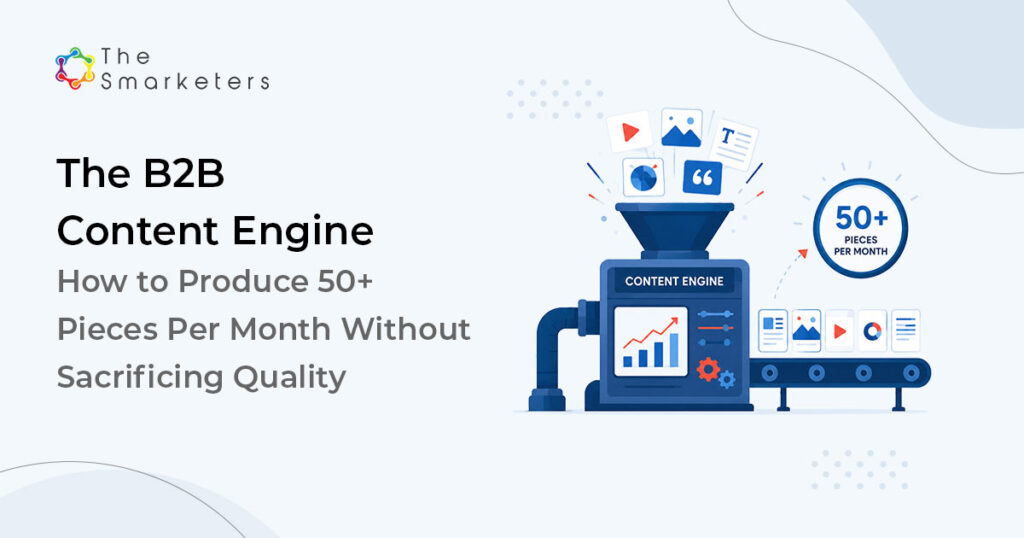
A B2B content production model is a repeatable system that turns one deeply researched anchor asset into a full month of channel-native content – across search, social, email, and AI retrieval surfaces – without scaling research effort for each derivative piece. The Smarketers 1:5:25 Content Production Model produces 31 pieces per theme from a single research spine: one anchor asset, five channel builds, and 25 distribution cuts. It is designed for B2B teams that need to show up across multiple buyer touchpoints without multiplying headcount.
A content team of three sits down for quarterly planning. The ask from leadership: show up in search, in AI answers, on LinkedIn, in the sales team’s follow-up emails, and in the podcast feed. The team’s current output: six blog posts a month, written well, published quietly, and outnumbered everywhere buyers actually look. A structured b2b content production model is the only way to close that gap without burning the team out.
The math behind that pressure is not imaginary. Buyers work through 8 to 13 pieces of content before they ever engage sales, and Forrester puts 70 to 80% of the buying journey before first vendor contact. If your six monthly posts are not among the pieces a buying group reads in that stretch, someone else’s fifty are. And the reading now happens in more places than your blog: Forrester found 94% of B2B buyers use generative AI during the purchase process, which means your content also has to exist in forms that AI assistants retrieve and cite.
The usual response is to pick a side: stay small and artisanal, or scale output and accept quality decay. Both choices lose. This article lays out the third option: a content production model built on one researched spine per theme, systematic repurposing, tightly scoped AI assistance, and editorial gates that do not bend under volume. It is the model we run at The Smarketers, for ourselves and for clients through our B2B content marketing services, and we will show the numbers from one of those engagements.
Quality vs. Quantity in B2B Content Production: Why the Trade-Off Is a False Choice
No, but only if you change what gets scaled. Quality and quantity trade off when every piece is created from scratch, because research and thinking are the expensive parts of content and they get thinner as volume rises. The trade-off disappears when research is produced once, deeply, and then expressed many times. Fifty derivative pieces from one strong research spine carry the quality of the spine. Fifty pieces from fifty shallow briefs carry the quality of a rushed afternoon.
This distinction matters more now than it did five years ago, for two reasons. First, distribution is fragmented: the same buyer touches search, LinkedIn, communities, video, and AI assistants, and each channel punishes content that was not made for it. Second, the volume bar moved. 41% of B2B marketers say short-form video drives the highest ROI of any video format (Sprout Social), and short-form only works as a stream, not as a monthly event. A team publishing six long articles cannot feed that stream. A team repurposing one spine into twenty-five cuts can.
There is a real trade-off hiding inside the false one, and naming it keeps the argument honest: the scarce resource is not production capacity, it is audience attention and expert time. Every piece you publish spends a little of the audience’s patience, and every spine you research spends hours from people whose calendars are already full. The engine model works because it economizes both: the audience meets one idea in the format they prefer instead of ten ideas in formats they skip, and the experts invest deeply in a few themes instead of shallowly in dozens.

Key takeaway: Scale expression, not research. The teams that break on volume are scaling the wrong half of the job: they multiply briefs and drafts instead of multiplying the formats of a few genuinely researched ideas.
The 1:5:25 B2B Content Production Model: One Spine, Five Builds, 25 Cuts
A b2b content production model is a repeatable system that turns one researched anchor asset into a full month of channel-native content on a fixed cadence. Our version is the 1:5:25 framework: one research spine, five channel builds, twenty-five distribution cuts.
That is 31 pieces per theme; two themes a month clears 50 pieces with one team and one research effort per theme – the same cadence we map out in every B2B content marketing strategy we build.
- The research spine (1). One anchor asset per theme that would survive scrutiny on its own: an original benchmark, a named framework, a documented client engagement, a teardown of a real problem. This is where senior time goes. If the spine is weak, the engine multiplies weakness, so the spine gets the deepest review in the system.
- Channel builds (5). The spine is rewritten, not trimmed, for five channels: a long-form blog or pillar page, a first-person LinkedIn article with an opinionated angle, a podcast or webinar segment, a community post written to that community’s rules, and an email issue. Each build answers the question a person on that channel is actually asking, in that channel’s voice.
- Distribution cuts (25). Statcards, chart posts, quote cards, short video clips, carousel frames, and comment-ready answers, all derived from the five builds. Cuts are cheap because the thinking is already done – this is what makes b2b content repurposing economical at scale. A coordinator plus templates can produce the full set in a day

The content repurposing framework map below shows how one spine spreads across a month. The point is not the exact counts; it is that every piece traces back to research that was done properly once.
| Layer | Assets | Who produces it | Time per theme |
|---|---|---|---|
| Research spine | 1 anchor (benchmark framework or case teardown) | Senior strategist + subject expert | 3–5 days |
| Channel builds | Blog/pillar, LinkedIn article, podcast segment, community post, email issue | Writer per channel, editor reviews all | 4–6 days (parallel) |
| Distribution cuts | 25 statcards, clips, quote posts, chart posts, reply drafts | Coordinator + design templates | 1–2 days |
One rule keeps the model honest: no cut ships without a parent. If a statcard cannot point to the spine it came from, it is decoration, and decoration is what buyers and AI assistants alike have learned to skip. Buyers already consult around seven information sources per purchase (Gartner); the engine’s job is to make sure several of those sources carry your thinking, in the native format of each place they look.
How to Use AI in a Content Production Model Without Losing Quality
AI belongs in the engine as an accelerant for defined tasks, not as the author. The distinction sounds obvious and is violated constantly, usually at exactly the moment volume targets get aggressive. Our working split after two years of running AI inside production:
- AI is good at: research synthesis across sources you supply, first-pass structure suggestions, variant generation for hooks and titles, format conversion (blog section to carousel copy), consistency checks against a style guide, and summarizing interviews for the writer who conducted them.
- AI is bad at: original claims, first-hand experience, numbers (it will invent them), opinions worth attributing to a named person, and any sentence your reader might quote. It also produces recognizable patterns; readers have learned the texture of machine-written filler and discount the brand that publishes it.
There is a commercial reason to hold this line beyond taste. Forrester found 20% of buyers lost confidence in a decision because of unreliable AI-generated information, rising to 28% among procurement. Publishing unverified machine-drafted claims puts your brand on the wrong side of that statistic. The engine’s stance: AI compresses hours, humans own every claim, and every number carries a source a person checked.
The task-level split we hold teams to, in one view:
| Task | What AI does | What a human owns |
|---|---|---|
| Research synthesis | Summarizes supplied sources and flags contradictions. | Chooses sources and verifies every claim kept. |
| Drafting | Structure suggestions and format skeletons. | All original claims, opinions, and final prose. |
| Repurposing | Converts approved copy between formats. | Channel judgment, final wording, and every number. |
| Quality checks | Style-guide and banned-phrase scans. | The publish decision, always. |
Smarketers insight: The most useful AI deployment in our own engine is not drafting at all. It is the unglamorous middle: converting an approved long-form piece into channel-specific skeletons that a writer then makes human. That step used to take a third of production time and carried zero creative value.
The Editorial Workflow That Keeps Quality Intact at Content Scale
Quality at volume is a workflow property, not a talent property. Teams that successfully scale content production do it by fixing the workflow first, not by hiring more writers. Talented teams produce bad content inside bad workflows the moment throughput doubles. The engine runs on four gates, and a piece that fails a gate goes back, not through:
- Source gate. Every external statistic verified against its primary source and linked; every internal number checked against the client report or analytics account. Anything unverifiable is cut or softened to directional language. This gate alone removes most of the quiet credibility damage scaled teams accumulate.
- Voice gate. Does it read like a person from this team wrote it? Banned-phrase lists, sentence-rhythm checks, and a hard rule against filler openings. One editor owns voice across all 50+ pieces so drift is caught in days, not quarters.
- Structure gate. Answer-first sections, self-contained passages, real headings. This is quality for the reader and, increasingly, for retrieval: AI assistants lift passages that stand alone, and structured pages are the ones that get lifted.
- Differentiation gate. The hardest one: does this piece say anything the top ten results do not already say? If the honest answer is no, it does not ship as a spine; it might survive as a cut. Volume without information gain is how brands train audiences to ignore them.
Cadence matters as much as the gates. The engine runs on a weekly rhythm: spine work early in the cycle, channel builds mid-cycle, cuts and scheduling at the end, and a standing measurement review that decides which themes earn a second spine. Measurement is unforgiving on purpose – a principle central to how we structure every B2B demand generation plan: with a median B2B conversion rate of 2.9% (Ruler Analytics, via First Page Sage), content that merely exists changes nothing. The review tracks engagement per piece, search and AI citations per spine, and pipeline influence per theme.
Two staffing details make the gates hold in practice. First, the editor who runs them cannot also carry a production quota; the moment gatekeeping competes with output targets, the gates lose. Second, subject experts review spines, never cuts: forty-five minutes of an engineer’s week protects thirty-one derivative assets, which is the best review economics in the whole system. Teams that route every asset past experts burn the goodwill the engine depends on, and teams that route nothing past them publish confidently wrong things at scale.
Inside The Smarketers B2B Content Production Model: Results from a Real Engagement
We run this b2b content production model as a service line, with the roles split the way the table above describes: senior strategists own spines, channel writers own builds, coordinators own cuts, and one editorial owner runs the gates. The model is deliberately boring to describe, which is rather the point. Engines beat heroics because they produce week after week without depending on anyone’s best day.
What it looks like in results: Perspectium, an integration software company in the ServiceNow ecosystem, came to us with deep technical expertise and content output that did not reflect it. We rebuilt production around researched spines aimed at the questions its buyers actually search, with disciplined repurposing behind each one.
Result: Perspectium grew organic traffic by 66.52%, with 25 keywords ranking in Google’s top 10, on the strength of a production system rather than a publishing sprint. (Smarketers client engagement; full story at thesmarketers.com/success-stories/)

The honest caveat: the engine amplified expertise that already existed. Perspectium’s engineers could answer questions competitors could not, and the spines were built from those answers. A content production model pointed at a company with nothing distinctive to say will produce fifty forgettable pieces a month with impressive efficiency.
When a High-Volume B2B Content Production Model Is Not the Right Fit
The engine is an operating model, and operating models have prerequisites. Skip it, or scale it down, in these situations:
- No spine-worthy expertise is accessible yet. If subject experts cannot give the content team real time, build the interview pipeline first. An engine without expert input becomes a paraphrasing machine.
- Distribution is not staffed. Fifty pieces nobody distributes is waste with better formatting. If there is no owner for LinkedIn, communities, and email, fix distribution for existing content before scaling production.
- Sales cycles run on a handful of accounts. A ten-account ABM motion usually needs deep, account-specific assets more than volume. Run the spine discipline, shrink the cut layer.
- Quality gates would be aspirational. If nobody can own the source and voice gates, volume will outrun review and the brand pays for it. Scale gates first, output second.
A reasonable starting point for most mid-market teams is a half-engine: one theme per month, 1:5:12, run for a quarter. It proves the workflow, surfaces the gaps, and produces enough signal to justify (or honestly reject) the full model. If you want to help pressure-test the model against your team’s reality, explore our content services: the first conversation is a working session on your production math, not a pitch.
Frequently Asked Questions
How big a team do you need to run a B2B content production model like the 1:5:25?
A minimum viable engine is four roles, not four hires: a strategist who owns spines, one or two writers for channel builds, a coordinator for cuts and scheduling, and an editor who runs the gates. Many teams cover this with three people plus fractional design. Below that, run one theme a month instead of two.
How long does it take before an engine shows results?
Expect the workflow to feel stable after one full monthly cycle and to show measurable traction in one to two quarters: engagement and search movement first, pipeline influence after that. Perspectium’s 66.52% organic growth accumulated over the engagement, not in the first month.
What does a content production model cost compared to traditional production?
Cost per piece drops sharply because research is amortized across 31 assets, but total spend usually stays flat or rises slightly; the budget shifts from many shallow briefs to fewer senior research days plus coordination. The honest framing is better unit economics, not a smaller invoice.
Which piece should be the research spine if we can only make one?
The asset that answers the question your buyers ask most in late research and that competitors answer worst. Original data and documented client outcomes make the strongest spines because they cannot be paraphrased away by competitors or by AI summaries.
Can AI write the distribution cuts if humans write the spine?
Partially. AI can draft cut skeletons (statcard copy, clip descriptions, post variants) because the claims already exist in the approved spine. A human still finalizes wording and checks every number, since cuts travel further than their parents and errors in them are the ones screenshotted.
How do you keep 50 pieces a month from cannibalizing each other in search?
Only the spine and its blog build target rankable keywords; cuts target feeds and communities, not search. Map one primary keyword per spine, interlink builds to the spine, and let distribution assets carry zero SEO ambition. Cannibalization is a symptom of every piece trying to rank.
What KPIs prove the engine is working?
Per spine: organic traffic and rankings, plus citations in AI answers. Per channel build: engagement native to that channel. Per theme: influenced pipeline and content-assisted conversions. Track cost per published piece as a health metric, but never as the goal; cheap, ignored content is still waste.
Does this model work for regulated industries with legal review?
Yes, with one change: legal reviews the spine once, in depth, and approved language flows into all 30 derivative pieces. That is faster and safer than reviewing 31 assets separately, which is how regulated teams usually drown. Build the review step into the spine timeline, not the cut timeline.

Swati Bansal
Sr. Content Strategist