Table of Contents
- The RFP Trap: Why IT Services Demand Generation Gets Stuck at the Wrong Stage
- Demand Generation for IT Services: Creating Pipeline Before the RFP Drops
- Thought Leadership That Positions You as the Expert
- How Account-Based Marketing for IT Services Powers the Pre-RFP Demand Motion
- The Pre-RFP Demand Framework
- Case Study: Enterprise Demand Without Waiting for the RFP
- When Demand Generation for IT Services Is Not the Right Approach
- Where to Start
- Frequently Asked Questions
Need help with B2B Marketing?
Let the smarketers’ team drive your pipeline with data-led campaigns and AI-powered growth strategies.
What is demand generation for IT services?
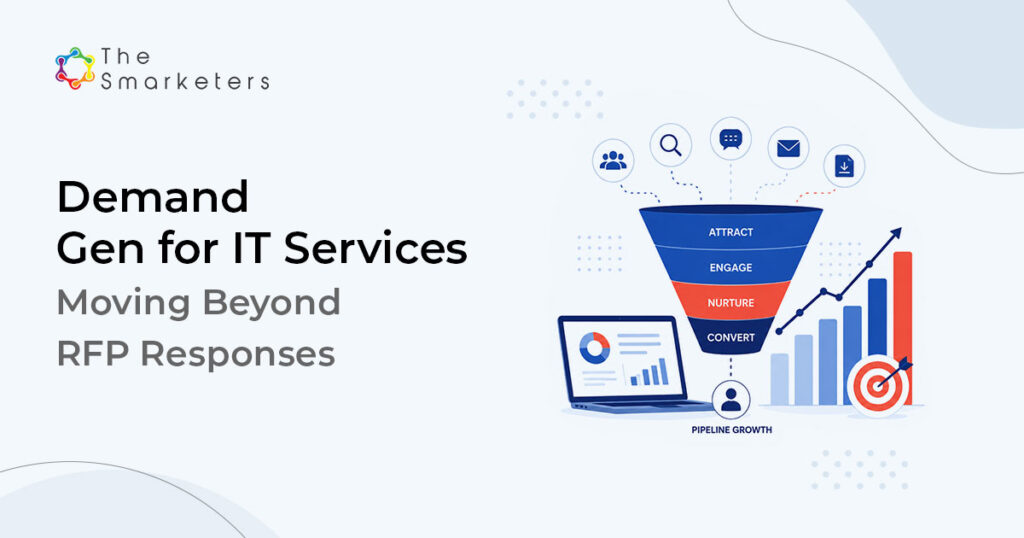
Demand generation for IT services is the set of marketing activities that build awareness, establish credibility, and create a pipeline with enterprise accounts before a formal procurement process begins. Unlike lead generation, which captures existing intent, IT services demand generation creates intent by positioning the firm as a trusted authority during the research and requirements-definition phase – typically 3 to 12 months before an RFP is issued.
An RFP lands in the inbox of an IT services firm. This is the demand generation problem most IT services firms never fully solve: by the time procurement begins, the real decision has usually already been made. Forty pages, three weeks to respond, seventeen mandatory sections. The delivery team drops billable work to write it. The pricing gets sharpened twice. The response is genuinely good. And the contract goes to the incumbent-adjacent vendor who had been advising the client’s CIO for the past year, whose fingerprints were on the requirements before the document ever went out.
Every service leader has lived some version of this, and the research says it is the norm, not bad luck. The 6sense Buyer Experience Report found that roughly 95% of the time, the winning vendor was already on the buyer’s Day-One shortlist, and about 80% of buyers contact first the vendor they already intend to buy from. If the first time an account hears your name is inside their procurement process, you are usually there to make the process look competitive.
This article is about the alternative: a demand generation motion that builds a predictable B2B pipeline for IT services firms – one that puts you in the room while the requirements are still forming. It includes the five-step framework we run at The Smarketers for services clients, and the honest limits of the approach.
The RFP Trap: Why IT Services Demand Generation Gets Stuck at the Wrong Stage
IT services firms lose RFPs they should win because the RFP is usually the end of the buying decision, not the beginning. By the time requirements are written, most of the evaluation has already happened, quietly and without vendor participation. Forrester’s research puts 70-80% of the buyer journey before first vendor contact, and buyers consume 8-13 pieces of content before engaging sales at all.

The economics compound the problem. A reactive, RFP-led pipeline has three structural costs that never show up on one invoice:
- Response cost. Senior delivery people write responses instead of billing. Firms that respond to everything effectively run an unpaid proposal factory.
- Win-rate ceiling. When you enter at the RFP stage, you compete on the buyer’s existing framing, usually written with someone else’s strengths in mind. Price becomes your main lever, which is exactly the position a services firm should never occupy.
- Pipeline volatility. You cannot forecast what you do not influence. RFP flow rises and falls with other people’s budget cycles, which is why so many services firms swing between bench and burnout.
Key stat: Roughly 95% of the time, the winning vendor was already on the buyer’s Day-One shortlist. The demand gen question for IT services is not “how do we respond better?” but “how do we get onto that list before the RFP exists?” (Source: 6sense Buyer Experience Report 2025.)
None of this means refusing RFPs. It means treating unsolicited RFPs as a lagging indicator: if most of your pipeline arrives that way, your market presence is a year behind your capability.
Demand Generation for IT Services: Creating Pipeline Before the RFP Drops
Getting onto the Day-One shortlist means being visible during the research the buyer does alone, which is most of it. Two findings define the terrain. First, that research is increasingly machine-mediated: Forrester found 94% of B2B buyers use generative AI during the purchase process, asking assistants exactly the questions that used to reach your sales team. Second, most of the buying group never identifies itself: up to 90% of identifiable account visitors remain anonymous, and only about 3% of web visitors ever fill a form. A demand program that only counts form-fills is measuring the visible tenth of the market.
For an IT services firm, pre-RFP demand creation comes down to three disciplines:
- Answer the evaluation questions publicly. Buyers researching a cloud migration or an ERP modernization ask the same twenty questions every cycle: build vs buy, cost ranges, team structures, failure patterns. The firm whose content answers those questions honestly, with numbers, becomes part of the requirements conversation without being invited.
- Show the work, not the brochure. Services are trust purchases. Teardown-style content, methodology deep dives, and honest post-mortems earn shortlist positions that capability decks never will. This is also what AI assistants cite when buyers ask them who is credible.
- Stay present between buying cycles. Enterprise IT buying is episodic; attention must not be. The firms that win the RFP were in the account’s field of vision for the four quarters before it, which is a rhythm problem, not a budget problem.
What does that look like as an asset mix? The formats that earn shortlist positions for services firms are consistently the unglamorous ones: evaluation guides that name real cost ranges, architecture teardowns with the trade-offs left in, migration post-mortems that admit what went wrong, and benchmark pieces built from delivery data. Gate almost none of it. With only about 3% of visitors ever filling a form, gating your best material optimizes for a metric while starving the 97% who are quietly building the shortlist.
Smarketers insight: The pattern we see across HubSpot implementations for life sciences clients: companies over-restrict content creation and under-restrict automation plumbing. Reversing that, generous with approved content, strict with workflow governance, raises output and lowers risk at the same time.
Thought Leadership That Positions You as the Expert
IT services thought leadership works when it is specific enough to be disagreed with. A point of view like “most ERP modernizations fail in the data migration phase, here is the sequencing that prevents it” creates demand; “digital innovation is accelerating” creates nothing. The test we apply: could a competitor publish the same piece? If yes, it is not a point of view.
Distribution matters as much as substance, and for this audience it concentrates in one place. LinkedIn accounts for 80% of B2B social media leads, and generates 277% more leads than Facebook and Twitter combined. The compounding move is publishing through named practitioners, your architects and delivery leads, rather than the company page alone. Buyers shortlist people they have already learned from; a services firm’s practitioners are its most credible media channel.
One editorial rule keeps this honest: attribute opinions as opinions and numbers to sources. Expertise content that overstates certainty gets picked apart in exactly the technical communities you are trying to win.
Cadence beats bursts. A practical operating rhythm for a mid-sized firm: one substantial point-of-view asset per service line per quarter, two practitioner posts per week across the named authors, and one piece of original delivery data per half. That volume is sustainable alongside billable work, and sustained presence is the variable that moves shortlist odds, not any single viral post.
How Account-Based Marketing for IT Services Powers the Pre-RFP Demand Motion
Account-based marketing for IT services is the natural operating system for the pre-RFP motion, because IT services revenue is concentrated in a relatively small number of high-value accounts. The evidence for the model is consistent. ITSMA finds 87% of marketers say ABM delivers higher ROI than other strategies, companies using ABM report a 48% increase in revenue per account, and Forrester finds 45% of ABM practitioners report revenue up 10%+ within 12 months.
The services-specific adaptation is coverage. The median B2B buying group is now 11.2 people for deals over $50K – a multi-stakeholder reality that requires buying committee marketing, not single-thread outreach. Services deals add procurement, security review, and the delivery-side stakeholders who will live with you for years. An ABM program that engages one sponsor has not covered the account; it has met the person who forwards the RFP.
| Reactive RFP motion | Pre-RFP demand motion |
|---|---|
| Pipeline arrives as procurement documents | Pipeline is built on named accounts before procurement starts |
| First contact: after requirements are fixed | First contact: while the problem is still being framed |
| Competes on price against the spec | Shapes the spec through advisory conversations |
| Win rate capped by incumbents and column-folder dynamics | Roughly 95% of wins go to Day-One shortlist vendors; the motion targets that list |
| Measured on responses submitted | Measured on qualified account engagement and pipeline influenced |
The Pre-RFP Demand Framework
How does an IT services firm run demand generation for IT services in a way that builds pipeline before the RFP drops? By running five moves in sequence, each feeding the next. This is the framework we implement for services clients; it assumes nothing more exotic than a CRM, a content engine, and leadership patience.

Step 1. Map the accounts that can buy. Build a named-account list from fit (industry, stack, deal size history), intent signals, and existing relationships. For most mid-sized services firms this is 50-200 accounts, not thousands.
Step 2. Publish a point of view. One opinionated, evidence-backed position per service line, expressed through articles, teardowns, and practitioner posts. This is the asset every later step distributes.
Step 3. Reach the whole buying group. Map the 11-plus roles per target account and run role-specific plays: architecture content for technical evaluators, risk and cost framing for finance, delivery proof for operations.
Step 4.Watch for pre-RFP signals. Intent data, leadership changes, tech stack audits, hiring patterns, and anonymous account visits. These surface accounts enter research mode a quarter or more before procurement.
Step 5.Shape the requirements. Offer assessments, benchmarks, and advisory sessions to accounts showing signals. The goal is not to rig the spec; it is to make sure the spec reflects the real problem, which favors whoever understands it best.
Still responding to RFPs that never convert? We build the pre-RFP demand motion for IT services firms. See how we build demand generation programs for technology companies and what the first two quarters realistically look like.
Case Study: Enterprise Demand Without Waiting for the RFP
A Fortune 100 technology company engaged us to build exactly this motion for a services-led offering, using the same enterprise ABM approach we run for system integrators: named enterprise accounts, buying-group-level engagement plays, and practitioner-authored content mapped to the questions those accounts were already researching. The program engaged 100+ enterprise accounts, with buying-group members interacting across content, events, and outbound touches before any procurement event existed.
Mechanically, the program ran the five framework steps in order: an account map scored on fit and existing relationships, a point of view built around the client’s delivery methodology, role-mapped plays for economic buyers and technical evaluators, an intent and signal layer to time outreach, and advisory-style first meetings instead of capability pitches. Nothing in that list is exotic. The differentiator was sequencing and persistence across quarters, which is precisely what most services firms abandon when the first month produces no meetings.
The same architecture, applied for Savantis, an enterprise software services firm, produced 150+ MQLs exclusively from companies with $500M+ in revenue: fewer leads than a volume program would report, and a pipeline sales actually wanted, as documented in our client success stories. (Smarketers client engagement.)
Smarketers insight: In both engagements the inflection point was the same: the first inbound conversation that opened with “we have been reading your material for months.” That sentence is the pre-RFP motion working. It arrives two to three quarters after the program starts, and almost never sooner.
When Demand Generation for IT Services Is Not the Right Approach
The pre-RFP motion has real prerequisites, and skipping them wastes budget.
- If the firm sells primarily into public-sector or heavily regulated procurement, where open tendering is mandatory and pre-engagement is restricted, the shaping plays above are limited by law. Demand work still helps brand recall, but the RFP process itself must stay arm’s-length.
- If utilization is at crisis levels and the firm needs revenue this quarter, this is the wrong tool. The motion takes two to three quarters to produce conversations. Short-term gaps are better closed through partner channels and existing-account expansion – a decision better framed through pipeline velocity and volume analysis.
- If no practitioner is willing to be visible, the thought-leadership layer collapses into brochure content. Buy-in from two or three delivery leaders is a genuine precondition, not a nice-to-have.
And the trade-off worth naming: shifting effort toward pre-RFP demand usually means responding to fewer unsolicited RFPs. For firms whose boards count submissions as activity, that reporting change needs managing before the strategy does.
Where to Start
Run one diagnostic this week: list your last ten RFP losses and mark how many the eventual winner had a prior relationship with. Then list your top 50 buyable accounts and honestly score your visibility in each. The gap between those two lists is your pre-RFP demand problem, quantified.
If you want help turning that gap into a program, explore how we build demand generation programs for technology companies and IT services firms. We will show you the account mapping, the signal stack, and what the first two quarters realistically look like.
Frequently Asked Questions
How long before a pre-RFP demand program produces a pipeline?
Expect first qualified conversations in two to three quarters, with pipeline effects compounding after that. Anything promising shortlist positions in weeks is describing advertising reach, not buying-group trust, and services buyers can tell the difference.
What budget does this require for a mid-sized IT services firm?
The main costs are content production, intent and account data, and one owner for the program. Most firms fund it by reallocating a portion of their RFP-response effort and event spend rather than net-new budget; the trade is fewer reactive submissions for more shaped opportunities.
Should we stop responding to RFPs entirely?
No. Qualify harder instead: respond where you had prior engagement, where you can speak to the requirement authors, or where the incumbent dynamics are genuinely open. Decline the rest and reinvest those hours in the named-account motion.
We have no marketing team to speak of. What is the minimum viable version?
One named-account list, one point of view per core service line, one practitioner publishing consistently on LinkedIn, and disciplined CRM notes on account signals. That covers steps 1, 2, and part of 4 of the framework and is enough to start moving shortlist odds.
How do we measure success before revenue shows up?
Track engaged accounts (multiple buying-group members interacting), depth of engagement per account, inbound conversations referencing your content, and RFPs arriving where you already had a relationship. Revenue follows those leading indicators by one to two quarters.
Does this work for subcontract-heavy or staffing-led services firms?
Only partially. Where buying is procurement-led and rate-card driven, relationships shape fewer decisions and the pre-RFP motion has less influence on outcomes. It works best where the client is buying judgment: architecture, transformation, managed services with design authority.
What role does AI search play in being found before the RFP?
A growing one: buyers increasingly ask AI assistants to name credible vendors and summarize approaches, so the same specific, evidence-backed content that wins human trust is also what gets cited in those answers. Structure it with clear questions, direct answers, and named authors.
Who should own this internally: sales or marketing?
One named owner with authority over both the account list and the content calendar, usually a growth or marketing leader with direct sales sponsorship. Split ownership is the most common failure mode we see, because the motion lives exactly on the sales-marketing boundary.

Indrani Gope
Content Head