Table of Contents
- Who Is Actually Building the Shortlist in Agentic Procurement?
- What can agents read today, and what defeats them?
- Which Eight Artefacts Does an Agent Need for Agentic Procurement?
- What does pricing opacity cost in an agentic evaluation?
- Why do PDFs lose to HTML in agent workflows?
- How do you design for the agent without degrading the human?
- What early signals show up in your log files?
- What should you build first?
- Where this argument overreaches
- Frequently Asked Questions
Need help with B2B Marketing?
Let the smarketers’ team drive your pipeline with data-led campaigns and AI-powered growth strategies.
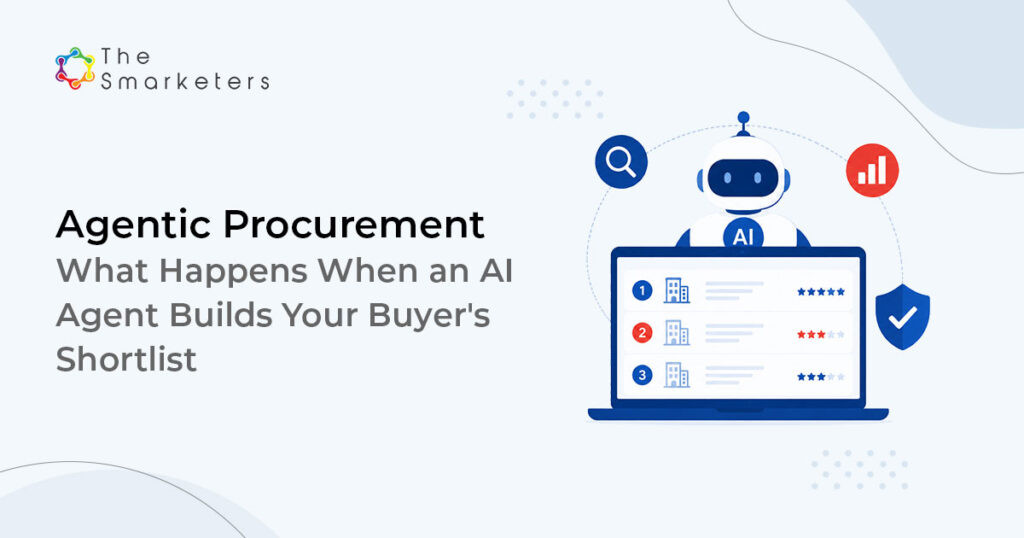
Marketers still design for a human who lands on a homepage and reads. Increasingly, the first visitor is not one. This is agentic procurement: an AI agent, not a person, doing the first pass of vendor research, pricing comparison and shortlist assembly, using only what it can read on your site, and the result is an AI-built vendor shortlist.
AI agents assembling vendor shortlists rely on machine-readable pricing, security, integration and outcome data. Vendors who keep those artefacts in PDFs or behind forms are systematically excluded before a human ever sees them, because the agent cannot verify what it cannot parse and reports what it found.
This is not a prediction about 2030. It describes what a procurement analyst with an assistant already does on a Tuesday afternoon.
Who Is Actually Building the Shortlist in Agentic Procurement?
A person, using a tool, working from public sources. This is what AI agents in B2B buying actually look like today, not a future state. The pattern is consistent: define requirements, ask an assistant for candidate vendors, ask it to compare them on named criteria, then verify manually before circulating.
STAT
94% of business buyers now use AI somewhere in the purchase process, up from 89% a year earlier. Source: Forrester, State of Business Buying, January 2026.
Exclusion therefore happens quietly. No rejection email, no lost demo. Your name simply does not appear on the candidate list, and nobody involved knows you were one.
STAT
68% of B2B buyers already have a front-runner in mind when the buying process begins, and that front-runner wins 80% of the time. Source: Forrester, B2B Summit, 2026.
The shortlist is where the front-runner gets set. Missing it is not a lost deal; it is a deal that never opens.
What can agents read today, and what defeats them?
Less than vendors assume, and the failures are mundane rather than exotic.
| Format | Agent handling | Practical result |
|---|---|---|
| HTML text | Reliable | Extracted and quoted |
| HTML table | Reliable, preferred | Used for comparison rows |
| JSON-LD schema | Reliable | Fills attributes directly |
| Inconsistent | Often skipped entirely | |
| Text in an image | Fails | Treated as absent |
| Behind a form | Fails | Treated as absent |
| Rendered only by script | Unreliable | Depends on the crawler |
Note that none of this is about persuasion. An agent is not unconvinced by your PDF. It never opened it.
Which Eight Artefacts Does an Agent Need for Agentic Procurement?
Eight, and most vendors publish three. Each needs to be HTML, dated, and reachable without a form.
- Category statement. One sentence naming what you sell, in the words buyers use.
- Pricing model. Structure, units and a range, even if not a final number.
- Integration list. Named systems, not “integrates with your stack”.
- Certification and compliance summary. Standards, scope, dates and auditor.
- Deployment and architecture facts. Hosting options, data residency, limits.
- Implementation timeline. Typical duration by scope band.
- Named outcomes. Client results with figures and context.
- Support and service terms. Response targets and coverage hours.
The eighth is the one nobody publishes and the one procurement asks about most. It is also the cheapest to write, since the answers sit in your contract templates.
VISUAL 1 · CAPTURE THIS
Screenshot of a vendor comparison produced by an AI assistant for a mid-market software category, with the sources panel open. Annotate two rows the agent left blank and, alongside, the vendor page where that fact exists only inside a PDF.
What does pricing opacity cost in an agentic evaluation?
More than it used to. A human researcher who hit “contact us for pricing” made an assumption and carried on. An agent records an absence, and a blank field in a comparison table reads as weakness in a way an evasive sentence never did.
You do not need to publish a rate card. You need to publish structure: what you charge for, what the units are, what drives the number up or down, and a range wide enough to be honest. That is enough to fill the row, and filling the row keeps you in the comparison.
We ran this for an enterprise services client who had refused published pricing for years. We did not publish rates. We published a pricing model page describing the three commercial structures they use, the variables that move each, and a typical engagement band. Inbound qualification improved within a quarter, mostly because unqualified conversations stopped, and the sales team stopped losing evaluations they never knew they were in.
PROOF POINT
Savantis generated 150+ MQLs from companies with more than $500M in revenue. Large-enterprise buyers run the most structured evaluations of any segment, and structured evaluations reward vendors whose facts are published rather than negotiated.
Why do PDFs lose to HTML in agent workflows?
Short answer: PDFs are unreliable for AI parsing, have no citable URL, and go stale. HTML pages have all three by default. Three reasons, and only one is technical.
The technical one: PDF parsing is inconsistent, tables lose structure, and many crawlers skip them by default. The second is addressing. An HTML page has a URL a machine can cite; a fact on page 14 of a PDF has no address, so a successful extraction is still hard to attribute. The third is currency. PDFs get replaced rather than updated, and the version an agent finds is often not your current one.
| Asset | Common format | Better format |
|---|---|---|
| Security overview | PDF one-pager | HTML page with dated facts |
| Case study | Gated PDF | HTML page with a figure in text |
| Integration catalogue | PDF matrix | HTML table, one row per system |
| Pricing guide | Sales-shared PDF | HTML pricing model page |
| Implementation guide | HTML with a timeline table |
Keep the PDF if design or distribution requires it. Publish the HTML version alongside and make it the canonical one.
How do you design for the agent without degrading the human?
By treating the agent as a reader who wants the summary first, which is what a busy executive wants anyway.
The pattern is layered. Lead each page with a short factual block answering its question, follow with a structured table, then let narrative and design carry the rest. Humans skim to the same place agents extract from, which is why this rarely trades one audience against the other.
Where it genuinely conflicts is the hero section. A large image with an abstract headline serves brand and gives an extractor nothing. Resolve it by keeping the headline and adding a factual subhead beneath it, in text.
KEY TAKEAWAY
Agent readiness is mostly information architecture, not new content. Nearly every fact an agent needs already exists somewhere in your organisation, in a format nothing can read.
What early signals show up in your log files?
Server logs are the only honest early indicator, since agent visits rarely appear as sessions.
Look for three things. Known AI crawler and agent user agents, counted per URL. Fetch patterns that are not human: no images, no CSS, several pages in quick succession, no return visits. And the ratio of crawler fetches to human sessions per page, which shows which pages machines work from.
Then compare that list against your eight artefacts. Pages that agents fetch often but which contain no extractable fact are the highest-return fixes on your site.
What should you build first?
In order, by return on effort. These five artefacts are the fastest path to agentic procurement readiness.
| Order | Artefact | Effort | Why first |
|---|---|---|---|
| 1 | Pricing model page | Low | Fills the row most often blank |
| 2 | Integration list as HTML table | Low | Direct requirement match |
| 3 | Support and service terms | Low | Almost nobody publishes it |
| 4 | Top case study in HTML | Medium | Outcome figure becomes quotable |
| 5 | Dated compliance summary | Medium | Clears the diligence check |
Five artefacts, achievable inside a month, and for most teams this is a website build task more than a content task.
Where this argument overreaches
Agents assemble shortlists; they do not sign contracts. In complex enterprise purchases a human committee still decides, negotiates and carries the risk. The average B2B buying decision involves 13 internal stakeholders and 9 external influencers, per Forrester’s State of Business Buying published in January 2026, and agent readiness affects the entry ticket rather than the outcome.
The tooling is also unsettled. Agent capability, crawler behaviour and citation conventions have all changed repeatedly in the past year, and any specific technique claimed as durable should be treated sceptically, including these. What is durable is the underlying requirement: publish facts in a form machines can read.
Finally, this can be overdone. Optimising every page for extraction produces a site that reads like a specification sheet and persuades nobody. Buyers who prefer a rep-free experience, 67% of them according to Gartner surveys released in March and May 2026, still expect a reason to choose you, which is positioning work rather than formatting, and usually sits upstream in a go-to-market engagement.
VISUAL 2 · CAPTURE THIS
Screenshot of a log analysis dashboard filtered to AI agent user agents, showing fetch counts by URL over 30 days with a pricing or integrations page ranked unexpectedly high. Annotate the gap between crawler fetches and human sessions on that URL.
Related reading: for the IT services specific version of this framework, see AEO for IT Services. For a broader look at optimising for AI when your topic has low search volume, see GEO Strategy for Niche B2B.
Frequently Asked Questions
Will AI agents choose vendors instead of people?
Not yet, and probably not entirely. Agents assemble the candidate list and populate comparison criteria, which is where most exclusion happens. Humans still evaluate, negotiate and sign. The practical risk is not being replaced by an agent but being omitted by one, silently, before any person reviews the options. Getting cited by AI agents at this stage is what keeps you in the room.
How do I get my company into AI-generated shortlists?
Publish the eight facts an agent needs in HTML: category statement, pricing model, named integrations, compliance summary, deployment facts, implementation timeline, named outcomes with figures, and support terms. Each dated, each reachable without a form. Missing facts appear as blank cells in a comparison, which reads worse than an unfavourable number. This is the core discipline of agentic procurement readiness. See how we structure this for clients.
Does refusing to publish pricing hurt in agentic buying?
Yes, more than it used to. A human researcher assumed and moved on; an agent records an absence and shows it as an empty row. You do not need a rate card. Publishing the commercial structure, the units, the variables that move the number and an honest range is enough to keep you in the comparison.
Are PDFs bad for AI visibility?
They are unreliable rather than banned. Parsing is inconsistent, tables often lose structure, individual facts have no citable address, and versions go stale because PDFs get replaced rather than edited. Keep the PDF where distribution needs it, publish an HTML equivalent alongside, and treat the HTML page as canonical.
How can I tell whether AI agents are visiting my site?
Server logs. Filter for known AI crawler and agent user agents and count fetches per URL, then look for non-human patterns: no images or CSS requested, several pages fetched in quick succession, no return visits. Compare heavily fetched pages against your list of publishable facts to find the gaps worth fixing.
Does optimising for agents make my site worse for humans?
Only if you replace the narrative rather than layering it. Leading a page with a short factual block and a structured table, then continuing with the story and design, serves both, because executives skim to the same place agents extract from. The genuine tension is hero sections, resolved by adding a factual subhead in text.

Enoch Pakanati
CEO