Table of Contents
- What does it mean that 68% arrive with a front-runner?
- Why In-Market SEO Alone Fails Your B2B Demand Creation Strategy
- What Forms Vendor Preference in B2B Before the Purchase Process Begins?
- What Are the Three Jobs of Out-of-Market B2B Content?
- Should B2B Content Educate on the Category or the Product?
- How do you measure preference before intent fires?
- How to Budget Your B2B Demand Creation Strategy vs. Demand Capture
- What Does an 18-Month B2B Content Strategy for Buying Groups Look Like?
- When Does a B2B Demand Creation Strategy Not Apply?
- Frequently Asked Questions
Need help with B2B Marketing?
Let the smarketers’ team drive your pipeline with data-led campaigns and AI-powered growth strategies.
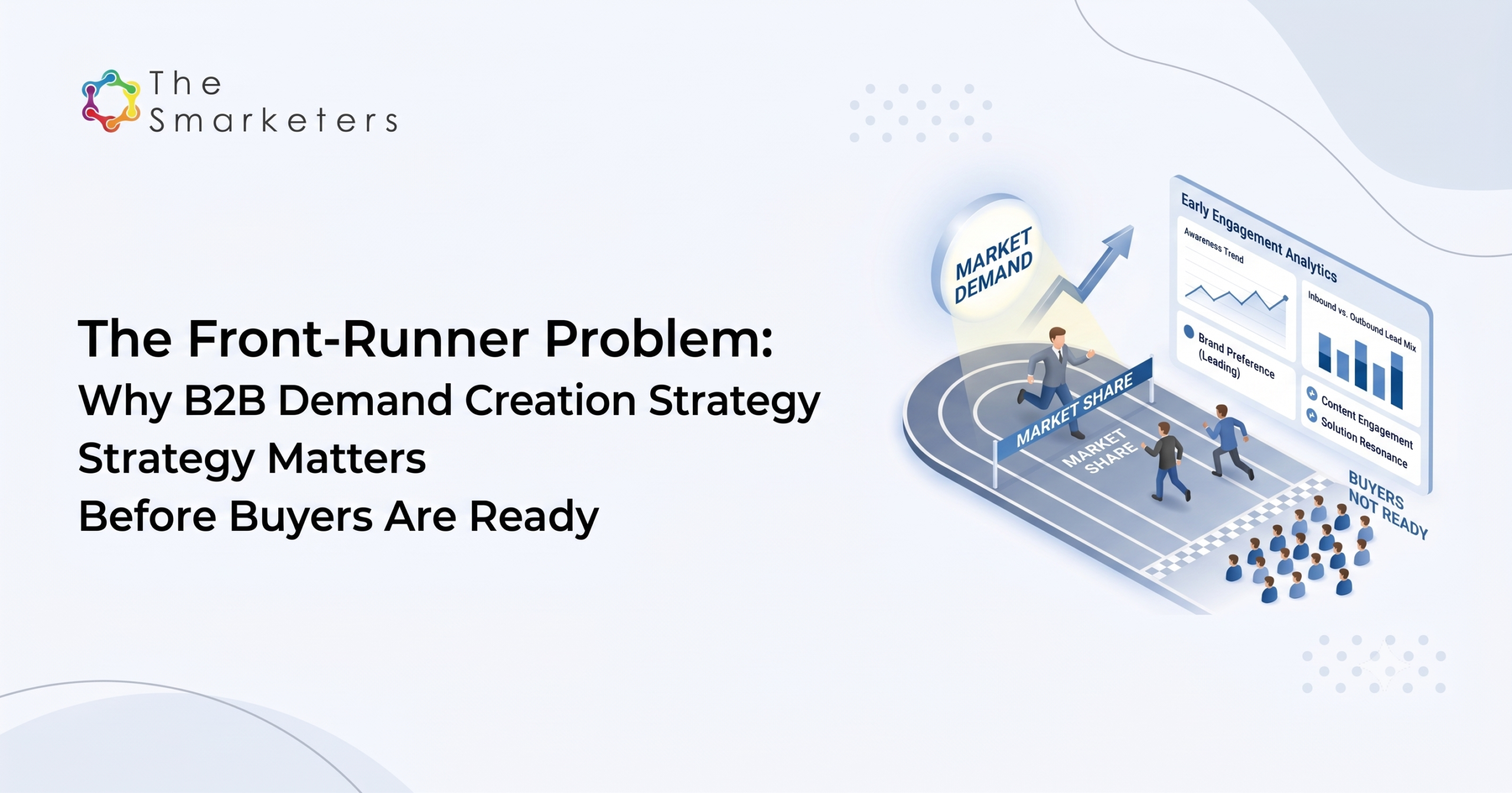
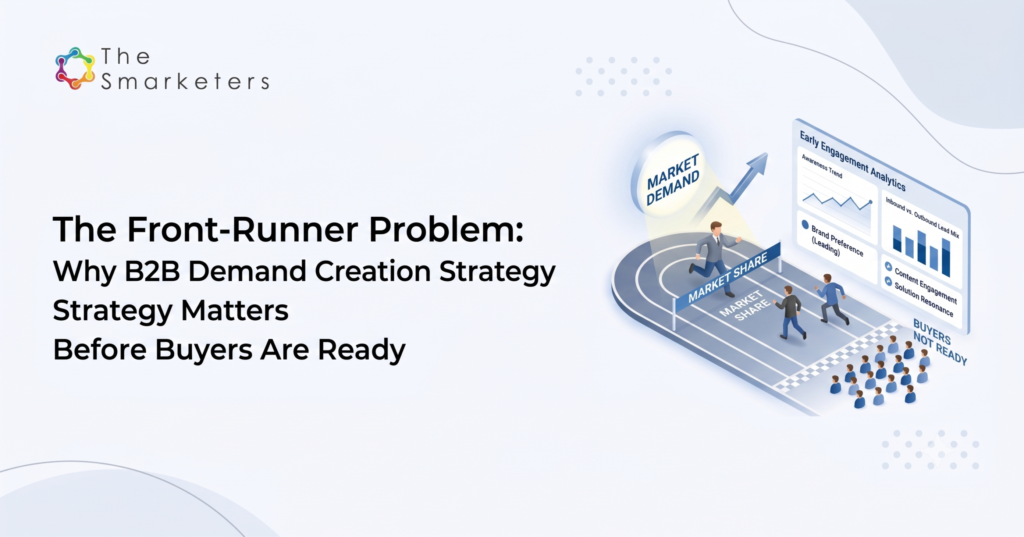
Most B2B buyers walk into an evaluation with a preferred vendor already chosen, and that vendor wins roughly four times out of five. That number reframes everything about B2B demand creation strategy: the decisive marketing work happened months earlier, long before any intent signal fired, and your capture programme is mostly competing for the one deal in five that is still open.
That is an uncomfortable number for anyone whose budget is built around in-market demand capture rather than demand creation.
What does it mean that 68% arrive with a front-runner?
It means the evaluation is often a confirmation exercise. The shortlist gets assembled, demos happen, the scorecard is filled in, and the vendor who was already preferred usually survives all of it. That dynamic shapes how you should structure content for every technical buying committee member.
STAT
68% of B2B buyers already have a front-runner vendor in mind when buying begins, and that front-runner wins 80% of the time. Source: Forrester B2B Summit, 2026.
Multiply it out. Of every hundred evaluations you enter as a challenger, 68 have a favourite who wins 54 of them. You are competing for 46, and some of those are open only because the front-runner disqualified itself.
The strategic response is not better competitive content. It is being the front-runner more often.
Why In-Market SEO Alone Fails Your B2B Demand Creation Strategy
Because in-market search is where preference gets confirmed, not formed. By the time someone searches a category term with commercial intent, most of the decision happened somewhere you were not measuring, including agentic procurement tools that now shortlist vendors before a human ever opens a browser.
STAT
68.01% of US Google searches ended without a click in early 2026, up from 60.45% in 2024. Source: SparkToro and Similarweb clickstream study, June 2026.
The capture channel is narrowing too. Answers arrive without a visit, so bottom-of-funnel traffic thins even where rankings hold. Competing harder for that surface means spending more to reach fewer people at the moment they are least persuadable.
None of this makes capture worthless. It makes capture a harvesting function whose yield is set by work done earlier.
What Forms Vendor Preference in B2B Before the Purchase Process Begins?
Preference forms during the out-of-market period, which for most enterprise categories runs somewhere between twelve and thirty-six months before a purchase. It forms from a small number of durable inputs, and it is remarkably resistant to change once set.
| Input | When it lands | Durability | Can you influence it? |
|---|---|---|---|
| Prior employment experience | Years earlier | Very high | No |
| Peer recommendation | Any time | High | Indirectly |
| Category education from one source | Out of market | High | Yes |
| Analyst or community consensus | Ongoing | Medium | Partly |
| Practitioner content over time | Out of market | Medium to high | Yes |
| Vendor advertising | Any time | Low | Yes |
| In-market comparison content | In market | Low | Yes |
The two columns that matter are durability and influence. Only two inputs are both durable and directly influenceable: category education and sustained practitioner content. That narrow intersection is where a demand creation budget should sit.
VISUAL 1 · CAPTURE THIS
Screenshot of a Google Search Console query report filtered to branded versus non-branded queries over 18 months, with the branded line trending up. Annotate the point where non-branded content investment began and the lag before branded demand moved.
What Are the Three Jobs of Out-of-Market B2B Content?
Three, and only three. Content that does none of them is doing brand awareness, which is a different budget with a different justification.
| Job | What it does | Format that works | Signal it is working |
|---|---|---|---|
| Frame the problem | Teaches the buyer to see the issue your way | Practitioner analysis, teardowns | Your framing appears in their language |
| Set the criteria | Defines what a good solution looks like | Evaluation guides, benchmarks | Your criteria appear in their RFP |
| Establish the source | Makes you the person they ask | Named authors, recurring formats | Direct and branded search rises |
The second job is the one that decides deals. When a buyer’s requirements document contains criteria you defined, the evaluation is already tilted, and no competitor’s demo fixes that. Criteria-setting content is undervalued because it converts nothing at the moment of publication.
Should B2B Content Educate on the Category or the Product?
Category, heavily, and earlier than feels comfortable. A buyer who does not yet know the category exists cannot form a vendor preference, and the organisation that teaches them the category usually becomes the reference point for every vendor they meet afterwards.
The practical split we use is roughly 70% category education, 20% approach or methodology, 10% product. Most B2B content calendars invert that, and then attribute the resulting flat pipeline to distribution rather than to subject matter.
KEY TAKEAWAY
If your content only makes sense to someone already shopping for what you sell, it can influence the 32% without a front-runner and nobody else.
How do you measure preference before intent fires?
You cannot measure preference with intent tools, which is why this work gets cut. But it is measurable, with four leading indicators to track B2B demand creation before intent data appears.
| Measure | How to capture it | What it indicates |
|---|---|---|
| Unprompted mention rate | Win and loss interviews, logged as a field | Whether you are recalled without prompting |
| Branded search trend | Search Console, 12-month view | Preference forming across the market |
| Front-runner rate | One CRM field, asked at qualification | Share of deals you enter as the favourite |
| Criteria match | Compare RFPs to your published framing | Whether your framing has been adopted |
Front-runner rate is the number worth arguing for. It is the only one that answers the board’s question directly, and it moves slowly enough that quarterly reporting is honest. For a practical guide to setting up this field, see our post on how to model a buying group in HubSpot.
VISUAL 2 · CAPTURE THIS
Screenshot of a HubSpot deal record showing a custom qualification field labelled Initial Vendor Preference, with the dropdown options visible. Annotate where the field sits in the qualification stage form and how it feeds the front-runner rate report.
PROOF POINT
For Josh Software, a sustained content and demand programme produced 300% ROI in seven months, more than 500 MQLs and over 4,000 visitors.
How to Budget Your B2B Demand Creation Strategy vs. Demand Capture
The honest answer is that it depends on how much of your category is in market at any moment. In long-cycle enterprise categories that share is small, and if most of your buyers are out of market while most of your budget chases the few who are not, the mismatch is the strategy problem rather than the spend level.
STAT
2026 marketing budgets sit at 7.8% of company revenue, and 56% of CMOs say budgets are insufficient. Source: Gartner 2026 CMO Spend Survey, 401 CMOs, released May 2026.
That constraint is real, which is why the split needs to be defensible rather than aspirational. A workable starting point in categories with long cycles is 40% creation, 40% capture, 20% account-based programmes aimed at named targets, revisited annually rather than quarterly. Moving creation spend up mid-year and back down at quarter end guarantees you pay for the cost of creation and never collect the return.
We shifted a client’s mix towards category education over four quarters while holding capture spend flat. Branded search moved first, at about month five. Front-runner rate, once the field was in the CRM, took closer to a year to show a trend we trusted. Neither number would have justified the shift on a quarterly review, which is the practical argument for setting the horizon before you start.
What Does an 18-Month B2B Content Strategy for Buying Groups Look Like?
It looks like a few formats repeated relentlessly rather than many tried once. Preference forms through recurrence with a recognisable source, and rotating formats resets recognition each time.
Pick two or three formats, publish them on a fixed cadence with named authors, and hold the schedule for six quarters before judging it. Then plan the first two quarters as pure build with no pipeline expectation, quarters three and four as the point where branded and direct signals should move, and quarters five and six as the first fair read on front-runner rate.
When Does a B2B Demand Creation Strategy Not Apply?
In fast-moving categories with short cycles and low switching costs, preference is weak and capture works fine. If your buyers evaluate in three weeks and switch annually, front-runner status is worth much less, and this whole model over-invests.
It also fails where the front-runner is structurally protected. If the preferred vendor is the incumbent platform everything integrates with, no amount of category education dislodges them, and the better play is coexistence rather than replacement.
There is also a measurement limitation. Front-runner rate depends on reps recording what buyers tell them, which is self-reported and prone to flattery. Treat it as directional, but it beats running a two-year investment on faith. Our full-funnel work and demand generation programmes are built on that split rather than on capture alone.
Frequently Asked Questions
How do buyers pick a favourite vendor before evaluating?
Preference forms during the out-of-market period from durable inputs: prior experience with the vendor, peer recommendation, and sustained category education from a recognisable source. Forrester reported at its 2026 B2B Summit that 68% of buyers have a front-runner when buying begins and that vendor wins 80% of the time.
What is the difference between demand creation and demand capture?
Demand capture converts buyers who already know they have a problem and are searching for solutions. Demand creation teaches buyers to recognise the problem and defines what a good solution looks like, months or years before any search happens. Capture harvests; creation determines how much there is to harvest.
How Do You Market to Out-of-Market B2B Buyers?
Do three things and nothing else: frame the problem in a way the buyer adopts, define the evaluation criteria they will later use, and become the recognised source they ask. That means practitioner analysis, evaluation guides and benchmarks published on a fixed cadence with named authors rather than campaign bursts.
What percentage of budget should go to demand creation?
In long-cycle categories a defensible starting split is 40% creation, 40% capture and 20% account-based programmes against named targets, reviewed annually. The precise ratio matters less than holding it steady, since moving creation spend seasonally pays the cost of creation without collecting the return.
How do you measure demand creation without intent data?
Track four leading numbers: unprompted mention rate captured in win and loss conversations, branded search volume trend, front-runner rate recorded by reps at qualification, and criteria match between your published framing and buyers’ written requirements. Front-runner rate is the one that answers a board question directly.
How long does it take to become a front-runner?
Building B2B vendor preference typically takes 12 to 18 months of consistent out-of-market content before measurable results appear. Building B2B vendor preference typically takes 12 to 18 months of consistent out-of-market content before measurable results appear. Plan for eighteen months and judge nothing before quarter three. Branded and direct signals usually move first, around months four to six. Front-runner rate takes closer to a year to show a trend worth trusting, which is why the reporting horizon has to be agreed before the investment starts.

Enoch Pakanati
CEO