Table of Contents
- Why RevOps for IT Services Firms Must Account for Delivery Capacity
- How do utilisation and bench shape the demand curve?
- Why plan demand per practice rather than for the company?
- How does skill mix become a targeting input?
- What Does Practice-Level Pipeline Planning Look Like for IT Services Firms?
- How Should IT Services Marketing and Delivery Teams Reforecast Together?
- How to Instrument RevOps for IT Services in HubSpot
- How Does Demand Planning for IT Services Change by Quarter?
- Where this approach falls down
- Frequently Asked Questions
Need help with B2B Marketing?
Let the smarketers’ team drive your pipeline with data-led campaigns and AI-powered growth strategies.
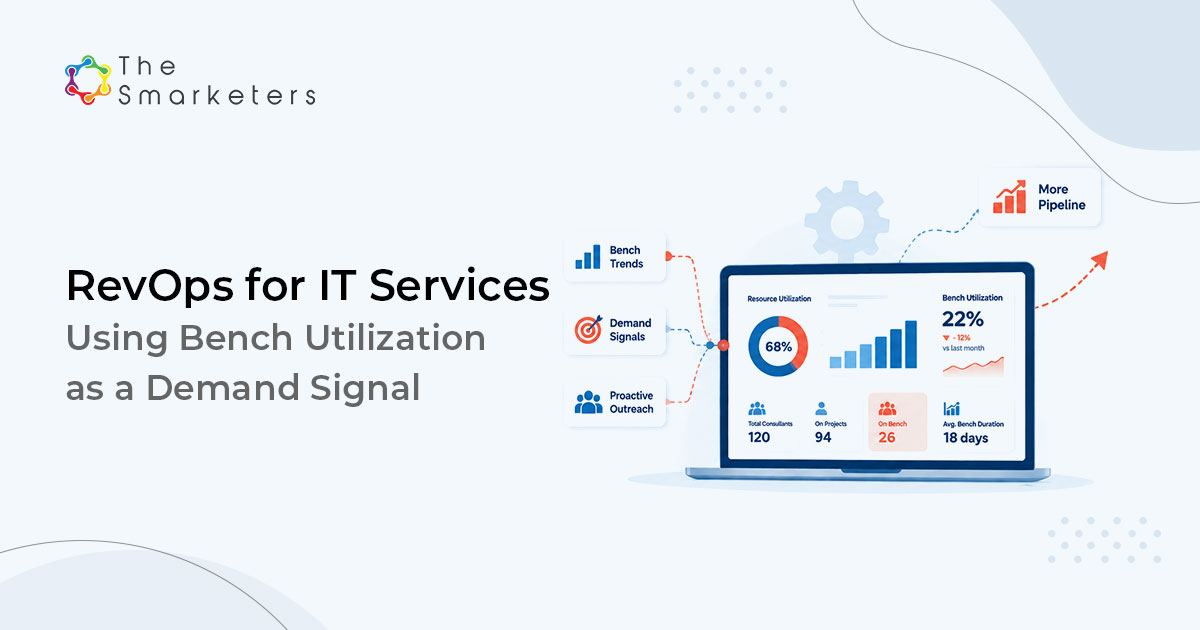
A services business does not sell a product. It sells the time of people it has already hired, which means the marketing plan and the resourcing plan are the same plan. RevOps for IT services firms starts at this intersection: demand generation planned per practice against bench and skill mix, not against a company-wide growth target. Undifferentiated lead volume produces pipeline the delivery organisation cannot staff, and that shows up in the accounts as margin erosion rather than as marketing success.
We worked with a services firm whose marketing team hit its pipeline target three quarters running while gross margin fell in each of them. The pipeline was real. It simply arrived for the practice with the fewest available consultants, and the work was subcontracted at a rate that removed most of the profit.
Why RevOps for IT Services Firms Must Account for Delivery Capacity
Because in a services P&L there are only three ways to fulfil demand you cannot staff, and two of them cost you money.
You subcontract, which typically halves the margin on that engagement. You hire ahead, putting salary cost on the books months before revenue. Or you delay the start date, the option clients least tolerate and the one most likely to lose the follow-on work.
Bench is the unbilled capacity of employed delivery staff, measured in available days at a given skill level. It is a cost already committed. When marketing generates demand that does not match the bench, the business pays twice, once for idle capacity in one practice and again for subcontracted delivery in another. This is the same problem that drives many IT services firms toward capacity-aware demand generation frameworks.
STAT
Marketing budgets sit at 7.8% of company revenue in 2026, and 56% of CMOs say their budget is insufficient to execute their strategy. Source: Gartner 2026 CMO Spend Survey, 401 CMOs, released May 2026.
With budgets that tight, spending against fully utilised practices is not a small inefficiency. It is the largest avoidable waste in most services marketing plans.
How do utilisation and bench shape the demand curve?
Professional services capacity planning starts with utilization: billable hours divided by available hours, expressed per practice per month. Bench is its inverse in people and skills. The number that matters for demand planning is neither alone, but the gap between projected and target utilisation across the next two quarters. The following table maps utilization signals to the correct marketing response for IT services RevOps teams: The following table maps utilization signals to the correct marketing response for IT services RevOps teams:
| Signal | What it means for demand | Marketing response |
|---|---|---|
| Utilisation above target, no bench | Overheating, delivery risk rising | Reduce spend, raise price, extend timelines |
| Utilisation at target, thin bench | Healthy | Maintain, focus on pipeline quality |
| Utilisation below target, bench rising | Capacity going unsold | Increase spend for that practice specifically |
| Bench concentrated in one skill | Structural mismatch | Reposition offers around that skill |
The fourth row is the one that changes marketing work rather than marketing budget. A bench heavy in one capability is a message problem before it is a demand problem.
Why plan demand per practice rather than for the company?
Because company-level targets average away the only information that matters. A firm at 82% overall utilisation can have one practice at 95% and another at 61%, and the company number tells you to do nothing.
Practice-level planning gives each practice its own pipeline target, target account list and budget line. It also means marketing has to say no to demand in overheated practices, which is the hardest part culturally and the part that makes it work.
| Planning unit | Company level | Practice level |
|---|---|---|
| Pipeline target | Single number | One per practice, set from bench gap |
| Target accounts | Shared list | Filtered by service line fit |
| Budget allocation | By channel | By practice, then by channel |
| Success measure | Total pipeline | Pipeline matched to available capacity |
| Failure mode | Unstable pipeline | Slower to reallocate between practices |
How does skill mix become a targeting input?
Start from the bench, not the account list. For each practice, list the capabilities sitting unbilled, then work backwards to the buyer whose problem they solve and the account attributes that predict it.
That produces a much narrower target list than a standard ICP exercise, and the narrowness is the point. Our account-based marketing programme for IT services are built this way, with the account list rebuilt each quarter from the resourcing forecast rather than fixed annually.
PROOF POINT
For Savantis, a services organisation selling into large enterprises, the account-based marketing programme for IT services produced more than 150 MQLs from companies with more than $500M in revenue. Concentrating on account size and fit rather than volume is what made the resulting pipeline deliverable at an acceptable margin.
What Does Practice-Level Pipeline Planning Look Like for IT Services Firms?
Pipeline planning by practice produces a lumpier, smaller number than a conventional pipeline view, and converts at a higher margin. Three changes do most of the work. Add expected delivery start date as a required field on every opportunity and report pipeline by that date rather than close date. Add primary service line as a required picklist. Then set separate pipeline targets per practice, derived from the bench gap two quarters out rather than last year’s number plus a growth percentage.
KEY TAKEAWAY
A services pipeline report organised by close date is a sales artefact. The same data organised by expected delivery start date is an operating plan, and it is the version the delivery organisation will actually read.
How Should IT Services Marketing and Delivery Teams Reforecast Together?
A recurring meeting with a defined agenda and two owners. Without it, resourcing and demand planning drift apart inside a quarter. This cadence is the operational foundation of any RevOps and MarTech programme for IT services.
| Cadence | Participants | Input | Output |
|---|---|---|---|
| Monthly | Practice leads, RevOps | Projected utilisation by practice, 2 quarters out | Ranked list of practices needing demand |
| Monthly | Marketing, sales leadership | Pipeline by service line and delivery start date | Budget reallocation between practices |
| Quarterly | COO, CMO, finance | Margin by practice, subcontract spend | Revised practice targets and account lists |
The monthly cadence matters more than the format. Quarterly is too slow, because a bench builds in weeks.
How to Instrument RevOps for IT Services in HubSpot
- Add primary service line and expected delivery start date as required deal properties at the qualification stage – a HubSpot implementation that typically takes a senior RevOps practitioner under an hour to configure.
- Add estimated effort in days, so pipeline can be expressed in capacity rather than only in currency.
- Create one pipeline report per practice, filtered by service line and grouped by delivery start month.
- Import projected utilisation from the resourcing system as a monthly record per practice, even as a manual upload.
- Build one view placing pipeline days sold against available bench days for the next two quarters.
- Alert when a practice shows projected utilisation below target with pipeline coverage under 2x.
Step four is where most implementations stall, because the resourcing system rarely has an API anyone wants to use. A monthly manual upload is fine. The value comes from the two numbers sitting in the same view, not from the elegance of the integration.
How Does Demand Planning for IT Services Change by Quarter?
IT services demand planning for RevOps changes meaningfully by quarter of the year, as the window for new pipeline to convert within the year narrows. The same model produces different behaviour depending on where you sit in the year.
| Period | Why the bench matters differently | Right marketing response |
|---|---|---|
| Q1 | Full year available for pipeline to convert | Fund slower-building demand for underutilised practices |
| Q2 | Cycle still fits inside the year | Practice-level demand generation at full weight |
| Q3 | Only short-cycle work will land in year | Assessments, fixed-scope offers, existing account expansion |
| Q4 | New pipeline delivers next year | Convert existing demand, reprice, sell short engagements |
The late-year shift is commercial rather than promotional. Pipeline created in Q4 delivers next year, so marketing’s job moves from creating demand to converting what already exists.
Where this approach falls down
This RevOps approach for IT services assumes a resourcing forecast roughly accurate two quarters out. Where project start dates routinely slip by a quarter, the bench projection is noise and the model sends budget to the wrong practice.
It works badly for firms selling one integrated offering across a single skill pool. Without meaningful practice separation, company-level planning is the correct level of granularity.
It can be taken too far. A pipeline built only around the current bench narrows what the firm sells, until the marketing plan mirrors yesterday’s hiring decisions. Reserve a fixed share of demand spend, usually 15% to 25%, for capabilities the firm intends to build.
This is an operating model, not a growth strategy. It improves the margin on revenue you can deliver. It will not tell you which market to enter next.
Frequently Asked Questions
How should an IT services firm plan demand generation?
Demand planning for IT services should run per practice, against the projected gap between target and forecast utilisation two quarters out. Each practice gets its own pipeline target, target account list and budget line, derived from bench and skill mix rather than from a company-level growth number. Report pipeline by expected delivery start date, not close date.
What is bench utilisation and why does marketing need it?
Utilisation is billable hours divided by available hours; bench is the unbilled capacity of employed staff, expressed in days and skills. Marketing needs it because it is the constraint on which demand is profitable. Pipeline for a fully utilised practice gets subcontracted or delayed, and both outcomes cost margin.
How do you shape the pipeline to delivery capacity?
Make primary service line and expected delivery start date required fields on every opportunity, add estimated effort in days so pipeline can be read as capacity, and set practice-level targets from the bench gap. Then report pipeline by delivery start month so resourcing and demand planning use the same view.
Should marketing reduce spend for an overheated practice?
Yes, and it is the hardest habit to establish. Demand created for a practice with no available capacity is either subcontracted at reduced margin, delayed at the cost of client goodwill, or filled by hiring ahead of revenue. Reallocating that budget to an underutilised practice is usually the highest-return move available.
How often should delivery and marketing reforecast together?
Monthly, with a quarterly review that includes finance. A bench builds in weeks, so a quarterly cadence discovers the problem after the cost has been incurred. The monthly meeting needs projected utilisation two quarters out and pipeline by service line and delivery start date.
Does capacity-led demand planning limit growth?
Capacity-led demand planning can limit growth if applied without exception, which is why reserving 15% to 25% of demand spend for capability-building is essential. A pipeline built only around today’s bench gradually narrows what the firm sells. Reserve a fixed share of demand spend, commonly between 15% and 25%, for capabilities the firm intends to build, and treat the rest of the plan as capacity-led.

Enoch Pakanati
CEO