Need help with B2B Marketing?
Let the smarketers’ team drive your pipeline with data-led campaigns and AI-powered growth strategies.
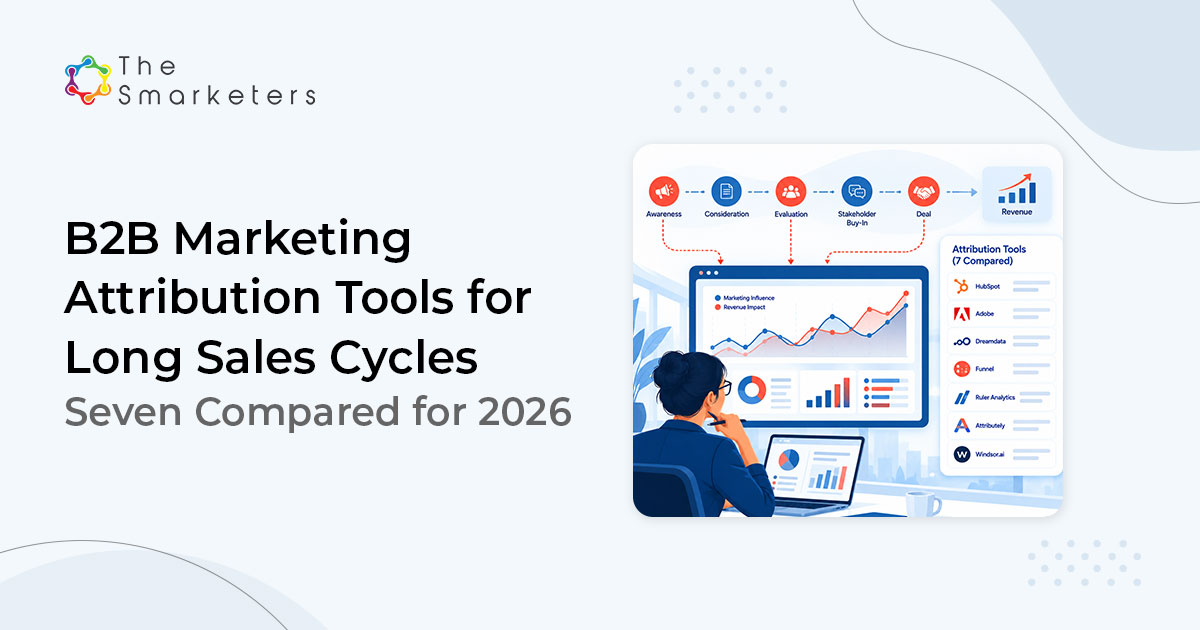
When a deal takes eighteen months, attribution stops being a modeling question and becomes a data retention question: does the tool still hold the first touch when the deal finally closes? The best B2B marketing attribution tools for long sales cycles keep touch history for your full cycle, write credit back to the CRM, and capture offline touches.
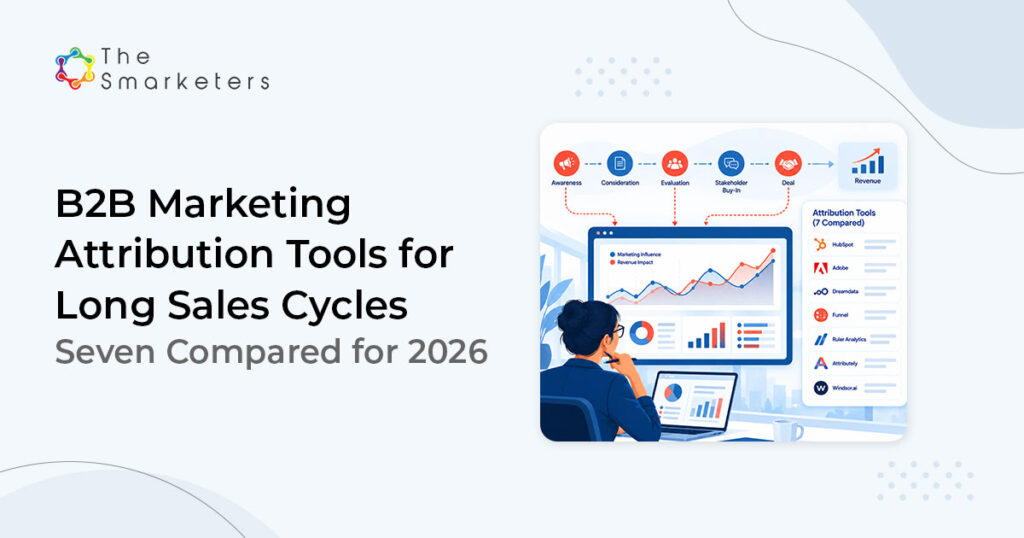
Of the seven compared here, Salesforce Campaign Influence and HubSpot suit CRM-native teams, Dreamdata, HockeyStack and Factors.ai suit account-level journeys, Adobe Marketo Measure suits Adobe stacks, and Ruler Analytics suits call-heavy pipelines. This comparison is for RevOps and marketing operations teams working with B2B sales cycles that run beyond a year. Entries are listed alphabetically rather than ranked, and assessed against the rubric below.
How we assessed these multi-touch attribution tools
A B2B marketing attribution tool records the marketing and sales touches that preceded an opportunity and assigns revenue credit to them, usually inside or alongside the CRM. For long sales cycles, the deciding factor is how long the tool keeps that touch history.
Five criteria, weighted toward lookback and CRM anchoring, because a model you cannot audit two years later is worthless in a budget conversation. Assessments come from public documentation read on 24 September 2026. Excluded: analytics products with no CRM object model, and ad platform reporting, since neither works as B2B attribution software over a long cycle.
| Criterion | Weight | Assessed by |
|---|---|---|
| Lookback and retention | 25% | Documented limits |
| CRM-anchored modeling | 25% | Objects written to CRM |
| Audit trail quality | 20% | Touch-level records |
| Offline touch capture | 20% | Documented inputs |
| Multi-entity support | 10% | Currency and entity handling |
| Tool | Best for | CRM connection | Offline touch capture | Retention limit |
|---|---|---|---|---|
| Adobe Marketo Measure | Adobe and Marketo stacks | Built on CRM data | Verify with vendor | Verify with vendor |
| Dreamdata | Account-level journeys | Joins CRM with web, ad and product data | Verify with vendor | Verify with vendor |
| Factors.ai | Joining anonymous account activity to attribution | Verify with vendor | Verify with vendor | Verify with vendor |
| HockeyStack | Unified go-to-market reporting | Ties touches to CRM pipeline | Verify with vendor | Verify with vendor |
| HubSpot attribution reporting | HubSpot-native teams | Native to the CRM | Only touches recorded in HubSpot | Verify with vendor |
| Ruler Analytics | Call and offline lead capture | Passes lead source to the CRM | Forms, calls and chat | Verify with vendor |
| Salesforce Campaign Influence | Finance-audited attribution | Native to the CRM | Depends on campaign member logging | Verify with vendor |
Lookback windows are the most important specification here and the least consistently published, so every entry carries a verification flag instead of an unsourced number.
The seven B2B marketing attribution tools compared
Adobe Marketo Measure: best for Adobe and Marketo stacks
B2B attribution with CRM data as the backbone, offering several multi-touch models and advertising spend integration, formerly sold as Bizible. Strongest at model maturity for teams already inside the Adobe and Marketo stack. Limitation: implementation is a project rather than a switch, and the value falls away outside that stack. [VERIFY: packaging and retention limits.]
Dreamdata: best for account-level journeys
Revenue attribution software that joins website, CRM, advertising and product data into account-level journeys, with a published data model. Strongest at account-based attribution, where several people touch a deal across a long period. Limitation: quality depends on how completely your CRM records activity. [VERIFY: retention and lookback limits on current plans.]
Factors.ai: best for joining anonymous account activity to attribution
Combines account identification, intent signals and multi-touch attribution, with advertising integrations and account journey views. Strongest at joining anonymous account activity to attribution without buying two products. Limitation: identification coverage varies by category and traffic volume, which changes what the model can see. [VERIFY: lookback windows and identification match rates.]
HockeyStack: best for unified go-to-market reporting
A revenue analytics platform tying marketing and sales touches to pipeline, with account journeys and dashboards built for go-to-market teams. Strongest at flexible reporting when marketing, sales activity and spend must sit in one view. Limitation: models are only as trustworthy as your CRM hygiene. [VERIFY: pricing and data retention.]
HubSpot attribution reporting: best for HubSpot-native teams
Native revenue and contact attribution reports in higher Marketing Hub tiers, built on the contacts, deals and activities already in the CRM. Strongest at zero integration cost and one source of truth for teams already on HubSpot. Limitation: it can only model interactions recorded in HubSpot. [VERIFY: report types by tier.]
Ruler Analytics: best for call and offline lead capture
Attribution focused on capturing lead sources across forms, calls and chat, then passing that source data into the CRM and advertising platforms. Strongest at offline attribution, particularly the telephone inquiries most models lose entirely. Limitation: designed around lead source rather than multi-stakeholder account journeys. [VERIFY: account-level modeling and retention limits.]
Salesforce Campaign Influence: best for finance-audited attribution
Native campaign influence models inside Salesforce, distributing opportunity credit across campaign members using standard or custom models. Strongest at auditability: the record sits in the CRM finance already trusts. Limitation: it depends entirely on campaign member data being logged consistently. [VERIFY: model options by edition.]
PROOF POINT
For a digital adoption platform client, we tracked 112 outbound MQLs through to 20 SQLs and 5 closed deals over six months, which is the chain that makes a long-cycle attribution model believable to a finance team.
Where does marketing attribution stop being useful?
Every B2B marketing attribution tool here inherits whatever your analytics misclassify. A first-party study reported by Search Engine Land, covering 51,200 AI Overview events for one brand from September 2025 to June 2026, found AI Overviews drove 7.53% of organic sessions, and 22.4% of those events were attributed to Direct rather than Organic. Attribution records where credit landed, not where the decision formed, which is why we also measure AI-influenced pipeline from discovery calls.
How do you choose a B2B marketing attribution tool for a long sales cycle?
Ask for the retention limit in writing before anything else, then compare it against your median cycle length plus six months. Next, decide whether the model must live in the CRM. If finance reviews the number, it should. Then check how offline touches arrive, since sales conversations, offline events and calls are where long-cycle influence hides. Buy the cheapest tool that passes those three tests, then spend what you save on recording sales and event activity properly in the first place.
NOTE
Disclosure: The Smarketers resells none of these tools and takes no affiliate revenue. We usually build a multi-touch revenue attribution dashboard in the client’s existing CRM first, then add a platform only where the CRM cannot answer the question. That work sits in our RevOps and MarTech practice and HubSpot implementation services.
Frequently Asked Questions
What attribution lookback window do long B2B sales cycles need?
Take your median cycle length and add six months, then treat that as the minimum retention requirement. For firms selling into infrastructure programs, that often means three years. Ask vendors for the limit in writing, since retention and lookback can be separate settings.
Is native CRM attribution good enough?
For many teams, yes. If the buyer journey is mostly digital and recorded in the CRM, native CRM attribution reporting answers the budget question without another contract. Dedicated B2B marketing attribution tools earn their cost when anonymous account activity, spend and product usage must join one journey.
Why do attribution reports disagree with analytics?
Because they count different things. Analytics counts sessions, attribution counts credited touches against deals, and misclassified sources move both. Reconcile them once a quarter and record which sources are known to be misattributed, rather than forcing the numbers to match.
Can attribution prove marketing caused revenue?
No. It shows which recorded interactions preceded revenue, which is evidence rather than proof. Pair it with held-out tests and account coverage data. The assessments above reflect public documentation read on 24 September 2026, so confirm retention terms with each vendor.

Indrani Gope
Content Head