
Table of Contents
- Why are B2B marketing agency pricing models so hard to compare?
- What does a marketing agency retainer actually buy?
- Is a dedicated agency pod worth the premium over a retainer?
- When does outcome-based (performance) pricing work in B2B?
- How much does a build-operate-transfer marketing model cost over 36 months?
- How do you compare marketing agency quotes by cost per output?
- Which marketing agency contract terms protect both sides?
- Which B2B marketing agency pricing model fits your stage?
- When does this pricing comparison not apply?
- Frequently Asked Questions
Need help with B2B Marketing?
Let the smarketers’ team drive your pipeline with data-led campaigns and AI-powered growth strategies.
Every B2B marketing agency pricing model is a decision about who carries capacity risk. A retainer puts it on the client, who pays for a block of capability whether or not it gets used. Outcome pricing puts it on the agency, which absorbs the cost of work that fails to convert. Build-operate-transfer moves both the capability and the risk to the client on a defined timeline. Everything else is packaging.
That framing is more useful than a rate card, because it tells you in advance which model will feel unfair when things go wrong.
Why are B2B marketing agency pricing models so hard to compare?
Agencies publish services and case studies. They rarely publish how they charge, partly because pricing is negotiated against budget and partly because each model looks weakest beside the others in a table. So procurement teams end up comparing quotes that are not comparable: a monthly figure with unstated deliverables against a project figure with unstated revisions.
STAT
56% of CMOs say their budgets are insufficient to execute their strategy, and 2026 marketing budgets sit at 7.8% of company revenue. Source: Gartner 2026 CMO Spend Survey, 401 CMOs, released May 2026.
When budget is tight, the pricing model matters more than the rate, because the model decides what happens to the money you cannot use.
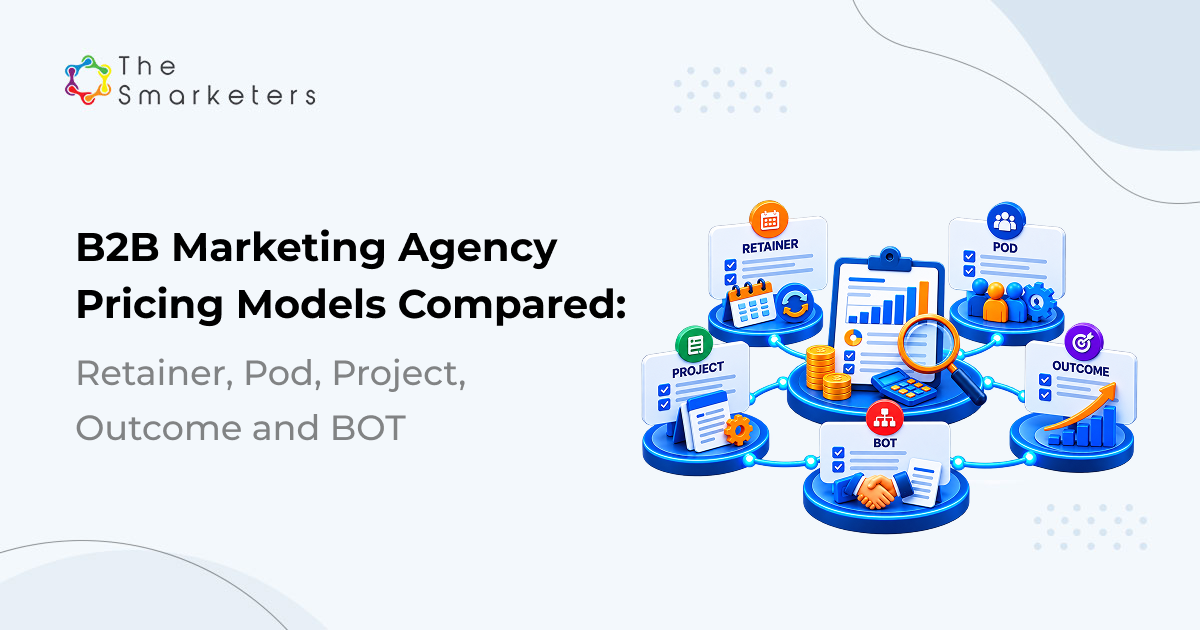
The five common B2B agency pricing models are the retainer (a monthly fee for access to a mixed team), the dedicated pod (named people at a fixed allocation), the project (a fixed fee for a defined deliverable), outcome pricing (fees tied to a metric) and build-operate-transfer (an agency-built function handed to your team on a schedule). Many agencies also offer a hybrid: a smaller base fee plus a performance bonus.
| Model | Who carries capacity risk | What you are buying | Where it fails |
|---|---|---|---|
| Retainer | Client | Access to a mixed team | Unused capacity, scope drift |
| Pod | Client | Named people at agreed allocation | Paying for idle specialists |
| Project | Agency | A defined deliverable | No continuity, revision fights |
| Outcome | Agency | Results against a metric | Attribution disputes |
| Hybrid (base fee plus performance bonus) | Shared | A smaller base team plus upside tied to a metric | Bonus definitions and attribution disputes |
| Build-operate-transfer | Shared, then client | Capability plus its handover | Transfer never happens |
What does a marketing agency retainer actually buy?
A marketing agency retainer buys access to a team, not a quantity of work, and that distinction is where most disappointment starts. The agency sizes the fee against an assumed hour envelope, but the contract describes services rather than hours, so neither side can settle an argument about whether the month was fully used.
Retainers leak in three predictable ways. Approval delays consume hours without producing output. Small unscoped requests accumulate until they displace planned work. And senior time gets consumed by status meetings that a shared document would handle.
Ask for the assumed hour envelope in writing, with the seniority mix behind it. An agency that cannot produce that number has not built the fee from cost, which means it is set by what it thinks you will pay.
Is a dedicated agency pod worth the premium over a retainer?
A dedicated agency pod is named people at an agreed allocation, typically half or full time, with overhead and specialist access shared across the agency. It costs more per hour than a retainer of the same size and less than hiring the equivalent team.
The premium buys continuity, because the same people hold the context, and specialist access without specialist headcount, since a pod can pull in a technical SEO specialist or a marketing automation engineer for a week without you employing one.
It fails when your workload is uneven. A pod running at 60% utilization for two quarters means full price for partial value, and no dashboard makes that feel acceptable.
When does outcome-based (performance) pricing work in B2B?
Outcome pricing works when the metric is inside the agency’s control and the B2B marketing attribution behind it is not disputable. That is a narrower set of conditions than most people assume.
| Condition | Outcome pricing works | Outcome pricing breaks |
|---|---|---|
| Metric ownership | Agency controls the full path to the metric | Sales conversion sits between work and payment |
| Attribution | Single-channel, clean tracking | Multi-touch, long cycle, offline influence |
| Cycle length | Weeks to a quarter | Nine months or more |
| Volume | Enough events for the average to hold | A handful of deals a year |
Paying per qualified lead usually works. Paying per closed deal usually does not, because the agency is then funding your sales team’s performance. In long cycles the agency prices the risk in anyway, so you pay a premium for a mechanism that mainly generates arguments about definitions.
How much does a build-operate-transfer marketing model cost over 36 months?
The build-operate-transfer model runs in three phases: the agency builds the capability, operates it while results stabilize, then hands it to your team with the systems, documentation and training intact. The economics only make sense across the full 36 months, so model it that way. This model covers a full team build including hiring, which is why it runs longer than a system-only handover.
Take F as your fully loaded monthly cost for one mid-level marketer. The table below uses F equal to $8,000 for illustration; replace it with your own figure and the shape holds.
| Phase | Months | Team composition | Monthly cost model | Example at F = $8,000 |
|---|---|---|---|---|
| Build | 1 to 6 | Agency-led, client sponsor | 3.0F | $24,000 |
| Operate | 7 to 24 | Agency-led, first hires shadowing | 2.5F plus 1F salary | $28,000 |
| Transfer | 25 to 36 | Client-led, agency advisory | 0.5F plus 3F salary | $28,000 |
| Steady state | 37+ | Client-owned | 3.5F salary | $28,000 |
Now compare agency and in-house marketing costs across the same window. Pure agency never reaches a steady state you own. An in-house marketing team costs less monthly from month twelve but produces nothing usable for the first four to six months while hiring runs.
KEY TAKEAWAY
The case for build-operate-transfer is not that it is cheapest. It is that it removes the four to six month capability gap at the start and leaves you owning the team at the end.
PROOF POINT
Josh Software, which had no full in-house marketing team, reached 300% ROI in seven months on an integrated inbound and ABM program, with more than 500 MQLs and over 4,000 visitors to its new website within about eight months. That is what an operate phase has to look like before any transfer conversation is worth having.
How do you compare marketing agency quotes by cost per output?
Convert every quote to a cost per unit of the thing you actually need: divide the monthly fee by the hours or deliverables it buys. Do it before the commercial conversation, not after.
| Input | Agency A retainer | Agency B pod |
|---|---|---|
| Monthly fee | $12,000 | $18,000 |
| Assumed hours included | 90 | 160 |
| Effective hourly rate | $133 | $113 |
| Long-form assets per month | 4 | 6 |
| Campaign builds per month | 2 | 4 |
| Cost per long-form asset | $3,000 | $3,000 |
| Cost per campaign build | $6,000 | $4,500 |
Each unit cost assumes the full fee is assigned to that one output type. For a blended view, split the fee by the hours each output consumes.
The higher monthly fee is the cheaper unit here. That flips the moment Agency B’s pod sits at partial utilization, which is exactly why the utilization question belongs in the contract rather than in the quarterly review.
Which marketing agency contract terms protect both sides?
Five terms decide whether the relationship survives its first bad quarter.
- A stated hour envelope and seniority mix, so both sides can settle a scope argument with arithmetic.
- A named escalation owner on the client side, because approval latency is the most common cause of underdelivery.
- A change mechanism with a threshold, so small requests either fit the envelope or become a documented trade.
- Asset and access ownership on day one. Accounts, ad platforms, documentation and source files belong to the client from the start, not at exit.
- A wind-down clause with a handover deliverable, not just a notice period. Notice alone gives you time, not knowledge.
We added a documented handover deliverable to a services engagement partway through, to settle an internal argument about continuity. Six months later the client’s new marketing manager onboarded from that document in two weeks rather than a quarter. It has been standard in our training and consulting scope since.
Which B2B marketing agency pricing model fits your stage?
Match the model to your capability position and marketing maturity, not to your revenue.
| Situation | Model that usually fits |
|---|---|
| No internal marketing function, need results this quarter | Retainer or pod |
| Function exists, one capability missing | Project or specialist pod |
| Committed to owning the team within three years | Build-operate-transfer |
| Single-channel, short cycle, clean tracking | Outcome |
| Uneven workload, unpredictable demand | Project |
When does this pricing comparison not apply?
None of this survives a badly defined objective. Every B2B marketing agency pricing model here produces poor economics when the brief changes each quarter, because rework is invisible in all of them and expensive in all of them.
The cost-per-output method also flatters volume. Six mediocre assets beat four good ones on the arithmetic and lose on results, so run it on quality-matched work or not at all.
And build-operate-transfer only pays off if the transfer happens. If the hiring plan for your BOT team slips twice, you have bought a retainer with extra documentation. Put transfer dates and hiring milestones in the same contract.
Frequently Asked Questions
How do B2B marketing agencies charge?
Four structures dominate: monthly retainers for access to a mixed team, dedicated pods for named people at an agreed allocation, project fees for a defined deliverable, and outcome pricing tied to a metric. Build-operate-transfer combines an agency-run build with a scheduled handover to an internal team. Hybrid deals combine a smaller base fee with a performance bonus.
How much does a B2B marketing agency cost per month?
Published 2026 benchmarks put most B2B agency retainers between $2,500 and $15,000 per month (Howl Marketing, 2026), with complex, long-cycle programs at the upper end. The monthly figure is only a starting point, so convert each quote to cost per output before comparing agencies.
Is retainer or project-based pricing better value?
Retainers win where the work is continuous and context matters, because relearning your business every project is expensive. Projects win where the workload is uneven or the requirement is a one-off build. Convert both to cost per output before deciding, since the monthly figure alone tells you nothing.
What does build-operate-transfer cost?
Model it over 36 months rather than monthly. In a typical 36-month phase model, the build phase costs roughly three times one loaded marketer’s monthly cost, the operate phase adds early internal salaries, and the transfer phase inverts the ratio as your team takes over. Total spend usually lands between pure agency and pure in-house.
Does outcome-based pricing save money?
Rarely, and that is not its purpose. Agencies price risk into outcome deals, so the unit cost is normally higher than a retainer producing the same result. What you buy is a shift of downside risk, which is worth paying for only when the metric is clean, the cycle is short and the volume is enough for averages to hold.
What should be in an agency contract?
A stated hour envelope with seniority mix, a named client-side escalation owner, a change mechanism with a value threshold, client ownership of all accounts and source files from day one, and a wind-down clause that specifies a handover deliverable rather than only a notice period.
How do we compare two quotes that look different?
Reduce both to cost per unit of output you need, then check the assumptions behind the units. Ask each agency for its assumed monthly hours, the seniority mix, the revision allowance and what happens to unused capacity. Quotes become comparable only once those four are on the table.

Enoch Pakanati
CEO