Table of Contents
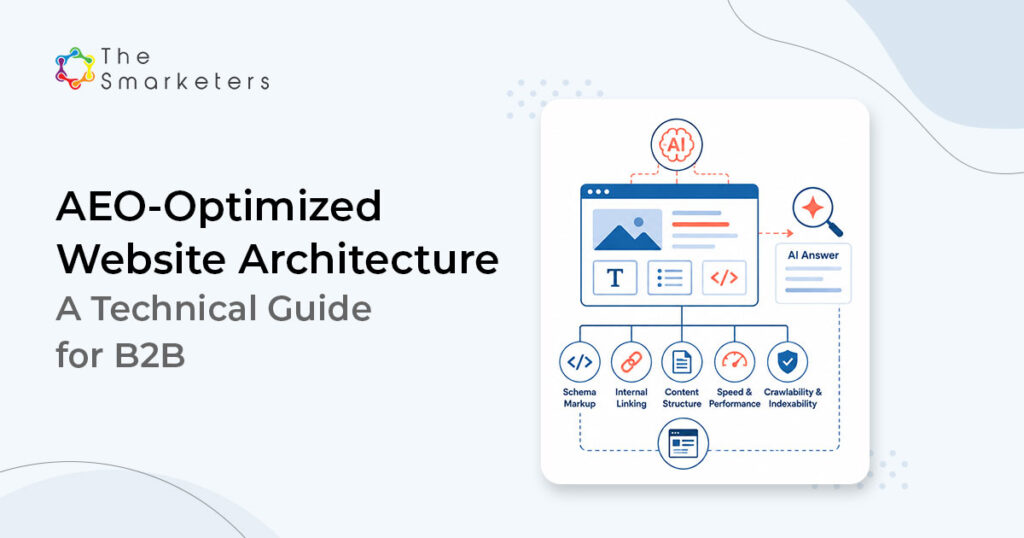
- The Parse-Ready Stack: Six Layers of AEO Website Architecture
- How Does Page Speed Affect AEO and AI Citations for B2B Sites?
- What Schema Markup Do B2B Sites Need for AEO?
- Content Structure: The AEO Website Architecture Layer AI Uses to Cite You
- How Does Internal Linking Support AEO and Entity Optimization?
- The Technical Implementation Checklist
- Case Study: Architecture Work Behind 3X Organic Growth
- When Is an AEO Architecture Rebuild the Wrong First Move?
- Smarketers Web Dev + AEO
- Frequently Asked Questions
Need help with B2B Marketing?
Let the smarketers’ team drive your pipeline with data-led campaigns and AI-powered growth strategies.
A B2B site can hold page-one Google rankings, pass every Core Web Vitals check in green, and still be absent from every answer ChatGPT or Perplexity gives about its category. AEO website architecture, the technical foundation that makes your site retrievable, renderable, and trustworthy to AI systems, is the reason why. The marketing team sees healthy dashboards. The buyers see a synthesized answer with three competitors in it. Both are looking at the same website.
The gap matters because the buyers moved first. Forrester found 94% of B2B buyers use generative AI during the purchase process, rating it a more meaningful source than vendor websites or sales conversations. And the winners are concentrated: within a topic, roughly 30 domains capture about 67% of ChatGPT citations. Getting into that set is partly a content problem, but the part that gets skipped is architectural. Retrieval systems have to fetch, render, parse, and trust your pages before your content quality ever gets a vote which is why understanding SEO, AEO, and GEO as one integrated system matters before any content investment.
This technical AEO guide covers the architecture side: crawl and render, speed, schema, content structure, internal linking for entity relationships, and a checklist you can hand to your developers. It closes with when an architecture rebuild is the wrong first move.
The Parse-Ready Stack: Six Layers of AEO Website Architecture
AEO website architecture is a site built so retrieval systems can fetch every important page, render it without executing a JavaScript app, parse its meaning from explicit structure, and verify who is making each claim, render it without executing a JavaScript app, parse its meaning from explicit structure, and verify who is making each claim. We organize the work into six layers, ordered from the server up, because each layer caps the value of everything above it. A perfectly structured page that AI crawlers cannot fetch is a well-formatted secret.

- Crawl and render layer: AI crawlers allowed in robots.txt, key content server-rendered, sitemaps current, Bing indexation confirmed (Bing feeds ChatGPT retrieval).
- Speed layer: fast first paint and stable rendering, because slow responses cost both crawler patience and human conversions.
- Schema layer: Organization, Person, Article, and FAQPage markup that tells machines who you are and who wrote what.
- Content structure layer: answer-first, self-contained sections a system can quote without the rest of the page.
- Entity linking layer: internal links whose anchors state relationships between topics, services, and proof.
- Measurement layer: AI referral segments in analytics plus a monthly citation prompt panel, so architecture changes get judged by citation movement.
The rest of this guide works through the layers that need the most explanation.
How Does Page Speed Affect AEO and AI Citations for B2B Sites?
Page speed affects AEO in two ways: it determines whether AI crawlers like PerplexityBot can retrieve your page under their latency budgets, and it decides whether the visitors those citations send will convert. A one-second delay in load time can cut conversions by approximately 7% and each additional second of load time between zero and five seconds drops conversion by roughly 4.42% on average. 47% of users expect a page to load in two seconds or less. Every visitor an AI assistant sends you still lands on your pages, so speed decides whether earned citations convert.
The machine side is about retrieval economics. Live-retrieval platforms like Perplexity fetch pages at query time under tight latency budgets; slow origins and render-blocked content make you an expensive source to use. We treat fast first paint and server-side rendering as the entry fee: they do not win citations by themselves, but slow, client-rendered pages quietly remove you from consideration. Mobile performance deserves specific attention, since desktop converts around 4.8% versus roughly 2.9% on mobile, a gap that widens on heavy pages.
In practice we set a simple speed budget for B2B sites: HTML response under half a second, the largest content element painted inside two seconds on mid-range mobile hardware, and no layout shift after first paint, thresholds we apply across every B2B website design and development engagement. Hitting those numbers is rarely about engineering heroics. It is about removing accumulated third-party scripts, right-sizing images, and letting a CDN do its job; the average B2B site we audit carries at least a dozen scripts nobody can name an owner for.
Key takeaway: Speed is a threshold, not a ranking hack. Get first paint fast, render content on the server, and stop optimizing milliseconds once you are comfortably inside user expectations. The citation gains live in the layers above.
What Schema Markup Do B2B Sites Need for AEO?
Schema markup is how you stop making machines guess and it’s one of the most consistently broken elements we surface in a technical AEO audit. Retrieval systems can usually infer what a page says; schema tells them what the page is, who published it, and who stands behind the claims, in a format built for parsing. For B2B sites, four types do most of the work:
| Schema type | Where | What it establishes | Common mistake |
|---|---|---|---|
| Organization | Site-wide | The company entity: name, logo, sameAs links to LinkedIn and directories. | Inconsistent names across the site and profiles, which fragments the entity. |
| Person | Author pages, articles | Named human expertise behind content; supports trust signals. | Generic "Team" authorship with no Person markup at all. |
| Article / BlogPosting | Every post | Headline, author, dates; machine-readable provenance. | Missing dateModified, which hides freshness from retrieval. |
| FAQPage | FAQ sections | Question-answer pairs pre-packaged for extraction. | Marking up questions whose answers are marketing copy, not answers. |
Two disciplines make schema pay off. First, validate everything; broken JSON-LD is worse than none because it signals carelessness to any system reading it. Second, keep the schema truthful to the visible page. Marking up content that is not really there is the structured-data version of cloaking, and platforms have every incentive to learn to ignore it.
A word on maintenance: schema is not a launch task. Author changes, rebrands, and CMS migrations silently break markup, so put a quarterly validation pass on the web team’s calendar and treat schema errors with the same seriousness as broken pages. Half the schema problems we find in audits shipped correct and decayed.
Content Structure: The AEO Website Architecture Layer AI Uses to Cite You
Retrieval systems lift passages, not pages. The unit of citation is a section that makes sense on its own, which is why structure beats style for AEO. The measured citation patterns reward it: platforms differ wildly in what they cite, only 11% of domains are cited by both ChatGPT and Perplexity, but extractable structure raises your odds everywhere at once. The rules, in order of impact:
- Answer first, expand second. Every H2 section opens with a direct answer to the question the heading implies, then adds nuance. If the answer is in paragraph four, a retrieval system has to work for it, and usually will not.
- Self-contained sections. A section that begins “As we saw above…” cannot be quoted alone. Repeat the subject noun; write each section as if it might be the only part anyone reads, because for AI answers, it is.
- Question-shaped headings where natural. Headings that match how buyers phrase prompts give retrieval an exact hook. Do not force every heading into a question; force the important ones.
- Tables and lists for anything comparative. Structured comparisons are the easiest content for a system to extract accurately, and the hardest to misquote.
- Named, attributed claims. Statistics linked to sources and opinions attributed to people give a platform something it can verify, and platforms that show citations prefer sources they can defend.

A structural note on where these platforms look: Reddit alone accounts for 46.7% of Perplexity’s top citations, and Wikipedia and Reddit together exceed 25% of ChatGPT’s US citations. Your architecture cannot change that mix, but it decides whether your domain is a viable candidate for the citations that do go to vendor and expert sites.
How Does Internal Linking Support AEO and Entity Optimization?
Internal links are how a site teaches machines its own knowledge graph. Every link is a statement: this page relates to that page, this service produced that result, this author owns this topic. Most B2B sites squander the layer with “learn more” anchors and orphaned posts.
The architecture that works is deliberately hierarchical:
- Hub-and-spoke topics. One pillar page per commercial topic, cluster articles linking up to it with descriptive anchors, and the pillar linking down to every spoke. The cluster tells retrieval systems which page is the authority on the topic.
- Descriptive anchors, always. The anchor text is the relationship label. “Our technical AEO audit process” teaches a machine something; “click here” teaches it nothing.
- Proof linked to claims. Service pages link to the case studies that substantiate them; case studies link back to the service. Claims and evidence become one connected subgraph instead of two strangers.
- Authors as entities. Every article links to its author page; author pages link to the author’s topics and profiles. This connects Person schema to a browsable structure, which is how named expertise becomes machine-legible.
Breadcrumbs earn a mention here because they serve both audiences at once: they expose the site hierarchy to machines through BreadcrumbList schema, and they give human visitors arriving mid-site, which is exactly how AI referrals arrive, an immediate sense of where they are. A buyer landing on a cluster article from a Perplexity citation should be able to see and reach the pillar in one click.
Smarketers insight: The fastest internal-linking win on most B2B sites is boring: find the ten pages you most want cited, and make sure each is reachable within two clicks of the homepage with a descriptive anchor. Depth is where good pages go to be forgotten, by crawlers and by buyers.
The Technical Implementation Checklist
The full checklist we run in technical AEO audits, grouped by layer. Hand it to your web team as-is.
- Robots.txt reviewed for AI crawlers (GPTBot, PerplexityBot, ClaudeBot and peers): allow the ones you want citations from, and document the decision either way.
- Key commercial and editorial pages indexed in Bing, not just Google; fix Bing-specific indexation gaps since Bing feeds ChatGPT retrieval.
- Primary content server-rendered or statically generated; nothing citation-worthy behind client-side JavaScript, tabs that hide content from the DOM, or infinite scroll.
- XML sitemaps current and segmented (pages, posts, case studies); lastmod dates real, not auto-stamped.
- Fast first paint on mobile hardware; images sized and lazy-loaded below the fold; third-party scripts audited quarterly and deleted ruthlessly.
- Organization schema site-wide with consistent naming and sameAs profiles; Person schema for every author; Article schema with real dateModified; FAQPage where genuine FAQs exist. All validated.
- Every commercial topic has one pillar, a linked cluster, descriptive anchors, and no orphaned pages more than three clicks deep.
- Breadcrumb navigation with BreadcrumbList schema on all editorial and service pages.
- Heading hierarchy semantic (one H1, nested H2/H3); answer-first openings on priority pages; comparison content in real HTML tables.
- GA4 segment for AI referrers (chatgpt.com, perplexity.ai, claude.ai, gemini.google.com); monthly prompt panel tracking citation share per platform.
Sequencing advice: run the checklist top to bottom. Teams love starting with schema because it ships in a sprint, but schema on pages that AI crawlers cannot fetch or render is decoration.
Case Study: Architecture Work Behind 3X Organic Growth
A cybersecurity client came to us with strong expertise, a large content archive, and flat visibility in both traditional and AI search, a pattern we also documented in our analysis of 27 B2B SEO rules that drive revenue. The audit found exactly the layered failure this guide describes: content hidden behind client-side rendering, no entity schema, long wind-up intros ahead of every answer, and internal links that treated the site as a list of posts rather than a graph of topics.
We rebuilt from the bottom of the stack up: server rendering and speed first, then entity markup, then restructuring the highest-intent pages into answer-first, self-contained sections, then a hub-and-spoke linking pass. Content quality barely changed; its legibility changed completely.
Result: 3X organic growth, compounding at 16.31% month over month, with restructured pages earning placements in both classic search results and AI-generated answers. (Smarketers client engagement; full story at thesmarketers.com/success-stories)

Our web practice was recognized in the Web Excellence Awards 2025, and this engagement is a fair picture of why: the wins came from disciplined engineering choices, not visual redesign. The caveat worth repeating: the client had real expertise for the architecture to expose. Structure amplifies substance; it cannot replace it.
When Is an AEO Architecture Rebuild the Wrong First Move?
Honest qualifiers before you commission anything. If your site has fewer than a few dozen pages and little organic presence, you do not have an architecture problem; you have a content and authority problem, and content marketing should get the budget first.
If your category is barely asked about in AI assistants yet, run the prompt panel to confirm before spending; a quarter of measurement costs almost nothing. And if a platform migration is already scheduled within the year, fold AEO requirements into that project instead of retrofitting twice. Architecture work pays back over years, which also means it is the wrong tool for a quarter-end pipeline emergency.
Smarketers Web Dev + AEO
Our web development and SEO, AEO, and GEO services run as one team, because the Parse-Ready Stack fails when developers and content strategists work from different tickets. If you want to know which layers your site fails today, get a Technical AEO Audit: we run the full checklist above against your site, baseline your citation share per platform, and hand you a prioritized fix list your own team can execute.
Frequently Asked Questions
How long does an AEO architecture retrofit take?
For a typical B2B site, the crawl, render, speed, and schema layers take four to eight weeks of engineering time; restructuring priority content runs in parallel over a quarter. First citation movement typically shows eight to twelve weeks after the retrievability fixes land.
Can we do AEO architecture on WordPress or HubSpot CMS, or does it need a rebuild?
Both platforms can pass every check in this guide. The requirements are server-rendered content, editable schema, clean heading structure, and controllable internal linking, all achievable on mainstream CMSs. Full rebuilds are only warranted when the existing stack blocks server rendering entirely.
Does blocking AI crawlers protect our content?
It removes you from citation consideration on those platforms, which for most B2B companies contradicts the commercial goal of being discovered and recommended. Publishers monetizing paywalled content face a different trade-off. Decide deliberately and document it.
Do Core Web Vitals scores directly affect AI citations?
No direct correlation has been credibly measured, and this guide does not claim one. Speed earns you reliable crawling and converts the visitors citations send; the measured conversion losses from slow pages (roughly 4.42% per added second) are reason enough on their own.
Which schema types matter most for AEO?
Organization and Person first, because they establish who you are and who is speaking; then Article with truthful dates, then FAQPage. Exotic types add little until those four are consistent and validated.
How do we measure whether architecture changes earned AI citations?
Two instruments: a GA4 segment for AI referrers as the floor, and a monthly panel of 30-50 buying-intent prompts run per platform as the real KPI. Report citation share per platform, never blended, since citation overlap between platforms is around 11% of domains.
Should FAQ answers on our site be short?
Two to four sentences, direct answer first. That length is quotable by retrieval systems and honest to readers. Ten-sentence FAQ answers are articles hiding in the wrong component, and marked-up non-answers erode trust in your schema.
What does a technical AEO audit include and what does it cost relative to an SEO audit?
A good one covers all six layers: crawl and render, speed, schema, content structure, entity linking, and measurement setup, and prices comparably to a thorough technical SEO audit since the crawling and rendering work overlaps heavily. The deliverable to insist on is a prioritized fix list, not a score.

Isha Gulati
Senior Marketing Manager