
Table of Contents
- What Should a Sales and Marketing SLA Include? 5 Rules to Write Down
- Who Owns an Orphaned Lead With No Assigned Rep?
- How to Audit Lead Response Time Against Your SLA
- How to Track the SLA Clock in HubSpot
- Why SLA Breaches and Lead Conversion Should Be Reviewed Separately
- What to Fix After Your First SLA Audit
- Run Your First SLA Audit Before the Next Pipeline Review
- Frequently Asked Questions
Need help with B2B Marketing?
Let the smarketers’ team drive your pipeline with data-led campaigns and AI-powered growth strategies.
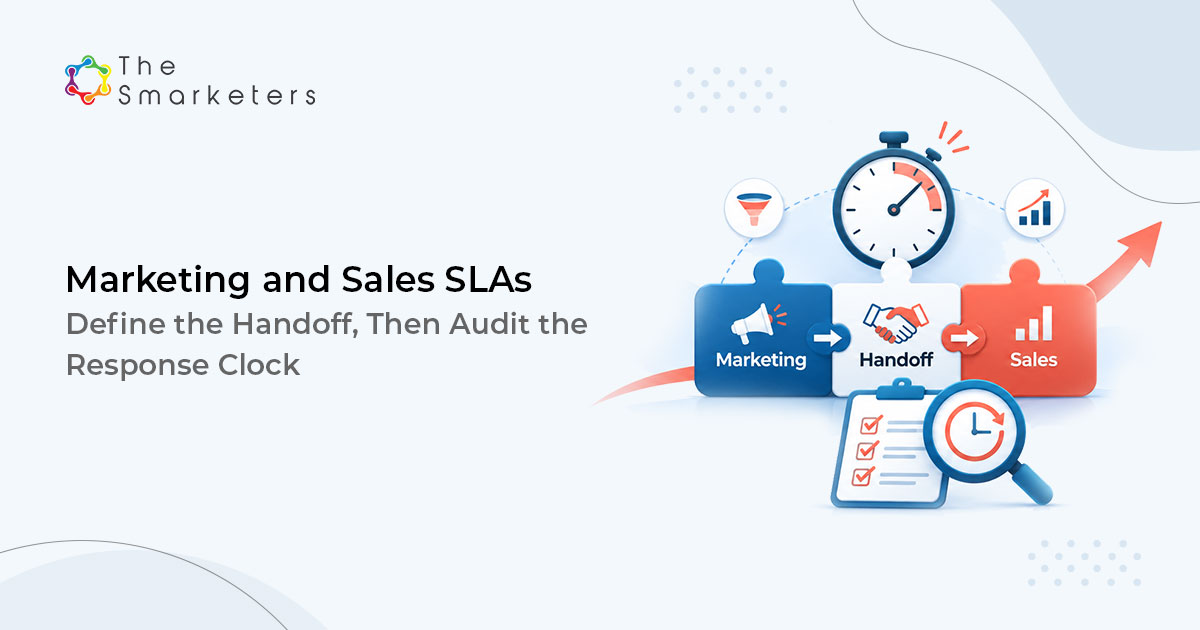
Most sales and marketing SLAs look fine on paper. “Sales will follow up on every MQL within 24 hours.” Everyone signs. Then three months later, marketing says sales ignores leads, sales says marketing sends junk, nobody can prove either point, and sales and marketing alignment stalls.
The SLA didn’t fail because people broke it. It failed because nobody could test it. When does the 24 hours start? Does a Saturday count? What if the lead had no owner for a day? Does an automated email count as follow-up?
If both teams can’t answer those questions the same way, the SLA is just a nice sentence. This guide shows how to turn your lead handoff rules into something you can actually audit.
What is a sales and marketing SLA? A sales and marketing SLA (service level agreement) is a written agreement that defines which leads marketing hands to sales, how quickly sales must make first meaningful contact and how both teams check whether that happened. Inside a revenue team, an SLA in sales usually means this lead follow-up promise, not a customer contract.
Key takeaways
- Write down when the clock starts, stops and pauses before anyone signs.
- Name an owner for leads with no owner, and count every orphan as an exception.
- Audit every qualified lead, not just the ones sales worked.
- Fix routing exceptions before you discuss individual breaches.
What Should a Sales and Marketing SLA Include? 5 Rules to Write Down
What qualifies a lead for sales review?
Not “an MQL,” but the exact conditions, such as a demo request from a company in your target segment, or a lead score above a threshold you’ve agreed with sales.
When does the clock start?
Usually the moment the lead meets those conditions and gets an owner. If it can meet the conditions without getting an owner, you’ve found your first problem.
What stops the clock?
Decide what counts as a meaningful first contact. A logged call, a personal email or a booked meeting are common choices. An automated sequence email usually shouldn’t count, because nobody has looked at the lead yet.
What pauses the clock?
Business hours, weekends and public holidays are the usual ones. Write them down, including which country’s holidays apply if your team works across regions.
What happens to rejected or recycled leads?
Sales needs a way to say “not ready” with a reason, and marketing needs to know when that lead can come back from lead nurturing and whether it starts a new clock.
Once those five are agreed, settle three details that teams often leave out.
Should every lead get the same response window?
Usually not. Many teams set a shorter window for high-intent actions, such as a demo or pricing request, and a longer one for content downloads. Give each tier its own clock in the SLA and audit each tier separately.
What happens when the clock runs out?
Agree on the action at the deadline, not just after the audit. Common choices are an alert to the SDR manager and reassigning the lead to another rep.
What does marketing commit to?
An SLA that binds only sales is half an agreement. Marketing usually commits to the written qualification rules, the minimum data each lead carries before handoff and routing rules that actually assign an owner.
Written down, those rules can be as short as this:
| Clause | Example wording |
|---|---|
| Qualification | A lead qualifies when [condition, such as a demo request] and it matches [target segment]. |
| Clock start | When the lead qualifies and has an assigned owner. |
| Clock stop | First logged call, personal email or booked meeting. Automated emails don't count. |
| Response windows | [Window] for high-intent requests, [window] for all other qualified leads. |
| Pauses | Outside [business hours], using the [country] public holiday calendar. |
| At the deadline | Alert [SDR manager] and reassign the lead to another rep. |
| Orphan owner | [SDR manager or marketing ops queue] reassigns unowned leads within [window]. |
| Recycling | A recycled lead starts a new clock only after it requalifies, with the rejection reason recorded. |
For a longer starting point with goals and accountability sections, HubSpot’s SLA guide and template is worth adapting.
Who Owns an Orphaned Lead With No Assigned Rep?
It’s an easy gap to leave open. A lead arrives, routing fails or the assigned rep is away, and the lead sits with no owner. The clock may not even start, because there’s no one for it to start against.
Name an owner for orphaned leads. Good candidates are the SDR manager or a marketing ops queue. Set a short window for reassignment and count every orphan as an exception in your audit, even if someone eventually picks it up. If you only measure lead response time for leads that had an owner, you’re measuring the part of the process that already works.
How to Audit Lead Response Time Against Your SLA
To audit a sales and marketing SLA, pull every lead that qualified in a set period, timestamp each clock event and sort each lead into one of four groups: met, breached, never contacted or exception.
Pick a period, such as last month, and pull every lead that met your qualification rules. Not just the ones sales worked. All of them.
For each one, record when it qualified, when it got an owner, when the first meaningful contact happened and any pause that applied. If these timestamps don’t exist yet, build them into your HubSpot implementation plan. Then sort every lead into one of four groups.
| Group | What it means | What to do |
|---|---|---|
| Met the SLA | First meaningful contact happened within the agreed time | Nothing, but sample a few to check the contact was real |
| Breached | Contact happened late | Look for patterns by rep, source, time of day or day of week |
| Never contacted | No meaningful contact at all | Find out whether the lead was seen, rejected silently or lost |
| Exception | No owner, routing failure or data problem | Fix the process before blaming anyone |
SLA attainment = leads that met the SLA ÷ all qualified leads in the period, including exceptions and never-contacted leads.
Here’s an illustrative example with made-up numbers. Say 200 leads qualified last month. 150 met the SLA, 25 were breached, 10 were never contacted and 15 sat with no owner for more than a working day. The headline “75% met SLA” sounds like a people problem. But 15 orphans is a lead routing problem, and it’s the one to fix first.
How to Track the SLA Clock in HubSpot
If you run HubSpot, map each clock event to a CRM property: the lifecycle stage date when the lead qualified, the date an owner was assigned and the first logged call, email or meeting. Then report on the gap between them, and flag leads that never got an owner as exceptions.
Why SLA Breaches and Lead Conversion Should Be Reviewed Separately
Review them separately. An SLA tells you whether the handoff happened as agreed, and conversion tells you what happened after it.
It’s tempting to judge the SLA by whether fast follow-up led to more meetings. Resist that, at least at first.
A sales and marketing SLA is a process promise. Did the handoff happen the way both teams agreed? Conversion is an outcome, and it depends on lead quality, timing, the offer and the rep. If you mix them, a fast reply to a poor lead can look like a failure, and a slow reply to a great lead can look like a success. Review the two separately, then look at how they relate once the process is reliable.
What to Fix After Your First SLA Audit
Fix exceptions before breaches. Orphaned leads and routing failures affect everyone, and they’re process fixes, usually in your CRM routing setup, rather than conversations about individual habits.
Then look at the breaches by pattern rather than by person. If most late responses come in on Friday afternoons, that’s a coverage question. If they come from one source, maybe those leads look less urgent to reps, and that’s a qualification conversation.
Finally, update the sales and marketing SLA itself. Expect the first audit to turn up at least one rule nobody had written down, such as whether a reply to a LinkedIn message counts as contact. Add it, date the change and tell both teams, the same way you’d version a revenue data contract.
Run Your First SLA Audit Before the Next Pipeline Review
Pull last month’s qualified leads, sort them into the four groups and bring the results to your next sales and marketing meeting. Start the conversation with the exceptions, not the breaches. It’s easier to agree on fixing a routing gap than on whose fault a late call was.
If you’d like help setting up the rules and reporting in your CRM, our B2B RevOps team can work through it with you.
Frequently Asked Questions
What is a sales and marketing SLA?
A sales and marketing SLA (service level agreement) is a written agreement that defines which leads marketing hands to sales, how quickly sales must make first meaningful contact and how both teams check whether that happened. Inside a revenue team, an SLA in sales usually means this lead follow-up promise, not a customer contract.
What is a good lead response time for an SLA?
There’s no single right number. Set it by lead type and by what your team can staff, with a shorter window for high-intent requests such as demo requests. Audit against it before you tighten it.
Does an automated email stop the SLA clock?
Usually not. An automated email confirms the system worked, not that anyone reviewed the lead. A common choice is to stop the clock at the first personal contact, such as a logged call, a personal email or a booked meeting. Whatever you choose, write it into the SLA.
Do recycled leads start a new response timer?
They should, but only once they meet the qualification rules again. Record the original rejection reason so you can see whether recycled leads are coming back for the right reasons.
Should business hours exclude public holidays?
Yes, if your sales team doesn’t work them. Agree which calendar applies, especially if sales and marketing sit in different countries, and apply the same rule in the audit.

Venugopal Mamidala
Director of MarTech