
Table of Contents
- What Are the Four Metrics to Measure AI Visibility?
- How Do You Build a Prompt Set for AI Visibility Tracking?
- How Should You Count AI Mentions and Citations?
- How Do You Check the Accuracy of AI Answers About Your Brand?
- How Do You Track AI Referral Traffic, and What Does It Miss?
- Why Should You Ask Buyers How They Use AI?
- What Should a One-Page AI Visibility Report Include?
- What Can’t This Framework Measure?
- Who Should Own AI Visibility Measurement?
- Frequently Asked Questions
Need help with B2B Marketing?
Let the smarketers’ team drive your pipeline with data-led campaigns and AI-powered growth strategies.
Somewhere in your organization, a presentation slide might claim, “AI visibility increased by 23%.” However, asking three different colleagues what that signifies will likely yield three distinct interpretations. Does it mean more appearances in ChatGPT? Extra links from Google’s AI Overviews? Increased traffic from AI platforms? Or a boost in sales pipeline?
That is the current dilemma with AI visibility metrics. Most attempts to measure AI visibility blend diverse data sources, track unrelated elements, and demonstrate vastly different outcomes. The metric improves, everyone feels satisfied, yet no one can pinpoint exactly what strategic decision the data actually supports.
This guide outlines a straightforward framework that is easy to justify to a leadership team. It covers four distinct metrics, their origins, what they can and cannot reveal, and the best way to report them without exaggerating their impact.
Quick answer: How do you measure AI visibility?
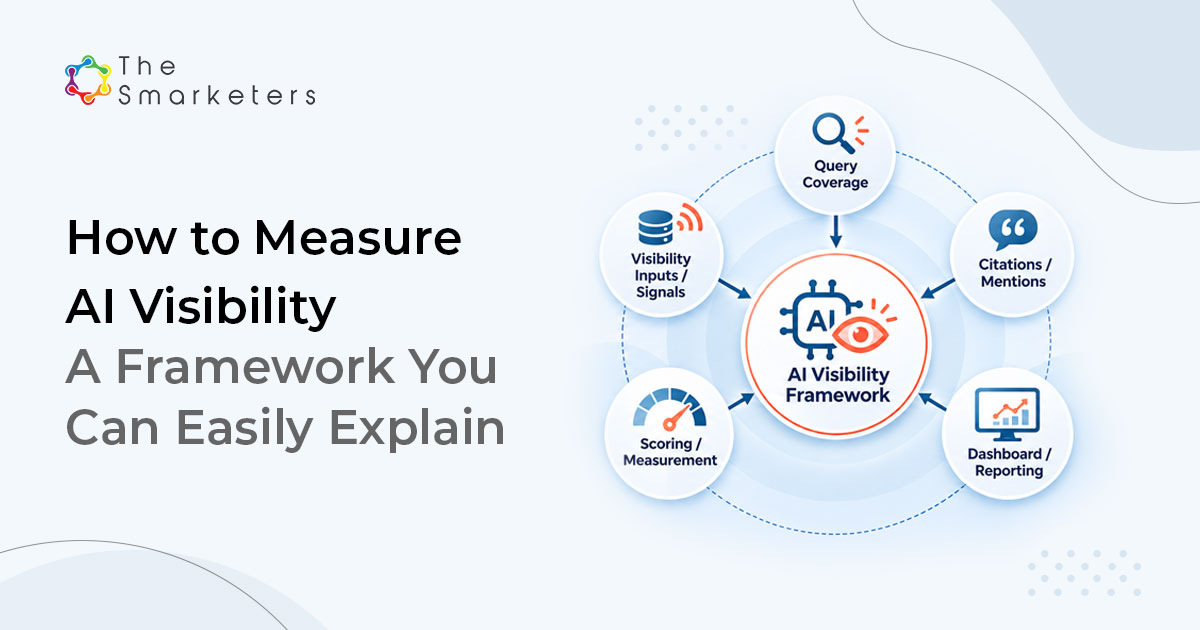
Track four separate metrics: mentions (how often AI names your brand), citations (how often it links to your site), accuracy (whether it describes you correctly), and referral visits (traffic from AI platforms in your analytics). Run the same fixed prompt set each month and report each metric on its own.
What is AI visibility? AI visibility is how often, and how accurately, AI platforms such as ChatGPT, Google AI Overviews, Claude, and Perplexity include your brand in their answers to the questions your buyers ask.
What Are the Four Metrics to Measure AI Visibility?
It is crucial to keep these metrics distinct, as they answer completely different questions.
- AI brand mentions indicate how frequently AI platforms state your brand name when responding to your designated test questions. Derived from a static set of prompts, they highlight your presence in generated answers but fail to show how many actual prospects are asking those specific questions.
- Citations reveal how often AI platforms include a link to your site as a reference in those same responses. Also stemming from your fixed prompt list, they confirm AI platforms are using your content, though they don’t guarantee the answer was accurate or that a user clicked the link.
- Accuracy determines if the AI outputs depict your brand truthfully. This requires manual review of the generated answers against factual information. While it highlights the quality of your brand’s representation, it is a time-intensive process and should be reserved for your most critical prompts.
- Referral visits track the actual number of users who navigated to your website directly from AI platforms. Pulled from your web analytics, this metric reflects genuine user behavior. However, it often undercounts reality, as many AI sessions don’t result in a click, and some referral data strips away the source entirely.
| Metric | Source | What it reveals | What it doesn't reveal |
|---|---|---|---|
| Mentions | Your static prompt list | Frequency of brand name appearances in test queries | The actual volume of real buyers asking those questions |
| Citations | Your static prompt list | How often your website is referenced via a link | The factual accuracy of the answer, or if clicks occurred |
| Accuracy | Manual assessment of AI responses | Whether the AI is describing your brand correctly | Overall search volume or traffic data |
| Referral visits | Web analytics and Search Console | Confirmed website traffic originating from AI tools | Views on answers that did not result in a direct click |
To turn these metrics into numbers you can report, use the formulas below. The examples are illustrative, not benchmarks.
| Metric | How to calculate | Illustrative example |
|---|---|---|
| Mention rate | Valid runs that name your brand ÷ total valid runs | 34 ÷ 88 = 39% |
| Citation rate | Valid runs that link to your domain ÷ total valid runs | 12 ÷ 88 = 14% |
| Accuracy rate | Answers rated accurate ÷ answers reviewed | 18 ÷ 25 = 72% |
| AI referral sessions | Sessions from AI referrers (chatgpt.com, perplexity.ai, etc.) in GA4 | Monthly count |
How Do You Build a Prompt Set for AI Visibility Tracking?
Three of the four ways to measure AI visibility (mentions, citations, and accuracy) rely on a static group of prompts that you execute identically each time. Without this baseline, month-over-month prompt tracking is virtually meaningless.
This is because AI-generated responses fluctuate significantly. A January 2026 study conducted by SparkToro and Gumshoe.ai tested 12 prompts across ChatGPT, Claude, and Google’s AI, running each roughly 60 to 100 times. For ChatGPT and Google AI, identical prompts yielded the exact same recommended brands less than 1% of the time. However, the overall frequency of a brand appearing was much more stable. Therefore, measuring total appearances across multiple test runs is far more reliable than trying to track a specific “ranking.” A later analysis by Conductor argues that consistency varies by intent type, which is another reason to group your prompts by type.
Building a consistent prompt framework involves selecting the conversational questions actual buyers ask, distinguishing between brand-specific and category-level prompts, logging the parameters of each run, executing prompts multiple times, and maintaining version control.
For example, a starter prompt set for a B2B SaaS brand might include:
- What does [Brand] do?
- Is [Brand] SOC 2 compliant?
- Best [category] tools for mid-market SaaS teams
- [Brand] vs [Competitor] pricing
- How do I reduce [problem] in [industry]?
How Should You Count AI Mentions and Citations?
Document your measurement criteria beforehand to prevent subjective interpretations once the data is in.
Log a “mention” whenever your brand is explicitly named within the generated text. Log an AI citation only when the answer links to your own website as a source. It’s important to separate these, as a link to your site is fundamentally different from a third-party directory mentioning your brand.
Determine what qualifies as a successful test run. Errors, AI refusals to answer, or instances where the tool bypassed live search unexpectedly should be documented, not ignored. Always report two figures: the number of planned runs and the number of valid runs. If 12 out of 100 attempts failed, document the failure and the reason behind it.
Furthermore, an absence of data does not equal zero. If a platform experiences an outage for a week preventing you from testing, that period simply lacks data; it doesn’t mean your brand lost all visibility.
How Do You Check the Accuracy of AI Answers About Your Brand?
Tallying mentions and links is straightforward. The true value lies in verifying whether the AI’s responses are factually correct, particularly for B2B organizations such as SaaS companies and cybersecurity firms, where a hallucination regarding pricing, integrations, or security compliance can kill a potential deal.
Since reviewing every single output is impossible, prioritize the queries most closely tied to purchasing decisions. These include product comparisons, pricing inquiries, and suitability questions. Assign a product marketer to evaluate these specific answers, categorizing them as accurate, partially accurate, or incorrect, while flagging any significant factual errors.
How Do You Track AI Referral Traffic, and What Does It Miss?
Web analytics provide concrete data on AI referral traffic, meaning visits that originate from AI tools, which is highly beneficial. However, consider these figures a minimum baseline, not a comprehensive total.
According to Google, clicks and impressions from AI Overviews and AI Mode are counted in the Search Console Performance report under the standard “Web” search type. Since June 2026, Search Console also offers a Generative AI performance report, but it shows impressions only, not clicks, so isolating AI-driven clicks from Google is still not possible.
For alternative AI platforms, monitor the referral sources within your analytics dashboard. OpenAI notes that ChatGPT adds the UTM parameter utm_source=chatgpt.com to its referral links, making those sessions identifiable in tools like GA4. Yet, this tracking isn’t foolproof.
Referral parameters can change or drop without notice, causing AI sessions to masquerade as direct traffic. Unannounced technical shifts like this are common, highlighting the importance of annotating your reporting charts when anomalies occur.
Keep in mind that many users consume an AI’s response without ever clicking a link. Some might independently search for your brand later, discuss it with a peer, or navigate directly to your site at a later date. Standard referral metrics will miss these indirect interactions completely.
Why Should You Ask Buyers How They Use AI?
The simplest fourth data source is direct inquiry. Include a field in your demo forms or ask during discovery calls about how prospects researched their challenges, and document whenever AI platforms are mentioned.
While this information is self-reported and partial, it remains the most authentic way to grasp how actual prospects utilize these technologies. Hearing the research process described in your buyers’ own words provides context that a quantitative chart simply cannot deliver.
What Should a One-Page AI Visibility Report Include?
A monthly AI visibility report should be concise enough to fit on a single page, addressing three core queries: What were the observations? What is our confidence level? What are our next steps?
| Section | What to show |
|---|---|
| What we observed | Mention and citation rates by prompt type, plus planned vs. valid runs |
| How confident we are | Accuracy scores, tracking anomalies, and any prompt changes |
| What we'll do next | Actions, owners, and due dates |
Display your mention and citation metrics from your standardized prompt list, categorized by prompt type, alongside the ratio of planned versus valid runs. Highlight the accuracy scores for lower-funnel prompts and explicitly list any major hallucinations.
Showcase referral traffic figures, appending a disclaimer about any tracking anomalies. Finally, include qualitative feedback from buyers if available, followed by a list of actionable next steps with assigned owners, such as updating a specific webpage to boost AI visibility, correcting a third-party listing, or introducing a new query to the testing cohort.
Always feature your data limitations prominently on the primary dashboard, rather than burying them in an appendix. If the testing prompts were modified or an AI platform experienced downtime, state it clearly.
What Can’t This Framework Measure?
This methodology cannot calculate your absolute visibility across every possible question a prospect might ask. It only measures your AI search visibility against the specific queries you actively monitor.
Furthermore, it cannot definitively prove that AI visibility directly generated revenue. While referral traffic and qualitative buyer feedback suggest influence, establishing concrete cause-and-effect requires a much more rigorous testing environment.
Finally, this system cannot force AI platforms to produce stable, consistent answers. Its only purpose is to make your tracking methodology consistent enough to identify genuine shifts in performance. Being transparent about these constraints is exactly what gives the rest of your measurement report its credibility.
Want AI visibility tracking that connects to pipeline? Talk to our AEO and GEO team.
Who Should Own AI Visibility Measurement?
Assign a specific owner to every component of the framework. The SEO or content director should manage the prompt list and approve additions. The analytics lead should oversee the measurement criteria, referral tracking, and the final dashboard. Product marketing should be responsible for auditing the factual accuracy of answers. Most importantly, a senior leader must own the resulting strategic decisions, ensuring the report drives action rather than just becoming a static monthly presentation.
Frequently Asked Questions
How many prompts do you need to measure AI visibility?
Begin with a modest scope. A pilot program of 15 to 25 queries, rooted in authentic buyer questions and distributed across brand, category, and problem-oriented themes, is highly manageable. Let your data lead refine the volume after reviewing the initial batch of results.
Can we compare citation frequencies across different AI platforms?
Exercise caution here. Different platforms have varying protocols for crawling the web, citing references, and formatting their output (see how each AI platform cites sources differently). It is far more accurate to benchmark each tool against its own historical performance.
Will this reporting framework prove that AI search drives revenue?
No. It simply illustrates your presence in specific test queries and quantifies direct referral traffic. Demonstrating a definitive link between AI visibility and closed revenue would necessitate strict incrementality testing or advanced attribution modeling that ties AEO and GEO programs to pipeline.
What is the difference between an AI mention and an AI citation?
A mention is when an AI answer names your brand. A citation is when it links to your website as a source. You can get one without the other, so track them separately.
Does Google Search Console show AI Overviews traffic?
Partly. AI Overviews and AI Mode clicks are counted inside the standard Web totals, and the Generative AI performance report shows impressions only. You can’t isolate AI clicks from Google.

Enoch Pakanati
CEO