Table of Contents
- What is a design win, and why does it lock in revenue for years?
- What are the four stages of the spec-in journey?
- What content works best when marketing to engineers?
- How do you make PDF datasheets findable by search engines and AI?
- Why is a sample request the real conversion event for engineers?
- How do reference designs and application notes help win specifications?
- How do distributors influence component specification?
- What metrics should replace MQLs in a spec-in business?
- When does spec-in marketing to engineers not apply?
- Frequently Asked Questions
Need help with B2B Marketing?
Let the smarketers’ team drive your pipeline with data-led campaigns and AI-powered growth strategies.
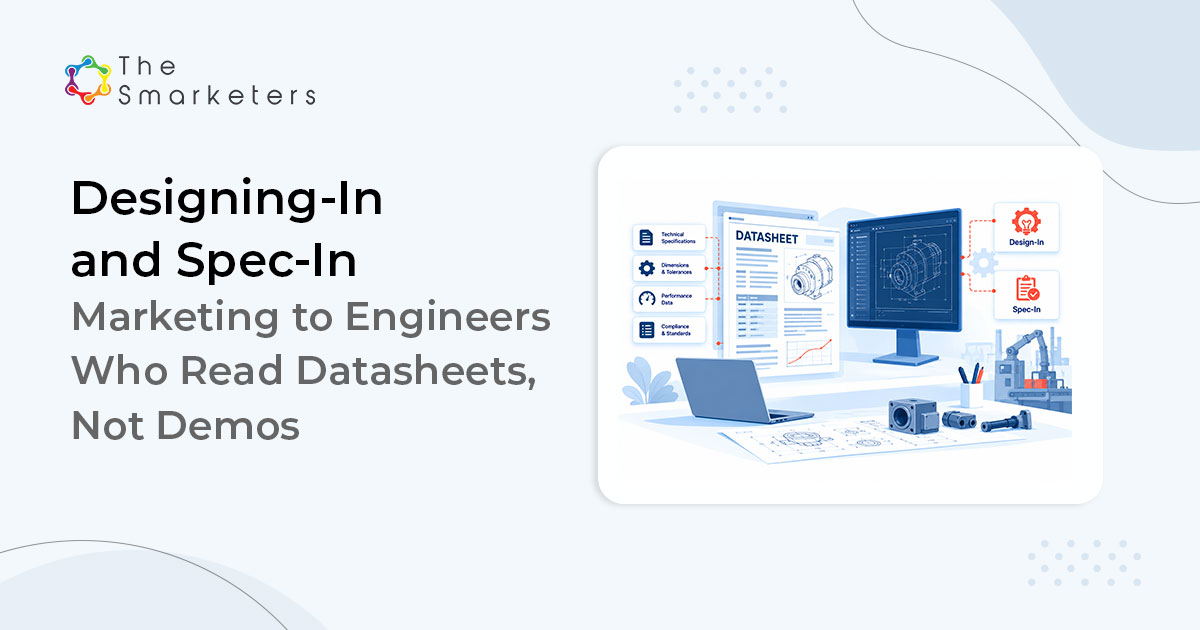
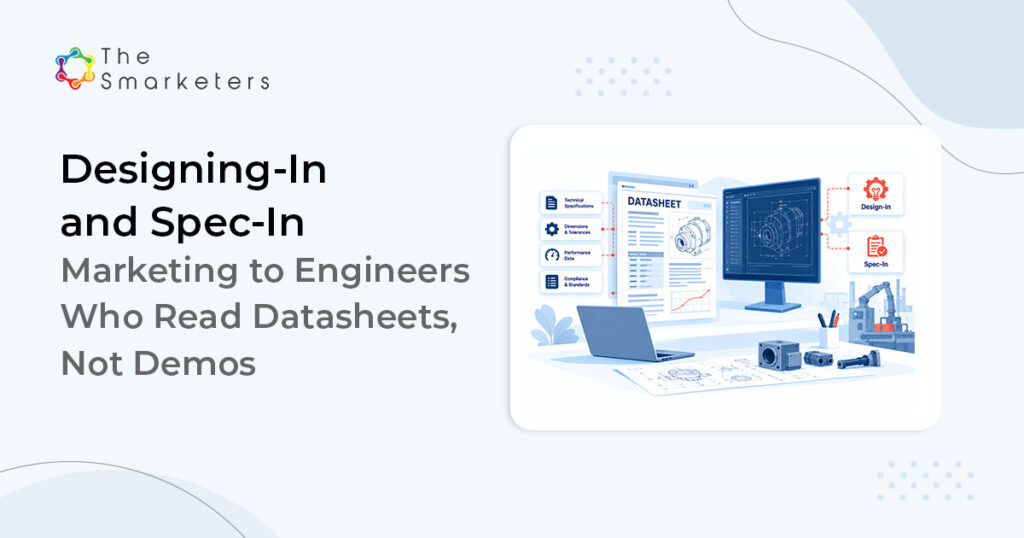
Ask a design engineer to sit through a demo and watch what happens. Marketing to engineers in component and equipment categories works differently: the conversion event is a sample request or a CAD download, not a meeting. Datasheets, application notes and reference designs are the primary marketing assets, and they need to exist as crawlable HTML as well as PDF, because a file nobody can retrieve does not influence a specification.
Most industrial teams still approach marketing to engineers with a lead-generation funnel behind this journey. It measures the wrong thing, gates the wrong asset, and reports success in a currency the sales team cannot use.
What is a design win, and why does it lock in revenue for years?
A design win happens when a customer specifies your part into their product’s bill of materials, and it locks in revenue because a specification is expensive to change. Once a part is on a bill of materials, requalifying an alternative costs engineering time, test cycles and often certification work, so the incumbent usually stays until the product itself is redesigned.
That changes the economics of marketing. A design win is not a deal; it is an annuity paid across the production life of the customer’s product. The decisive moment also happens early, during evaluation, long before anyone in sales hears about the project.
KEY TAKEAWAY
In spec-in categories, how to market to engineers comes down to being present and technically credible at the evaluation stage, because the commercial stage is largely decided by then.
What are the four stages of the spec-in journey?
The spec-in journey has four stages: search, evaluate, sample and qualify. The engineer behaves differently in each.
| Stage | What the engineer does | What they need from you |
|---|---|---|
| Search | Parametric search, part number lookup, forum threads | Accurate specs in HTML, findable part pages |
| Evaluate | Compares datasheets, checks lifecycle and compliance status | Full datasheet, errata, lifecycle status, models |
| Sample | Requests a sample or evaluation board, downloads CAD | Fast fulfilment, low friction, clear terms |
| Qualify | Tests, simulates, designs the part into the board or system | Application notes, reference designs, FAE access |
Notice how little of this involves a salesperson. Gartner found 67% of B2B buyers prefer a rep-free experience, while 69% still turn to sales reps to validate AI-generated insights, according to a survey of 645 B2B buyers, released in May 2026. In engineering categories that split shows up as a long silent evaluation followed by a sudden, very technical question.
What content works best when marketing to engineers?
They are the content. Everything else supports them. In a GlobalSpec and TREW Marketing survey of more than 800 engineers, reported in 2022, 77% named datasheets as useful when researching major work purchases, well ahead of product demo videos at 42%.
An engineer’s list of technical content looks nothing like a content calendar: parametric selector tables, full datasheets, simulation models, CAD and STEP files, footprint and symbol libraries, application notes, reference designs, errata sheets, lifecycle notices and compliance documentation. Each removes a specific reason not to specify your part.
The strategic error is treating these as engineering deliverables that marketing publishes, rather than the technical content assets that decide the outcome. That framing is why datasheets sit unversioned on a file server while the blog gets a redesign.
How do you make PDF datasheets findable by search engines and AI?
Publish the specification twice: once as an HTML page and once as the PDF engineers download. This is the highest-return change in most industrial SEO and content programmes and usually the least popular internally.
Six things to fix, in order:
| Fix | What it changes |
|---|---|
| HTML page per part number | Specifications become quotable text, not an image |
| HTML versions of key application notes | The system answer becomes retrievable |
| Text-based PDFs with real filenames and titles | The file can be parsed and identified |
| Lifecycle and compliance status in HTML | Answers the second thing an engineer checks |
| Structured product data on the part page | Attributes become machine-readable |
| PDFs in the sitemap and index checks | Stops assuming the file was crawled |
STAT
68.01% of US Google searches ended without a click in January to April 2026, up from 60.45% in 2024. Source: SparkToro study using Similarweb clickstream data, June 2026. The 2024 figure came from a different data panel, so treat the trend as directional.
Read that alongside how engineers search. If the answer to “what is the operating temperature range of part X” is locked inside a PDF, an answer engine cannot state it, and your competitor whose spec table sits in HTML gets quoted instead. That is not an SEO problem. It is a specification problem.
Why is a sample request the real conversion event for engineers?
Because nobody requests a sample casually. It means an engineer has a live project, has shortlisted your part for a design-in, and is prepared to spend bench time on it. Next to an ebook download, that is not a difference of degree.
Design the form around what the field application engineer needs: application, target production volume, timeline to production, design stage. Then remove everything else. Every extra field costs you samples, and a sample not requested is a design not won.
We worked with an industrial client whose gated PDF library produced a healthy MQL count and almost no design activity. We ungated the datasheets, moved the form to the sample and evaluation kit request, and added the four project questions. Total form fills fell sharply. Conversations with engineers who had a live board went up, and sales stopped ignoring the marketing queue.
PROOF POINT
A Fortune 500 industrial automation client generated more than 300 opportunities in four weeks with a 90% reduction in cost per lead, by targeting the engineering audience directly rather than running broad demand generation.
How do reference designs and application notes help win specifications?
They answer the system question rather than the component question, which is the question that actually blocks a specification.
An engineer rarely fails to choose your part because of a specification line. They fail because they are unsure how it behaves in their topology, alongside their controller, under their thermal constraints. A reference design that shows the whole circuit or subsystem, with the bill of materials and the measured results, removes that doubt in a way no product page can.
These assets also travel. Application notes get linked from forums, quoted in distributor content and referenced in other manufacturers’ documentation, which makes them the most durable third-party visibility available in this category.
How do distributors influence component specification?
Often at the very start, which is uncomfortable for component manufacturers who assume they own the first search. Engineers routinely begin at a distributor’s parametric search because it shows stock, price and lead time next to the specification.
That makes distributor data a marketing asset you do not directly control. Three things need to be right and are frequently wrong: the parametric attributes, the lifecycle status, and the link to the current datasheet revision. An outdated attribute quietly filters your part out of searches you would have won.
Audit your top parts across your main distributors on a fixed schedule, and treat corrections as marketing work rather than an operations ticket. It is cheaper than any campaign and it affects the stage where the decision is made.
What metrics should replace MQLs in a spec-in business?
Change the object you count when marketing to engineers. An MQL count in a spec-in business is close to meaningless, because the volume is dominated by students, competitors and engineers browsing.
Track five things instead.
| Metric | What it tells you |
|---|---|
| Sample requests with a named project | Real evaluation volume |
| Design registrations | How many projects you are inside |
| Sample to design-win conversion | Whether the technical support works |
| Sample to first production order | How long revenue actually takes |
| Estimated lifetime volume per win | What the programme is worth |
The last one makes the case for the whole programme, because one design win in a high-volume product can outweigh a year of lead generation.
This requires the CRM data model to hold a design record rather than only an opportunity, which is usually the real blocker. Our manufacturing marketing and account-based marketing for manufacturers work here almost always begins with that data model, not with content. If you want an outside view of your own setup, book an engineer-led content review.
When does spec-in marketing to engineers not apply?
Not every industrial category is a spec-in category. If your product is a configured system sold through a quotation and a site visit, the design win framing does not fit, and the sample request is not your conversion event.
Ungating also has a real cost. You lose the contact record on the datasheet download, and if your commercial model depends on early outbound follow-up, that trade is not automatically worth making. Test it on one product family first.
None of this compensates for a weak part either. Content makes a competitive component easier to specify. It does not make an uncompetitive one specifiable, and engineers spot the difference faster than most marketing teams expect.
Frequently Asked Questions
How do you market to design engineers?
Publish the technical documentation they actually use, in retrievable form: HTML specification pages per part, full datasheets, simulation and CAD models, application notes and reference designs. Remove gates from reference material and put the form on the sample or evaluation kit request, where intent is genuinely high.
What is a design win in manufacturing marketing?
A design win is the point at which a customer specifies your part or subsystem into their product design and bill of materials. Because requalifying an alternative costs engineering time and test cycles, the win typically produces revenue across the production life of the customer’s product.
Should datasheets be gated?
Generally no. Gating reference material removes you from evaluation, and engineers will simply use a competitor whose specification is visible. Put the form on the sample request, the evaluation kit and the design support conversation instead, where the buyer has a live project and expects to identify themselves.
How do I make PDF datasheets rank and get cited?
Publish the specification as a crawlable HTML page alongside the PDF, with the spec table as real text. Use text-based PDFs with descriptive filenames and titles, add structured product data, show lifecycle and compliance status in HTML, and include PDFs in the sitemap and index checks.
How do distributors affect specification decisions?
Many engineers start at a distributor’s parametric search because it shows stock, price and lead time beside the specification. If your parametric attributes, lifecycle status or datasheet links are outdated there, your part is filtered out of searches before you are ever considered. Audit distributor data regularly.
What metrics replace MQLs in a spec-in business?
Sample and evaluation kit requests tied to a named project, design registrations, sample-to-design-win conversion rate, time from sample to first production order, and estimated lifetime volume per design win. The last number is what justifies the programme to a finance team.

Swati Bansal
Sr. Content Strategist