Need help with B2B Marketing?
Let the smarketers’ team drive your pipeline with data-led campaigns and AI-powered growth strategies.
AI visibility platforms differ less in what they track than in who controls the prompt list. Tools that generate prompts from keyword data suit categories with recorded search volume. Tools that accept an imported prompt set suit narrow B2B categories where volume sits near zero. This list helps marketing leaders compare AI visibility platforms before buying a first tracker.
What is an AI visibility platform?
An AI visibility platform tracks how often your brand is mentioned or cited in answers from engines like ChatGPT, Perplexity and Google AI Overviews, for a set list of prompts. The better platforms also name the third-party domains those answers cite, which tells you where to earn coverage.
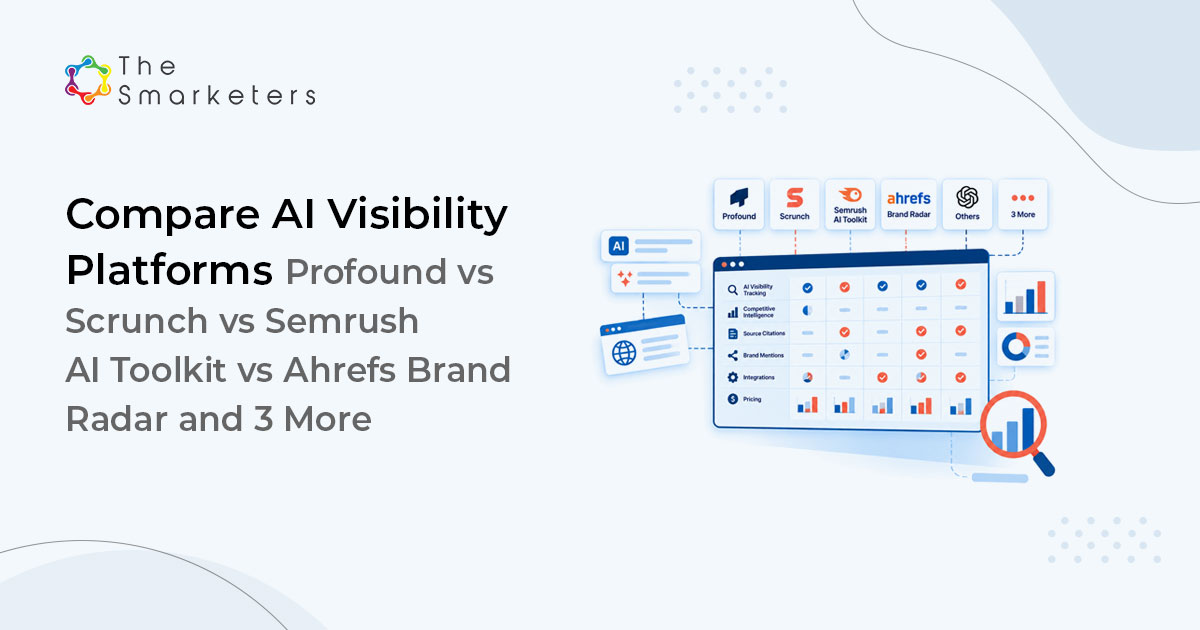
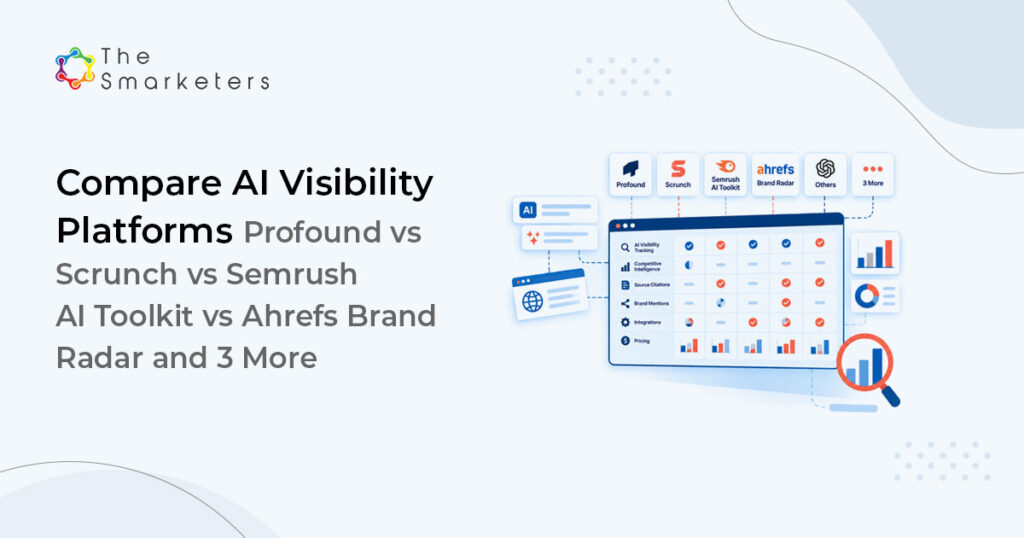
Here is how the seven platforms compare at a glance.
| Tool | Best for | Main limitation | Weighted score |
|---|---|---|---|
| Profound | Citation source depth and AI crawler data | Enterprise-level commitment | [ADD SCORE] |
| Scrunch AI | Tracking plus agent readiness | More scope than tracking-only buyers need | [ADD SCORE] |
| Semrush AI Toolkit | Teams on Semrush | Thin prompts in zero-volume categories | [ADD SCORE] |
| Ahrefs Brand Radar | Teams on Ahrefs | Keyword corpus, not a hand-built prompt list | [ADD SCORE] |
| Peec AI | Fast setup | Narrower feature surface | [ADD SCORE] |
| Otterly.AI | Low-cost entry | Tiered prompt allowances | [ADD SCORE] |
| Writesonic | Tracking with content workflows | Tracking is one module of many | [ADD SCORE] |
How did we compare AI visibility platforms?
Six criteria for judging AI visibility tools for B2B, weighted towards prompt control: the decision most B2B teams get wrong. Scores come from public documentation and pricing pages read on 10 September 2026. Excluded: rank trackers with no AI module, and AI visibility tools that hide what they monitor.
| Criterion | Weight | Assessed by |
|---|---|---|
| Custom prompt import | 25% | Import supported |
| Engine coverage | 20% | Engines documented |
| Citation source reporting | 20% | Domains named |
| Low-volume handling | 15% | Nil-volume output |
| Export and API | 10% | Export documented |
| Price transparency | 10% | Pricing public |
Prompt import carries the heaviest weight: a tracker you cannot aim at your own list measures someone else’s category.
NOTE
Disclosure: The Smarketers resells none of these platforms and takes no affiliate revenue from them. We build the client prompt set by hand first, then pick the cheapest tool that can hold it. That method sits behind our AEO service line and our SEO, AEO and GEO work.
What are the best AI visibility tools for B2B teams?
Profound: Best for citation source depth and AI crawler data
An enterprise answer engine analytics platform tracking brand mentions, citations and the sources behind AI answers, plus how AI crawlers reach your site. Strongest at depth of source attribution for teams wanting citation and agent data together. Limitation: positioned at the enterprise end, so the commitment suits funded programmes. [VERIFY: price.]
Scrunch AI: Best for visibility tracking plus agent readiness
One of the few AI search visibility tools that combines monitoring with readiness checks on how your site presents itself to AI agents. Strongest where the buying question is both “are we cited” and “can an agent parse our pages”, so site work and measurement share a tool. Limitation: that readiness scope exceeds a tracking-only buyer’s needs. [VERIFY: engines and prompt import.]
Semrush AI Toolkit: Best for teams already on Semrush
Semrush’s AI visibility tracking module, covering brand presence and sentiment in AI answers beside the keyword and competitor data a subscriber already holds. Strongest for teams standardised on Semrush who want one login and comparable reporting. Limitation: prompt discovery draws on Semrush’s query corpus, thin where a category has no recorded volume. [VERIFY: prompt import.]
Ahrefs Brand Radar: Best for teams already on Ahrefs
Ahrefs’ tracker for brand mentions across AI Overviews and AI assistants, built on the Ahrefs index and its keyword database. Strongest as a low-friction addition for teams already paying for Ahrefs, with large-scale mention data behind it. Limitation: organised around a keyword corpus, not a hand-built prompt list. [VERIFY: prompt upload.]
Peec AI: Best for fast prompt-level setup
A prompt-level LLM visibility tracker showing where a brand appears across answer engines, with competitor comparison and a sources view. Strongest at setup speed: a readable prompt-by-prompt picture within an hour of signing up. Limitation: a narrower feature surface than the enterprise platforms, so complex reporting outgrows it. [VERIFY: export and API.]
Otterly.AI: Best for low-cost entry and multi-brand agencies
Monitors brand mentions and linked citations across AI search results, aimed at smaller teams and agencies running several brands. Strongest at cost of entry for a first measurement habit rather than a full programme. Limitation: prompt allowances are tiered, so your ceiling depends on the plan. [VERIFY: allowances per tier.]
Writesonic: Best for tracking bundled with content production
A content production platform that also offers AI search visibility tracking, so measurement and publishing sit in one tool. Strongest for teams wanting tracking bundled with content workflows rather than bought separately. Limitation: tracking is one module in a broader suite, which matters if measurement is the only job. [VERIFY: module scope.]
PROOF POINT
Perspectium sells into a single enterprise software ecosystem with almost no recorded keyword volume. Depth in a narrow topic set, not breadth, grew organic visibility by 66.52% and moved 25 keywords into the top ten.
When is an AI visibility tool not worth buying?
Below roughly 1,000 prompts, a spreadsheet beats a platform. We run one for a client in a single software ecosystem: 200 prompts, three engines, monthly, following our method for measuring AI search visibility. The log of cited sources became the outreach list for winning AI citations. Roughly 84% of AI citations come from earned, third-party media, per Muck Rack’s 2026 analysis of more than 25 million AI citations.
Not sure you need a platform yet? Book an AI Visibility Audit.
How do you compare AI visibility platforms for a B2B shortlist?
When you compare AI visibility platforms, start with your prompt count. Under 1,000 prompts, run the spreadsheet for a quarter first, so you know what you want a tool to answer. Above that, rank the shortlist on prompt import, then on whether the citation report names the domains you will need to pitch. Engine coverage matters less than vendors imply, since ChatGPT, Perplexity and Google AI Overviews carry most B2B answers today. Confirm pricing directly with each vendor, and rerun the shortlist yearly, because feature gaps between these products close quickly. If you would rather hand the job off, see our guide to choosing a B2B AEO agency.
Frequently Asked Questions
How do you compare AI visibility platforms?
Compare them on six criteria: custom prompt import, engine coverage, citation source reporting, low-volume handling, export and API, and price transparency. Weight prompt import highest, because a tracker you cannot aim at your own prompt list measures someone else’s category.
Which AI visibility tool suits a niche B2B category?
Whichever one lets you import your own prompt list. Niche categories return little keyword volume, so a platform that builds prompts from keyword data produces a misleading set. Check the import path first, and confirm the tool names cited domains.
What is the best AI visibility tool for B2B?
It depends on your prompt control needs. For niche categories with little search volume, pick a tool that imports your own prompt list and names cited domains. For teams already paying for Semrush or Ahrefs, their AI modules add tracking with no new login.
Semrush AI Toolkit vs Ahrefs Brand Radar: which should you pick?
Pick the one that matches the SEO suite you already pay for. Both build tracking on their own keyword databases, so both are thin in categories with little recorded search volume. If your category is niche, check whether either accepts your own prompt list first.
How much do AI visibility platforms cost?
Entry pricing runs from self-serve monthly plans to enterprise contracts, and moves often enough that any figure here would be stale within a quarter. Ask each vendor for pricing against your prompt count, since allowances rather than seats drive the invoice.
Do I need a platform at all?
Not below about 1,000 prompts. A monthly manual check across the engines your buyers use gives the same coverage signal, plus a log of cited sources for outreach. Platforms earn the spend once that check costs more than the insight.
What is a realistic B2B citation benchmark?
Modest. Walker Sands, in an April 2026 benchmark of 828 companies across 14 industries and 45 million queries, found median enterprise B2B brands appear in about 3% of relevant AI Overviews. Set targets against your own prompt set, using our AI citation benchmarks by B2B vertical.

Indrani Gope
Content Head