Table of Contents
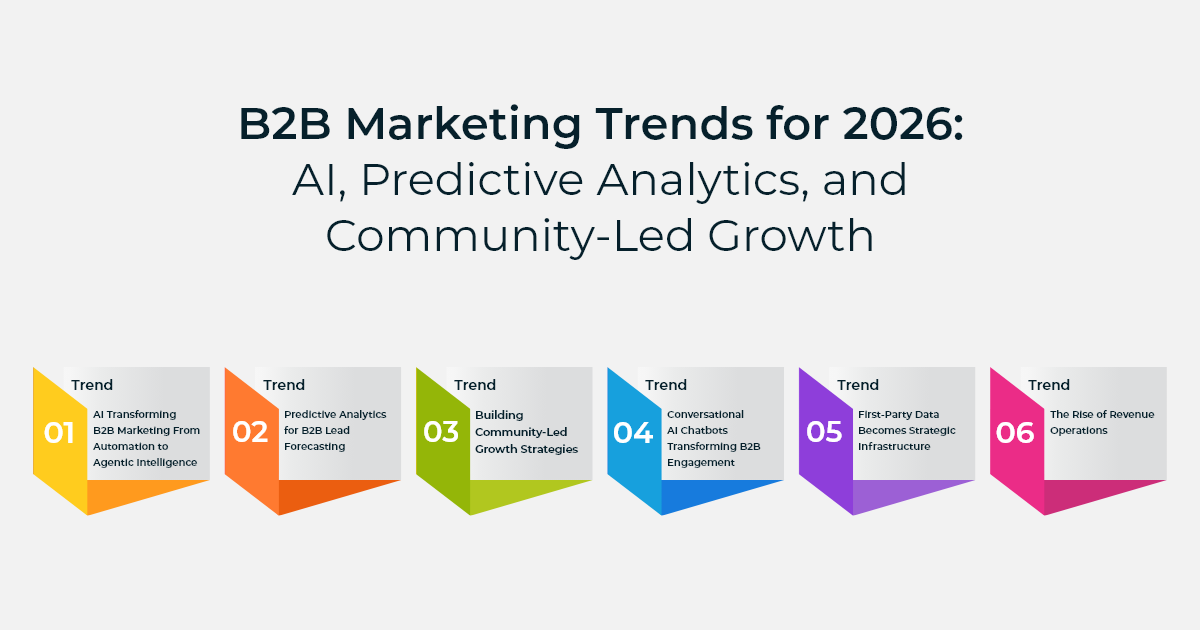
- Trend 1: AI Transforming B2B Marketing From Automation to Agentic Intelligence
- Trend 2: Predictive Analytics for B2B Lead Forecasting
- Trend 3: Building Community-Led Growth Strategies for B2B
- Trend 4: Conversational AI Chatbots Transforming B2B Engagement
- Trend 5: First-Party Data Becomes Strategic Infrastructure
- Trend 6: The Rise of Revenue Operations
- Looking Ahead
- Frequently Asked Questions
Need help with B2B Marketing?
Let the smarketers’ team drive your pipeline with data-led campaigns and AI-powered growth strategies.
The B2B marketing landscape is undergoing a fundamental transformation. As we move through 2026, three powerful forces are reshaping how businesses connect with buyers: artificial intelligence, predictive analytics, and community-led growth strategies. These shifts signal a complete rethinking of how B2B organizations build pipelines, engage prospects, and drive sustainable revenue growth.
B2B marketers’ challenges have intensified:
- Customer acquisition costs continue to climb, with companies reporting significant increases in the price of winning new business.
- Buying committees have expanded, now averaging six to ten decision-makers per purchase, according to Gartner research.
- Sales cycles have lengthened as buyers conduct more independent research before engaging with vendors.
In this environment, efficiency and relevance matter more than volume. Against this backdrop, forward-thinking marketing teams are deploying AI to automate complex workflows, using predictive analytics to identify high-value accounts before competitors, and building communities where buyers naturally congregate. In this article, let’s explore these approaches that help you understand how modern B2B buyers actually make decisions.
Trend 1: AI Transforming B2B Marketing From Automation to Agentic Intelligence
“Artificial intelligence has moved from experimental technology to essential infrastructure in B2B marketing.”
According to CoSchedule’s 2025 State of AI in Marketing Report, 85% of marketers now actively use AI tools in content creation and workflow augmentation. The shift represents a maturation from basic automation to reasoning systems that can analyze context and make strategic decisions.
From Automation to Agentic Intelligence
The most significant development in AI for marketing involves agentic systems, which operate with adaptive intelligence. This means that these AI agents perceive data, reason through context, and take meaningful action without constant human oversight. Unlike traditional marketing automation that follows rigid if-then logic, AI agents continuously learn and adjust based on outcomes.
Marketing operations teams are transitioning from managing individual tools to designing agent workflows.
“As industry analysts note, the skill that matters is no longer writing better prompts but architecting systems where multiple specialized agents work together seamlessly.”
This evolution means that routine campaign tasks, lead scoring, content generation, and even strategic recommendations increasingly happen through autonomous AI systems.
Consider the practical application: an AI agent monitoring your website can identify when a high-value prospect from a target account visits your pricing page. It analyzes their previous interactions, company data, and intent signals in real time. Based on this analysis, it determines the optimal engagement strategy, whether that means triggering a personalized chatbot conversation, alerting a sales representative, or serving tailored content. This entire sequence has the potential to happen in seconds without human intervention.
Nowadays, technology can drive every stage of the marketing funnel.
- Assisting with campaign planning and performance forecasting
- Enabling better resource allocation
- Driving scalable personalization across channels
- Providing real-time buyer insights that help teams prioritize accounts and customize outreach.
The Role of Marketers Once AI Agents Start Handling Campaigns
“AI handles execution while humans own strategy, creativity, and relationship building.”
When AI manages repetitive aspects of campaign deployment, marketing professionals can focus on what machines cannot replicate: creative problem-solving, emotional intelligence, and strategic thinking.
Marketing teams will increasingly focus on several critical areas. They will set business goals and define success metrics that AI systems work to achieve. They will provide context, including brand guidelines, audience insights, and competitive intelligence that inform AI decision-making. They will design customer experiences that blend AI efficiency with human touchpoints. And crucially, they will oversee AI governance, ensuring systems operate ethically and align with company values.
The role evolution also means developing new competencies.
- Marketers need to understand how AI models work, not necessarily coding them, but grasping their capabilities and limitations.
- They must become adept at analyzing AI-generated insights and translating them into actionable strategies.
- The most valuable marketing professionals in 2026 combine traditional marketing expertise with AI literacy.
For B2B companies navigating this transition, the integration of AI into existing marketing operations requires careful planning. Organizations that successfully blend AI capabilities with human expertise see the strongest results. This is where experienced marketing partners can make a significant difference, helping teams understand which processes to automate and which require human oversight.
Trend 2: Predictive Analytics for B2B Lead Forecasting
Predictive analytics is the intersection of data science and marketing strategy. It uses machine learning to analyze historical patterns and forecast future outcomes so that B2B teams can quickly act on opportunities before competitors even identify them.
How B2B Teams Leverage Predictive Analytics for Real-Time Personalization
Companies using predictive models to optimize marketing spend achieve better return on investment by allocating resources to accounts most likely to convert. Industry research shows:
- They achieve up to 73% higher accuracy in identifying high-intent accounts compared to manual selection methods.
- Win rates can increase by 38% when predictive scoring guides sales prioritization.
However, in 2026, the application of predictive analytics has evolved beyond basic lead scoring. Modern B2B teams deploy predictive models that analyze more than 100 signals to determine conversion probability and deal velocity. These signals include:
- Firmographic data (company size, industry, revenue)
- Technographic information (technology stack, recent software purchases)
- Behavioral patterns (website engagement, content consumption)
- Intent signals (search behavior, competitor page visits).
The power of predictive analytics becomes evident in account-based marketing strategies. Traditional ABM relied on static account lists created through manual research. Predictive analytics transforms this into a dynamic engine that continuously evaluates which accounts show the highest likelihood of conversion. The system monitors market changes, technology migrations, and budget allocation signals, updating target lists daily rather than quarterly.
Real-time personalization flows directly from these predictive insights. When a prospect from a high-scoring account visits your website, predictive models instantly determine their position in the buying journey, likely pain points, and content preferences. The system then dynamically adjusts messaging, offers, and calls-to-action to match that specific context. This level of personalization was technically impossible just a few years ago. Now it happens automatically at scale.
Trend 3: Building Community-Led Growth Strategies for B2B
While AI and analytics optimize existing channels, community-led growth represents a fundamentally different approach to B2B marketing. It recognizes that buyers increasingly trust peer recommendations over vendor messaging and that the most valuable conversations happen in spaces brands do not directly control.
Why Community-Led Growth is the New Marketing Driver
Traditional marketing channels face several challenges as follows:
- Cold outreach reply rates have dropped to around 5-6%, with recent research showing an average of 5.8% in 2025, compared to 6.8% in 2023.
- Ad costs continue rising while effectiveness declines.
- Email inboxes overflow with promotional messages that recipients routinely ignore.
In this environment, the community offers an alternative based on trust and belonging rather than interruption.
Community-led growth means building or participating in spaces where your target buyers naturally gather to exchange ideas, solve problems, and share experiences. These communities exist across various platforms: private Slack and Discord channels, Reddit forums, LinkedIn groups, niche professional networks, and purpose-built community platforms.
The data supporting this approach is compelling. Community-sourced deals close faster, at higher values, and with stronger win rates compared to leads from traditional outbound channels. Members of active communities demonstrate higher lifetime value and better retention rates than customers acquired through paid advertising.
Community as a growth driver means members contribute, support each other, and advocate for your brand without being asked. This differs fundamentally from community as a marketing channel, where brands push announcements and content. In effective B2B communities, peer-to-peer interaction creates value independent of the company’s presence.
Which AI Tools Are Best for Community-Led Growth on Reddit and Discord?
Building and managing communities at scale requires technological support. Several tools help B2B teams identify opportunities, track conversations, and engage authentically within community spaces.
For Reddit community marketing
Platforms like PainOnSocial analyze subreddits to identify the most discussed pain points in your target market. These tools scan conversations across relevant communities, extracting themes and problems that prospects actively discuss. This intelligence allows teams to engage in conversations with genuine value rather than promotional messaging.
When selecting subreddits for B2B community marketing, focus on communities with three characteristics:
- Relevant audience composition
- Active daily discussions
- Tolerance for business-related topics when presented with an appropriate context
Start by mapping your ideal customer profile to potential subreddits. If you sell DevOps tools, obvious communities include r/devops, r/sysadmin, and r/kubernetes. But extend beyond the obvious. Your prospects also participate in broader communities like r/programming, industry-specific forums, and career-focused subreddits.
For Discord community management
The platform itself provides robust analytics through Server Insights. These tools reveal member demographics, traffic sources, and engagement patterns. Discord’s Growth & Activation metrics help community managers understand which invite links drive the most valuable members and which channels generate the strongest engagement.
Discord has evolved beyond its gaming origins.
“According to recent platform statistics, non-gaming communities now represent 46% of the user base and are growing faster than gaming communities. The platform serves 259 million monthly active users who spend an average of 94 minutes daily in conversations.”
This engagement level exceeds virtually every other digital platform, making Discord an attractive space for B2B community building, particularly for technical products and developer-focused companies.
When using Discord for B2B community growth, several strategies prove effective. Create structured channels that support different conversation types:
- Announcements
- Getting started guides
- General discussion
- Technical support
- Exclusive content for paid members
Implement clear governance policies that prevent spam while encouraging genuine participation. Partner with complementary communities to cross-promote and expand reach.
AI tools enhance community management across both platforms. Some of them include the following:
- Sentiment analysis tools monitor community conversations to identify emerging frustrations or opportunities.
- Automated moderation systems flag inappropriate content while allowing constructive discussion.
- Content recommendation engines suggest relevant resources based on community questions and interests.
The key to community-led growth is providing value before making asks. Successful B2B brands participate in communities by answering questions, sharing expertise, and addressing concerns without immediate sales pitches. They facilitate user-generated content, highlight community members’ successes, and create spaces where peers help each other. This approach builds trust and credibility that translates into business opportunities over time.
For technology companies looking to build authentic communities around their products or services, combining community strategy with content expertise creates a powerful multiplier effect. Organizations that excel at both content creation and community engagement see the strongest results in building lasting relationships with target accounts.
Trend 4: Conversational AI Chatbots Transforming B2B Engagement
Conversational AI chatbots represent another significant trend reshaping B2B marketing in 2026. These tools have evolved far beyond scripted question-and-answer bots. Modern conversational AI understands context, learns from interactions, and handles complex multi-turn conversations that feel remarkably human.
Leading Conversational AI Tools for B2B

Several platforms lead the B2B conversational AI space, each with distinct strengths.
Drift remains among the most popular for B2B sales enablement and conversational marketing.
- It blends AI-driven conversations with intelligent routing to human sales representatives, qualifying leads, and booking meetings in real time.
- Analyzes visitor behavior, company data, and intent signals to determine optimal engagement strategies.
Organizations using Drift report that it has become their number one channel for high-intent leads.
HubSpot’s chatbot builder integrates deeply with the HubSpot CRM ecosystem, making it attractive for companies already using HubSpot for marketing automation.
The platform offers:
- Drag-and-drop chatflow creation
- Prebuilt templates for common use cases
- Seamless data synchronization across marketing and sales workflows
This integration means every chatbot conversation enriches CRM records, informing future personalization.
Intercom provides another strong option, particularly for businesses prioritizing customer support alongside lead generation.
- Intercom’s AI-powered Fin Agent can resolve up to 50% of customer support queries automatically.
- It connects to knowledge bases, help documentation, and internal resources to provide accurate answers.
For B2B companies with complex products requiring technical support, Intercom bridges marketing, sales, and customer success in a unified platform.
IBM Watson Assistant offers enterprise-grade conversational AI with a strong emphasis on security, compliance, and customization.
It supports:
- Complex dialogue flows
- Integrates with back-end business systems
- Provides detailed analytics on conversation patterns
This makes it suitable for large B2B organizations with specific regulatory requirements or technical integration needs.
Implementing Conversational AI Effectively
The most successful conversational AI implementations follow several principles. They start with clear use cases rather than trying to automate everything simultaneously. Common starting points include qualifying inbound website leads, answering frequently asked questions, scheduling sales meetings, and providing basic product information.
Effective chatbots maintain a natural, brand-aligned tone rather than sounding robotic or overly formal. They acknowledge when they cannot answer a question and smoothly transition to human agents when appropriate. The best implementations use chatbot interactions to gather information that informs future marketing, tracking which questions prospects ask most frequently and which topics generate the strongest engagement.
Integration with CRM and marketing automation platforms ensures chatbot conversations contribute to comprehensive customer profiles. When a prospect interacts with a chatbot, that conversation history should be available to sales representatives, informing their outreach strategy. This integration transforms chatbots from isolated tools into components of unified revenue operations.
Conversational AI particularly excels at instant lead qualification. When someone visits your website outside business hours, the chatbot can assess their fit for your solution, understand their needs, and either book a meeting for later or provide immediate resources. This 24/7 availability means no opportunity goes unaddressed simply because prospects engage when sales teams are unavailable.
Trend 5: First-Party Data Becomes Strategic Infrastructure
The decline of third-party cookies and tightening privacy regulations make first-party data a strategic necessity rather than optional enhancement. B2B marketers who build robust first-party data strategies gain competitive advantages that grow more significant over time.
Why First-Party Data Matters More in 2026
First-party data refers to information companies collect directly from their audiences through owned channels: website behavior, form submissions, email engagement, product usage, purchase history, and customer feedback.
Unlike third-party data purchased from external sources, first-party data reflects actual interactions with your brand. This makes it more accurate, more relevant, and more valuable for personalization and prediction.
Research from the Content Marketing Institute reveals a striking reality:
“While 91% of B2B marketers report collecting first-party data, only half have moved beyond exploratory or developing stages in their implementation strategy.”
The infrastructure required for collection, governance, and activation presents significant challenges that many organizations have not yet addressed.
The shift toward first-party data creates several advantages as follows:
- Enables privacy-compliant personalization that respects user consent and regulatory requirements.
- Improves targeting accuracy by reflecting actual buyer interests rather than inferred behavior from third-party sources.
- Provides direct customer insights that inform product development, content strategy, and go-to-market approaches.
- Creates a proprietary data asset that competitors cannot replicate.
Leading B2B organizations approach first-party data collection strategically. They offer interactive tools like ROI calculators, product configurators, and diagnostic assessments that require email addresses to save or share results. They create gated content that provides genuine value, making the data exchange feel fair rather than exploitative. They host webinars, virtual events, and training sessions that require registration while delivering substantive education. They build private communities and user groups where participation requires profile creation.
Activating First-Party Data for Growth
Collecting data means nothing without systems to activate it. This requires integration across marketing technology stacks, connecting website analytics, CRM platforms, marketing automation tools, and business intelligence systems. When these tools share data seamlessly, you can track how prospects engage across multiple touchpoints, gradually building comprehensive profiles that inform increasingly personalized experiences.
First-party data powers account-based marketing with unmatched precision. You can identify which accounts show genuine interest based on actual engagement rather than purchased contact lists. You can track how multiple stakeholders from a single account interact with different content, revealing the composition of the buying committee. You can determine optimal timing for sales outreach based on engagement patterns rather than arbitrary cadences.
The data also enables sophisticated segmentation beyond basic demographics. You can segment by behavioral signals like content topics consumed, features explored in product trials, or questions asked during webinars. You can identify patterns that predict conversion, churn risk, or upsell potential. These insights allow targeting that feels relevant because it reflects demonstrated interests rather than assumptions.
Organizations with mature first-party data strategies report significant performance improvements. They achieve substantial increases in conversion rates and reductions in customer acquisition costs. They improve lead quality, as contacts in their databases have demonstrated genuine interest through voluntary engagement. They enhance customer lifetime value through personalization that continues after purchase.
For companies building sophisticated ABM programs, first-party data becomes the foundation for everything else. Without clean, comprehensive data on how target accounts engage with your brand, even the most advanced AI and predictive analytics tools cannot deliver optimal results.
Trend 6: The Rise of Revenue Operations
Another significant trend reshaping B2B marketing in 2026 involves the rise of revenue operations, commonly called RevOps. This approach unifies marketing, sales, and customer success around shared revenue goals, breaking down traditional silos that fragment the customer journey.
Traditional organizational structures created friction. For instance,
- Marketing optimized for lead volume
- Sales focused on closing deals
- Customer success worried about retention
These groups often worked from different data sets, used disconnected tools, and measured success through conflicting metrics. The result was disjointed customer experiences and inefficient resource allocation.
RevOps addresses this by establishing unified revenue data models, shared KPIs, and integrated technology stacks. When implemented effectively, it provides real-time visibility into pipeline velocity, win rates, and marketing-sourced revenue attribution.
“According to Aberdeen Group research, organizations achieving full sales and marketing alignment report 38% higher win rates. Wheelhouse Advisors found that companies aligning these teams generate 208% more revenue from marketing efforts.”
The technical foundation involves connecting CRM, marketing automation platforms, customer success tools, and analytics systems into a cohesive ecosystem. Data flows seamlessly between these tools, ensuring everyone works from the same information. When marketing generates a lead, sales immediately sees the complete engagement history. When sales closes a deal, customer success inherits a comprehensive account context. This continuity improves outcomes at every stage.
RevOps also enables more sophisticated measurement. Instead of tracking marketing-qualified leads as a vanity metric, organizations measure marketing’s contribution to closed revenue, expansion opportunities, and customer lifetime value. This shift focuses marketing efforts on activities that genuinely influence business outcomes rather than activities that merely generate activity metrics.
The challenge many organizations face involves implementing RevOps principles while managing day-to-day operations. This requires not just technical integration but cultural change, as teams accustomed to operating independently must learn to collaborate around shared goals. Organizations that successfully navigate this transition typically combine internal champions with external expertise to accelerate the process and avoid common pitfalls.
Looking Ahead
The trends shaping B2B marketing in 2026 represent interconnected shifts rather than isolated developments.
- AI and predictive analytics require high-quality first-party data to function effectively.
- Community-led growth benefits from AI tools that surface relevant opportunities.
- Conversational AI chatbots collect first-party data while providing immediate value to prospects.
- RevOps ensures these capabilities work together rather than creating new silos.
Organizations that succeed will approach these trends as an integrated system. They will:
- Deploy AI not to replace human marketers but to augment their capabilities, handling execution while humans focus on strategy and creativity.
- Build predictive models on the foundations of clean, unified data that flows across revenue operations platforms.
- Engage communities authentically, using AI to identify opportunities while ensuring human experts provide genuine value.
- Collect first-party data through value exchanges that respect privacy and build trust.
The pace of change demands continuous learning and experimentation. What works today may need adjustment next quarter as tools evolve, buyer behaviors shift, and competitive dynamics change. Successful marketing teams build learning into their operations, running controlled experiments, measuring outcomes rigorously, and scaling what proves effective while quickly abandoning what does not.
The opportunity extends beyond incremental improvement. These trends enable fundamental rethinking of how B2B organizations attract, engage, and convert buyers. Companies that invest now in AI infrastructure, predictive capabilities, community strategies, and unified data platforms position themselves for sustained competitive advantage. Those who wait risk falling behind as the gap between leaders and laggards widens.
For organizations that lack the internal bandwidth or expertise to implement these strategies effectively, partnering with specialized B2B marketing agencies can accelerate progress significantly. The right partner brings not just tactical execution but strategic guidance, helping companies prioritize initiatives, avoid common mistakes, and achieve results faster than attempting everything internally. When evaluating potential partners, look for agencies with proven experience in ABM, inbound marketing, and marketing automation, particularly those recognized by industry organizations for excellence in these areas. Agencies like Smarketers, a HubSpot Diamond Partner specializing in B2B demand generation and marketing automation, exemplify this approach by combining strategic expertise with technical implementation capabilities. The best partnerships combine your deep industry knowledge with their marketing expertise, creating a multiplier effect that neither party could achieve alone.
Frequently Asked Questions
What is agentic AI and how does it differ from traditional marketing automation?
Agentic AI represents autonomous systems that perceive information, reason through context, and take action without constant human oversight. Unlike traditional automation that follows rigid if-then rules, agentic AI continuously learns and adapts. For example, traditional automation sends a follow-up email three days after a form fill, while agentic AI analyzes the prospect’s company, engagement history, and intent signals to determine the optimal message, timing, and channel dynamically.
How can B2B teams get started with predictive analytics if they lack data science expertise?
Start by ensuring your data foundation is solid with clean CRM records and integrated marketing systems. Most major platforms like HubSpot, Marketo, and Pardot now include predictive scoring in their advanced tiers with user-friendly interfaces. Begin with these built-in features, prove value, then expand to specialized predictive analytics platforms as your competency grows.
What are the biggest mistakes companies make when building B2B communities?
The most common error is treating communities as broadcast channels for promotional content rather than spaces for genuine peer-to-peer interaction. Other mistakes include choosing platforms before defining purpose, scaling too quickly, and lacking clear governance policies. Start small with highly relevant members, establish norms through example, and let authentic engagement guide growth over months, not weeks.
How much should B2B companies invest in conversational AI chatbots?
Investment depends on your website traffic volume and lead qualification needs, with many platforms offering free or low-cost tiers. Evaluate ROI by tracking response times, lead qualification rates, and meeting bookings. Most organizations see positive ROI within 90 days if they receive at least 1,000 monthly website visitors from their target audience.
What legal and privacy considerations apply to first-party data collection?
First-party data collection must comply with GDPR, CCPA, and similar regulations requiring explicit consent, clear data usage explanations, and easy opt-out mechanisms. Best practices include conducting privacy impact assessments, maintaining detailed consent records, and ensuring third-party tools also comply. Work with legal counsel to ensure your implementation meets all applicable requirements in your operating jurisdictions.
How do AI agents impact the role of marketing operations professionals?
Marketing ops roles are evolving from managing individual tools to designing integrated agent workflows that provide AI systems with business context and data pipelines. This shift requires new skills in understanding AI capabilities, designing governance frameworks, and system orchestration. The role becomes more strategic, focusing on architecture rather than execution, making these professionals more valuable as organizations need experts bridging marketing strategy and technical implementation.
What metrics should B2B marketers track to measure success with these emerging trends?
Move beyond vanity metrics toward revenue-focused measurements like marketing’s contribution to pipeline generation, conversion rates at each funnel stage, and customer acquisition cost. Track sales cycle length to determine whether AI and personalization accelerate deals. Most importantly, tie marketing activities to closed revenue and customer lifetime value using revenue attribution models.
How can smaller B2B companies compete with larger enterprises in adopting these technologies?
Many technologies now offer scaled solutions at various price points, with free tiers and usage-based pricing that grows with your business. Small companies can move faster than enterprises, testing approaches and iterating without bureaucratic obstacles. Focus on areas like community building where authentic engagement provides advantages, and consider partnering with specialized marketing agencies to access enterprise-level expertise without building large internal teams.

Enoch Pakanati
CEO