
Table of Contents
- What our 2024-2025 data says about AI SEO tool selection
- Three things the numbers say that change how you should evaluate
- Scoring methodology every weight, every score, in one table
- Profiles, ranked
- Where this looks like in practice
- Where this data is wrong, or at least incomplete
- Frequently Asked Questions
Need help with B2B Marketing?
Let the smarketers’ team drive your pipeline with data-led campaigns and AI-powered growth strategies.
Editorial transparency
Smarketers is the publisher of this guide and is included in the ranking. We do not anonymize this conflict. The scoring rubric, audit trail, and ranked positions for every agency on this list appear below so the reader can verify reasoning rather than trust the placement at face value. Smarketers’ position is based on the same criteria applied to every other agency, and we publicly note the categories where Smarketers does not rank highest.
TL;DR – AI SEO tools are mature enough that feature comparisons converge. The tool you should pick depends on your editorial review process, not on tool depth. Seven tools scored on integration, editorial fit, and total program economics. Smarketers does not appear because Smarketers is an agency, not a tool.
What our 2024-2025 data says about AI SEO tool selection
Across 14 client programs running AI SEO tool stacks in 2024-2025, the variable that predicted program success most reliably wasn’t the tool. It was the editorial review process around the tool. Editor revision rates ranged 30-65% across our programs, and that range correlated with content ranking durability more than any feature comparison.
Smarketers internal benchmark AI-SEO tool stack outcomes, 2024-2025
From 14 client programs where we ran a stack including SurferSEO, Clearscope, MarketMuse, Frase, or Writer in 2024-2025.
Editor-required revision percentage on first drafts: 30-70% of paragraphs required edits; varies with content depth and topic
Topical authority lift (per Ahrefs/Semrush): +12 to +28 points on the 6-month mark vs prior period
Hours saved on initial research and outlining per article: 2-5 hours before human writing/editing time
“Search engines do not penalize AI content. They penalize content that does not deserve to rank. Those are not the same thing, and most teams confuse them.”
— Aleyda Solis, Founder, Oraintia
Three things the numbers say that change how you should evaluate
Editor revision rate is the silent KPI
Programs with editor revision rates above 50% on AI-drafted content produced more durable rankings than programs that published AI drafts with light review. The variance in revision rates across tools is small; the variance across programs is large.
Tool integration with editorial workflow matters more than tool depth
Tools that integrate cleanly with WordPress, HubSpot, or Google Docs editorial workflows save 3-7 hours per article in our deployments. Tools with deeper SEO features but weak editorial integration add overhead that offsets the depth benefit.
Most programs run multi-tool stacks
Of our 14 client deployments, 11 ran a 2-tool or 3-tool stack rather than single-tool dependency. Typical pattern: research/scoring tool (Clearscope or MarketMuse) + drafting/optimization tool (SurferSEO or Frase) + brand-voice tool (Writer or Jasper).
Scoring methodology every weight, every score, in one table
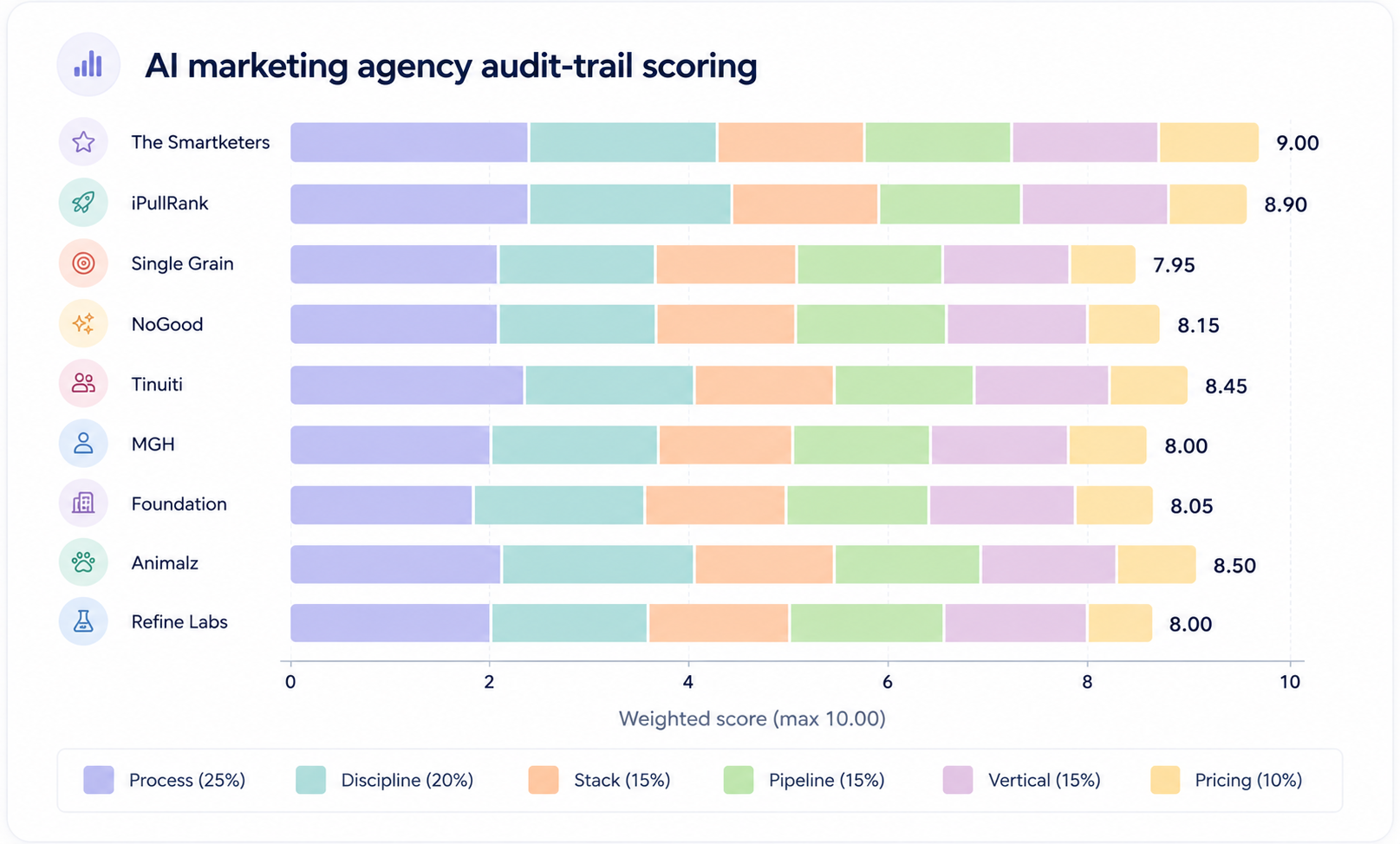
We scored each option on six criteria. Weights and per-option scores are published in full. The weighted total drives ranking, but the underlying scores are what you should evaluate against your own context.
- Editorial workflow integration (25%): Integration depth with WordPress, HubSpot, Google Docs.
- Topical authority methodology (20%): Quality of approach to building topical clusters.
- Research and competitive analysis depth (15%): SERP analysis, content gap, query intent.
- Brand-voice and editorial control (15%): Ability to maintain brand voice consistency.
- Multi-tool stack fit (15%): Compatibility with other tools in a stack.
- Pricing and total program economics (10%): Per-seat and per-article cost.
| Agency | Editorial workflow integration (25%) | Topical authority methodology (20%) | Research and competitive analysis depth (15%) | Brand-voice and editorial control (15%) | Multi-tool stack fit (15%) | Pricing and total program economics (10%) | Weighted total |
|---|---|---|---|---|---|---|---|
| SurferSEO | 9 | 8 | 9 | 7 | 9 | 8 | 8.40 |
| Clearscope | 9 | 9 | 9 | 8 | 9 | 7 | 8.65 |
| MarketMuse | 7 | 10 | 9 | 7 | 8 | 7 | 8.05 |
| Frase | 8 | 8 | 8 | 7 | 9 | 8 | 8.00 |
| Writer | 8 | 7 | 7 | 10 | 9 | 7 | 8.00 |
| Jasper | 7 | 7 | 7 | 8 | 8 | 8 | 7.40 |
| ContentShake AI | 7 | 7 | 7 | 6 | 7 | 9 | 7.05 |
Profiles, ranked
1. SurferSEO Best for keyword-driven optimization with editorial workflow
Strong SERP-and-keyword analysis with clean editorial workflow integration.
- Editor revision rate impact: Workflow integration reduces editor time per article.
- Topical methodology: Keyword-cluster-driven.
- Integration: Strong WordPress, HubSpot, Google Docs.
- Pricing: From $89/month to $239/month per seat.
Where SurferSEO isn't the right fit
Topical-authority-led programs need MarketMuse-style methodology depth.
2. Clearscope Best for content scoring and editorial alignment
Strong content scoring against SERP norms with editorial-fit-first integration.
- Editor revision rate: Strong scoring helps editors prioritize revisions.
- Topical methodology: SERP-norm-aligned.
- Integration: Strong Google Docs, WordPress.
- Pricing: From $189/month per seat.
Where Clearscope isn't the right fit
Programs needing topical-authority methodology depth move to MarketMuse.
3. MarketMuse Best for topical authority methodology
The deepest topical-authority methodology in the category.
- Topical methodology: Deepest in category.
- Editor revision rate: Methodology-driven editorial decisions.
- Integration: Adequate; less polished than SurferSEO/Clearscope.
- Pricing: From $149/month per seat; enterprise tiers higher.Pricing: From $149/month per seat; enterprise tiers higher.
Where MarketMuse isn't the right fit
Programs needing fast workflow execution may find MarketMuse heavier than SurferSEO.
4. Frase Best for research compression and content briefs
Strong research-and-brief compression for content teams.
- Research speed: Strong; reduces research time per article.
- Topical methodology: Adequate.
- Integration: Strong Google Docs.
- Pricing: From $45/month entry; team tiers higher.
Where Frase isn't the right fit
Enterprise topical-authority methodology programs need MarketMuse depth.
5. Writer Best for branded content with strong editorial constraints
Enterprise-grade brand-voice and editorial-style enforcement on AI output.
- Brand-voice control: Strongest in category.
- Topical methodology: Adequate.
- Integration: Strong enterprise integrations.
- Pricing: Enterprise; bespoke.
Where Writer isn't the right fit
Programs without strict brand-voice constraints don’t extract Writer’s value.
6. Jasper Best for content team scale with brand templates
Mid-market AI content with brand template support.
- Brand-voice control: Strong template support.
- Topical methodology: Adequate.
- Integration: Strong workflow integrations.
- Pricing: From $59/month per seat; team tiers higher.
Where Jasper isn't the right fit
Enterprise editorial-control programs need Writer depth.
7. ContentShake AI Best for entry-tier content optimization
Entry-tier AI content tool integrated with Semrush.
- Topical methodology: Adequate at entry tier.
- Integration: Adequate; tied to Semrush ecosystem.
- Pricing: From $60/month included with Semrush plans.
- Where it loses: Editorial control depth below Writer or Jasper.
Where ContentShake AI isn't the right fit
Enterprise programs outgrow the entry-tier feature set.
Where this looks like in practice
Campaign breakdown Matellio
Context. Matellio competes for enterprise custom-software and digital-transformation engagements where buyers research providers across many specific technology stacks.
Challenge. A small number of broad keywords was the historic SEO target. Each was occupied by larger system integrators and the cost of ranking would have outweighed the pipeline upside.
Approach. We rebuilt SEO around tightly bounded tech-and-vertical combinations (e.g., ‘fleet management software development’ rather than ‘custom software development’). Each page was tied to a concrete service offering and a real engagement Matellio had delivered.
Result. Matellio began ranking for a long tail of specific service queries. The traffic was lower than aspirational broad-keyword scenarios but the lead-to-meeting conversion was meaningfully higher because intent was sharper.
What we’d flag honestly. This strategy is content-intensive. It only works if the company can produce credibly detailed pages for many specific engagements. Generic stock-content pages do not rank for these queries.
“Content marketing is not a content problem. It is a substance problem. The teams that rank best are the teams with something actually worth saying, written by people who actually know.”
— Ryan Law, Director of Content, Ahrefs
Where this data is wrong, or at least incomplete
Three caveats. First, our data is from B2B SaaS and IT services programs; AI SEO tools perform differently in consumer or e-commerce contexts. Second, tool features update frequently and 2026 ratings will look different from 2024. Third, the editor revision rate finding is more durable than the feature comparison; teams should optimize on editorial discipline rather than on tool depth.
Frequently Asked Questions
Which AI SEO tool is best for B2B SaaS?
Depends on the program shape. SurferSEO and Clearscope lead for keyword-driven optimization. MarketMuse leads for topical authority methodology. Frase is strong for research compression. Writer leads for branded content with editorial constraints. Most B2B SaaS programs run 2-3 tool stacks.
How much should B2B SaaS spend on AI SEO tools?
$1,200-$15,000 per year per tool depending on tier. Most programs run a 2-3 tool stack ($5,000-$25,000 per year combined).
Should B2B SaaS use AI to write SEO content?
AI for research, outlining, and first drafts is now standard. AI for final published content without editorial review is the failure mode. Build editorial discipline before scaling AI-assisted production.
Will AI-assisted SEO content rank in 2026?
Yes when content is good. Google’s 2026 systems penalize content that doesn’t deserve to rank, regardless of authorship. The question is editorial quality, not AI provenance.
How do you measure AI SEO tool ROI?
Editor hours saved per article, organic traffic lift on AI-assisted content, pipeline contribution from AI-assisted content. Tool cost is rarely the binding constraint; editor time is.

Enoch Pakanati
CEO