Need help with B2B Marketing?
Let the smarketers’ team drive your pipeline with data-led campaigns and AI-powered growth strategies.
In 2018, gating a good whitepaper produced 8 to 15% form completion. Today that same gated piece converts at 2 to 5%. The gate has not gotten worse; the surrounding world has. Buyers have access to frictionless alternatives (Substack essays, podcast interviews, Reddit threads, LinkedIn posts, ChatGPT summaries) for every gated asset, and most buyers take the frictionless option.
Meanwhile the cost of producing the gated asset has not dropped. You still spend 40 to 120 hours producing a research report, paying designers, and promoting it. If the form is only converting 3%, you are running a highly inefficient demand funnel.
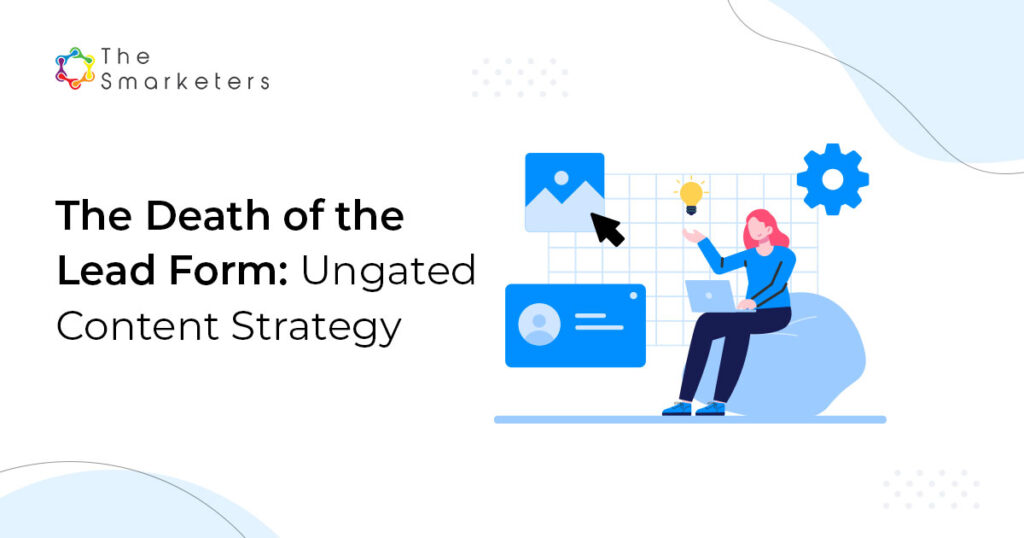
Ungating is not about abandoning content or forms. It is about reallocating which content carries which conversion mechanism. Some content should be completely open. Some should still have a form. The art is knowing which is which.
Teams combining intent data with Google Ads Customer Match see 30 to 50% CAC compression vs standalone campaigns (TrustRadius B2B Martech Benchmark 2025). In-market account CTR on bottom-funnel queries runs 2.4x higher than aggregate account CTR (The Smarketers Intent Integration Audit 2026, n=22 campaigns).
Why the math has shifted
1. Gate friction is higher
Buyers face more daily friction from subscriptions, sign-ups, and cookie banners. Their tolerance for another form has dropped. What was a minor annoyance in 2018 is a hard stop in 2026.
2. Alternatives are better
A Substack essay, a podcast episode, or a long LinkedIn post can cover what used to require a gated report. Buyers notice. The gated report wins only when it is meaningfully better than the alternatives, which most gated content is not.
3. AI engines cannot see gated content
A gated page shows a form to ChatGPT’s crawler. The content never gets cited. An ungated page can be cited in AI engine responses for years. The long-term reach difference compounds.
4. MQL quality has collapsed
Most gated form MQLs in 2026 are researchers, students, competitors, or one-time tire-kickers. Sales-accepted rates on inbound MQLs have fallen from 40% in 2018 to 15 to 25% in 2026. The MQLs you are protecting are largely not buyers.
The 4 content categories and what to do with each
1. Thought leadership content (ungate)
Essays, perspective pieces, industry analysis, provocative arguments. These pieces build authority, get cited, drive reach. Ungate completely. Offer a newsletter or follow option at the bottom for readers who want more.
2. How-to and educational content (ungate)
Guides, tutorials, frameworks. Buyers find these through search and AI engines. Gating kills reach without improving quality. Ungate. Measure share of voice, not MQL.
3. Research reports and benchmarks (selectively gate)
Proprietary data and deep research warrant gating because they have genuine scarcity value. But consider a split: ungate the summary report (20 pages of findings with charts) and gate the full dataset or methodology appendix. Best of both.
4. Assessments, calculators, and product-intent content (gate)
ROI calculators, maturity assessments, personalised scorecards, pricing simulators. These carry purchase intent. A buyer filling one out is signalling real interest. Gate, but offer a clear value exchange: personalised output, not just a PDF.
GATE ANYTHING THAT SIGNALS PURCHASE INTENT. UNGATE ANYTHING THAT BUILDS AUTHORITY. DO NOT GATE THE MIDDLE CATEGORY (GENERIC THOUGHT LEADERSHIP) JUST BECAUSE YOU ALWAYS HAVE.
What replaces MQL volume as the metric
If you ungate thought leadership, your MQL volume from content drops. The panic reaction is to re-gate. The better response is to change the metric.
- Content reach. Pageviews, shares, time on page, scroll depth.
- AI citations. Share of Model on category queries, citation count on key content pieces.
- Branded search lift. Searches for ‘your brand + topic’ 30 to 90 days after publication.
- Pipeline influence. % of closed-won deals where the content appears in the touch path.
- Soft conversions. Newsletter subscriptions, webinar registrations, consultation requests, free trial starts. Each has lower intent than a form MQL but higher intent than a cold visitor.
The transition plan
Month 1 to 2: Audit
Catalogue all gated content. Classify each piece as thought leadership, how-to, research, or product-intent. Identify the 60 to 80% that belong ungated.
Month 3: Ungate the first cohort
Ungate thought leadership and how-to content. Replace the gate with a soft conversion offer (newsletter, related content, follow on LinkedIn). Do not ungate research or product-intent content in this phase.
Month 4 to 6: Measure and iterate
Track the new metrics. Expect MQL volume to drop. Expect reach, citations, and branded search to rise. Measure pipeline from content specifically (attribution report by content touch).
Month 7 to 9: Refine gating on research
For research reports, experiment with the split approach: ungate summary, gate appendix. For assessments and calculators, keep the gate but refine the value exchange (better personalised output, tighter form, clear promise).
Month 10 to 12: Build the soft-conversion stack
Replace lost MQLs with a portfolio of soft conversions. Newsletter, webinar, consultation, free trial, community. Each serves different intent signals. The portfolio together replaces the single-point gate.
The executive conversation
Boards and CMOs accustomed to MQL metrics will push back. The counter-argument: ‘MQL volume is down because we ungated. Pipeline from content is up. AI citations are up 8x. Branded search is up 40%. The business is better; the measurement is different.’
Bring the pipeline data. Do not ungate and then fail to show the pipeline effect. The transition only survives executive scrutiny if the pipeline numbers hold.
Frequently Asked Questions
Why is gating content dying?
Buyers have more options than ever. A gated whitepaper competes with free Substacks, podcast interviews, Reddit threads, LinkedIn posts, ChatGPT answers, and analyst reports. The friction of a form submission deters buyers who can get adjacent information frictionlessly elsewhere. Gated conversion rates have fallen from 8 to 15% in 2018 to 2 to 5% in 2026.
Do ungated pieces generate any leads?
Yes, but via different mechanisms. Ungating increases share and citation by 3 to 8x. It improves AI engine visibility substantially. It drives branded search lift (30 to 60 days later, searches for ‘your brand + topic’ increase). Attribution shifts from direct-response MQL to multi-touch pipeline influence.
What should I gate vs ungate?
Ungate: thought leadership articles, research reports, how-to guides, industry analysis. Gate: product trials, pricing calculators, personalised assessments, custom demos. Rule of thumb: ungate anything that builds authority; gate anything that signals purchase intent.
How does ungating affect MQL volume?
MQL volume usually drops 30 to 60% in the first 90 days after ungating. Pipeline from content often stays flat or increases as reach and quality improve. Many teams discover their MQLs were largely researchers, students, and competitors. True buyers convert through different paths anyway.
What replaces the lead form?
Multiple softer conversion points: newsletter signup, webinar registration, free consultation request, targeted product trial. Plus AI-era measurement: tracking which content gets cited in AI engines, which pages get re-shared, which content correlates with sales conversations. The goal shifts from individual MQL capture to demand influence.
Book a content gating audit

Enoch Pakanati
CEO