Table of Contents
- What Is B2B Lead Generation in 2026?
- Why Do So Many B2B Lead Generation Programs Underperform?
- The Lead Generation Architecture That Actually Works
- Layer 1: How Do You Create Demand Without Cold Outreach?
- Layer 2: How Do You Capture Demand at the Moment of Intent?
- What Should You Measure: Pipeline Velocity, Not MQLs
- Your 90-Day B2B Lead Generation Rollout Plan
- What Does This Playbook Look Like in Practice? Four Scenarios
- Where The Smarketers Fits
- Frequently Asked Questions
Need help with B2B Marketing?
Let the smarketers’ team drive your pipeline with data-led campaigns and AI-powered growth strategies.
What Is B2B Lead Generation in 2026?
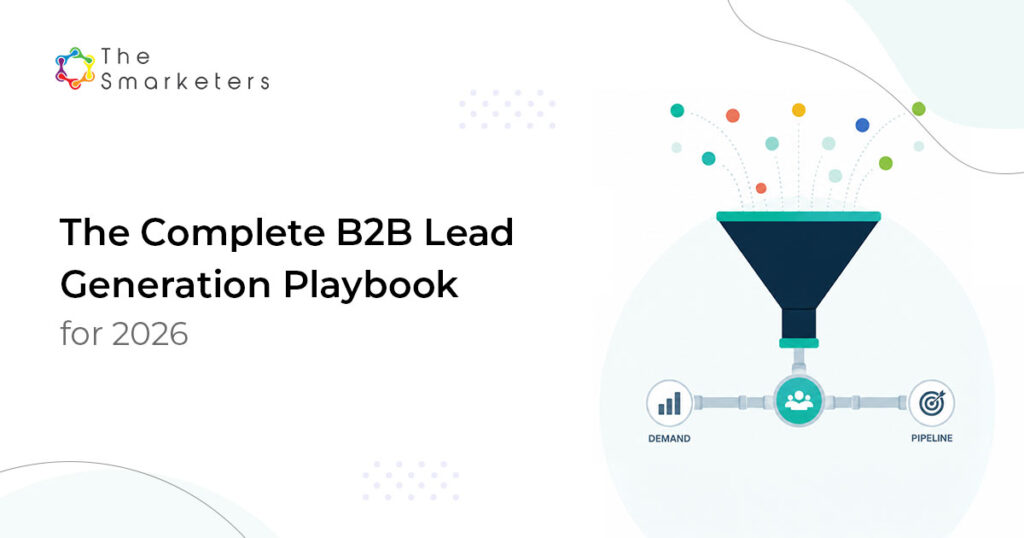
B2B lead generation is the process of turning business buyers’ attention into qualified, sales-ready pipeline. In 2026 it is less about collecting contact forms and more about creating demand, capturing it at the moment of intent, and helping a whole buying committee reach a decision.
B2B lead generation: A connected system that creates demand in future buyers, captures it when buyers start looking, and accelerates engaged accounts toward a purchase. The output is qualified pipeline, measured by velocity and revenue, not by raw lead count.
Most B2B teams do not have a lead problem. They have an architecture problem. They run campaigns that capture the small slice of buyers already in-market, then wonder why the pipeline never compounds. The programs that work in 2026 are built as a system, not a series of campaigns.
This guide lays out that system. It is written for VPs of Marketing, CMOs, and Heads of Demand Gen who have the budget, the tools, and a dashboard full of activity, but cannot reliably point to the pipeline that activity was supposed to create. The thesis is simple. Build lead generation as an architecture with three layers, measure it by pipeline velocity, and adapt the channel mix to the market you sell into. For the deeper view on the demand engine that feeds it, see our guide to B2B demand generation.
Why Do So Many B2B Lead Generation Programs Underperform?
Because most programs only chase the roughly 5% of buyers who are in-market today, while ignoring the 95% who will buy later. They optimize cost-per-lead instead of pipeline, score single contacts instead of buying groups, and trust attribution models that miss how buyers actually decide.
Start with how buyers behave. According to the LinkedIn B2B Institute and the Ehrenberg-Bass Institute, only about 5% of business buyers are in-market at any given time. The other 95% are not ready to buy, no matter how good your offer is. A program built only to capture demand competes with every rival for that same 5%, which bids up cost and caps growth.
~5%
of B2B buyers are in-market at any given time

Then look at how buyers buy. Gartner research finds that a typical buying group for a complex B2B solution involves six to 10 decision makers, and that buyers spend only about 17% of the total purchase journey meeting with potential suppliers. Score one contact’s form fill and you are reacting to a fraction of a much larger, mostly invisible process.
6–10
decision makers in a typical B2B buying group
purchase journey meeting with potential suppliers. Score one contact’s form fill and you are reacting to a fraction of a much larger, mostly invisible process.Put those two realities together and the usual failure points become obvious. Four show up in almost every audit we run:
- You generate leads, not demand. You harvest the in-market 5% and never invest in the 95%, so the funnel never grows.
- Your content answers questions nobody is asking. Topics are chosen for keyword volume, not for the questions buyers and AI assistants actually ask.
- Your attribution model is lying to you. Single-touch models credit the last click and hide the dark social and peer conversations that really drove the deal.
- You optimize cost-per-lead instead of pipeline velocity. Cheap leads that never close look efficient on a dashboard and starve revenue in reality.
We unpack these in the companion blog, Why Your B2B Demand Generation Isn’t Working. The fix is structural, and it starts with the architecture below.
The Lead Generation Architecture That Actually Works
The architecture has three layers. Demand creation builds awareness and trust in future buyers. Demand capture converts the buyers who are ready now. Pipeline acceleration helps engaged accounts and their buying committees move to a decision. Each layer feeds the next, and all three are measured against pipeline.

Most teams own one layer and call it a strategy. Performance marketers live in capture. Brand and content teams live in creation. Sales lives in acceleration. The pipeline leaks in the gaps between them. The work is to run all three as one connected system with shared goals and clean handoffs.
Layer 1: How Do You Create Demand Without Cold Outreach?
You create demand by publishing useful, point-of-view content where future buyers already spend time, then showing up consistently. Thought leadership, community presence, and dark social do the work that cold email cannot: they build familiarity and trust long before a buyer is ready to talk to sales.
Demand creation is the layer most B2B teams underfund, because its payoff is delayed and hard to attribute. It is also the layer that decides whether you ever escape the fight for the in-market 5%. Three moves matter most:
- Publish a real point of view. Take a clear position on a problem your buyers recognize. Generic best-practice content gets ignored by readers and by AI assistants.
- Show up in dark social. LinkedIn feeds, Slack and WhatsApp groups, podcasts, and peer communities are where buying conversations actually happen. Most of this is invisible to your analytics, which is exactly why competitors skip it.
- Build topical authority. Cover a topic in depth across a pillar page and supporting articles so search engines and AI models treat you as a credible source.
Layer 2: How Do You Capture Demand at the Moment of Intent?
You capture demand by being visible and easy to choose the moment a buyer starts looking. That means ranking for high-intent search, appearing in AI answers, acting on intent signals, and retargeting engaged accounts. Capture converts the demand creation already built, so the two layers must run together.
Demand capture is where most lead gen budget already lives. The shift for 2026 is where buyers look. They no longer start only in Google. They ask ChatGPT, Perplexity, Claude, and Gemini, and they read AI Overviews before they ever click. If your brand is missing from those answers, you are invisible at the exact moment of intent.
- High-intent SEO. Own the commercial and comparison queries buyers use right before they shortlist vendors.
- Answer engine optimization (AEO). Structure content so AI assistants can extract and cite it. This is fast becoming the highest-impact capture channel in B2B.
- Intent data. Watch for accounts researching your category, then prioritize them for sales and ABM.
- Retargeting. Stay present with accounts that already engaged with your demand creation, rather than buying cold impressions.

Layer 3: Why Multi-Threading Decides Whether Deals Close
Because no single person signs off a complex B2B purchase. With six to 10 people in the buying group, a deal threaded to one champion stalls the moment that person goes quiet. Multi-threading engages the whole committee, and account-based marketing plus tight sales and marketing SLAs turn engaged accounts into closed revenue.
Pipeline acceleration is where marketing and sales either align or quietly blame each other. The job is to move from a single hand-raise to orchestrated engagement across the committee: the economic buyer, the champion, the technical evaluators, and the blockers who can kill a deal late.
- Map the buying committee. Identify the roles in each target account before, not after, the deal slows down.
- Multi-thread deliberately. Give every role a reason to engage, with content and proof aimed at their specific risk.
- Run ABM on the accounts that matter. Concentrate effort where deal size and fit justify it, instead of spreading thin.
- Write real SLAs. Define what a qualified, accepted lead is, how fast sales follows up, and what happens when they do not.
“We were able to substantially increase the lead gen numbers due to the structured approach and process, with better alignment between sales and marketing and well defined SLAs.”
Raman Kishore, Manager, Account-Based Marketing, Exotel
| Channel | Primary job | What good looks like | Common mistake |
|---|---|---|---|
| LinkedIn (organic + ads) | Creation + capture | Consistent POV content; ABM ads to named accounts | Treating it as a lead form, not a demand channel |
| SEO + AEO | Capture | Ranking and getting cited for high-intent and AI queries | Chasing volume keywords with no buying intent |
| Paid search | Capture | Owning commercial and competitor queries efficiently | Bidding on broad terms that never convert |
| Email + nurture | Acceleration | Relevant, segmented sequences tied to intent | Batch-and-blast to a cold list |
| Webinars + events | Creation + acceleration | Targeted sessions that engage whole accounts | One-off events with no follow-through |
| Community + dark social | Creation | Genuine presence where buyers talk to peers | Selling instead of helping |
What Should You Measure: Pipeline Velocity, Not MQLs
Measure pipeline velocity, the speed at which qualified pipeline turns into revenue. It combines number of opportunities, average deal value, win rate, and sales cycle length into one number. Unlike MQL volume, it cannot be gamed by collecting cheap leads that never close.
Pipeline velocity: Pipeline velocity = (number of qualified opportunities x average deal value x win rate) ÷ sales cycle length. It tells you how much revenue your pipeline generates per unit of time, and it exposes the lead programs that look efficient but never convert.
Cost-per-lead optimizes for the cheapest top of funnel. Pipeline velocity optimizes for revenue. When you switch the scorecard, the whole program changes: you stop rewarding volume and start rewarding conversion, deal size, and speed. Model your own number with our Pipeline Velocity Calculator and MQL-to-SQL conversion calculator.
Your 90-Day B2B Lead Generation Rollout Plan
In days 1 to 30, fix tracking and CRM data, map the buying committee, and ship a few demand assets. In days 31 to 60, switch on capture through SEO, AEO, and intent signals, and align sales SLAs. In days 61 to 90, multi-thread top accounts and report pipeline velocity.

- Days 1–30, Foundation. Clean CRM data and fix attribution tracking. Map buying committees for your top accounts. Publish three point-of-view assets and one pillar page.
- Days 31–60, Activation. Launch high-intent SEO and AEO. Turn on intent monitoring. Agree SLAs with sales on lead definition, follow-up speed, and feedback.
- Days 61–90, Compounding. Multi-thread engaged accounts, double down on what converts, and report pipeline velocity rather than lead volume to leadership.
What Does This Playbook Look Like in Practice? Four Scenarios
The same three-layer architecture adapts to your situation. Below are four common scenarios, each showing which layer to lead with, what to build, and what changes. Find the one closest to yours and start there, rather than copying a generic funnel.
Scenario 1: PLG SaaS moving upmarket (your motion stalls above $50K ACV)
Your product-led motion works for small accounts, but enterprise deals stall. The reason is structural: self-serve signup assumes one user decides, while a $50K+ purchase runs through a committee of six to 10 people who never touch your free tier.
- Lead with Layer 3 (acceleration). Layer multi-threading on top of product signals. When one user activates, map the rest of the committee (security, procurement, the economic buyer) and give each a reason to engage.
- Add Layer 1 for the buyers who never self-serve. Executives do not sign up for trials. Reach them with point-of-view content and peer proof so your brand is familiar before sales calls.
- Keep Layer 2 honest. Track product-qualified accounts, not just product-qualified leads, so a single active user does not look like a deal.
Outcome to expect: fewer but larger opportunities, longer cycles you can actually forecast, and a clean handoff between self-serve and sales-led motions.
Scenario 2: Services or consulting firm with 6 to 9 month cycles
You sell expertise, not software, and trust is the whole game. Buyers shortlist firms they already see as credible, so demand creation does most of the work and capture closes a decision that was made earlier.
- Lead with Layer 1 (creation). Senior people publishing real points of view, plus a handful of deep, citable assets, build the authority that gets you shortlisted.
- Use Layer 2 for high-intent capture. Own the commercial and comparison queries (“best [service] firm,” “[service] for [industry]”) and make sure AI assistants can cite you.
- Layer 3 is relationship multi-threading. Engage the sponsor, the budget holder, and the skeptics with proof aimed at each one’s risk.
Scenario 3: Manufacturing or industrial with risk-averse, offline buyers
Your buyers are operations and engineering leaders who dislike being marketed to and make slow, careful, in-person decisions. Digital still matters, but it supports relationships rather than replacing them.
- Lead with targeted Layer 3 + events. A focused list of accounts, reached through industry events, webinars, and direct relationships, beats broad digital spend.
- Use Layer 1 to build quiet credibility. Technical, specific content (not hype) reassures risk-averse buyers and gives sales something useful to share.
- Keep Layer 2 narrow. Own the specific problem and product queries your buyers actually search; ignore vanity volume.
Scenario 4: Early-stage company with no demand and an unknown brand
Nobody is searching for you yet, and few are searching for your category. Capture-first tactics fail here because there is no existing demand to capture. You have to create it.
- Lead almost entirely with Layer 1. Founder-led content, a sharp point of view, and presence in the communities your buyers already trust create the demand that does not exist yet.
- Add Layer 2 only as demand appears. Once people search your name or category, capture it with a few high-intent pages and AEO. Building capture before demand is wasted effort.
- Run Layer 3 lightly and by hand. With low volume, multi-thread your handful of real opportunities manually. Do things that do not scale yet.
Where The Smarketers Fits
The Smarketers builds and runs this architecture for B2B technology, SaaS, manufacturing, and life-sciences companies. As an ITSMA-awarded ABM agency and a HubSpot Platinum Solutions Partner, the team connects demand creation, capture, and acceleration into one pipeline-focused program.

The Smarketers has worked with 250+ clients and helped generate a reported 450 million and more in pipeline. The point of the architecture is not more activity. It is pipeline you can predict, explain, and grow.
“What I value most about The Smarketers team is they are very knowledgeable about B2B and Account-Based Marketing. I also find them to be very collaborative and responsive.”
Adam Turinas, CEO, HealthLaunchPad
Frequently Asked Questions
What is B2B lead generation?
B2B lead generation is the process of turning business buyers’ attention into qualified pipeline. In 2026 it spans three jobs: creating demand in future buyers, capturing demand when buyers start looking, and accelerating engaged accounts toward a purchase decision across the whole buying committee.
How long does B2B lead generation take to show results?
Demand capture can produce leads within weeks, but durable pipeline usually takes about 90 days to compound. Demand creation pays off over two to three quarters as awareness and trust build. Programs judged only on month-one leads tend to be cut just before they would have worked.
What is the difference between demand generation and lead generation?
Demand generation creates and grows interest in a category or solution, much of it invisible to analytics. Lead generation captures that interest as identifiable contacts and pipeline. You need both: demand generation feeds the funnel, and lead generation converts it into sales conversations.
How much does B2B lead generation cost?
It varies by market, channel mix, and goals, so judge spend by pipeline velocity and cost per qualified opportunity, not cost per lead. Cheap leads that never close are the most expensive option. Model your own economics with a pipeline velocity calculator before setting budgets.
What metrics should B2B marketers track for lead generation?
Track pipeline velocity, qualified opportunities, win rate by source, average deal value, and sales cycle length. These reflect revenue. Vanity metrics like raw lead volume, form fills, and cost per lead can rise while pipeline stays flat, which is why they mislead so many teams.
Get the 15-Point AEO Checklist

Enoch Pakanati
CEO