Table of Contents
- Problem 1: You're Generating Leads, Not Demand
- Problem 2: Your Content Answers Questions Nobody Is Asking
- Problem 3: Is Your Attribution Model Lying to You?
- Problem 4: You're Optimizing Cost-Per-Lead, Not Pipeline Velocity
- Problem 5: Does Your Sales Team Trust Your Leads?
- What These Problems Look Like in the Wild: Three Scenarios
- How Do You Fix All Five at Once?
- Frequently Asked Questions
Need help with B2B Marketing?
Let the smarketers’ team drive your pipeline with data-led campaigns and AI-powered growth strategies.
What Is B2B Demand Generation, and Why Do Programs Fail?
B2B demand generation is the work of creating and capturing interest in your solution across a whole buying group. Most programs fail not because of a bad tactic, but because of structural flaws: they chase leads instead of demand, measure the wrong things, and lose the trust of sales.
B2B demand generation: The system that builds awareness and intent in future buyers, then converts that intent into qualified pipeline. It is broader than lead generation, which only captures the buyers already raising their hand.
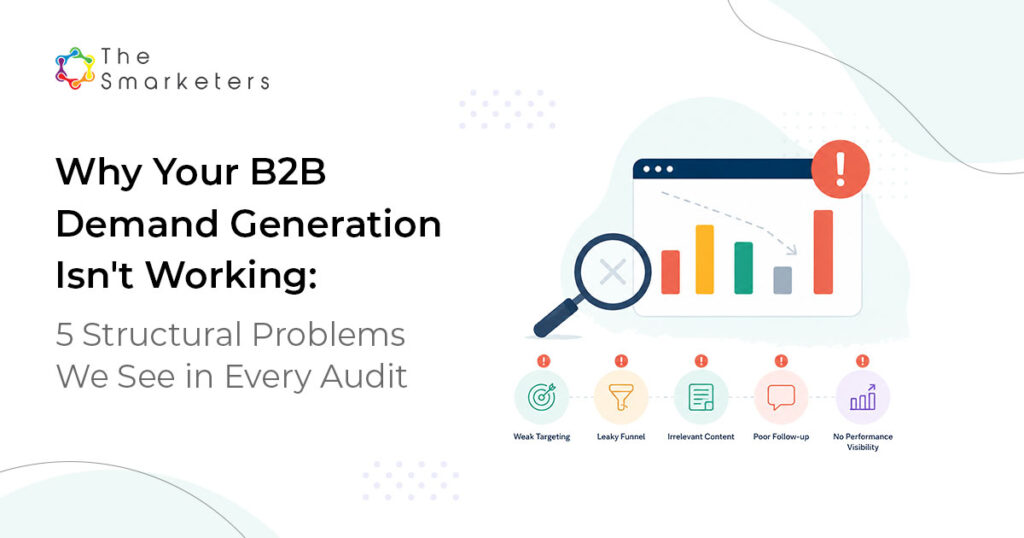
I run demand generation engagements, which means I spend a lot of time inside other teams’ funnels. The patterns repeat. Last quarter we audited 14 B2B demand gen programs across SaaS, IT services, and manufacturing. Eleven of them shared the same five structural problems. Not tactical mistakes. Structural ones, baked into how the program was designed.
Here are the five, and the fix for each.

Problem 1: You're Generating Leads, Not Demand
Lead generation captures buyers already looking. Demand generation creates new interest in buyers who are not. If your whole program is built to harvest the small in-market group, your pipeline can never grow beyond it, and you pay more each quarter to fight for the same buyers.
Most underperforming programs are pure capture. They run paid search, gated whitepapers, and a contact form, then report leads. The problem is that, at any moment, only a small fraction of your market is ready to buy. The rest are future buyers you are doing nothing to influence.
The fix. Split your program in two. Keep capturing the in-market buyers, but invest deliberately in creating demand among the rest through point-of-view content, community, and consistent presence where buyers spend time. This is the heart of the B2B Lead Generation Playbook, which lays out the full demand creation and capture architecture.
Problem 2: Your Content Answers Questions Nobody Is Asking
Many teams choose topics by keyword volume alone, then publish content that no buyer or AI assistant actually needs. The result is traffic that never converts. Useful demand gen content answers the real questions buyers ask, in the words they use, including the questions they now type into AI tools.
Buyers have changed how they research. They ask ChatGPT, Perplexity, Claude, and Gemini full questions, and they read AI-generated answers before clicking anything. Content written only for a keyword string does not get cited in those answers, and it does not help a real person decide.
The fix. Build content around buyer questions and decisions, not just keywords. Structure it so answer engines can extract it: clear question headings, direct answers up top, and depth below. For the editorial system behind this, see our B2B content marketing services.
Problem 3: Is Your Attribution Model Lying to You?
Probably, yes. First-touch and last-touch models credit a single click and hide everything else: the LinkedIn post, the peer recommendation, the podcast. They make cheap channels look great and starve the demand creation that actually drove the deal. Multi-touch plus self-reported attribution gets far closer to the truth.

Here is the trap. Single-touch attribution credits the last form fill, so leadership defunds the brand and content work that created the demand in the first place. The funnel looks more efficient on paper and gets weaker in reality.
The fix. Add a self-reported attribution question (“How did you hear about us?”) to your forms and pair it with regular pipeline reviews where sales says what actually influenced each deal. Treat attribution as directional evidence, not absolute truth.
Problem 4: You're Optimizing Cost-Per-Lead, Not Pipeline Velocity
Cost-per-lead rewards the cheapest top of funnel, which is usually the lowest quality. Pipeline velocity rewards revenue: opportunities, deal size, win rate, and speed. When CPL is your scorecard, you fill the funnel with leads that never close and call it efficiency.

Watch what happens when a team is measured on CPL. They buy cheap leads, the MQL count rises, and everyone celebrates. Then sales works the list, finds it hollow, and conversion collapses. The cheap leads were the most expensive choice. Model the difference with our Pipeline Velocity Calculator.
The fix. Change the scorecard. Report pipeline velocity and cost per qualified opportunity to leadership. Let CPL be a diagnostic, not a goal.
Problem 5: Does Your Sales Team Trust Your Leads?
If sales quietly ignores marketing leads, no amount of volume will help. Distrust usually comes from a vague lead definition, slow or missing follow-up, and no feedback loop. The fix is a written SLA: what qualifies a lead, how fast sales acts, and how they report back.
This is the problem that kills the most pipeline, because it wastes everything upstream. Marketing passes leads, sales decides they are weak, and the leads sit untouched. Marketing sees no conversions and generates more volume to compensate. The cycle gets worse.
The fix. Write a real service-level agreement between sales and marketing. Define a qualified, accepted lead together. Set a follow-up window. Build a simple feedback loop so marketing learns which leads convert. This alignment is also the foundation of any account-based marketing program.
A 2-minute self-audit
Before you read the fix, run this quick diagnostic. Answer honestly. Every “yes” points to one of the five problems above.
- Does more than 80% of your budget go to capturing in-market buyers, with little spent on creating demand? (Problem 1)
- Do you choose content topics mainly by keyword volume, not by the questions buyers and AI tools actually ask? (Problem 2)
- Does your reporting credit a single first or last touch for each lead? (Problem 3)
- Is cost-per-lead a target your team is measured against, rather than a diagnostic? (Problem 4)
- When you ask sales, do they admit they rarely work marketing leads? (Problem 5)
Two or more yeses, and your demand gen has a structural problem, not a tactical one. The fix is the same in every case.
What These Problems Look Like in the Wild: Three Scenarios
These problems are easier to spot in real situations than in the abstract. Here are three we see often, the symptom each team reported, what was actually wrong, and the fix that worked. See which one sounds like your quarter.
Scenario 1: The SaaS team with 10,000 MQLs and no pipeline
A growth team hit its lead target every month and still missed revenue. The dashboard looked healthy; the board was not. What was actually wrong: Problems 1 and 4. They were capturing the in-market few with cheap lead magnets and optimizing cost-per-lead, so volume rose while quality fell. The fix: they re-scored the funnel on pipeline velocity, cut the lead magnets that produced unqualified volume, and reinvested in demand creation. Lead count dropped; qualified pipeline went up.
Scenario 2: The services firm whose content ranks but never converts
A consulting firm ranked for dozens of keywords and got steady traffic that produced almost no inquiries. What was actually wrong: Problem 2. The content answered high-volume questions their buyers were not actually asking before a purchase, so it pulled readers with no intent. The fix: they rebuilt the content around real buying questions and the prompts people type into AI tools, then added clear next steps. Less traffic, far more qualified conversations.
Scenario 3: The company where sales quietly ignores marketing leads
Marketing passed hundreds of leads a month; sales worked almost none of them and blamed lead quality. What was actually wrong: Problems 3 and 5. Single-touch attribution credited the wrong sources, so marketing optimized for the wrong leads, and there was no shared definition of a qualified lead or follow-up SLA. The fix: they wrote a joint lead definition and SLA, added self-reported attribution, and ran weekly pipeline reviews together. Trust returned, and conversion followed.
“We were able to substantially increase the lead gen numbers due to the structured approach and process, with better alignment between sales and marketing and well defined SLAs.”
Raman Kishore, Manager, Account-Based Marketing, Exotel
How Do You Fix All Five at Once?
Stop running demand gen as disconnected campaigns and run it as one architecture: create demand in future buyers, capture it at the moment of intent, and accelerate engaged accounts with aligned sales. Measure the whole thing by pipeline velocity. Fix the structure, and the five problems resolve together.
The five problems are symptoms of one root cause: a program built as a set of tactics instead of a connected system. The companies that fix this treat demand generation as an architecture with shared goals across marketing and sales. The full model lives in the B2B Lead Generation Playbook, and the managed version is our demand generation service.
PROOF POINT · What fixing the structure looks like
KeyReply generated 100+ marketing qualified leads in six months and cut cost per lead from $75 to $51.86, with click-through rising from 2% to 4.43%.
Eclat Health cut cost per lead from $5 to $1.82 (a 63.6% reduction) and grew lead generation 8X in a year.
Acuvate lifted organic inbound leads by 292% on a constrained budget by creating demand, not just buying it.
“After acquiring all the services offered by The Smarketers, our marketing department posted impeccable results in the first quarter of this fiscal year.”
Supriya Jadhav, Marketing Manager, Josh Software
Frequently Asked Questions
What is the difference between demand generation and lead generation?
Demand generation creates and grows interest in your solution, much of it invisible to analytics. Lead generation captures that interest as identifiable contacts. Demand generation feeds the funnel; lead generation converts it. Programs that only do capture run out of buyers to convert.
Why is my B2B demand generation not producing pipeline?
Usually one of five structural problems: you capture demand instead of creating it, your content answers the wrong questions, your attribution misleads you, you optimize cost-per-lead over pipeline velocity, or sales does not trust your leads. They are design flaws, not tactical ones.
How do you measure demand generation success?
Measure pipeline velocity, qualified opportunities, win rate by source, average deal value, and sales cycle length. These tie to revenue. Lead volume and cost-per-lead can improve while pipeline stays flat, which is why they mislead teams into scaling the wrong activity.
How long does B2B demand generation take to work?
Capture tactics can show leads in weeks, but demand creation compounds over two to three quarters as awareness and trust build. Pipeline usually firms up around the 90-day mark. Programs cut before then are often abandoned just before they would have paid off.
What is the MQL trap?
The MQL trap is optimizing for marketing qualified lead volume instead of revenue. Cheap leads inflate the MQL count, look efficient on a dashboard, then fail to convert. Chasing more of them makes the funnel leak worse, not better. Pipeline velocity is the honest alternative.
Think your demand gen has one of these five problems?

Siddharth Rampelli
Senior Growth Marketing Manager