Need help with B2B Marketing?
Let the smarketers’ team drive your pipeline with data-led campaigns and AI-powered growth strategies.
What Is B2B Demand Generation?
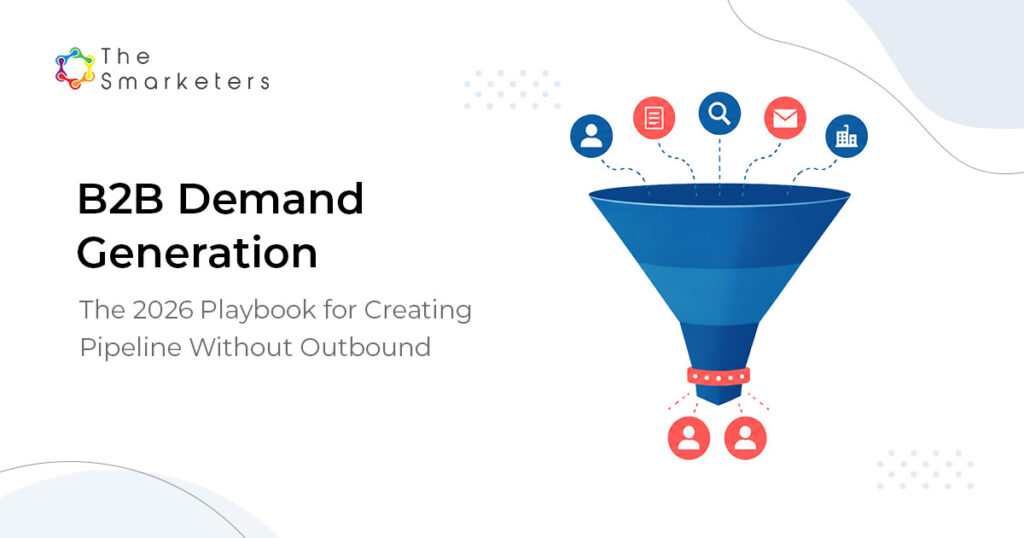
B2B demand generation is the work of creating and capturing interest in your solution across a whole buying group, then converting it into a qualified pipeline. It is broader than lead generation, which only captures the buyers already raising their hand, and broader than outbound, which interrupts them.
B2B demand generation: A system that creates demand in future buyers, captures it at the moment of intent, and converts engaged accounts into pipeline. Success is measured by qualified pipeline and pipeline velocity, not by lead volume or activity.

Why Does Outbound-Only Stop Working?
Because at any moment only about 5% of your market is in-market, and outbound competes for exactly that slice, against everyone else, bidding the cost up. Demand generation invests in the other 95% so that when they enter the market, they already know and trust you.
This is the 95-5 rule from Professor John Dawes at the Ehrenberg-Bass Institute, popularised by the LinkedIn B2B Institute: roughly 95% of business buyers are not in-market at any given time (LinkedIn B2B Institute). Outbound-only programs fish only in the 5% pond; demand generation stocks the whole lake.
~95%
How Do You Create Demand (the 95%)?
By being useful and visible where future buyers already are, with a real point of view: thought leadership, community presence, dark social, and ungated, answer-shaped content that spreads and gets cited by AI tools. The goal is familiarity and trust long before a buyer is ready to talk.
- Publish a point of view. Take a clear position on a problem your buyers recognize. Generic best-practice content is ignored by people and by AI engines alike.
- Show up in dark social. Feeds, communities, and podcasts are where buying conversations happen, invisible to your analytics, which is why rivals skip them.
- Build topical authority. Cover a topic in depth so both search and AI treat you as a credible source.
How Do You Capture Demand (the 5%)?
By being visible and easy to choose the moment a buyer starts looking: high-intent SEO, answer engine and generative engine optimization, intent data, and retargeting engaged accounts. Capture converts the demand creation you have already built, so the two must run together.
What Metrics Actually Predict Revenue?
Pipeline velocity, qualified opportunities, win rate by source, average deal value, and sales-cycle length. These tie to revenue and resist gaming. Lead volume and cost-per-lead can rise while pipeline stays flat, which is why Forrester retired the MQL in favour of buying-group pipeline metrics.
Forrester found a lead-centric process converts at under 1% from inquiry to closed-won, and has moved the industry from the MQL waterfall to a buying-group revenue model (Forrester). Measure the group and the pipeline, not the individual form fill.
| Vanity Metric | Revenue Metric |
|---|---|
| Lead volume | Qualified pipeline and pipeline velocity |
| Cost per lead | Cost per qualified opportunity |
| Form fills | Win rate by source |
| MQL count | Buying-group engagement |
Your 90-Day Demand Generation Plan
- Days 1–30. Fix tracking and CRM data, define qualified pipelines with sales, and ship a few point-of-view assets.
- Days 31–60. Launch capture (SEO, AEO, intent), and align on a real lead-to-pipeline SLA.
- Days 61–90. Multi-thread engaged accounts, double down on what converts, and report pipeline velocity to leadership.
Want a pipeline that doesn't depend on outbound?
Frequently Asked Questions
What is B2B demand generation?
It is the work of creating and capturing interest in your solution across a whole buying group, then converting it into a qualified pipeline. It is broader than lead generation, which only captures buyers already raising their hand, and broader than outbound, which interrupts the small in-market slice.
Why does outbound-only marketing stop working?
Because only about 5% of your market is in-market at any time, and outbound competes for exactly that slice against everyone else, bidding the cost up. Demand generation invests in the other 95% so they know and trust you before they enter the market.
How do you create demand versus capture it?
Creating demand means being useful and visible to future buyers through point-of-view content, community, and dark social. Capturing demand means being easy to find and choose when buyers start looking, through high-intent SEO, AEO and GEO, intent data, and retargeting. You need both, run together.
What metrics predict revenue in demand generation?
Pipeline velocity, qualified opportunities, win rate by source, average deal value, and sales-cycle length. These tie to revenue and resist gaming. Forrester retired the MQL because lead-centric funnels convert at under 1%; measure the buying group and pipeline, not individual form fills.
How long does B2B demand generation take?
Capture tactics can produce leads in weeks, but durable pipeline usually compounds over about 90 days, and demand creation pays off across two to three quarters as awareness and trust build. Programs judged only on month-one leads are often cut just before they would have worked.

Siddharth Rampelli
Senior Growth Marketing Manager