Table of Contents
- Total Cost of Ownership: The License Is the Smallest Number
- Implementation Complexity and Timeline: Speed Is a Risk Metric
- Manufacturing-Specific Features: What Each Platform Actually Offers
- Integration with ERP and PLM Systems: Where Manufacturing Deals Are Won and Lost
- When HubSpot Wins vs When Salesforce Wins
- Common Mistakes in Manufacturing CRM Selection
- What a Working System Looks Like: 300+ Opportunities in 4 Weeks
- The Smarketers Recommendation
- Frequently Asked Questions
Need help with B2B Marketing?
Let the smarketers’ team drive your pipeline with data-led campaigns and AI-powered growth strategies.
A manufacturing sales director we spoke with described her CRM this way: “We pay for a system nobody opens. The real pipeline lives in a spreadsheet the plant managers keep.” Her company had bought an enterprise CRM three years earlier, customized it heavily, lost the consultant who understood the customization, and watched adoption collapse to the sales-ops team of one. The license renewal was coming up, and the honest question on the table was not “which CRM has more features.” It was “which CRM will our people actually use.”
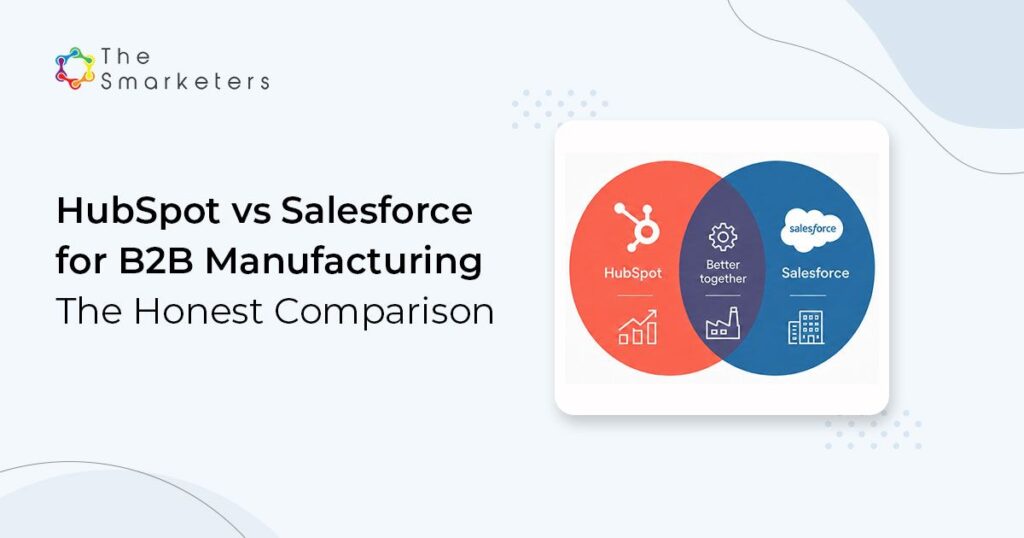
That is the right frame for HubSpot vs Salesforce in manufacturing, and here is the direct answer up front: HubSpot usually wins for small and mid-market manufacturers, for teams without a dedicated CRM admin, and for companies where marketing, sales, and service need to share one system. Salesforce usually wins for large enterprises with deeply custom quote-to-cash processes, a staffed admin team, and complex multi-entity structures. Everything below is the reasoning, the costs, and the manufacturing-specific detail behind that answer, including where our own bias sits.
Full disclosure before we compare anything: The Smarketers is a HubSpot Platinum Solutions Partner. We implement HubSpot for a living, so we see more of its wins. We also see the deals where Salesforce was the right call, and we will tell you exactly what those look like, because a recommendation you cannot trust is worth nothing.
Both platforms are safe bets by market position. Salesforce leads the CRM market with roughly a 20.7% share according to IDC, while HubSpot holds about 38% of the marketing automation market and is the fastest-growing major CRM by customer count, ending 2025 with roughly 288,700 customers and $3.13B in revenue, up 19% year over year. Neither is going away. The question is fit, not survival.

Total Cost of Ownership: The License Is the Smallest Number
The honest TCO answer: HubSpot is usually meaningfully cheaper over three years for mid-market manufacturers, not because its list price is always lower, but because its cost structure has fewer categories. With CRM adoption growing at roughly 12.6% per year, vendors have learned to compete on sticker price and recover margin elsewhere. So compare structures, not quotes:
| Cost category | HubSpot | Salesforce |
|---|---|---|
| Licenses | Tiered hubs; seat-based pricing with free foundational CRM. Costs step up at Professional and Enterprise tiers. | Per-user editions; most manufacturing use cases require higher editions plus add-on clouds. |
| Implementation | Weeks to a few months for a typical mid-market scope; often handled by a solutions partner. | Months to a year for a typical enterprise scope; usually requires a systems integrator. |
| Administration | Designed for a part-time admin or power user in year two. | Typically needs one or more dedicated, certified admins on payroll. |
| Customization and development | Configuration-first; custom code is the exception. | Development-first at depth; Apex work and managed packages are common line items. |
| Integration middleware | Native connectors cover common ERP scenarios; middleware is needed for complex or legacy systems. | Vast integration ecosystem; enterprise middleware and integration user licensing add cost. |
| Training and adoption | Short ramp; interface familiar to anyone who has used modern web software. | Longer ramp; role-based training programs are usually budgeted formally. |
We deliberately avoid quoting exact license prices here because both vendors change packaging often and negotiate hard at the enterprise level. Directionally, across the manufacturing implementations we have scoped, the multi-year gap comes less from licenses and more from the two ongoing categories: dedicated administration and custom development. If you must hire two certified admins and retain a development partner to keep the system alive, that cost recurs every year the CRM does.
A practical negotiation note for either vendor: get the three-year picture in writing before signing year one. Ask specifically what the renewal uplift policy is, which features on your requirements list sit in a higher tier than the one quoted, and what the integration user or API call limits are at your tier. Manufacturers get surprised less by list prices than by discovering in month nine that the feature the quote-to-cash process depends on lives two tiers up.
Key takeaway: Price the year-two team, not the year-one project. The CRM that requires permanent specialist staffing is the more expensive CRM at almost any license price.
Implementation Complexity and Timeline: Speed Is a Risk Metric
Implementation timelines differ by roughly one order of scope: a typical mid-market manufacturing HubSpot deployment measures in weeks to a few months, while an equivalent Salesforce deployment usually measures in months to a year. That difference is not just about impatience. Long implementations carry compounding risks that manufacturing leaders know well from ERP projects: sponsor turnover, requirement drift, and the slow death of user enthusiasm before anyone logs a deal.
The deeper difference is philosophical. HubSpot is opinionated software: it assumes a broadly standard pipeline and asks you to configure within it. Salesforce is a platform: it assumes you will build your process into it, which is precisely its strength and its cost. Manufacturers with genuinely unusual commercial processes, multi-tier distribution with consignment stock, complex rebate structures, engineer-to-order quoting with hundreds of dependencies, may find HubSpot’s opinions constraining and Salesforce’s blankness liberating. Most manufacturers we assess believe their process is unusual. On inspection, perhaps two in ten actually are.
Whichever platform you choose, phase the rollout around the sales team’s trust rather than the feature list. A sequence that works consistently in manufacturing: start with pipeline and quoting visibility only, prove that reps get value back within the first month (fewer status meetings, faster quote approvals), then layer in marketing automation, then service. Rollouts that switch on everything at once train users to see the CRM as reporting overhead imposed from above, and no amount of dashboard polish recovers from that first impression.
One implementation warning that applies to both platforms: do not migrate a dirty database. Deduplicate accounts, standardize naming, and archive dead records before cutover, not after. Every week of data cleanup done pre-migration saves a month of distrust post-launch, because reps forgive a missing feature faster than they forgive wrong data.
Manufacturing-Specific Features: What Each Platform Actually Offers
Neither platform is a manufacturing system out of the box, so judge them on how well they handle the commercial patterns manufacturers actually run: long quote cycles, distributor and rep-firm channels, buying committees, and service revenue attached to installed equipment.
- Quoting and CPQ. Salesforce has the deeper native CPQ capability for engineer-to-order complexity with heavy configuration rules. HubSpot handles standard and moderately configured quoting well, and integrates with dedicated CPQ tools when product logic outgrows it.
- Channel sales. Both support partner and distributor models. Salesforce offers more elaborate partner management at enterprise tiers; HubSpot’s shared inbox, partner portals via configuration, and simpler permissioning tend to fit rep-firm networks with lighter admin.
- Buying committees. Manufacturing deals rarely have one buyer. The median B2B buying group is now 11.2 people for deals over $50K, and both CRMs model multi-contact deals. The practical edge goes to whichever system your reps will faithfully log contacts into, which is an adoption question, not a feature question.
- Service and aftermarket. If service contracts and spare-parts revenue matter, both offer service modules. HubSpot’s advantage is that service shares the same record and interface as sales and marketing; Salesforce’s advantage is depth for large field-service operations.
- Marketing integration. This is HubSpot’s home turf. For manufacturers building demand programs, running the CRM and marketing automation as one native system removes the sync failures that quietly corrupt lead handoff between separate tools.
There is also the unglamorous question of where selling actually happens in manufacturing: on the road, on the plant floor during site visits, and in the truck between them. Both platforms have capable mobile apps; the difference reps report is friction. Logging a site-visit note, snapping a nameplate photo onto the account, or checking the last order before walking into a meeting has to take seconds, or it will not happen. Whichever platform you evaluate, put the mobile workflow in front of two of your most skeptical field reps for a week before the decision meeting. Their verdict predicts adoption better than any feature matrix, and adoption is the number that decides whether the buying-committee data above ever gets captured. Marketing conversion benchmarks in the sector suggest what is at stake: manufacturing websites convert at roughly 3 to 5%, so a manufacturer’s pipeline is usually built on a small number of expensive signals. A CRM that drops even a fraction of them costs real deals.
Integration with ERP and PLM Systems: Where Manufacturing Deals Are Won and Lost
The blunt rule: map your ERP and PLM integration requirements before you shortlist a CRM, because this is the single largest source of hidden cost on both platforms. A CRM that cannot see order history, inventory availability, or engineering change status will always lose to the spreadsheet that can.
For the common mid-market ERPs, both platforms have mature paths: native or partner-built connectors exist on both sides, and middleware platforms cover the rest. The differences show at the edges. Salesforce’s integration ecosystem is broader and goes deeper into legacy and heavily customized ERP estates, at consulting rates to match. HubSpot’s connector ecosystem covers the mainstream cleanly and costs less to maintain, but a genuinely exotic legacy ERP may need custom middleware work either way. PLM integration is less standardized on both platforms; treat effortless-sounding PLM sync claims from either vendor’s sales team with skepticism, and demand a working demonstration against your actual system.
Scope the integration honestly in three tiers: what must sync in real time (usually quote, order status, and customer master data), what can sync daily (invoices, shipments), and what only needs linking, not syncing (drawings, spec documents). Most manufacturing CRM integrations fail by over-scoping tier one. Real-time everything is an expensive way to sync data nobody checks in real time.
When HubSpot Wins vs When Salesforce Wins
Our assessment framework, the Manufacturing CRM Fit Test, comes down to five questions. Answer them honestly and the decision usually makes itself:

| Choose HubSpot when... | Choose Salesforce when... |
|---|---|
| You are a small or mid-market manufacturer without a dedicated CRM admin team. | You have (and will keep funding) certified admins and a development partner. |
| Marketing, sales, and service need one shared record and one interface. | Sales operations is the center of gravity and other functions run their own systems. |
| Your quoting is standard or moderately configured. | Engineer-to-order CPQ with deep configuration rules is core to how you sell. |
| You need adoption fast, from field reps and channel partners who hate software. | Your organization has proven it can drive adoption of complex enterprise tools. |
| ERP integration needs are mainstream and connector-based. | You run a heavily customized or multi-instance ERP estate needing deep custom integration. |
| You want demand generation and CRM in one native system. | You already run a separate, entrenched marketing automation stack you will not replace. |
Notice what is absent from that table: feature counts. At the tiers manufacturers actually buy, both platforms pass the capability bar for pipeline management, forecasting, and reporting. The columns above are about organizational fit, and organizational fit is why the same platform can be a success story at one manufacturer and shelfware at its competitor across town. Be equally suspicious of anyone who says HubSpot cannot scale (its enterprise tier runs serious sales organizations) and anyone who says Salesforce is always worth the overhead (for a 15-rep industrial distributor, it rarely is).
Smarketers insight: The most reliable predictor we see is the year-two admin question. Companies that cannot name who will administer the CRM in eighteen months should not buy the platform that assumes someone will.
Common Mistakes in Manufacturing CRM Selection
Four failure patterns account for most of the CRM regret we encounter in manufacturing, and they apply regardless of which platform you pick:
- Buying for the org chart you want, not the one you have. A CRM selected for a future 12-person sales-ops team, operated by one overloaded coordinator, fails on schedule.
- Letting IT or procurement choose alone. The daily users are field reps and inside sales. If they were not in the evaluation, expect the spreadsheet shadow-CRM within a quarter.
- Migrating everything. Ten years of dead accounts and abandoned opportunities do not become an asset in a new system. They become the reason nobody trusts it.
- Skipping the demand-generation question. A CRM full of manually keyed contacts is a filing cabinet. Decide up front how leads will actually enter the system, because a CRM cannot fix an empty top of the funnel.
And one honest caveat about the comparison itself: if you are a global enterprise manufacturer with thousands of sales users, multi-entity consolidation, and a decade of Salesforce customization already embedded in your operations, this comparison is largely academic. Migration cost and risk at that scale usually outweigh platform preference, and the better investment is making your existing instance work.
What a Working System Looks Like: 300+ Opportunities in 4 Weeks
Before: a Fortune 500 industrial automation company with strong products, a capable sales team, and a demand engine that was not feeding them. Lead flow was expensive and inconsistent, and pipeline visibility across marketing and sales was fragmented.
After: 300+ sales opportunities generated in four weeks, with cost per lead cut by 90% (Smarketers client engagement).
The bridge: an integrated, HubSpot-based demand and ABM program in which the CRM, marketing automation, and reporting ran as one system. Targeting and content did the demand work; the platform’s job was making every response visible, routable, and attributable within minutes rather than days. That is the standard a manufacturing CRM should be held to: not feature count, but how fast a buyer signal becomes a seller action.

The Smarketers Recommendation
For most small and mid-market B2B manufacturers, HubSpot is the better commercial decision: faster to deploy, cheaper to keep alive, and far more likely to be used by the people who touch revenue. For large enterprises with custom quote-to-cash processes and staffed admin teams, Salesforce earns its complexity. If you sit in the middle, run the Fit Test above with your real staffing plan, not your aspirational one.
If you want a second opinion grounded in your actual systems, our team runs CRM assessments as part of our HubSpot services practice: current-state audit, ERP integration mapping, migration scoping, and an honest read on whether HubSpot fits, informed by the demand generation programs the CRM ultimately has to serve.
Next step: Get a CRM Assessment and get a documented fit recommendation for your manufacturing sales process before you sign anything.
Frequently Asked Questions
How long does a HubSpot implementation take for a manufacturer?
For a typical mid-market manufacturer, expect weeks to a few months depending on data quality, ERP integration scope, and quoting complexity. The single biggest schedule variable is how clean your account and contact data is before migration, so start the cleanup before the project.
Can we run both HubSpot and Salesforce together?
Yes, and some manufacturers do: Salesforce as the sales system of record with HubSpot for marketing. A supported native sync exists. It works, but you inherit ongoing sync governance, duplicate-record risk, and two license bills, so we recommend it as a transition state rather than a destination.
What does CRM migration cost beyond the software?
Budget for data cleanup, integration work, training, and temporary productivity loss during cutover. Directionally, services and internal time often equal or exceed the first-year license cost on either platform. The recurring year-two costs, admin staffing and custom development, are where the platforms genuinely diverge.
Which CRM integrates better with SAP or other major ERPs?
Both have mature connector paths for mainstream ERP systems, directly or through middleware. Salesforce goes deeper into heavily customized and legacy estates at higher consulting cost; HubSpot covers standard scenarios with less maintenance overhead. Demand a working demonstration against your actual ERP instance before deciding.
Is HubSpot capable of handling long manufacturing sales cycles?
Yes. Multi-year cycles with buying committees are a pipeline configuration and process question, not a platform limitation. Model deal stages on your real quote-to-order flow, track committee contacts on every deal, and use automation to keep long-dormant deals visible instead of forgotten.
When is Salesforce clearly the right choice for a manufacturer?
When engineer-to-order CPQ complexity is core to selling, when you run a large multi-entity enterprise with dedicated admin staff, or when a decade of existing Salesforce customization makes migration riskier than optimization. In those cases we say so in assessments, despite being a HubSpot partner.
How should we measure whether the new CRM is working?
Pick metrics the old system could not deliver: speed from inquiry to first sales touch, percentage of deals with complete buying-committee data, pipeline coverage by product line, and marketing-sourced opportunity value. Adoption metrics matter for the first two quarters; revenue metrics matter after that.
Do we need a demand generation program before the CRM matters?
You need both, but sequence matters less than integration. A CRM without lead flow is an empty filing cabinet; demand programs without a CRM lose what they capture. Scope them together, which is exactly why our CRM assessments include a demand-generation readiness review.

Venugopal Mamidala
Director of MarTech