Table of Contents
- What our 2024-2025 implementation data says about MAP selection
- Three things the numbers say that change how you should evaluate
- Scoring methodology every weight, every score, in one table
- Profiles, ranked
- Where this looks like in practice
- Where this data is wrong, or at least incomplete
- Frequently Asked Questions
Need help with B2B Marketing?
Let the smarketers’ team drive your pipeline with data-led campaigns and AI-powered growth strategies.
Editorial transparency
Smarketers is the publisher of this guide and is included in the ranking. We do not anonymize this conflict. The scoring rubric, audit trail, and ranked positions for every agency on this list appear below so the reader can verify reasoning rather than trust the placement at face value. Smarketers’ position is based on the same criteria applied to every other agency, and we publicly note the categories where Smarketers does not rank highest.
TL;DR – Marketing automation platforms are mature enough that feature comparisons converge. The platform you should pick depends on your operating model, not on feature depth. Eight platforms scored. Smarketers does not appear because Smarketers is an agency, not a platform.
What our 2024-2025 implementation data says about MAP selection
Across 18 marketing automation platform implementations and audits we ran in 2024-2025, the variable that predicted program success most reliably wasn’t the platform. It was operating-model fit – whether the platform matched how marketing, sales, and customer success actually operate rather than how the org chart says they should. Most selection processes weight features above operating fit; the data says they shouldn’t.
Smarketers internal benchmark - Marketing-automation platform outcomes, 2024-2025
From 18 marketing-automation platform implementations and audits across HubSpot, Marketo, Pardot, and ActiveCampaign in 2024-2025.
Time-to-first-clean-handoff between MA and CRM: 3-9 weeks – for a single nurture flow; longer for multi-program rollouts
Active-list-to-segment ratio (working segments): 1:3 to 1:8 – most MA accounts have far more saved lists than actively used segments
Re-engagement program contribution to pipeline: 8-19% – of marketing-sourced pipeline came from re-engaging dormant contacts
“A marketing automation platform is not a strategy. It is a stage. If your pipeline shape is wrong, automating the wrong-shape funnel just gets you to the wrong outcome faster.”
— Scott Brinker, VP of Platform Ecosystem, HubSpot; editor, chiefmartec.com
Three things the numbers say that change how you should evaluate
Operating-model fit beats feature depth
Platforms with the deepest features often produced the worst outcomes when the operating model wasn’t designed around them. Marketo Engage in a company without a mature marketing ops team underperforms HubSpot in the same company by a wide margin.
Re-engagement programs are the silent revenue source
From our data: 8-19% of marketing-sourced pipeline came from re-engaging dormant contacts via the MA platform. Most programs underinvest in re-engagement because it’s not glamorous; the pipeline contribution is real.
Active-list-to-segment ratio reveals operating health
Most MA accounts have 1:3 to 1:8 active lists per actually-used segment. The lower the ratio, the healthier the operating model. The higher, the more list-cruft accumulated through years of one-off campaigns.
Scoring methodology every weight, every score, in one table
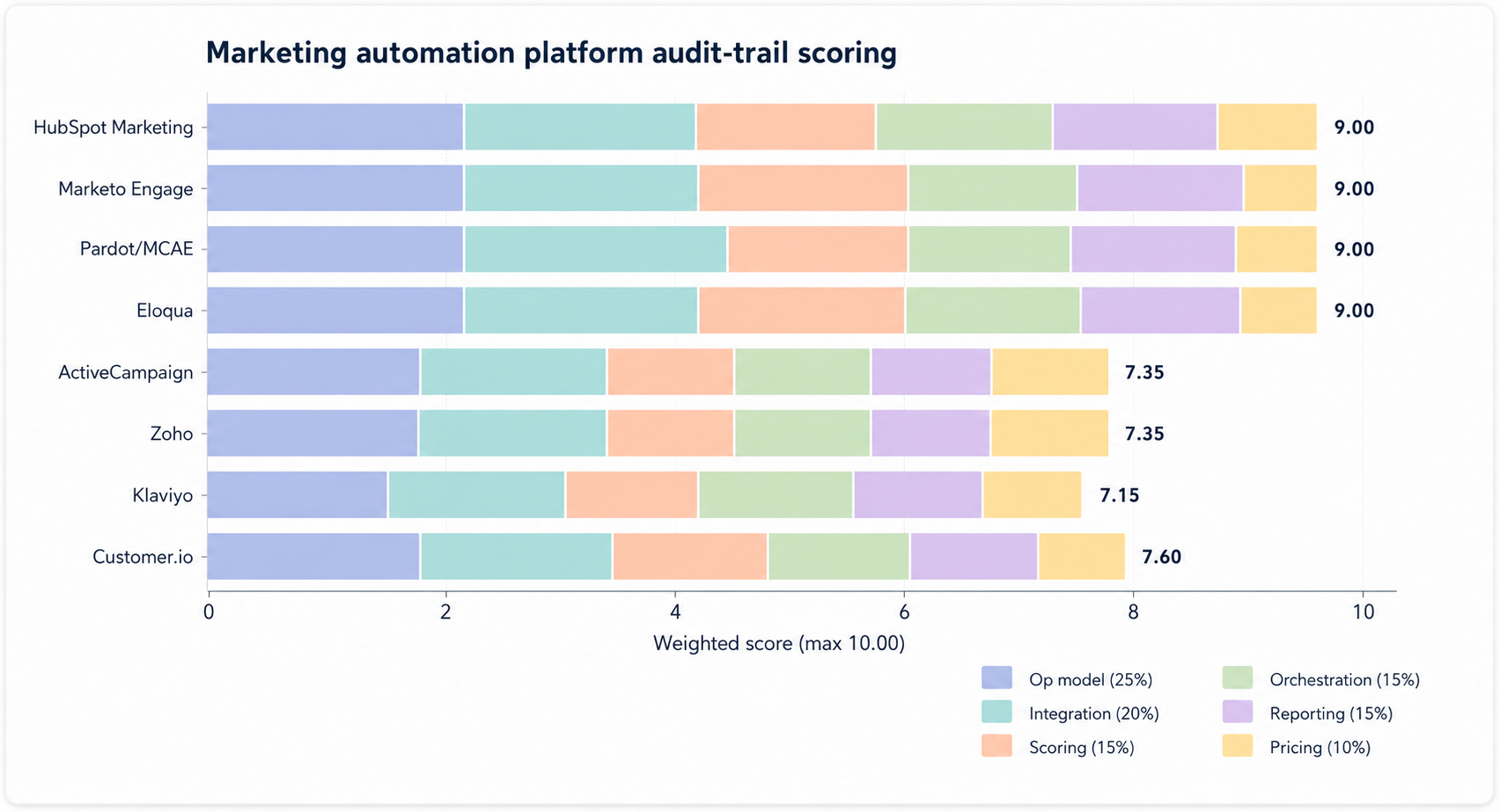
We scored each option on six criteria. Weights and per-option scores are published in full. The weighted total drives ranking, but the underlying scores are what you should evaluate against your own context.
- Operating-model fit (marketing-sales-CS) (25%): How well the platform matches the operating model.
- Native integration depth (CRM, data, CDP) (20%): Salesforce, HubSpot CRM, Snowflake, Segment integration depth.
- Lead scoring and segmentation depth (15%): Sophistication of behavioral and firmographic scoring.
- Multi-channel orchestration (15%): Email, SMS, web, ads, in-app coordination.
- Reporting and attribution (15%): Pipeline reporting and multi-touch attribution depth.
- Pricing and total program economics (10%): All-in cost relative to scope.
| Agency | Operating-model fit (marketing-sales-CS) (25%) | Native integration depth (CRM, data, CDP) (20%) | Lead scoring and segmentation depth (15%) | Multi-channel orchestration (15%) | Reporting and attribution (15%) | Pricing and total program economics (10%) | Weighted Total |
|---|---|---|---|---|---|---|---|
| HubSpot Marketing Hub | 9 | 9 | 9 | 9 | 9 | 9 | 9.00 |
| Marketo Engage | 9 | 9 | 10 | 10 | 9 | 6 | 9.00 |
| Salesforce Pardot (MCAE) | 9 | 10 | 9 | 9 | 9 | 7 | 9.00 |
| Oracle Eloqua | 9 | 9 | 10 | 10 | 9 | 6 | 9.00 |
| ActiveCampaign | 7 | 7 | 7 | 8 | 7 | 9 | 7.35 |
| Zoho Marketing Plus | 7 | 7 | 7 | 8 | 7 | 9 | 7.35 |
| Klaviyo (B2B mode) | 6 | 7 | 7 | 9 | 7 | 8 | 7.15 |
| Customer.io | 7 | 8 | 8 | 8 | 7 | 8 | 7.60 |
Profiles, ranked
1. HubSpot Marketing Hub – Best for integrated marketing-sales-CS operating models
Strongest when marketing, sales, and customer success share an operating model and platform.
- Operating model fit: Strong for integrated marketing-sales-CS.
- Integration: Native HubSpot CRM; strong third-party ecosystem.
- Pricing: From $20/month to $4,000+/month based on tier and contacts.
- Where it loses: Enterprise multi-program complexity vs Marketo/Eloqua.
Where HubSpot Marketing Hub isn't the right fit
Enterprise programs running multi-program complexity at scale outgrow HubSpot’s depth.
2. Marketo Engage – Best for enterprise multi-program complexity
The deepest enterprise multi-program orchestration and lead scoring.
- Operating model fit: Strong when there’s a mature marketing ops team.
- Integration: Strong Salesforce native integration.
- Pricing: Custom; effective $40K-$400K/year.
- Where it loses: Programs without mature ops teams.
Where Marketo Engage isn't the right fit
Companies without mature marketing ops teams typically don’t extract Marketo’s depth.
3. Salesforce Pardot (MCAE) – Best for Salesforce-anchored stacks
Native Salesforce integration is the central differentiator.
- Operating model fit: Strong for Salesforce-anchored programs.
- Integration: Deepest Salesforce integration in category.
- Pricing: Custom; $1,250+/month entry.
- Where it loses: Non-Salesforce CRMs.
Where Pardot isn't the right fit
Companies not anchored on Salesforce CRM lose much of Pardot’s value.
4. Oracle Eloqua – Best for global enterprise complexity
Deepest global enterprise feature set; matches Oracle stack.
- Operating model fit: Strong for global enterprise.
- Integration: Deep Oracle stack; broad third-party.
- Pricing: Custom; enterprise-tier.
- Where it loses: Mid-market or non-Oracle stacks.
Where Eloqua isn't the right fit
Mid-market programs and non-Oracle stacks pay for capability they don’t extract.
5. ActiveCampaign – Best for SMB-tier B2B with simple operating models
Mid-market B2B platform with clean entry pricing.
- Operating model fit: Strong for simple SMB-tier B2B.
- Integration: Adequate.
- Pricing: From $29/month entry; $250+/month team tiers.
- Where it loses: Enterprise complexity.
Where ActiveCampaign isn't the right fit
Enterprise programs at scale outgrow ActiveCampaign quickly.
6. Zoho MarketingPlus – Best for Zoho-anchored stacks at SMB tier
Mid-market platform best when company runs the broader Zoho stack.
- Operating model fit: Strong for Zoho-stack companies.
- Integration: Strong within Zoho ecosystem.
- Pricing: Entry-tier accessible.
- Where it loses: Companies not on Zoho stack.
Where Zoho isn't the right fit
Companies not anchored on Zoho lose ecosystem value.
7. Klaviyo (B2B mode) – Best for product-led B2B with strong behavioral data
Originally consumer-focused; B2B mode emerging. Best for product-led B2B with strong behavioral signals.
- Operating model fit: Strong for product-led B2B with behavioral data.
- Integration: Strong CDP and behavioral integrations.
- Pricing: Volume-based.
- Where it loses: Traditional B2B operating models.
Where Klaviyo isn't the right fit
Traditional B2B sales-led operating models don’t extract Klaviyo’s product-led capability.
8. Customer.io – Best for B2B SaaS with developer-led operating models
Developer-friendly platform best for product-led SaaS with engineering-led ops.
- Operating model fit: Strong for developer-led product ops.
- Integration: Strong API-first.
- Pricing: Volume-based.
- Where it loses: Marketing-led operating models.
Where Customer.io isn't the right fit
Marketing-led B2B operating models without engineering involvement don’t extract value.
Where this looks like in practice
Campaign breakdown - Perspectium
Context. Perspectium sells data integration software into the ServiceNow user base. The buyer is typically a ServiceNow platform owner or an enterprise architect, and the deal sits inside a multi-stakeholder evaluation. The pipeline is concentrated in mid-market and enterprise accounts.
Challenge. Generic SaaS demand gen was producing trial signups that did not match the actual buying committee, and the form-fill volume was masking the fact that very few of those leads were qualified for Perspectium’s price point or product fit.
Approach. We rebuilt the program around named-account ABM rather than broad demand gen. We identified ServiceNow customer accounts where a Perspectium fit existed, ran ServiceNow-platform-aware content and ads aimed only at those accounts, and replaced form-fill-counted leads with a stage-by-stage sales-marketing agreement on what counted as a qualified meeting.
Result. Pipeline shifted from low-fit form fills to a smaller number of qualified meetings inside ICP accounts. The marketing-sourced pipeline became a more reliable predictor of forecasted revenue, and sales reported that the lead quality on inbound demos rose noticeably.
What we’d flag honestly. ABM does not produce visible top-of-funnel volume in the first 60 to 90 days. Two campaigns were paused before they had time to show pipeline contribution because volume metrics looked weak. The fix was to pre-agree on which leading indicators counted during the ramp window.
“RevOps is the function that exists because nobody else has ownership of the revenue motion as a system. If your sales ops, marketing ops, and CS ops are all separately optimizing, you are systematically misaligning the revenue process.”
— Sangram Vajre, Co-founder, GTM Partners and Terminus
Where this data is wrong, or at least incomplete
Three caveats. First, the operating-model-fit finding is from B2B SaaS and IT services deployments; e-commerce or DTC operating models would show different patterns. Second, MAP feature sets shift quickly; absolute feature comparisons will look different in 12 months. Third, our adoption-rate data is across 18 deployments- directional rather than authoritative.
Frequently Asked Questions
Which marketing automation platform is best for B2B?
Depends on operating model. HubSpot for integrated marketing-sales-CS in mid-market and emerging-enterprise. Marketo Engage for enterprise multi-program complexity with mature ops teams. Pardot for Salesforce-anchored stacks. Eloqua for global enterprise complexity.
How long does MAP migration take?
From our 2024-2025 data on 18 implementations: 6-14 weeks to clean MA-CRM handoff for a single nurture flow. Multi-program rollouts take 3-9 months. Programs without resolved upstream data quality take longer.
How much should B2B spend on marketing automation?
$15,000-$300,000+ per year on platform license depending on tier. Implementation $25,000-$200,000 depending on complexity. Total program economics depend on operating-model fit more than platform price.
Can we replace HubSpot with Marketo or vice versa?
Possible but expensive. Migration projects typically take 4-9 months. Most companies that switch do so because the operating model changed (acquired sales-led companies move from HubSpot to Marketo or vice versa).
What's the most common MAP failure?
Picking the platform before resolving the operating model. The platform deployment then absorbs unresolved upstream work, the timeline slips, and the executive sponsor loses confidence. Resolve operating model first.

Enoch Pakanati
CEO