Table of Contents
- What is the most common real GEO harm in B2B?
- Why Do LLMs Favour Competitor Comparison Pages Over Your Own Site?
- How to Audit What AI Models Say About Your Brand (Step by Step)
- What kind of counter-content actually displaces a comparison page?
- How Does Third-Party Correction Work in a Defensive GEO Strategy?
- When should you publish your own versus page?
- How Do You Monitor GEO Drift After Competitor Narrative Remediation?
- When does legal escalation backfire?
- When This Defensive GEO Strategy Does Not Apply
- Frequently Asked Questions
Need help with B2B Marketing?
Let the smarketers’ team drive your pipeline with data-led campaigns and AI-powered growth strategies.
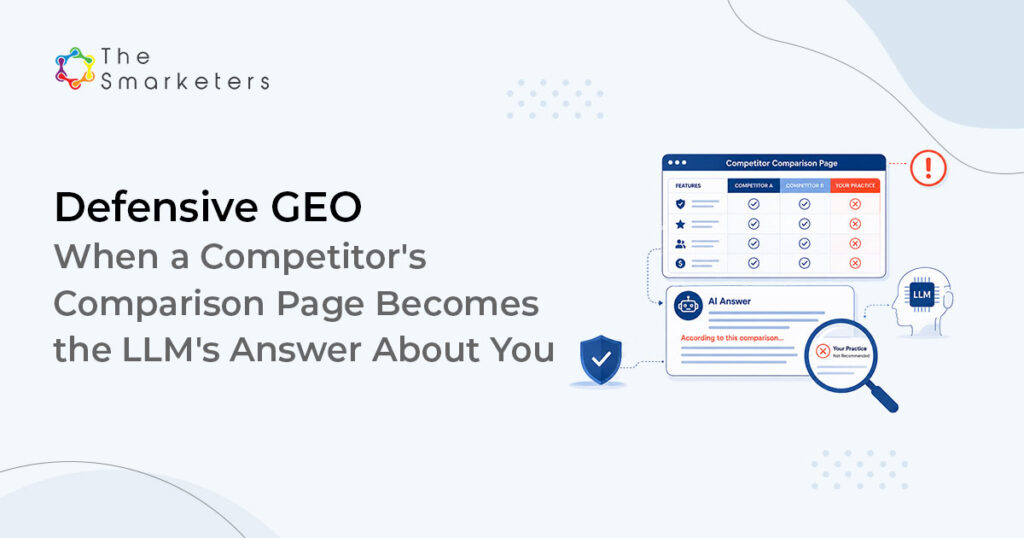
The most expensive thing a competitor can publish about you is a comparison page you never read. When competitor comparison page GEO goes unmanaged, that rival’s page becomes the canonical answer machines give about your product – and publishing your own versus page rarely displaces it. Correction runs through third-party surfaces the model already trusts: review platforms, analyst notes and community threads. Your own site is the weakest lever in a defensive GEO strategy.
That is uncomfortable, because the versus page is the reflex and the cheapest thing to commission.
What is the most common real GEO harm in B2B?
Not hallucination. The frequent harm is accurate citation of a biased source. A competitor writes a comparison table, positions your product on criteria they chose, and publishes it. The model retrieves it, summarises it fairly, attributes it. Nothing is fabricated. The framing is simply not yours.
The second harm is staleness. A model describes pricing you retired, an integration you deprecated or a limitation you fixed two releases ago, because that source is still the most cited thing written about you.
STAT
68% of B2B buyers already have a front-runner vendor in mind when the buying process begins, and that front-runner wins 80% of the time. Source: Forrester, presented at the B2B Summit, 2026.
That is why this matters commercially. The comparison answer is read before you know a buying cycle exists, at the moment the front-runner gets chosen.
Why Do LLMs Favour Competitor Comparison Pages Over Your Own Site?
Because comparison pages are shaped like answers. They carry named entities, explicit criteria, structured tables and direct claims. When a buyer asks which of two vendors suits a use case, a comparison page supplies a ready-made structure that fits the question with almost no synthesis.
Your product page does not. It carries positioning, benefits and a call to action, and asserts nothing about alternatives. Even ranking perfectly in conventional search, it is a poor retrieval candidate for a comparative question.
| Content type | Retrievability for a comparative query | Why |
|---|---|---|
| Competitor comparison page | High | Named entities, criteria, structured claims |
| Third-party review page | High | Multiple opinions, structured attributes |
| Analyst or category report | High | Independent and evaluative |
| Your product page | Low | No comparison, no named alternatives |
| Your case study | Medium | Specific outcome but single-vendor |
How to Audit What AI Models Say About Your Brand (Step by Step)
Run a GEO brand audit manually before buying a monitoring tool – the first pass is diagnostic rather than continuous. The goal is to identify which six to twelve domains currently supply the narrative about your brand and whether those claims are accurate.
Run four question types across the engines your buyers use – the same engines and prompt format we cover in our guide to measuring AI search visibility.
| Question type | Example wording | What it exposes |
|---|---|---|
| Direct | What is [brand], is [brand] any good | Baseline description accuracy |
| Comparative | [brand] versus [competitor], alternatives to [competitor] | Whose framing is winning |
| Fit | Best tool for [use case] in [industry] | Whether you are a candidate at all |
| Objection | Is [brand] expensive, does it integrate with [platform] | Stale pricing and feature claims |
For each answer record three things: the claim made about you, whether it is accurate, and every source cited. The source list is the real output. It shows which handful of domains supply the narrative, usually the same six to twelve URLs across every question.
VISUAL 1 · CAPTURE THIS
Screenshot of a ChatGPT answer to a “brand A versus brand B” query with the citation sidebar expanded, showing which domains the answer drew from. Annotate the competitor-owned source and the two third-party sources, and mark which claim came from which.
What kind of counter-content actually displaces a comparison page?
Not a mirror-image versus page. Matching a competitor’s comparison format on your own domain rarely displaces it in AI retrieval, because the model already has a trusted source and yours carries obvious commercial interest. The competitor comparison page GEO pattern that works is narrower and less satisfying to write.
Build a criteria page rather than a comparison page. Instead of arguing you beat a named rival, publish the category’s evaluation criteria with the tradeoffs stated honestly, including where a different architecture is the better choice. It is retrievable for the same comparative queries and reads as reference material, not a sales argument.
To fix AI claims about your brand that are stale or inaccurate, publish a dated facts page: current pricing model, integrations, certifications, deployment options and limits, in HTML with dates. Most staleness harm is fixed here, because you have given retrieval systems a more recent and specific source than the one they were using.
We ran this for an infrastructure software client whose category answers were framed entirely by one rival’s comparison hub. We did not publish a versus page. We shipped a criteria page, a dated facts page, and spent eight weeks correcting records on four review platforms and two community threads. Within a quarter the answers cited three sources instead of one, and the description of the client’s deployment model was accurate for the first time.
PROOF POINT
A cybersecurity client, ProArch, achieved 3X organic growth through this kind of work – the same approach we apply in our AEO and GEO programme for cybersecurity firms: correcting and expanding the third-party record rather than out-publishing competitors on owned pages.
How Does Third-Party Correction Work in a Defensive GEO Strategy?
This is the lever with the most weight and the least glamour.
STAT
Roughly 84% of AI citations come from earned media and third-party sources. Source: research presented at MozCon, 2026.
Work the sources your audit surfaced, in the order they appeared. On review platforms the fix is volume and recency of detailed customer reviews, not a vendor response. On analyst and trade writing it is a briefing with current data. On community threads it is a named employee answering the actual question, disclosed as an employee, without a pitch.
| Surface | Realistic time to influence answers | Cost pattern |
|---|---|---|
| Review platforms | 6 to 12 weeks | Customer outreach effort |
| Community threads | 4 to 8 weeks | Employee time, ongoing |
| Analyst and trade notes | One to two quarters | Briefing programme |
| Category directories | 2 to 4 weeks | Low, mostly admin |
| Your own site | Slow and partial | Content production |
Directories are the underrated row. Quick, cheap, factual and frequently cited, and most B2B companies have inaccurate listings on at least three.
When should you publish your own versus page?
There is a narrow case. Publish one when buyers are actively searching your brand plus a competitor name in conventional search and no neutral third-party comparison exists, or when a factual error needs a citable rebuttal on the record.
Do not publish one to change what a model says about you. It is a source with an obvious interest, and it competes for retrieval against material the model has less reason to discount. A versus page can be good conventional SEO and near-worthless defensive GEO at the same time, which is why we treat the two as separate budget lines in AEO and GEO services.
STAT
Roughly 84% of AI citations come from earned media and third-party sources. Source: research presented at MozCon, 2026.
How Do You Monitor GEO Drift After Competitor Narrative Remediation?
Your AI brand narrative decays without monitoring. Models refresh, sources get re-crawled, and a competitor publishes an update. Re-run the same audit questions monthly, with identical wording, logging the same three fields. Consistent wording matters more than question volume. Teams managing multiple clients or categories find this easier to maintain with the automated AEO and GEO workflow we publish separately.
Watch two indicators. Source concentration, meaning how many distinct domains the answers draw on, where more is better and one is dangerous. And claim accuracy, scored per answer as accurate, stale or wrong. A rising source count with flat accuracy means new sources are repeating an old error.
When does legal escalation backfire?
Rarely worth it, and usually counterproductive. Factually defensible comparative claims are lawful in most commercial contexts, and a takedown demand against one generates exactly the coverage that gets indexed, discussed and cited.
Escalate where a claim is demonstrably false and material, where a trademark is misused, or where confidential material has been published. Even then the practical route is a correction request with evidence attached, not a letter.
When This Defensive GEO Strategy Does Not Apply
Third-party correction assumes third parties exist. In categories with no review platforms and no active communities, the middle of this playbook is unavailable, and the realistic option is analyst relationships plus a dated facts page, which moves slowly.
It also assumes the competitor’s claims are broadly accurate. If a rival is publishing genuinely false statements, LLM brand protection becomes a legal and communications matter first and a retrieval matter second, and treating it purely as GEO wastes time.
Finally, remediation does not equal preference. Getting the model to describe you accurately removes a disadvantage; it does not create a reason to buy. Buyers use an average of seven information sources according to Gartner research published in May 2026, and correcting one of them changes less than teams expect. The rest is positioning work, which is where an AEO measurement stack guide should be pointed once the record is clean.
VISUAL 2 · CAPTURE THIS
Screenshot of a brand narrative audit tracker in Google Sheets with columns for question, engine, claim, accuracy rating and cited sources, filtered to show only stale claims. Annotate the source domain appearing most often across the stale rows.
Frequently Asked Questions
What is the competitor comparison page GEO and why does it matter?
Competitor comparison page GEO is the discipline of managing what AI systems say about your brand when a rival’s comparison page has become the primary source for those answers. It matters because 68% of B2B buyers have a front-runner vendor in mind before the formal buying process begins (Forrester, 2026), and that front-runner is often chosen based on AI-generated comparison answers – answers your competitor may be framing on your behalf.
A competitor's comparison page ranks for my brand name. What do I do?
Audit which sources the answers cite before reacting. If the comparison page is one of several, the fix is adding accurate third-party records so it stops being the only voice. If it is the sole source, publish a dated facts page and work review platforms and communities, which carry more retrieval weight than your own site.
What does ChatGPT say about my company, and how do I check?
Ask four question types across the engines your buyers use: direct brand questions, comparatives against named rivals, fit questions for your use case, and objection questions about price or integrations. Record the claim, whether it is accurate, and every cited source. Six to twelve domains usually supply the narrative.
How do I fix incorrect AI-generated claims about my product?
Give retrieval systems a better source. Publish a dated facts page in HTML covering pricing model, integrations, certifications and limits, then correct the third-party records your audit surfaced, starting with directories. Most incorrect claims are stale rather than invented, and staleness is fixed by supplying something more recent.
Should I publish a versus page against my competitor?
Only for conventional search demand, or to put a factual correction on the record. It rarely changes what a model says, because it is an obviously interested source competing against material the model has less reason to discount. A criteria page covering honest category tradeoffs is more retrievable for the same questions.
How long does defensive GEO take to show results?
Directory corrections can influence answers in two to four weeks. Review platforms and community threads typically take six to twelve weeks. Analyst and trade coverage runs one to two quarters. Owned content is the slowest and least reliable of the four, which is the opposite of how most teams sequence the work.
Is legal action worth it against an unfair comparison page?
Usually not. Defensible comparative claims are lawful in most commercial contexts, and a takedown demand tends to generate coverage that gets indexed and cited, enlarging the problem. Reserve escalation for demonstrably false and material claims, trademark misuse or leaked confidential material, and start with an evidenced correction request.

Enoch Pakanati
CEO