Need help with B2B Marketing?
Let the smarketers’ team drive your pipeline with data-led campaigns and AI-powered growth strategies.
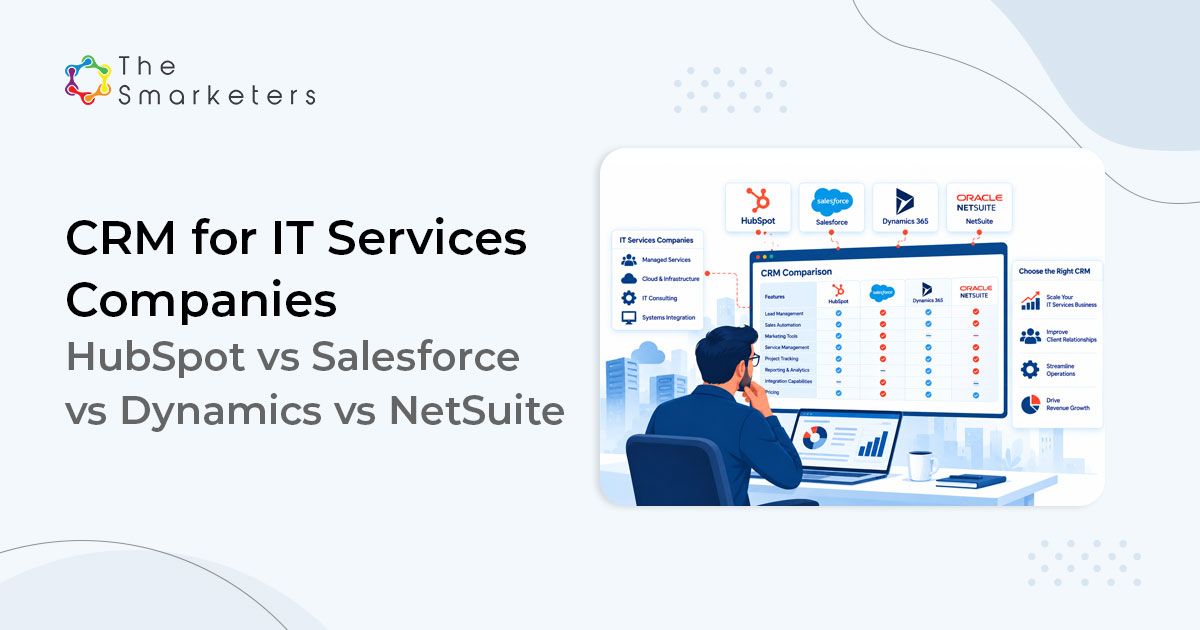
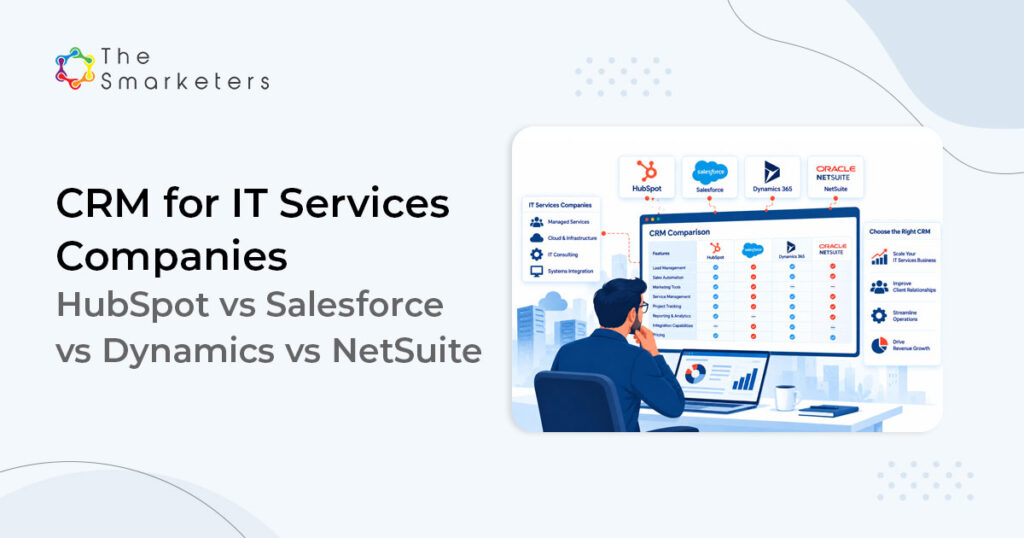
Choosing a CRM for IT services companies comes down to four things a generic review never covers: whether a bid can be modeled as something other than a deal, whether delivery capacity is visible during the sale, how the CRM meets your PSA, and what multi-entity reporting costs. This comparison of HubSpot, Microsoft Dynamics 365, NetSuite and Salesforce is for services leaders and RevOps teams, and most of it applies to any CRM for professional services firms. Each platform is assessed against the rubric below and listed alphabetically.
In short: Dynamics 365 or NetSuite usually fit firms whose finance already runs on that platform family, Salesforce fits complex bid structures, and HubSpot fits marketing-led firms that keep delivery data in a separate PSA.
How we assessed CRMs for IT services firms
Five criteria, weighted towards the services-specific problems, since every platform here handles ordinary pipeline management competently. Scores come from public product documentation and pricing pages read on 14 September 2026. Excluded: proposal and PSA tools that do not function as the system of record.
| Criterion | Weight | Assessed by |
|---|---|---|
| Bid and project pipeline modelling | 25% | Custom objects documented |
| Resource and utilisation visibility | 20% | Native or integration only |
| PSA integration | 20% | Documented connectors |
| Multi-entity support | 15% | Currency and entity handling |
| Three-year cost predictability | 20% | Published pricing and tiers |
We publish weights rather than a composite score. Licence cost is only a third of the real number, and the rest depends on your configuration, so a single ranking would mislead.
Which CRM is best for IT services companies?
| Platform | Strongest at | Main limitation | Best fit |
|---|---|---|---|
| HubSpot | Adoption speed and joining marketing to pipeline | Utilization and project accounting live in the PSA | Marketing-led firms keeping a separate PSA |
| Microsoft Dynamics 365 Sales | Shared identity, Teams and Power BI with a Microsoft estate | Capability spread across modules and licenses | Firms whose finance runs on Microsoft |
| NetSuite CRM | Same ledger, projects and revenue recognition as finance | Lighter marketing functionality | Multi-entity firms already on NetSuite |
| Salesforce Sales Cloud | Complex bid structures and deep configurability | Higher administration and implementation effort | Firms wanting the CRM shaped to an existing process |
HubSpot: Best for marketing-led firms with a separate PSA
A single platform covering marketing, sales and service on one record set, with custom objects available on Enterprise subscriptions for modeling bids, projects or engagements. Strongest at adoption speed and at joining marketing activity to pipeline, for example through a multi-touch attribution dashboard, without a separate integration project. Limitation: utilization and project accounting live in your PSA, not here.
Microsoft Dynamics 365 Sales: Best for firms already on Microsoft finance
The customer engagement application in the Microsoft business applications family, sharing identity, Teams and Power BI with the rest of a Microsoft estate. Strongest where finance already runs on Microsoft, since multi-entity reporting can sit in the same platform family. Limitation: capability is spread across modules and licenses, so scoping takes longer. [VERIFY: current licensing bundles and included Power BI capacity.]
NetSuite CRM: Best for multi-entity firms already on NetSuite
The CRM module inside the NetSuite business system, sharing the same ledger, project records and revenue recognition as the finance application. Strongest at multi-entity, multi-currency services firms that already run NetSuite, where project profitability sits one click from the opportunity. Limitation: marketing functionality is lighter than dedicated platforms. [VERIFY: current marketing automation scope and connector options.]
Salesforce Sales Cloud: Best for complex bid structures
The most configurable option here, with an ecosystem of professional services applications, including PSA products built natively on the platform. Strongest at complex bid structures and at firms that want the CRM shaped exactly to an existing process. Limitation: that configurability is the cost, in administration and in implementation time. [VERIFY: current edition pricing and platform license requirements.]
What drives the real cost of a CRM for IT services firms?
Licenses are rarely the biggest line once implementation, integration and administration are counted.
| Cost driver | Where teams underestimate it |
|---|---|
| Licences | Tier upgrades needed for objects |
| Implementation | Data migration and process design |
| Integration | PSA, finance and ticketing links |
| Administration | Ongoing admin or partner retainer |
| Reporting | Building multi-entity views |
PROOF POINT
We have run HubSpot and revenue operations work for IT services and product engineering firms, including a custom HubSpot implementation for SunTec, as a HubSpot Platinum Solutions Partner. [ADD ONE REAL METRIC FROM THE SUNTEC ENGAGEMENT BEFORE PUBLISHING] [ADD FIRST-PERSON DETAIL: WHAT THE TEAM CONFIGURED, SUCH AS THE BID OBJECT OR PSA SYNC, AND OVER WHAT PERIOD]
When does CRM choice not matter for IT services firms?
Any of these will work if the process underneath is defined, and none will rescue a firm where sales and delivery disagree about what a qualified opportunity is. Forrester’s State of Business Buying, January 2026, records 13 internal stakeholders in the average decision, and services deals typically add a delivery lead who is not in your CRM at all, a pattern our IT services GTM strategy guide covers in depth. Model the roles before the migration.
How do you choose a CRM for IT services companies?
When choosing a CRM for IT services companies, start with the system of record for money. If finance runs on one platform family, keeping CRM in that family removes a reconciliation problem that no dashboard fixes later. If marketing is the constraint and delivery data lives in a PSA you are keeping, favor the platform your team will actually use daily and integrate the rest with HubSpot or your chosen CRM. Then price three years, not one, including administration. Migration cost is a one-off; the administration model is what you live with for the next several years.
NOTE
Disclosure: The Smarketers is a HubSpot Platinum Solutions Partner, so treat the HubSpot entry as coming from a partner. We assess the others, including Salesforce, on published documentation and hold no reseller relationship with them, so read the HubSpot vs Salesforce for IT services question with that in mind. See our HubSpot implementation services and ABM for IT services companies.
Frequently Asked Questions
Which CRM is best for an IT services firm?
The one that matches where your money is recorded and how bids are structured. Firms with a strong PSA and a marketing-led pipeline usually favor a platform with fast adoption. Firms with heavy multi-entity reporting favor keeping CRM in the same family as finance. Both work, but the wrong pairing creates permanent reconciliation work.
Can HubSpot handle project and bid pipelines?Can HubSpot handle project and bid pipelines?
Custom objects on the higher tiers let you model bids, engagements or programmes separately from deals, and associate them with companies and contacts. Utilisation and project accounting still belong in a PSA. Confirm current object and property limits for your tier before designing the schema, since they affect what can be reported.
Do we need a PSA as well as a CRM?
Most services firms above roughly thirty billable people do. The CRM tracks the pursuit; the PSA tracks capacity, timesheets and margin. The integration between them matters more than either product choice, because forecast accuracy depends on capacity data arriving in the CRM while the deal is still open.
What does a CRM implementation really cost?
Licences are the smallest line. Budget for data migration, process design, integration to PSA and finance, and either an internal administrator or a partner retainer. Ask vendors for a three-year total across all four, then compare. The assessments above reflect published documentation as of 14 September 2026.
Is HubSpot or Salesforce better for IT services firms?
It depends on what constrains you. HubSpot suits marketing-led firms that keep delivery data in a PSA and value fast adoption. Salesforce suits firms with complex bid structures that want the CRM shaped exactly to an existing process, and it costs more in administration and implementation time.
When is NetSuite CRM the right choice for an IT services firm?
When the firm already runs NetSuite for finance and operates across several entities or currencies. The CRM shares the same ledger, project records and revenue recognition, so project profitability sits next to the opportunity. Its marketing functionality is lighter than dedicated platforms.

Indrani Gope
Content Head