Table of Contents
- What can MDF be used for, and what will vendors refuse to fund?
- How do you build an MDF marketing proposal that gets funded?
- How do you run co-branded ABM without diluting your own position?
- How does the MDF claim process work, from proof of execution to reimbursement?
- How should you measure MDF ROI honestly?
- Can you use MDF from multiple vendors at once?
- When should you plan MDF requests?
- When MDF-funded ABM is the wrong choice
- Frequently Asked Questions
Need help with B2B Marketing?
Let the smarketers’ team drive your pipeline with data-led campaigns and AI-powered growth strategies.
Every partner manager has a pot of money they need to spend and not enough credible proposals to spend it on. MDF marketing, using a vendor’s market development funds to pay for pipeline-generating activity, can underwrite a large share of an account-based program for partners who can evidence execution and produce pipeline. The binding constraint is almost never fund availability. It is proposal quality and the discipline of the claim documentation afterwards.
That gap is why the same three partners in an ecosystem get funded repeatedly while everyone else assumes the money does not exist.
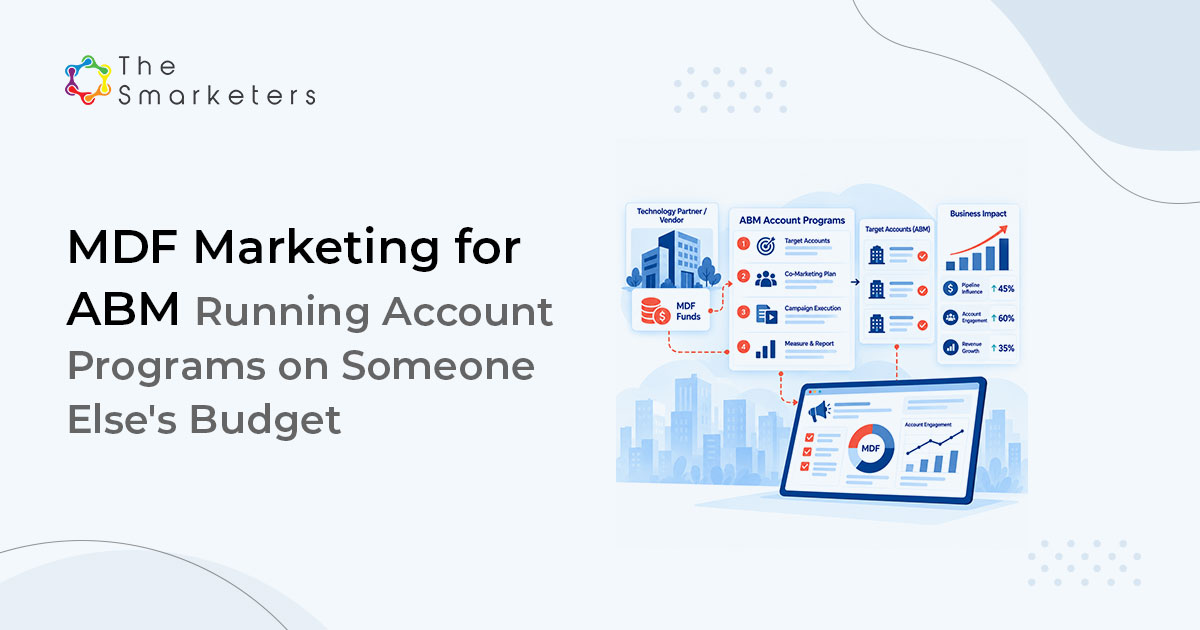
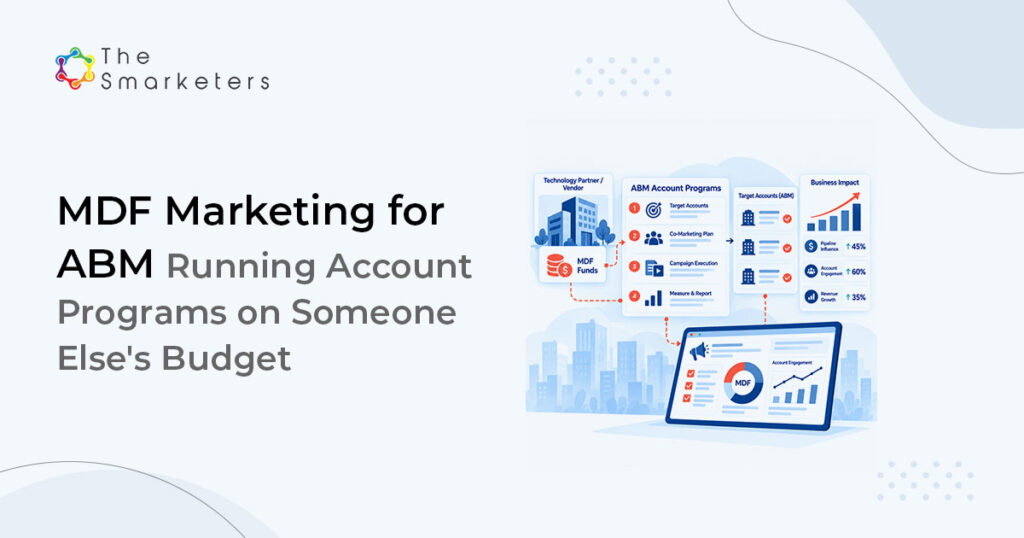
How MDF-funded ABM works in five steps:
- Agree the plan and named account list with the vendor’s partner manager.
- Get pre-approval before any spend.
- Execute as approved and register every opportunity for co-sell.
- Collect proof of execution while the campaign runs.
- File the claim inside the window and report net cost per opportunity.
Why is MDF marketing the least-used pipeline budget in enterprise tech?
Because for most channel partners, claiming it looks like paperwork and feels like risk. Partners front the cost, run the activity, submit evidence and wait for reimbursement, and one missing document can sink the claim.
STAT
2026 marketing budgets sit at 7.8% of company revenue and 56% of CMOs say their budgets are insufficient to deliver strategy. Source: Gartner 2026 CMO Spend Survey, 401 CMOs, released May 2026.
Set that against a vendor budget line that is allocated, discretionary and often expires at period end. Teams under pressure ignore it because nobody owns the process internally.
MDF vs co-op funds: what is the difference?
Be precise about terms. Market development funds (MDF) are discretionary, proposal-based and allocated by a partner manager against an agreed plan. Co-op funds usually accrue as a proportion of what you resell and are reimbursed against qualifying activity rather than pitched for. Most partners treat the two as one thing, which is why the proposals read wrong.
| Dimension | Market development funds (MDF) | Co-op funds |
|---|---|---|
| How it is earned | Proposal-based and discretionary | Accrues as a share of resale |
| Approval | Pre-approval against an agreed plan | Reimbursed against qualifying activity |
| Best for | Planned account campaigns | Ongoing qualifying activity |
What can MDF be used for, and what will vendors refuse to fund?
Rules vary by vendor and change each fiscal year, so treat this as a general pattern, not a rulebook. The consistent principle: vendors fund activity that produces registered opportunities and platform consumption in a defined solution area. Funding is also partial: AWS, for example, states that MDF cash covers up to 50% of the cost of completed eligible activities.
| Typically fundable | Typically refused |
|---|---|
| Demand campaigns tied to a named workload | Generic corporate brand advertising |
| Executive briefings and immersion days | Internal salaries and headcount |
| Assessments and migration readiness work | Entertainment, hospitality and gifts |
| Production for a joint solution campaign | Activity delivered before approval |
| Field events and joint webinars | Capital equipment |
| Digital media against an agreed account list | Anything without a pipeline outcome |
The fourth row on the right catches people. Nearly every program requires approval before spend, and retrospective claims are usually rejected without appeal.
How do you build an MDF marketing proposal that gets funded?
Write it for the approver, not your own team. The reviewer has a solution area target, a consumption target and a pile of vague submissions, and wants the one they can defend. Six elements do the work.
| Element | What it must contain | Why the approver cares |
|---|---|---|
| Named account list | Actual companies and the workload each fits | Shows the plan is real |
| Vendor priority | The specific service or migration motion | Maps to their target |
| Pipeline forecast | Opportunity count, deal size, timeline | Lets them defend the spend |
| Registration commitment | Every opportunity into the co-sell system | How they get credit |
| Line-item budget | Media, production, events, each with a supplier | Claimable third-party cost |
| Owner and cadence | Who reports what, on which dates | Reduces their admin risk |
KEY TAKEAWAY
A proposal that names 40 target accounts and forecasts 12 registered opportunities will beat a better campaign idea with no account list, every time.
How do you run co-branded ABM without diluting your own position?
Carefully, with a rule agreed up front about who owns the argument. The failure mode is a campaign where the vendor supplies the point of view and you supply the logo, producing leads the vendor could have generated alone.
The split that works in ABM for cloud partners: the vendor owns the platform context, you own the domain expertise and the implementation reality. A joint asset about migrating a regulated workload should carry the vendor’s architecture guidance and your delivery evidence, including the parts that were difficult.
Two guardrails. Run every joint asset through brand review early rather than at the end, because logo usage and claims wording are what delay approval. And keep one asset per funded program that is entirely yours, on your own domain, so the campaign builds something buyers can find later in search and AI answers.
PROOF POINT
A Fortune 500 industrial automation client generated 300+ opportunities in 4 weeks with a 90% reduction in cost per lead, running a tightly targeted account program rather than broad-based demand generation. That opportunity count is the shape of number a funding approver can act on.
How does the MDF claim process work, from proof of execution to reimbursement?
This is where most funded programs lose money, and it is avoidable. Build the evidence pack while the campaign runs.
| Stage | What it involves | Where it goes wrong |
|---|---|---|
| Pre-approval | Approved before any spend | Campaign starts first |
| Execution | Delivered as described in the proposal | Scope drifts from the plan |
| Proof of execution | Creative, invoices, attendee lists, reports | Evidence gathered months later |
| Claim submission | Filed inside the vendor's window | Window missed, funds expire |
| Reimbursement | Paid after review, against third-party invoices | Internal costs rejected |
Proof-of-execution requirements differ by vendor, but the pattern is consistent: dated third-party invoices, files or screenshots of the actual creative showing correct branding, evidence of reach or attendance, and a results report. Keep one folder per funded activity from day one. It costs nothing and it is the difference between a claim paid and a claim written off.
Claim windows and reimbursement rules are revised regularly, so confirm the current process at the start of each fiscal period rather than assuming last year’s applies.
How should you measure MDF ROI honestly?
Measure MDF marketing return by reporting two numbers, not one. Partners routinely present funded pipeline as though it cost them nothing, which is untrue and destroys credibility the moment a CFO looks closely.
Report gross program performance, what the vendor sees, and net cost per opportunity after the funded portion, what your board should see. If a program produced 20 opportunities and the vendor covered part of the cost, your internal metric is net contribution divided by 20. That number decides whether to run it again. Both are easier when you track partner pipeline in HubSpot from day one.
We ran a funded account program for a partner in a single vendor ecosystem across two quarters. The first quarter went well on vendor metrics and badly on ours, because the account list had been widened at the vendor’s request and the extra accounts converted at a third of the rate. We rebuilt the target account list, kept it narrow, and accepted a smaller allocation. Net cost per opportunity roughly halved.
Can you use MDF from multiple vendors at once?
Yes, provided you never let two vendors fund the same activity. Double-claiming is a compliance breach, and it ends partner relationships rather than merely embarrassing you.
Segment by workload, not by account. One vendor can fund a data platform program at an account while another funds a security program there, as long as campaigns, landing pages, creative and cost centers are genuinely separate.
The complication is the buying group. The average B2B buying decision now involves 13 internal stakeholders and 9 external influencers, according to Forrester’s State of Business Buying, January 2026. Two funded programs will reach overlapping people, so map the buying group first and sequence them rather than letting two vendors shout in the same month.
When should you plan MDF requests?
Earlier than most partners think, and on the vendor’s fiscal calendar rather than yours. Allocation conversations generally happen before a fiscal period opens, and unspent funds frequently expire at period end rather than rolling forward.
A workable rhythm: build next period’s proposal a quarter ahead, agree the account list before the allocation meeting, submit in the first weeks, and hold a reserve proposal for funds that come loose late. Those late reallocations go to whoever already has a costed plan on the shelf.
When MDF-funded ABM is the wrong choice
Funded programs bend your account strategy toward the vendor’s priorities. If the workloads the vendor is pushing are not the workloads where you win, taking the money will cost you focus, and the honest answer is sometimes to decline.
MDF also does not scale to a whole program. It funds campaigns, not the persistent account-based marketing infrastructure underneath them: the data, the intent signals, the sales alignment. Those remain your cost.
Program mechanics also change. Fund categories, eligibility, claim windows and approval thresholds are revised on the vendors’ own timelines, and anything published about them dates quickly. Verify before you commit spend. Our cloud partner ABM engagements start with that verification for exactly this reason.
Frequently Asked Questions
How do I use MDF funds for an account-based program?
Submit a proposal before spending anything, naming target accounts, the vendor solution area, forecast opportunity count and a line-item budget. Commit to registering resulting opportunities for co-sell. Then collect proof of execution as the campaign runs and file the claim inside the vendor’s window.
What is the difference between MDF and co-op funds?
Market development funds are discretionary and proposal-based, allocated by a partner manager against an agreed plan. Co-op funds usually accrue automatically as a proportion of what you resell and are reimbursed against qualifying activity. Most partners have both, and the proposals read quite differently.
What do hyperscalers refuse to fund?
Generally: internal salaries, entertainment and gifts, capital equipment, generic brand advertising, and anything delivered before approval was granted. Retrospective claims are the most common rejection. Categories vary by vendor and are revised each fiscal year, so confirm current rules before planning.
What percentage of campaign costs does MDF cover?
It depends on the vendor and partner tier. AWS, for example, states that MDF cash covers up to 50% of the cost of completed eligible activities, with promotional credits offsetting AWS usage during the campaign. Treat the vendor’s current program guide as the authority, because percentages and eligibility change.
How do I prove execution when claiming?
Keep dated third-party invoices, files or screenshots of the creative showing correct branding, evidence of reach or attendance, and a results report. Build the folder while the campaign runs. Requirements differ by vendor, but reconstructing evidence afterwards is where most claims fail.
How should MDF ROI be reported internally?
Report two numbers. Gross program pipeline is what the vendor sees. Net cost per opportunity, calculated on your contribution after the funded portion, is what your board should see. Presenting funded pipeline as free costs credibility the moment finance examines it.
Can I take funding from more than one vendor at once?
Yes, if no activity is funded twice. Separate campaigns by workload, with distinct creative, landing pages, invoices and cost centers. Double-claiming is a compliance breach. Sequence overlapping programs so buyers at shared accounts get a coherent order rather than simultaneous pitches.

Indrani Gope
Content Head