
Table of Contents
- What is a manufacturing marketing strategy?
- Manufacturing marketing strategies at a glance
- Application evidence
- An open specification library
- Fast technical inquiry handling
- A procurement evidence pack
- Demos, samples and site visits
- Search and AI visibility for technical questions
- General brand advertising
- Where should manufacturers start?
- How do you keep technical marketing claims accurate?
- Start with the questions buyers already ask
- Frequently Asked Questions
Need help with B2B Marketing?
Let the smarketers’ team drive your pipeline with data-led campaigns and AI-powered growth strategies.
A process engineer is evaluating three suppliers for a new line. She’s not short on brochures. What she needs is proof: will this part work in her application, at her temperatures and tolerances, and can the supplier deliver it on time and support it afterwards?
Brochures and brand ads don’t help much with that. They’re built to create awareness, and her problem is verification.
So we’ve ranked seven common manufacturing marketing strategies by one criterion: how directly each one helps technical buyers, meaning engineering, operations and procurement, check that you can actually deliver. Reach and brand still matter. But in B2B manufacturing marketing, a buyer who can’t verify you won’t shortlist you, however familiar your name is.
Key takeaways
- The best manufacturing marketing strategies help technical buyers verify fit and delivery, not just recognize your name.
- Application evidence, open specifications and fast technical answers rank highest.
- Procurement needs its own evidence pack: certifications, lead times, capacity and terms.
- Search and AI visibility only pay off when real evidence sits behind them.
- Brand advertising builds awareness but rarely helps a buyer decide.
What is a manufacturing marketing strategy?
A manufacturing marketing strategy is a plan for how a manufacturer attracts, convinces and supports technical buyers, usually engineering, operations and procurement teams, across long, multi-stakeholder buying cycles. The strongest strategies focus less on awareness and more on giving those buyers evidence they can verify: application results, specifications, certifications and fast technical answers.
Manufacturing marketing strategies at a glance
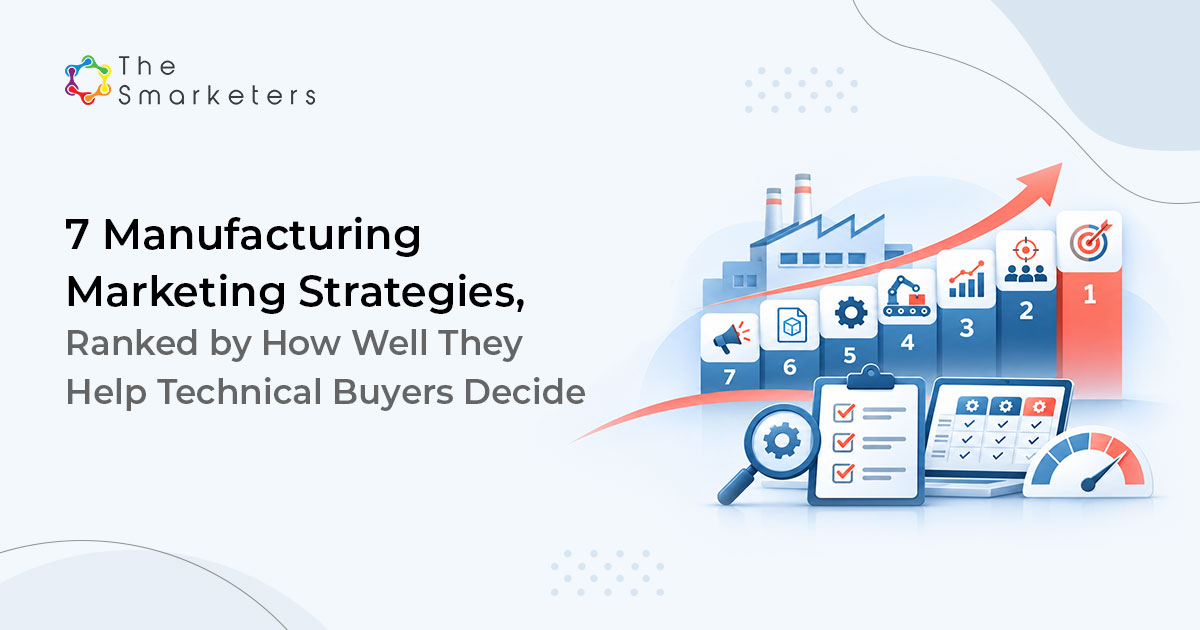
| Rank | Strategy | Helps engineering verify fit? | Helps procurement verify delivery? | Typical formats and channels |
|---|---|---|---|---|
| 1 | Application evidence | Directly | Partly | Application notes, test results, case studies |
| 2 | An open specification library | Directly | Partly | Datasheets, CAD files, certificates |
| 3 | Fast technical inquiry handling | Directly | Partly | Web forms, chat, applications engineer routing |
| 4 | A procurement evidence pack | Partly | Directly | Certification pages, RFQ packs, supplier portals |
| 5 | Demos, samples and site visits | Directly | Partly | Sample programs, plant tours, trade shows |
| 6 | Search and AI visibility for technical questions | Partly | Partly | SEO, structured data, AI answer engines |
| 7 | General brand advertising | Rarely | Rarely | Trade media ads, LinkedIn, display |
Application evidence
When it comes to marketing to engineers, nothing helps more than seeing your product working in a situation like theirs. Application notes, worked examples and test results that describe the conditions, not just the outcome, answer the question “will it work for me?”
This ranks first because it’s the evidence technical buyers use to decide. It also gives sales something credible to send. The key is that engineering signs off every claim. A marketing team writing about tolerances on its own is how credibility gets lost.
Where client details are confidential, describe the application without naming the customer, and get approval before publishing anything specific.
An open specification library
An open specification library puts datasheets, drawings, CAD files, material certificates and installation guides where they’re easy to find and download. Engineers may want these before they’ll speak to anyone, which is why inbound marketing for manufacturing starts with open specifications.
The hard question is what to gate. Putting every datasheet behind a form can lift manufacturing lead generation numbers, but it also slows down the engineers you most want to help, and some will simply move on to a supplier who doesn’t ask. A sensible middle ground is to keep standard specifications open and ask for details only for files that genuinely need a conversation, such as custom configurations.
Fast technical inquiry handling
Fast technical inquiry handling means getting a quick, qualified answer to every technical question. When an engineer asks a technical question, the speed and quality of the answer is marketing. A generic “thanks, a sales rep will be in touch” can lose them.
Route technical inquiries to someone who can answer them, usually an applications engineer, and agree how quickly that should happen. Treat this as part of your marketing strategy, not just sales operations. It may be the first real conversation a buyer has with you.
A procurement evidence pack
Procurement teams want different proof from engineers. They need quality certifications such as ISO 9001, lead times, capacity, supply chain resilience, warranty and service terms, and references.
Put this together before anyone asks for it. When it arrives quickly and completely, it removes delays late in the deal. It ranks fourth only because it helps once a buyer is already interested, rather than helping them decide whether you fit.
Demos, samples and site visits
Seeing and handling the product, or visiting the plant, is powerful verification. Trade show marketing can serve this purpose too, when it’s used for real technical conversations rather than just collecting badge scans.
These rank in the middle because they’re expensive and don’t scale. Use them for qualified opportunities where hands-on proof will make the difference, and make sure the right technical people are there.
Search and AI visibility for technical questions
Engineers search for specific problems, materials and standards. Some also ask AI tools. If your application evidence and specifications are well structured and easy to find, both search engines and AI tools can surface them, which is the foundation of B2B SEO for manufacturing companies.
This ranks sixth not because it’s unimportant, but because it depends on the first four. Visibility only helps if there’s useful evidence behind it. Our guide to measuring LLM visibility covers how to check whether AI tools describe you accurately.
General brand advertising
Brand ads keep your name in front of the market, and that has value for future buyers. But on our criterion, helping a technical buyer verify fit right now, they do very little.
Keep some budget here if your market doesn’t know you, since awareness still has a place in any industrial marketing strategy. Just don’t expect it to fix a verification problem. An engineer who recognizes your logo still needs the datasheet.
Where should manufacturers start?
If you’re rebuilding your manufacturing marketing strategy, work down the list. Before spending on reach, make sure there’s evidence worth finding. Ask engineering, operations and procurement contacts which questions they ask every supplier, then check which of those your current content answers.
How do you keep technical marketing claims accurate?
In manufacturing content marketing, technical buyers are quick to spot a claim engineering can’t support. Agree a simple rule: any performance claim, specification or comparison needs an engineering owner who approves it, and it gets reviewed when the product changes. It slows publishing slightly and protects you from the kind of mistake that ends a supplier relationship.
Start with the questions buyers already ask
List the five questions your engineers and procurement contacts ask most often. Check which of these manufacturing marketing strategies answers each one, and where the gaps are. That gives you a far better starting point than a channel plan, and our manufacturing GTM playbook can help you build the rest.
If you’d like help building that evidence into an account-based program for manufacturers, talk to our manufacturing ABM team.
Frequently Asked Questions
What is the most effective marketing strategy for manufacturers?
For technical buyers, application evidence usually does the most work: application notes, worked examples and test results that show your product performing in conditions like theirs, with engineering approval on every claim. It answers the question buyers care about most, which is whether it will work for them.
Should manufacturers gate datasheets and CAD files?
Keep standard specifications open and ask for details only for files that genuinely need a conversation, such as custom configurations. Gating everything slows down the engineers you most want to help, and some will move on to a supplier who doesn’t ask.
Should manufacturers publish test reports before an NDA?
Publish what you can describe without revealing confidential customer details or proprietary methods, such as the test conditions and general results. Keep detailed reports for after an NDA. The goal is to give engineers enough to decide whether a conversation is worth having.
What evidence differs for OEM and end-user buyers?
As we cover in our guide to ABM for industrial manufacturers, OEMs usually need integration details, consistency across volumes and long-term supply commitments. End users tend to focus on performance in their application, maintenance and support. Tailor the evidence pack to each, rather than sending the same brochure.
Do trade shows still work for manufacturers?
Yes, when they’re used for real technical conversations with the right engineers present, not just badge scanning. Treat them as one verification touchpoint, then follow up with the specifications and application evidence the buyer asked about.

Shimon Joseph
VP of Growth and Partnerships