
Table of Contents
- What Is Demand Creation and What Is Demand Capture?
- Demand Creation vs Demand Capture at a Glance
- Why Do Sales and Marketing Need One Shared Account Record?
- Demand Creation vs Demand Capture: 4 Questions That Tell You Where to Invest
- How Do You Measure Demand Creation and Demand Capture?
- Should You Cut Demand Creation When Pipeline Is Weak?
- How to Decide Where to Invest Next Quarter
- Frequently Asked Questions
Need help with B2B Marketing?
Let the smarketers’ team drive your pipeline with data-led campaigns and AI-powered growth strategies.
It’s easy for the answer to come down to who argues best. Search fans point to cost per lead. Brand fans point to long buying cycles. Both have a point, and neither has looked at where the pipeline is actually getting stuck.
In the demand creation vs demand capture debate, the two aren’t rivals. They’re the two halves of B2B demand generation, and they do different jobs. The useful question isn’t which one is better. It’s which one is holding you back right now.
Key takeaways
- Demand creation builds awareness among buyers who aren’t shopping yet. Demand capture converts buyers who already are.
- As a rule of thumb, only about 5% of B2B buyers are in the market at any time, so funding capture alone limits future pipeline.
- Don’t start with a budget split. Find the first stage where your funnel says “no” and invest there.
What Is Demand Creation and What Is Demand Capture?
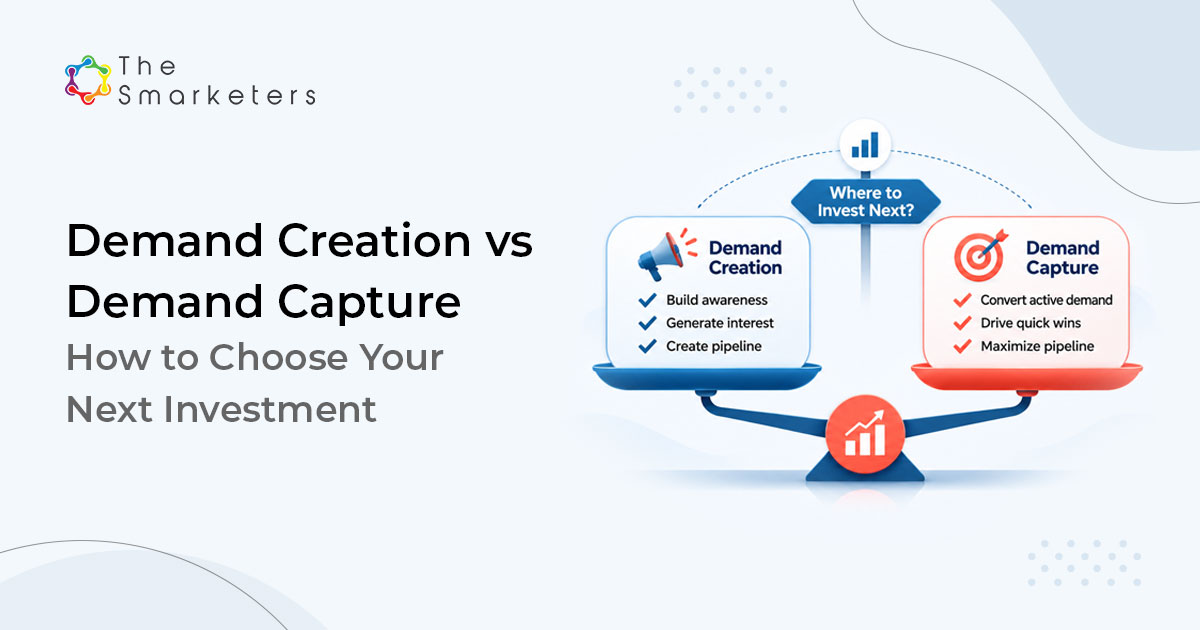
Demand creation is marketing that helps buyers recognize a problem and remember your brand before they’re ready to buy. Demand capture is marketing that turns buyers who are already researching into conversations. Together, they make up B2B demand generation: creation fills the future pipeline, capture converts the current one.
B2B demand creation helps buyers recognize a problem and form a view of what a good solution looks like, sometimes long before they’re ready to buy. Think of educational content, podcasts, events, thought leadership and brand advertising aimed at people who aren’t shopping yet.
Demand capture helps buyers who are already looking take the next step. Think of B2B paid search ads, review sites, comparison pages, demo requests and retargeting aimed at people actively researching.
Demand Creation vs Demand Capture at a Glance
| Demand creation | Demand capture | |
|---|---|---|
| Who it's for | People who aren't looking yet | People already looking |
| Main job | Make sure buyers know you and think of you when the need arrives | Turn active interest into a conversation |
| Typical channels | Content, social, events, podcasts, brand ads | Search, review sites, comparison pages, retargeting, demo offers |
| When results show up | Later, and harder to trace | Sooner, and easier to trace |
| Main risk | Spending on awareness that never turns into pipeline | Competing harder for a small pool of active buyers |
| How to measure | Unprompted mentions, branded search, inbound from accounts you've reached | Clicks, form fills, demo-to-opportunity rate |
Why Do Sales and Marketing Need One Shared Account Record?
The 95:5 rule says that at any given time, only about 5% of B2B buyers are in the market, while the other 95% won’t buy for months or even years. Professor John Dawes of the Ehrenberg-Bass Institute set it out in 2021, in research for LinkedIn’s B2B Institute.
It’s a rule of thumb, not a law. The real share depends on how often companies in your category switch providers. But the logic holds. If you only fund capture, you’re competing for a small group of in-market buyers, and you’re doing nothing to make sure the out-of-market majority think of you when their time comes.
That doesn’t mean capture is a waste. When a buyer is ready, you need to be easy to find and easy to talk to. It means that in any demand capture vs demand creation decision, each needs to be judged on what it’s supposed to do.
Demand Creation vs Demand Capture: 4 Questions That Tell You Where to Invest
Instead of starting with a budget split, start with where the pipeline is getting stuck. Work through these in order.
To decide between demand creation and demand capture, check four stages in order: recognition, reach, response and conversion. Invest where the first stage fails.
- Do the right people know who you are? Talk to sales about recent lost deals and new opportunities. If buyers keep saying they’d never heard of you before the RFP arrived, you have a recognition problem. That points to creation.
- Are you reaching the right accounts at all? Check whether your content and campaigns are actually seen by your target accounts and the roles you sell to, not just by a broad audience. If the reach isn’t there, fix the targeting before spending more on either side.
- When they see you, do they respond? If the right people see your content but don’t engage, the message or offer may be the problem. That’s a creative question more than a budget one.
- When they respond, do they convert? If plenty of good-fit people request demos but few become opportunities, the bottleneck sits in capture, follow-up or qualification. More awareness won’t fix it.
The first place you get a “no” is where your next investment probably belongs.
You’ll find plenty of suggested budget splits online. Treat them as someone else’s starting point, not a diagnosis of your funnel.
How Do You Measure Demand Creation and Demand Capture?
Capture is easier to measure, which gives it an edge in most demand creation vs demand capture budget arguments. Clicks, form fills and cost per lead show up within days, which is why so many teams still favor lead generation over demand generation. Just remember those numbers are better at showing where buyers came from than proving you created the demand. A search click from someone who already knew your name might have happened anyway.
Creation is harder. Its effects show up later and across many touches. Useful signals include more buyers mentioning you unprompted in discovery calls, more people searching for your brand name, and more inbound conversations from accounts you’ve been reaching. None of these is perfect. Branded search, for example, also rises for reasons that have nothing to do with marketing. Treat them as evidence that points in a direction, not as proof.
If you need to show that a specific creation program changed outcomes, you’ll need a comparison, such as accounts that saw the program against similar ones that didn’t. Our piece on alternatives to influenced pipeline covers how to set that up.
| Demand creation | Demand capture | |
|---|---|---|
| Leading signals | Unprompted mentions in discovery calls, branded search | Clicks, form fills |
| Stronger proof | Accounts you reached compared with similar ones you didn't | Demo-to-opportunity rate |
| Watch out for | Branded search moving for reasons unrelated to marketing | Taking credit for demand it didn't create |
Should You Cut Demand Creation When Pipeline Is Weak?
It’s the instinct when the quarter looks bad. Cut the slow stuff and push everything into what converts this month.
Sometimes that’s the right short-term call. But be clear about the trade. Cutting your demand creation strategy may protect this quarter’s numbers while shrinking the pool of buyers who know you next year. If you do cut, cut deliberately, write down what you expect to happen and check later whether it did.
How to Decide Where to Invest Next Quarter
Take last quarter’s numbers and work through the four questions. Write down where you first get a “no” and what evidence told you so. That’s a much stronger case for the next investment than a percentage split borrowed from somewhere else.
If you’d like help reading your funnel this way, our B2B demand generation team can work through it with you.
Frequently Asked Questions
Can paid search create demand as well as capture it?
Mostly it captures demand that already exists, because people only search for things they already know they need. It can play a small part in creation for new categories, but don’t count on it to make people aware of a problem they haven’t recognized yet.
Is branded search a reliable measure of demand creation?
It’s a useful signal, but not a clean one. Branded search can rise because of news, a competitor’s mistake, a sales push or seasonality. Look at it alongside other signals, such as how often buyers mention you unprompted in sales conversations.
How do demand creation and demand capture fit into demand generation?
People often frame it as demand generation vs demand capture, but demand generation is the umbrella. Demand creation and demand capture are its two parts: one builds future demand, the other converts demand that already exists.
Is demand capture the same as lead generation?
Not exactly. Lead generation focuses on collecting contact details. Demand capture is broader: it means being easy to find and easy to talk to when a buyer is ready, through search, review sites and comparison pages.

Siddharth Rampelli
Senior Growth Marketing Manager