Need help with B2B Marketing?
Let the smarketers’ team drive your pipeline with data-led campaigns and AI-powered growth strategies.
What is RevOps for IT Services?
RevOps for IT services is a revenue operations framework adapted for professional services businesses IT consulting firms, system integrators, managed service providers, and cloud partners. Unlike SaaS RevOps, which centres on recurring revenue, product usage data, and self-serve pipeline, IT services RevOps is built around project-based and SOW-driven revenue, long relationship cycles, utilisation and capacity management, and the consultative selling motion where trust and track record matter more than feature comparisons.
The Problem With SaaS RevOps Playbooks for IT Services
Every RevOps framework, every revenue operations guide, and every RevOps technology stack recommendation you will find online was built for SaaS companies. Monthly recurring revenue. Churn rates. Product-qualified leads. Expansion through feature upsell.
IT services companies do not have any of those things. They have Statement of Work agreements. They have utilisation rates. They have 14-month RFP cycles. They have account expansion through relationship depth, not product-led growth.
When IT services firms try to implement standard SaaS RevOps, the friction shows up fast. CRM pipeline stages built for 30-day cycles do not map to 18-month deals. Lead scoring models built for product engagement do not capture relationship warmth. Revenue forecasting models built on MRR produce meaningless numbers for project-based billing.
The IT services RevOps framework requires a different architecture one that reflects how professional services revenue actually works.
65% of IT services firms cite poor sales and marketing alignment as a top revenue challenge
The IT Services Revenue Model: Key Differences from SaaS
| Revenue Factor | SaaS Model | IT Services Model |
|---|---|---|
| Revenue type | Subscription / MRR | Project-based / SOW/retainer |
| Revenue trigger | Product signup or upgrade | Statement of Work signed |
| Expansion signal | Feature usage, seat addition | New project, SOW renewal, scope expansion |
| Churn signal | Cancellation or downgrade | No renewal discussion, competitor mention, satisfaction drop |
| Pipeline driver | Product-qualified leads, trials | Relationships, referrals, RFP invitations, ABM |
| Sales cycle | 30 to 180 days | 6 to 24 months, often longer |
| Success data | Product usage, NPS, support tickets | Delivery quality, utilisation, project satisfaction, renewal intent |
RevOps Architecture for IT Services: The 5 Core Components
Component 1: CRM Pipeline Stages Built for IT Services
Standard SaaS CRM stages (Lead > MQL > SQL > Opportunity > Closed) do not map to IT services buying behaviour. IT services pipeline stages should reflect the actual selling motion: Awareness Contact > Relationship Building > Business Case Development > RFP / Proposal Stage > Contract Negotiation > Closed Won / Lost. Add a parallel track for account expansion: Account Health Review > Expansion Conversation > Scope Discussion > Renewal / New SOW.
Component 2: SOW Tracking and Revenue Recognition
SOW revenue is fundamentally different from MRR. A single signed SOW may span 18 months of revenue recognition. Your RevOps infrastructure needs to track: SOW value, revenue recognition schedule, delivery milestone payments, and scope change history. This data feeds both forecasting and account expansion identification.
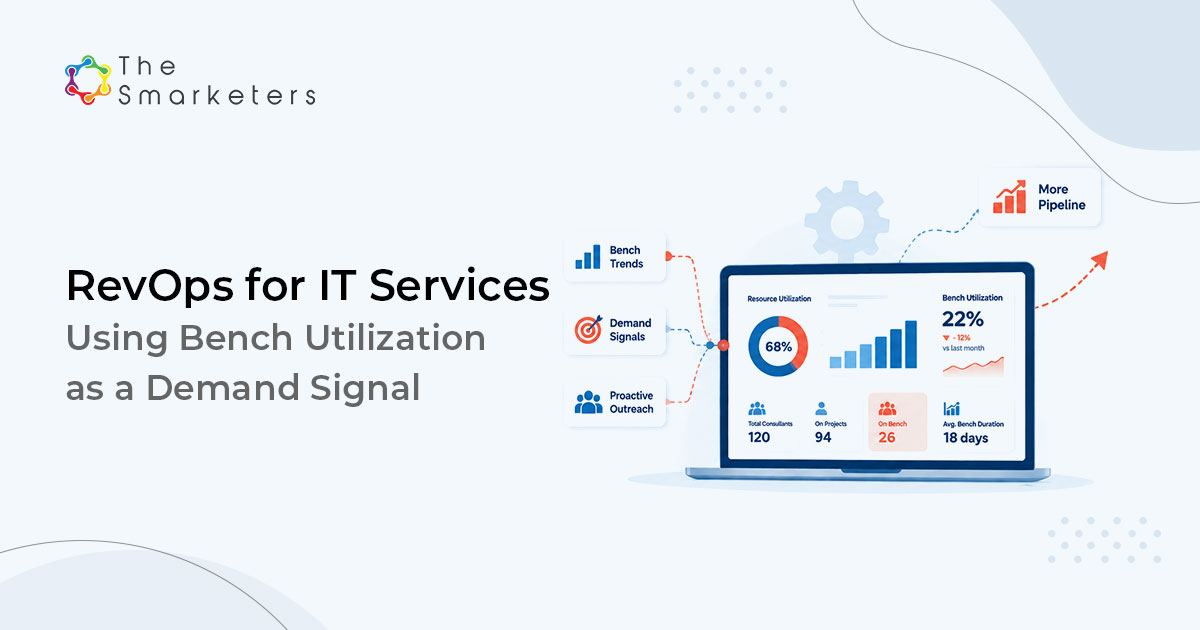
Component 3: Utilisation Rate as a Revenue Signal
For IT services firms, utilisation rate the percentage of billable hours actually billed is a direct revenue efficiency metric. RevOps should track utilisation by practice, by client, and by team, and connect underutilisation trends to pipeline gaps that need to be filled. This connection between delivery capacity and pipeline development is unique to IT services and almost entirely absent from SaaS RevOps frameworks.
Component 4: Key IT Services Revenue Metrics
| Metric | What It Measures | Why It Matters in IT Services |
|---|---|---|
| SOW renewal rate | Percentage of SOWs renewed within 90 days of expiry | Primary retention signal renewal rate directly predicts revenue stability |
| Account expansion rate | Revenue growth within existing accounts year-on-year | IT services growth is heavily account expansion-driven |
| Time-to-proposal | Days from RFP receipt to proposal submission | Faster proposals correlate with higher win rates in competitive RFPs |
| Utilisation rate | Billable hours / total available hours | Capacity signal underutilisation indicates pipeline shortfall |
| Win rate by RFP type | Win rate segmented by deal type and size | Identifies which opportunities to pursue and price competitively |
Component 5: ABM Integration with RevOps
ABM is not a separate marketing programme for IT services companies it is the primary pipeline generation motion. RevOps infrastructure should connect ABM account engagement data directly to CRM opportunity creation and pipeline attribution. When an ABM-targeted account crosses the engagement threshold, that signal should flow automatically into the CRM as a pipeline entry, not sit in a separate marketing platform.
Tech Stack for IT Services RevOps
| Function | Recommended Tool | IT Services-Specific Use |
|---|---|---|
| CRM | HubSpot or Salesforce | SOW-based pipeline stages, account expansion tracking |
| ABM Platform | 6sense or Demandbase | Account scoring, intent data for RFP prediction |
| Revenue Attribution | HockeyStack or Dreamdata | Multi-touch attribution across long 18-month cycles |
| Sales Engagement | Apollo or Outreach | Relationship-based sequences for senior stakeholder outreach |
| Data Enrichment | Cognism or ZoomInfo | Buying committee mapping, technographic signals |
| Reporting | HubSpot or Tableau | Utilisation, pipeline velocity, SOW renewal dashboards |
Related Reading
- Pipeline Velocity vs. Pipeline Volume: Why B2B Teams Are Measuring the Wrong Thing
- Buying Committee Marketing: How to Run ABM When 11 People Control the Deal
- ABM for IT Services Companies and System Integrators
About The Smarketers
The Smarketers is India’s first ITSMA-awarded ABM agency and a HubSpot Gold Partner. With 40+ implemented ABM programs and an 85% success rate, they work with B2B technology companies, IT services firms, and life sciences companies to drive pipeline through ABM, demand generation, and RevOps.
Frequently Asked Questions
Why don't standard SaaS RevOps frameworks work for IT services companies?
SaaS RevOps is built around recurring revenue metrics, product usage data, and self-serve pipeline. IT services revenue is project-based and SOW-driven, sales cycles are 6 to 24 months, and there is no product usage data to drive scoring or expansion triggers. Applying SaaS RevOps to an IT services context produces misaligned pipeline stages, meaningless lead scores, and inaccurate forecasting.
What are the most important RevOps metrics for IT services companies?
The five most important metrics are: SOW renewal rate (primary retention signal), account expansion rate (growth through existing clients), time-to-proposal (efficiency in competitive RFPs), utilisation rate (capacity and pipeline gap signal), and win rate by deal type (guides pursuit strategy and pricing).
How does ABM integrate with RevOps for IT services firms?
ABM is the primary pipeline generation motion for most IT services firms targeting specific accounts with coordinated, multi-stakeholder marketing over long periods. RevOps provides the infrastructure for that ABM motion: account-level CRM data, engagement tracking, threshold-based sales alerts, and pipeline attribution. Without RevOps integration, ABM data sits in marketing platforms and never connects to revenue outcomes.
What CRM pipeline stages should IT services companies use?
IT services pipeline stages should reflect the actual selling motion: Awareness Contact, Relationship Building, Business Case Development, RFP / Proposal Stage, Contract Negotiation, Closed. Add a parallel account expansion track: Account Health Review, Expansion Conversation, Scope Discussion, Renewal / New SOW. Standard SaaS stages like MQL and SQL are not meaningful in an IT services context.
How do IT services companies track revenue from existing accounts?
Account expansion tracking in IT services requires monitoring SOW renewal dates, scope change history, account satisfaction scores, and stakeholder relationship depth. RevOps systems should flag accounts 90 to 120 days before SOW expiry, trigger account health reviews when satisfaction signals drop, and connect delivery team observations to sales pipeline data.
Building RevOps for Your IT Services Firm?

Enoch Pakanati
CEO