Need help with B2B Marketing?
Let the smarketers’ team drive your pipeline with data-led campaigns and AI-powered growth strategies.
Why Does Outbound-Only Stop Working for SaaS?
Because SaaS categories are crowded, and outbound fishes only in the small pool of buyers who happen to be in-market now. At any moment only about 5% are, so outbound-only programs bid against every competitor for the same prospects, while ignoring the 95% who will buy later.
The 95-5 rule from the Ehrenberg-Bass Institute, popularised by the LinkedIn B2B Institute, holds that around 95% of buyers are not in-market at any given time (LinkedIn B2B Institute). For SaaS, where switching is easy but attention is scarce, the brands that create demand in the 95% own the category when buyers finally enter it.

How Do You Build a SaaS Demand Engine?
| Outbound-only | Demand Generation | |
|---|---|---|
| Who You Reach | The ~5% in-market now | The 95% future buyers plus the 5% |
| Mechanism | Interrupt and chase | Create trust, then capture intent |
| Cost Trend | Rises as everyone competes | Compounds as content and brand build |
| Metric | Meetings booked | Qualified pipeline and velocity |
- Create demand. Point-of-view content, founder and team presence on LinkedIn, community, and ungated assets that spread and get cited by AI tools.
- Capture intent. High-intent SEO, AEO and GEO, product-qualified signals, and retargeting engaged accounts.
- Convert. Multi-thread the buying group, align sales on a real SLA, and judge it on pipeline, not leads.
What About Product-Led Growth?
PLG and demand generation are complements, not rivals. PLG captures self-serve demand; demand generation creates the awareness that fills the top of the PLG funnel and reaches the buyers, often executives, who never sign up for a trial. The strongest SaaS programs run both and measure them on pipeline.
Which Metrics Predict SaaS Revenue?
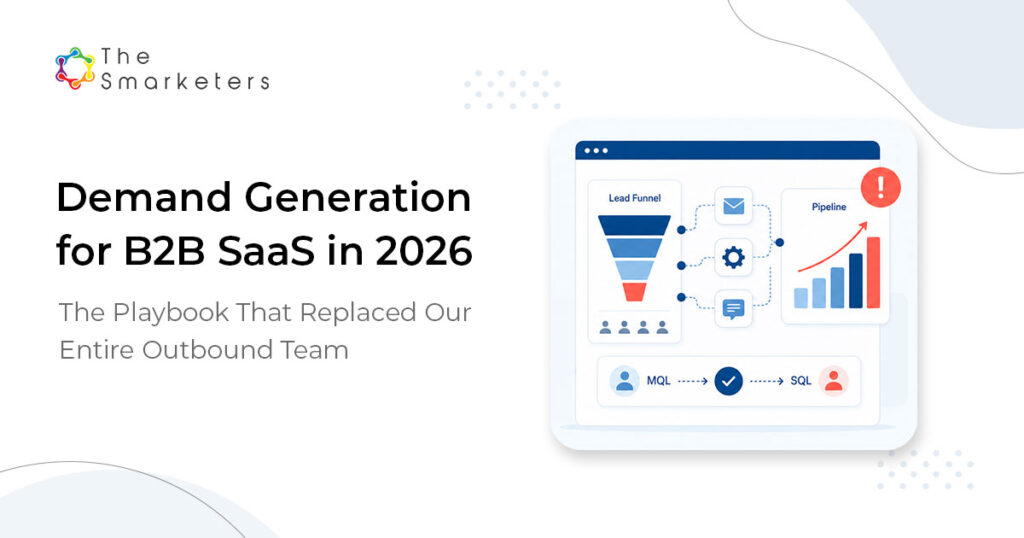
Pipeline velocity, qualified opportunities, win rate by source, and product-qualified accounts, not raw lead or signup counts. Forrester retired the MQL because lead-centric funnels convert at under 1%; for SaaS, judge demand gen on pipeline and revenue, not on activity.
Forrester’s research underpins this shift to buying-group pipeline metrics (Forrester).
Want SaaS pipeline that doesn't depend on outbound?
Frequently Asked Questions
Why is outbound-only failing for B2B SaaS?
Because SaaS categories are crowded and outbound only reaches the roughly 5% of buyers in-market right now, competing against every rival for the same prospects. It ignores the 95% who will buy later, so pipeline caps out and costs rise. Demand generation invests in that 95%.
How do you build a demand engine for SaaS?
Create demand with point-of-view content, team presence, community, and ungated assets; capture intent with high-intent SEO, AEO and GEO, product-qualified signals, and retargeting; then convert by multi-threading the buying group and aligning sales on a real SLA. Measure pipeline, not leads.
Is PLG a replacement for demand generation?
No, they complement each other. PLG captures self-serve demand, while demand generation creates the awareness that fills the PLG funnel and reaches executives who never start a trial. The strongest SaaS programs run both and measure each on pipeline and revenue, not signups alone.
What demand gen metrics matter for SaaS?
Pipeline velocity, qualified opportunities, win rate by source, and product-qualified accounts, not raw leads or signups. Forrester retired the MQL because lead-centric funnels convert at under 1%, so judge SaaS demand generation on pipeline and revenue rather than activity.
How long does SaaS demand generation take to work?
Capture tactics can produce pipeline within weeks, but demand creation compounds over two to three quarters as content, brand, and community build awareness. Pipeline typically firms up around 90 days. Programs judged only on early lead counts are often cut before they pay off.

Siddharth Rampelli
Senior Growth Marketing Manager