Table of Contents
- Why Is Selling Analytics to Non-Technical Buyers So Hard?
- How Should Data Companies Select Target Accounts?
- What Content Works for CDOs, CIOs, and Business Leaders?
- The Executive Multi-Thread Matrix
- Case Study: 100+ Enterprise Accounts Engaged for a Fortune 100 Technology Company
- When ABM Is Not the Right Approach for an Analytics Company
- Where to Start
- Frequently Asked Questions
Need help with B2B Marketing?
Let the smarketers’ team drive your pipeline with data-led campaigns and AI-powered growth strategies.
The proof of concept succeeded. Query times dropped, the data team is enthusiastic, your champion has the slides ready. Then the CFO asks one question: “what does this do for margin?” The room goes quiet, the deal goes to “next quarter,” and next quarter it goes to the competitor whose pitch started with margin. Analytics companies lose more revenue in that silence than in any competitive bake-off.
The structural problem is that analytics platforms are bought by committees where most members cannot evaluate the technology. The median B2B buying group is now 11.2 people for deals over $50K, and in a data platform deal that group spans a CDO who speaks your language, a CIO managing consolidation pressure, a CFO pricing risk, and business-line leaders who just want their Monday report to be right. Win the technical evaluation and you have persuaded perhaps three of the 11.
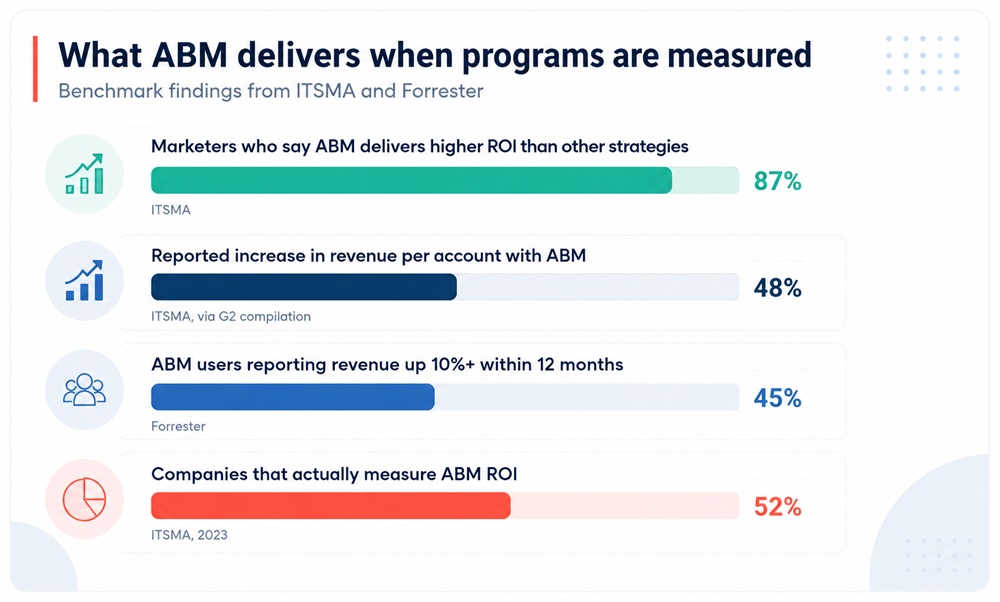
Account-based marketing is the discipline built for exactly this shape of problem, and the evidence for it is unusually strong: 87% of marketers say ABM delivers higher ROI than other marketing strategies (ITSMA). This article covers how to aim it at analytics deals specifically: account selection, executive-specific content, multi-threading, and the operating model we use at The Smarketers for technology clients, including an engagement that puts 100+ enterprise accounts into active engagement for a Fortune 100 technology company.
Why Is Selling Analytics to Non-Technical Buyers So Hard?
Because the value of analytics is always one translation step away from the budget holder. A cybersecurity vendor can point at breach costs. An analytics vendor has to explain that better data infrastructure leads to better decisions, which lead, eventually and diffusely, to business outcomes. Every hop in that chain is a place for a CFO to discount your claim.
Buyer behavior makes the translation gap more dangerous, not less. Gartner found 67% of B2B buyers prefer a rep-free buying experience, which means the executive members of your buying committee are mostly forming their view from what they can read and what their colleagues tell them, not from your sales calls. If your public content and your champion’s internal deck both speak in pipelines and schemas, the executives are forming their view from nothing.
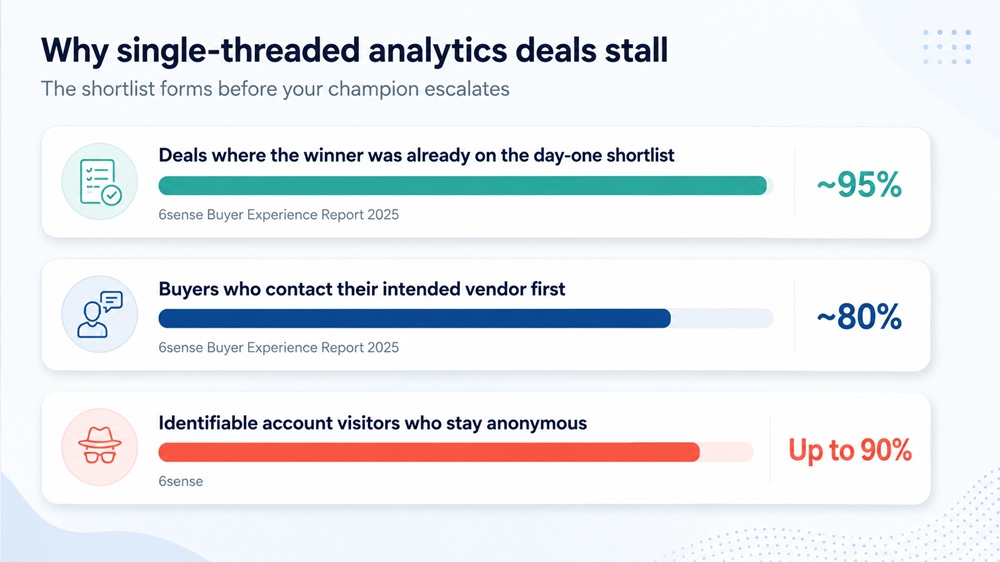
And they form it early. 6sense found the winning vendor was already on the day-one shortlist roughly 95% of the time, with about 80% of buyers contacting their intended vendor first. For analytics companies this is the whole argument for ABM: the executive-language groundwork has to be laid at target accounts before the evaluation begins, because by the time procurement calls, the narrative is set.
Key takeaway: The technical win and the commercial win are two different campaigns running on two different languages. ABM for analytics companies is the machinery for running both at the same accounts at the same time.
How Should Data Companies Select Target Accounts?
On evidence of data investment appetite, not on logo lists. Analytics deals die at accounts that admire the technology but have no active mandate to change how they use data. The selection signals that predict real buying intent are observable from outside:
| Signal tier | What to look for | Why it predicts a deal |
|---|---|---|
| Leadership signals | A CDO or VP Data hired in the last 18 months; data or AI initiatives named in earnings calls or annual reports | Someone senior owns a mandate and a budget line, and needs visible wins |
| Team signals | Open roles for data engineers, analytics engineers, ML engineers; growth of the data function on LinkedIn | Headcount investment precedes platform investment; teams hire before they re-platform |
| Stack signals | Cloud migration announcements, contracts with adjacent tools, legacy BI systems near end-of-life | Re-platforming windows are when analytics decisions actually open |
| Pain signals | Regulatory reporting pressure, M&A integration, public data incidents | A dated, external forcing function beats any internally generated urgency |
Score your target universe against these tiers and be ruthless about the cut line. ABM economics only works with focus: ITSMA’s benchmark work also found only 52% of companies measure ABM ROI at all, and in our experience the unmeasured programs are usually the overextended ones, running “ABM” against 500 accounts with resources sized for 50.
Then tier what survives the cut. A workable starting split for an analytics company: a one-to-one tier of 5-10 accounts where every asset is account-specific (usually accounts with an active re-platforming window and a named executive sponsor to win), a one-to-few tier of 20-30 accounts grouped by industry where content is versioned rather than rebuilt, and a one-to-many tier that receives programmatic plays until their signals warrant promotion. The tiers are a budget instrument, not a status symbol; accounts should move down as readily as up when signals fade.
Related Reads: How to Get Sales on Board with Account-Based Marketing
What Content Works for CDOs, CIOs, and Business Leaders?
Different content per role, built from one shared proof spine. The proof spine is the set of verifiable outcomes your platform has produced. Each executive then gets that proof translated into the problem they are paid to solve:
| Executive | What they are paid to solve | Content that lands | Content that fails |
|---|---|---|---|
| CDO / VP Data | Proving the data function creates business value | Peer case studies with adoption and time-to-value numbers; architecture depth they can defend internally | Generic thought leadership; anything that restates their own strategy back to them |
| CIO | Consolidation, risk, and total cost of ownership | TCO comparisons, integration and security documentation, migration-risk honesty | Feature tours; content that ignores their existing stack |
| CFO | Capital allocation and defensible ROI | An economic model with conservative assumptions they can stress-test; payback timelines from real deployments | ROI claims without methodology; "data is the new oil" framing |
| Business-line leaders | Their own KPIs: revenue, churn, forecast accuracy | One-page stories: what decision improved, what number moved | Anything about the platform itself |
Two production rules make this manageable. First, build the economic model once, with your best customer data, and version it per industry; it is the single asset that moves CFO conversations, and Gartner’s finding that buyers consult an average of seven information sources, with 69% validating AI-generated insights through sales reps, means your numbers will be checked against whatever the committee’s AI research surfaced. Conservative assumptions survive that check; inflated ones convert your champion into a skeptic. Second, every asset must work as a forward: assume the CDO sends it to the CFO with one line of context, because that is how committee persuasion actually happens.
The Executive Multi-Thread Matrix
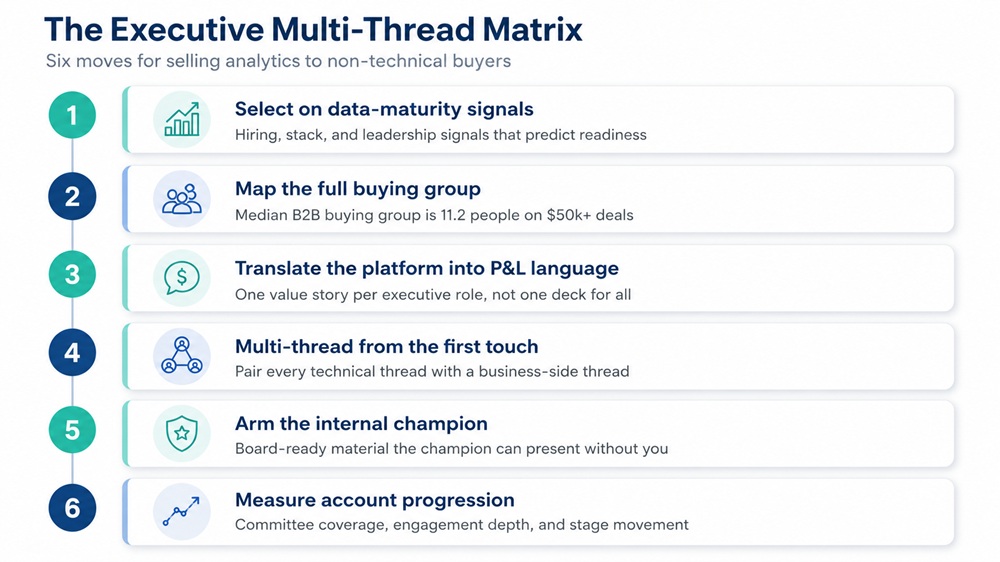
How do analytics companies sell to the C-suite? By multi-threading deliberately: pairing every technical relationship with a business-side relationship at the same account, from the first touch, with content matched to each thread. We run this as a six-step sequence:
- Select on data-maturity signals. Use the signal tiers above to pick accounts where a mandate exists. A brilliant campaign at an account with no mandate is expensive theater.
- Map the full buying group. Name the likely 11: data leadership, IT, finance, security review, procurement, and the business lines the platform serves. Mark which relationships exist and which are empty seats.
- Translate the platform into P&L language. One value hypothesis per executive role, written in their vocabulary, anchored to the shared proof spine. This is a writing job, and it is the step most analytics marketers skip.
- Multi-thread from the first touch. Run executive-track content to business stakeholders in parallel with the technical evaluation, not after it. Up to 90% of identifiable account visitors stay anonymous, so use account-level intent signals rather than waiting for form fills to tell you the committee is researching.
- Arm the internal champion. Build the board-ready deck, the one-page economic summary, and the objection answers your champion needs to sell without you in the room. Your champion presents to the committee more often than you ever will.
- Measure account progression. Committee coverage, engagement depth per role, and stage movement per account. Report revenue per account over lead volume; that is where ABM shows its work.
The payoff for this discipline is what the benchmark data describes: companies using ABM report a 48% increase in revenue per account (ITSMA), and 45% of B2B marketers using ABM report revenue up 10% or more within 12 months (Forrester). Forrester’s regional analysis puts the most common ABM ROI advantage at 21-50% over other marketing approaches, with 23% of respondents reporting 51-200% higher ROI. Those numbers come from focused, measured programs; they are not a property of the acronym.
Case Study: 100+ Enterprise Accounts Engaged for a Fortune 100 Technology Company
A Fortune 100 technology client asked us to open enterprise conversations for a data-centric offering in a market where every target account already had incumbent vendors and inbound produced nothing at the executive level.
Before: strong product references, near-zero engagement from named enterprise accounts, and a sales team single-threading into IT contacts who could evaluate but not buy. After: 100+ enterprise accounts moved into active engagement through the program. The bridge was the matrix above, run patiently: a signal-scored target list instead of an aspirational logo sheet, role-translated value stories for business and finance stakeholders alongside the technical material, and multi-channel executive touches sequenced with sales rather than dropped on top of them. (Smarketers client engagement; more at https://thesmarketers.com/success-stories/.)
The honest caveat: engagement is an earlier-stage metric than revenue, and we report it as such. Enterprise analytics deals close on sales execution over quarters; what ABM changed here was the number of committee-level conversations available to execute on, which had been the binding constraint.
When ABM Is Not the Right Approach for an Analytics Company
ABM is an operating commitment, not a campaign setting, and there are honest disqualifiers:
- Your ACV cannot carry it. Role-specific content, intent tooling, and multi-quarter account plays are only rational when contract values run well into five figures and expansion is real. A $12K self-serve analytics product wants product-led growth and inbound, not account plays.
- Sales is not committed to the same account list. ABM without sales alignment is a newsletter with better targeting. If sales will not co-own account selection and follow the plays, fix that agreement before spending a dollar on media.
- You cannot yet name the accounts that should buy. Pre-product-market-fit companies need the signal of broad demand programs to find their market. Narrowing to 50 accounts before you know your ICP just makes your guesses more expensive.
- You are not prepared to measure it properly. Proving ROI is a top challenge for 47% of ABM practitioners (Demand Gen Report 2026), and the fix is structural: define account-progression metrics and reporting before launch. A program that cannot show its math gets its budget reallocated in the first soft quarter.
Smarketers insight: The strongest predictor of ABM success we see is not budget or tooling. It is whether marketing and sales can sit in one room and agree on 50 accounts and what “progress” means at each of them. Teams that cannot do that in an afternoon are not ready, whatever their stack looks like.
Where to Start
Run the translation test this week: take your three most strategic open deals and ask, for each, what the CFO-language version of your value story is and who at the account has actually seen it. If the answer is “we do not have one” or “nobody,” you have found the constraint on your enterprise motion, and it is fixable.
If you want a structured working session on your account list, buying-group map, and executive content gaps, discuss your ABM strategy with our team. It is the same diagnostic that opened the Fortune 100 engagement above, and it will tell you within a week whether ABM is your highest-return move or premature.
Frequently Asked Questions
How long before an analytics ABM program shows results?
Expect engagement-level results (committee coverage, executive content consumption at named accounts) within one quarter, and pipeline effects in two to four quarters, matched to enterprise buying cycles. Forrester found 45% of ABM users report revenue up 10%+ within 12 months; treat that as the realistic horizon, not the first board update.
How many accounts should a data company start with?
Fewer than you want. For a first program, 30-50 accounts selected on data-maturity signals lets you run genuinely role-specific plays with a small team. Expanding a working program is easy; rescuing a diluted one rarely happens.
What budget does executive-track content actually require?
The expensive assets are one-time builds: an economic model with defensible methodology, two or three deep peer case studies, and role-translated one-pagers. Most analytics companies can build the core set in a quarter by reallocating existing content budget rather than adding to it.
Do we need intent data tools to run this?
They help with timing, not with strategy. Given that up to 90% of identifiable account visitors stay anonymous, account-level intent signals tell you when a committee is researching. But signal without executive-language content just means you watch deals form and die with better instrumentation.
How do we handle the CDO who wants to keep the vendor relationship technical?
Respect the thread and add threads rather than going around anyone. The play is to arm the CDO with business-language material so compelling that presenting it upward makes them look good. Champions block vendors who threaten their control; they promote vendors who improve their standing.
What metrics convince a CFO that ABM is working?
Revenue per account, pipeline created at named accounts, committee coverage trend, and cost per opportunity compared against your previous motion. ITSMA found companies using ABM report a 48% increase in revenue per account; anchor reporting to that class of metric and avoid lead-volume theater.
Can ABM and product-led growth coexist for a data platform?
Yes, and for many analytics companies the pairing is the whole model: PLG creates usage signals inside target accounts, and ABM converts that usage into an enterprise agreement by reaching the executives the product never touches. The failure mode is running them as separate teams with separate account lists.
When should we hire an agency versus building ABM in-house?
Build in-house if you have ABM operators on staff and your constraint is bandwidth. Bring in outside help when the constraint is capability: buying-group research, executive-language content, and orchestration across channels. Either way, insist on a model where the playbook transfers to your team rather than renting it forever.