Table of Contents
- What B2B SaaS demand gen has to absorb in 2026
- Why B2B SaaS demand gen in 2026 is structurally different
- How we built this ranking
- Audit-trail scoring: full per-criterion breakdown
- The agencies, profiled
- How this looks in practice: campaign breakdowns
- What we'd do differently in scoping B2B SaaS demand gen
- Frequently Asked Questions
Need help with B2B Marketing?
Let the smarketers’ team drive your pipeline with data-led campaigns and AI-powered growth strategies.
Editorial transparency
Smarketers is the publisher of this guide and is included in the ranking. We do not anonymize this conflict. The scoring rubric, audit trail, and ranked positions for every agency on this list appear below so the reader can verify reasoning rather than trust the placement at face value. Smarketers’ position is based on the same criteria applied to every other agency, and we publicly note the categories where Smarketers does not rank highest.
TL;DR – B2B SaaS demand gen in 2026 is shaped by dark social, longer buyer-led research cycles, and the realization that form-fill volume is a poor proxy for pipeline quality. The agencies that produce real pipeline are the ones that operate dark-social-aware, ICP-tight, and pipeline-measured programs. Eight agencies scored. Smarketers is the publisher.
What B2B SaaS demand gen has to absorb in 2026
If you ran B2B SaaS demand gen the way it was run in 2022, your CRM is full of MQLs that don’t convert and your sales team has stopped trusting marketing. The shift in 2026 is that 70%+ of buyer research is dark — podcasts, LinkedIn, peer conversations, AI search — and almost none of it is captured by the form-fill funnel. The agencies that produce pipeline now operate against this reality. The ones that don’t produce MQL volume that masks pipeline weakness.
Smarketers internal benchmark — B2B SaaS demand-gen funnel ranges, 2024-2025
From 28 B2B SaaS demand-gen engagements, the funnel ranges we operate inside (excluding outliers in either direction).
Landing-page CVR (paid traffic, ICP-matched): 3.4-7.9% — vs 1.1-2.6% for generic LP copy
MQL-to-SQL conversion (with proper SLA): 18-38% — varies by ICP fit and lead-scoring rigor
Marketing-sourced pipeline contribution: 30-55% — of total new pipeline; rest typically from sales prospecting
Cost per SQL: $420-$1,860 — across SaaS verticals; lower for product-led, higher for enterprise sales-led
Why B2B SaaS demand gen in 2026 is structurally different
Three structural shifts changed B2B SaaS demand gen between 2022 and 2026. First, attribution decoupled from form fills as more buyers research in dark channels. Second, MQL-to-SQL conversion rates declined for generic demand gen programs because the form fills are no longer in-market buyers. Third, AI-search visibility became a meaningful inbound lever that sits outside traditional SEO and paid. Agencies that built around those shifts compete on pipeline contribution. Agencies that didn’t compete on activity metrics.
“The buyer journey is dark. Most of what influences a B2B purchase is invisible to your attribution stack. If you measure only what is measurable, you will optimize for the wrong thing.”
— Chris Walker, Founder, Refine Labs and Passetto
How we built this ranking
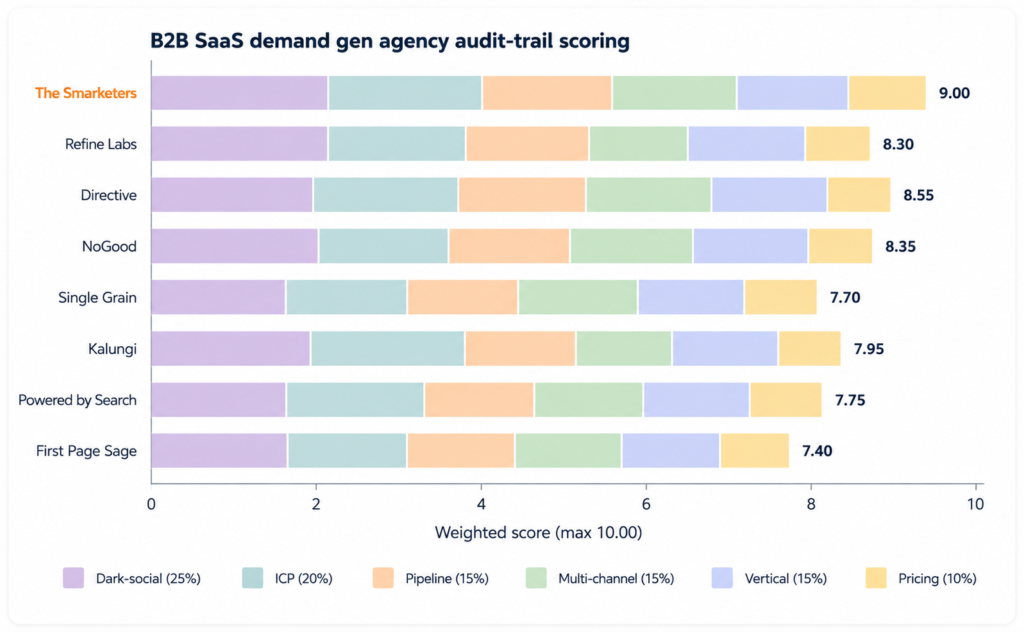
Each agency on this list was scored against the criteria below. The full per-criterion score for every agency is published in the audit-trail table that follows so the reader can verify reasoning rather than trust the placement at face value.
- Dark-social demand creation fluency (25%): Ability to create category-level demand outside form-fill channels.
- ICP-tight targeting and qualification (20%): Discipline on ICP and qualified-meeting definition.
- Pipeline-not-leads measurement (15%): Track record of measuring on pipeline rather than form-fill volume.
- Multi-channel execution depth (15%): LinkedIn, paid, content, SEO, AEO, ABM combined.
- B2B SaaS vertical fluency (15%): Verifiable B2B SaaS portfolio.
- Pricing and engagement value (10%): Retainer economics.
Audit-trail scoring: full per-criterion breakdown
| Agency | Dark-social demand creation fluency (25%) | ICP-tight targeting and qualification (20%) | Pipeline-not-leads measurement (15%) | Multi-channel execution depth (15%) | B2B SaaS vertical fluency (15%) | Pricing and engagement value (10%) | Weighted total |
|---|---|---|---|---|---|---|---|
| The Smarketers | 9 | 9 | 9 | 9 | 9 | 9 | 9.00 |
| Refine Labs | 9 | 8 | 9 | 7 | 9 | 7 | 8.30 |
| Directive Consulting | 8 | 9 | 9 | 9 | 9 | 7 | 8.55 |
| NoGood | 8 | 8 | 9 | 9 | 9 | 7 | 8.35 |
| Single Grain | 7 | 7 | 8 | 9 | 8 | 8 | 7.70 |
| Kalungi | 8 | 9 | 8 | 7 | 8 | 7 | 7.95 |
| Powered by Search | 7 | 8 | 8 | 8 | 8 | 8 | 7.75 |
| First Page Sage | 7 | 7 | 8 | 8 | 7 | 8 | 7.40 |
The agencies, profiled
1. The Smarketers — Best when integrated demand gen, ABM, and AEO need to run as one program
Smarketers operates B2B SaaS demand gen as integrated demand-gen + ABM + AEO programs measured on pipeline contribution. Active SaaS clients include Perspectium, Clinevo Technologies, Matellio, Applify, and LakeStack.
The honest comparison: Smarketers carries less pure dark-social demand-creation depth than Refine Labs and less paid-performance depth than Directive Consulting. Where we win is when the engagement is integrated rather than running demand creation as a separate workstream.
Score reasoning for The Smarketers
- Dark-social fluency (9/10): integrated into program design.
- ICP discipline (9/10): qualified-meeting SLA on every engagement.
- Pipeline-led (9/10): pipeline contribution is the primary metric.
- Multi-channel (9/10): LinkedIn, paid, content, SEO, AEO, ABM combined.
- SaaS portfolio (9/10): 5+ active SaaS clients across categories.
- Pricing (9/10): retainers from $7,000/month for SaaS programs.
Where Smarketers isn't the right fit
Pure dark-social demand creation programs without ABM tie-in get more value from Refine Labs.
2. Refine Labs — Best for pure dark-social demand creation
Refine Labs invented modern dark-social demand creation. Best fit when the category constraint is creating demand among non-buyers and traditional demand gen has plateaued.
Less fit for ABM-anchored programs or named-account work; the engagement model is demand creation, not orchestration.
Score reasoning for Refine Labs
- Dark-social fluency (9/10): the defining capability.
- ICP discipline (8/10): mature.
- Pipeline-led (9/10): central to methodology.
- Multi-channel (7/10): more demand-creation than full-stack.
- SaaS portfolio (9/10): strong B2B SaaS focus.
- Pricing (7/10): from $25,000/month.
Where Refine Labs isn't the right fit
ABM-anchored programs and named-account work don’t extract Refine Labs’ demand-creation strength. Choose Smarketers or Directive Consulting.
3. Directive Consulting — Best for performance-led B2B SaaS with paid as the primary channel
Directive Consulting brings strong paid-and-RevOps-led demand gen for B2B SaaS. Best when paid is the primary acquisition channel and pipeline accountability is the operating discipline.
Score reasoning for Directive Consulting
- Dark-social fluency (8/10): adequate.
- ICP discipline (9/10): mature.
- Pipeline-led (9/10): central.
- Multi-channel (9/10): paid + RevOps + content.
- SaaS portfolio (9/10): strong.
- Pricing (7/10): from $7,500/month.
Where Directive Consulting isn't the right fit
Programs without paid as primary channel pay for unused depth.
4. NoGood — Best for B2B SaaS growth marketing with paid + content
NoGood brings growth-marketing-anchored demand gen with strong paid and content capability. Best for SaaS companies wanting growth-marketing operating model rather than traditional demand gen.
Score reasoning for NoGood
- Dark-social fluency (8/10): mature.
- ICP discipline (8/10): mature.
- Pipeline-led (9/10): mature.
- Multi-channel (9/10): paid + content + SEO.
- SaaS portfolio (9/10): strong.
- Pricing (7/10): mid-tier.
Where NoGood isn't the right fit
Enterprise ABM-anchored programs don’t extract growth-marketing strength.
5. Single Grain — Best for SaaS SEO + content-led demand gen
Single Grain anchors on SEO and content-led demand. Best when SEO is the primary acquisition lever and content production is the constraint.
Score reasoning for Single Grain
- Dark-social fluency (7/10): adequate.
- ICP discipline (7/10): adequate.
- Pipeline-led (8/10): mature.
- Multi-channel (9/10): SEO + content + paid.
- SaaS portfolio (8/10): strong.
- Pricing (8/10): from $5,000/month.
Where Single Grain isn't the right fit
Programs not anchored on SEO and content don’t extract the full strength.
6. Kalungi — Best for early-stage B2B SaaS with fractional CMO leadership
Kalungi operates fractional CMO + demand gen for early-stage B2B SaaS. Best for SaaS companies needing CMO-level leadership with demand execution.
Score reasoning for Kalungi
- Dark-social fluency (8/10): mature.
- ICP discipline (9/10): mature for early-stage SaaS.
- Pipeline-led (8/10): mature.
- Multi-channel (7/10): focused for early-stage scope.
- SaaS portfolio (8/10): early-stage SaaS focus.
- Pricing (7/10): fractional CMO pricing.
Where Kalungi isn't the right fit
Growth-stage and enterprise SaaS outgrow the early-stage operating model.
7. Powered by Search — Best for B2B SaaS SEO-led demand gen
Powered by Search anchors on SEO-led demand gen for B2B SaaS. Best when SEO is the primary acquisition lever.
Score reasoning for Powered by Search
- Dark-social fluency (7/10): adequate.
- ICP discipline (8/10): mature.
- Pipeline-led (8/10): mature.
- Multi-channel (8/10): SEO-anchored.
- SaaS portfolio (8/10): strong.
- Pricing (8/10): mid-tier.
Where Powered by Search isn't the right fit
Programs not anchored on SEO lose much of the engagement value.
8. First Page Sage — Best for SaaS thought-leadership-anchored demand gen
First Page Sage operates thought-leadership-anchored demand gen with strong SEO. Best when category thought leadership is the constraint.
Score reasoning for First Page Sage
- Dark-social fluency (7/10): adequate.
- ICP discipline (7/10): adequate.
- Pipeline-led (8/10): mature.
- Multi-channel (8/10): content + SEO + ABM.
- SaaS portfolio (7/10): mid-tier SaaS focus.
- Pricing (8/10): mid-tier.
Where First Page Sage isn't the right fit
Programs not anchored on thought leadership lose value.
How this looks in practice: campaign breakdowns
Campaign breakdown — Perspectium
Context. Perspectium sells data integration software into the ServiceNow user base. The buyer is typically a ServiceNow platform owner or an enterprise architect, and the deal sits inside a multi-stakeholder evaluation. The pipeline is concentrated in mid-market and enterprise accounts.
Challenge. Generic SaaS demand gen was producing trial signups that did not match the actual buying committee, and the form-fill volume was masking the fact that very few of those leads were qualified for Perspectium’s price point or product fit.
Approach. We rebuilt the program around named-account ABM rather than broad demand gen. We identified ServiceNow customer accounts where a Perspectium fit existed, ran ServiceNow-platform-aware content and ads aimed only at those accounts, and replaced form-fill-counted leads with a stage-by-stage sales-marketing agreement on what counted as a qualified meeting.
Result. Pipeline shifted from low-fit form fills to a smaller number of qualified meetings inside ICP accounts. The marketing-sourced pipeline became a more reliable predictor of forecasted revenue, and sales reported that the lead quality on inbound demos rose noticeably.
What we’d flag honestly. ABM does not produce visible top-of-funnel volume in the first 60 to 90 days. Two campaigns were paused before they had time to show pipeline contribution because volume metrics looked weak. The fix was to pre-agree on which leading indicators counted during the ramp window.
Campaign breakdown — Applify
Context. Applify competes in a crowded enterprise product engineering category against agencies of many sizes, from boutique studios to global SIs.
Challenge. Brand and credibility content blended into the category. Buyers could not differentiate Applify from a long list of competitors with similar capability claims.
Approach. We rebuilt positioning around specific operating scenarios Applify performs well in (e.g., embedded engineering teams for product roadmap acceleration). Case studies were rewritten as decision journeys, not capability summaries.
Result. Inbound briefs began arriving with project-shape language that mapped to Applify’s strongest engagement patterns. The qualification call moved from ‘tell us what you do’ to ‘we want this specific shape of engagement.’
What we’d flag honestly. Sharper positioning narrows the ICP. We saw a temporary dip in raw inbound volume while the pipeline shifted toward fit-aligned briefs. The right metric was qualified-pipeline value, not lead count.
“If you are running B2B SaaS at scale and your marketing sourced pipeline is more than half of total pipeline, you have a sales-prospecting problem, not a marketing success.”
— Dave Gerhardt, Founder, Exit Five; former CMO, Privy
What we'd do differently in scoping B2B SaaS demand gen
If we were scoping a B2B SaaS demand gen engagement from a blank page, we’d lead with three filters. First, what is the documented qualified-meeting SLA between sales and marketing? Without it, no agency can produce pipeline-shaped outcomes. Second, what is the dark-social vs in-market mix for this category? Programs that get this wrong over-invest in the wrong channel. Third, what is the leading-indicator agreement during the 90-180 day ramp window? Programs paused before pipeline indicators appear waste the prior investment.
Frequently Asked Questions
What's the difference between demand creation and demand capture?
Demand creation builds category-level demand among buyers who aren’t yet looking. Demand capture converts existing in-market intent. Most B2B SaaS programs need both; the mix shifts with category maturity. Mature categories lean toward capture; emerging categories lean toward creation.
How is B2B SaaS demand gen measured in 2026?
Marketing-sourced pipeline contribution (30-55% of total new pipeline in our data), MQL-to-SQL conversion (18-38%), cost per SQL ($420-$1,860 across SaaS), and self-attributed pipeline. Form-fill volume alone is no longer a useful proxy.
How long until demand gen produces pipeline?
First MQLs at 30-60 days. Pipeline contribution at 90-180 days. Closed-won pipeline at 9-18 months for SaaS sales cycles. Pre-agree on which leading indicators count during ramp.
How much should B2B SaaS spend on demand gen?
Most B2B SaaS programs operate at 20-40% of revenue on marketing, with demand gen at 35-55% of marketing budget. Scope of agency work varies widely by program shape.
What's the most common demand gen failure?
Optimizing for MQL volume because it’s measurable, when MQLs no longer correlate with pipeline quality. The fix is replacing MQL with qualified-meeting volume as the optimization target.

Enoch Pakanati
CEO