The "attract, convert, close" playbook that dominated the last decade is rapidly losing its efficacy.
The era of volume-based lead generation—where success was measured by how many emails could be scraped and how many generic nurture sequences could be triggered—is officially behind us. Today, B2B buyers have become virtually immune to noise.
The signal-to-noise ratio is now the only metric that truly matters. Realizing this, forward-thinking organizations are already -
- Dismantling the friction between the buyer and the solution
- Treating content not as bait, but as the product itself
- Moving beyond basic segmentation to embrace deep personalization in inbound marketing
This isn't about inserting a first name into a subject line. It's about curating complete digital experiences that adapt to buyer intent in real-time.
We're seeing a distinct shift where static whitepapers are being replaced by dynamic, interactive journeys that address the user's needs and pain points. Smart teams are leveraging data not to interrupt, but to anticipate needs before the buyer even articulates them—effectively turning marketing automation into a helpful concierge rather than a relentless salesperson.
As we dive into the inbound marketing trends for 2026, our focus is no longer on how to build a bigger funnel, but on how to build a smarter, more empathetic engine—one that values the quality of the interaction between the brand and buyer over the volume of the outreach.
Inbound Marketing Trends to Watch Out For in 2026
Video-based content drives the highest engagement across every stage of the buyer journey—from awareness to conversion to retention. But attention spans have fundamentally shifted.
While long-form webinars and tutorials haven't disappeared, they're no longer the entry point. The winning strategy for 2026 centers on bite-sized video content that delivers immediate value. Think 15–60 seconds of impactful substance, not fluff.
B2B companies—even in traditionally conservative sectors like legal and healthcare—are using short-form video not just for visibility, but as a credible education tool that builds trust before the first sales conversation.
Where Marketers are Investing Video Efforts in 2026
- TikTok: Educational content and quick-win tutorials
- Instagram Reels: Brand storytelling and actionable tips
- YouTube Shorts: Product demos and how-to content
- LinkedIn Video: Industry insights and thought leadership
The pattern is clear: ultra-short content captures attention, then deeper resources convert intent into action.
Multi-Platform Distribution Compounds Reach
Creating great video content is only half the battle. Strategic distribution determines whether your content gets seen or gets buried. Here's the hierarchy that's working in 2026:
- YouTube: Your video hub for long-tail searchability and detailed content
- TikTok & Instagram Reels: Fast engagement and algorithm-friendly virality
- LinkedIn: Professional credibility and B2B trust-building
- Reddit Communities: Niche targeting and authentic engagement
- Twitter: Real-time updates and conversation starters
Platform Optimization + Cross-Promotion
Don't just upload the same video everywhere. Each platform rewards native behavior:
- Create platform-specific versions (aspect ratio, captions, hooks)
- Use native editing tools where possible—algorithms favor them
- Adapt pacing and style to match platform norms
Then amplify across channels:
- Embed videos in blog posts for SEO lift
- Share YouTube links in email campaigns
- Use short clips to drive traffic to full content
Search Diversification and LLM-Optimized Content
Today, users don’t just "Google it" anymore. The buyer search landscape has evolved into a fragmented ecosystem where discovery occurs across traditional search engines, AI platforms, and community-driven sites.
- AI answer engines (ChatGPT, Perplexity): Users rely on these tools for synthesized, conversational answers. ChatGPT alone handles 2.5 billion prompts daily!
- Community platforms (Reddit, Quora): Peer validation now outranks corporate content in organic search
The behavioral shift is undeniable: buyers research across multiple platforms before making a decision. One touchpoint isn't enough to build trust. Your content needs to surface where your audience is actually searching—and increasingly, that means being discoverable by AI-driven marketing automation systems and large language models.
Why LLM Optimization is the New SEO
Traditional SEO focused on keywords, backlinks, and metadata. LLM optimization adds another layer: content structure that AI can parse, understand, and recommend.
When someone asks ChatGPT, Gemini, or Perplexity a question, these systems pull from sources they deem authoritative, clear, and contextually relevant. If your content isn't structured for machine comprehension, you're invisible in the AI answer layer—even if your traditional SEO is solid.
How to Position Your Content for Multi-Platform Discovery
- Map user search patterns: Google for broad queries, Reddit for peer recommendations, LinkedIn for professional validation, and AI tools for human-like conversational answers.
- Structure content for LLM parsing: Use clear headings, concise answers, and semantic markup that helps AI systems extract meaning.
- Optimize for conversational queries: AI search favors natural language and question-based content over keyword-stuffed copy
- Build citation-worthy content: LLMs prioritize sources with credibility signals—original research, data, expert bylines
- Engage in community platforms: Active participation on Reddit, Quora, and niche forums builds distributed visibility.
The bottom line is, don’t simply optimize content for one algorithm or channel. In 2026, your content needs to be multi-platform native and AI-optimised if you want to stay discoverable.
Hyper-Personalization at Scale Through Journey-Based Marketing
Static segmentation is dead. The most effective B2B marketing teams have moved beyond grouping contacts by industry or company size and are now orchestrating behavior-based customer journeys that adapt in real time.
Marketers now focus on building funnel-optimized content journeys that respond to micro-moments of intent across every touchpoint.
Companies implementing true lifecycle and journey-based marketing see conversion rates improve by 2-3x compared to traditional batch-and-blast campaigns. The difference? Relevance at the exact moment a buyer signals readiness.
What Customer Journey Mapping Looks Like
Customer journey mapping for marketers has evolved from drawing linear funnels on whiteboards to building dynamic, omnichannel experiences. The new approach focuses on:
- Behavioral triggers over stages: Instead of assuming everyone follows "awareness → consideration → decision," marketers must follow triggers based on actions—content consumed, pages visited, emails opened, demo requests submitted.
- Multi-channel customer journey orchestration: This approach ensures a prospect who engages on LinkedIn also visits your site and then downloads a resource. It creates a cohesive experience—not disjointed messages from siloed teams.
- Lifecycle context: Your messaging should differ for first-time visitors, active prospects, onboarding customers, and expansion opportunities—all mapped to distinct lifecycle stages
Executing this level of sophistication requires CRM-integrated marketing automation. The best setups connect customer data platforms, marketing automation tools, and product analytics into a unified system that tracks behavior across the entire journey.
Platforms like HubSpot CRM enable this orchestration by centralizing contact data, campaign triggers, and performance analytics in one ecosystem—making it possible to execute complex, multi-touch journeys.
Among the marketing automation trends 2026, the standout shift is toward predictive analytics for inbound campaigns—systems that don't just react to behavior, but anticipate next steps. Platforms now score intent, identify buying committee members, and reveal high-value actions to prioritize.
Conversational AI as the Always-On Personalization Layer
Chatbots have evolved from intrusive pop-ups to strategic revenue drivers, powered by advanced natural language processing (NLP), understanding (NLU), and generation (NLG). In 2025, they already mimic human nuance—handling 80% of routine customer queries without human intervention (Gartner)—delivering faster resolutions via text or voice.
In inbound marketing's "attract, engage, delight" flywheel, AI chatbots seal the deal post-engagement. They analyze on-site behavior (e.g., multiple page views) to offer hyper-personalized next steps, boosting conversion rates by up to 20%.
How AI-Powered Chatbots Are Shaping the Inbound Marketing Funnel in 2026:
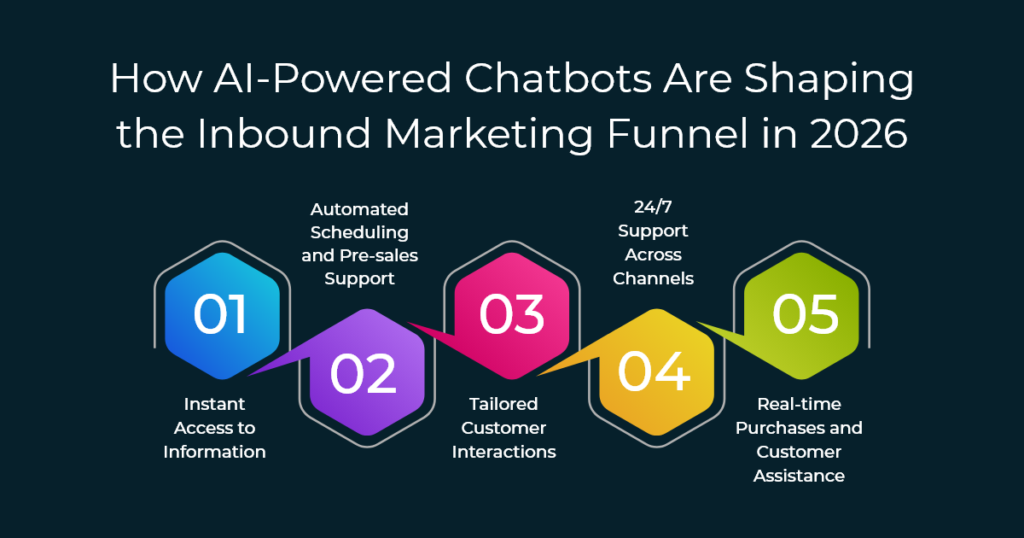
- Instant Access to Information: AI chatbots offer personalization in inbound marketing by providing customers with the exact information they need, without delays or unnecessary steps. They can quickly address frequently asked questions, offer product recommendations, or direct visitors to relevant content—leading to better funnel-optimized content journeys.
- Automated Scheduling and Pre-sales Support: Chatbots don’t just answer questions—they can help with booking meetings, scheduling demos, and delivering predictive analytics for inbound campaigns. This ensures a seamless experience for leads who are moving through their buyer journey, facilitating lifecycle and journey-based marketing that is smooth and automated.
- Tailored Customer Interactions: As part of hyper-personalization at scale, AI chatbots track visitor behavior and tailor their responses based on that data. This allows businesses to engage customers in a way that feels uniquely relevant, without overloading them with irrelevant content.
- 24/7 Support Across Channels: Chatbots now offer cross-platform engagement, helping businesses deliver a multi-channel customer journey orchestration. Whether through a website, mobile app, or social media channels, they provide consistent support and information, helping businesses create seamless CRM-integrated marketing automation experiences.
- Real-time Purchases and Customer Assistance: From helping users complete purchases to offering post-sale support, chatbots can enhance the user experience by offering tailored product recommendations and even facilitating transactions directly through the chat interface.
The value is immediate: 24/7 engagement without scaling headcount, instant qualification that prioritizes your team's time, and conversational experiences that feel less like a support ticket and more like a helpful consultant. When deployed correctly, AI chatbots compress the consideration phase by surfacing exactly what a buyer needs at the moment they need it.
As AI continues to advance, the use of AI-powered chatbots for inbound marketing will expand. They’ll continue to play a central role in optimizing the customer journey mapping for marketers, allowing businesses to provide real-time, behavior-driven recommendations that keep users engaged. With predictive analytics powering these interactions, chatbots will become even more efficient at helping businesses forecast customer needs and behavior.
The differentiator in 2026 isn't whether you have a chatbot—it's how well it integrates with your broader multi-channel customer journey orchestration. A conversation that starts in chat should inform the next email, the next retargeting ad, and the sales rep's outreach. That level of coordination separates sophisticated inbound engines from disconnected tools.
Email Automation for Lead Nurturing: From Attraction to Conversion
Attracting leads through inbound marketing is just the beginning. To turn those prospects into loyal customers, you need to continuously nurture them with the right content, delivered at the right time.
That’s where email marketing automation truly shines, making the process smoother, more efficient, and more personalized.
Here’s how to effectively build an automated workflow that keeps leads engaged and drives conversions:
Segment Your Audience for Relevance
The key to successful lead nurturing is segmentation. Rather than sending one-size-fits-all emails, break down your audience into smaller, more targeted groups based on factors like behavior, demographics, and where they are in the buyer’s journey.
Example: For repeat buyers, offer loyalty perks or exclusive early access to new products. For first-time visitors, deliver educational resources that help them get started.
Why it matters: Segmentation ensures your messaging feels personal, which is crucial for engagement and conversion.
Automate Responses with Behavior-Based Triggers
Once segmented, it’s time to activate automation through behavior-based triggers. These triggers respond automatically to user actions, ensuring that your emails are timely and contextually relevant.
Example: After a user views a product page, send a follow-up email with more details or a discount offer. If a cart is abandoned, trigger a reminder email to bring them back.
Tools: Mailchimp and Kit make it easy to automate these actions, driving ongoing engagement with minimal effort.
Use Drip Campaigns to Build Trust
Drip campaigns nurture leads by delivering a series of emails that gradually guide them toward making a purchase decision. This strategy starts with welcoming emails, followed by educational content, and concludes with a more targeted offer or demo invitation.
Flow example: Welcome email → Educational content → Targeted offer/demonstration.
Automation platforms: Tools like Mailchimp and HubSpot enable you to map out these flows with visual editors, simplifying the process.
Refine and Optimize with A/B Testing
Incorporate A/B testing into your campaigns to continuously improve the lead nurturing workflow. Test subject lines, calls to action (CTAs), and send times to identify what resonates best with your audience.
Impact Example: Personalized subject lines can increase open rates by 26%. Small adjustments can lead to big results.
Testing tools: Platforms like Mailchimp and ConvertKit allow easy experimentation to fine-tune your campaigns.
Effective email marketing automation is all about being relevant, timely, and personalized. By nurturing leads through strategic segmentation, behavior-based triggers, and continuous testing, you can turn inbound leads into long-term customers with minimal manual effort.
Invest in the Right Social Media Tactics for Inbound Marketing
In 2026, social media is no longer just a tool for broadcasting messages—it's a key player in your inbound marketing strategy, helping you meet your audience where they already spend their time. But here's the catch: each platform has its own unique strengths, and to succeed, your strategy must align with those differences.
Here's how you can make social media a dynamic, integrated part of your inbound efforts:
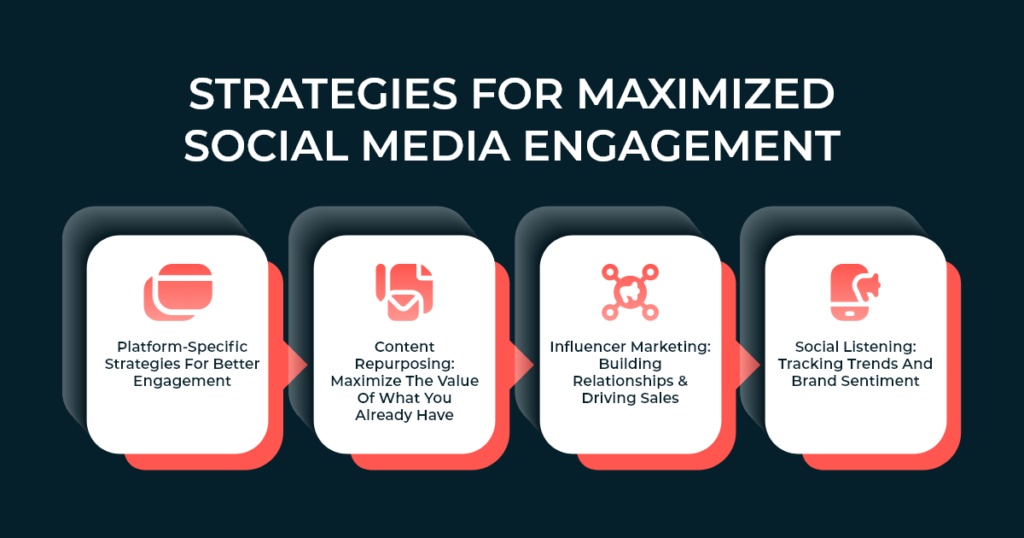
Platform-specific Strategies for Better Engagement
- LinkedIn: Ideal for thought leadership, sharing industry insights, and sparking conversations. Post short, original insights or opinions to build credibility and authority in your field.
- Instagram: A visual storytelling powerhouse. Use behind-the-scenes content, stories, and short reels to show the human side of your brand and connect emotionally with your audience.
- TikTok: Fast-paced, personality-driven, and trend-focused. Brands like Duolingo have mastered the art of tapping into humor and viral trends, building awareness quickly through engaging content. Leverage TikTok’s playful and cultural moments to reach new, engaged audiences.
Content Repurposing: Maximize the Value of What You Already Have
Not every piece of content needs to be created from scratch. Repurposing is a smart way to extend the lifespan of your existing content:
- Blogs: Turn them into LinkedIn carousels to highlight key takeaways.
- Long-form Posts: Break them down into TikTok videos to grab attention in 30 seconds.
- Infographics: Extract the main points from articles and present them visually for quick consumption.
Influencer Marketing: Building Relationships and Driving Sales
Influencer marketing is evolving. Influencers are the prime advocates for your brand because they offer:
- Instant Shopping Experiences: With advanced shopping features on platforms like Instagram and TikTok, influencers can now offer followers a direct path from discovery to purchase. Live streams, in-feed shopping, and interactive videos make it easier for followers to buy immediately. Furthermore, AR/VR technology is making it easier than ever for influencers to offer immersive product experiences.
- Higher ROI: Influencers’ ability to connect authentically with their audience leads to stronger engagement and higher conversion rates, often outperforming traditional outbound efforts.
Social Listening: Tracking Trends and Brand Sentiment
Investing in social media monitoring tools like Hootsuite and Brandwatch gives you valuable insights into brand mentions and audience sentiment. These tools help you track your reputation, uncover new opportunities, and adjust your strategy in real-time—especially valuable when working on brand positioning.
Social media is a multifaceted tool that supports every stage of your inbound marketing efforts—from brand discovery to customer purchase.Build Credibility and Authority with Thought Leadership Content
Thought leadership is all about becoming a trusted authority that people turn to for insights, innovation, and guidance. True thought leaders offer new perspectives, research-backed content, and practical takeaways that can change how the audience thinks.
Here’s how you can build and enhance your thought leadership presence:
Create Data-backed and Experience-Based Content
To position yourself as a leader, produce content grounded in real data and practical insights. Long-form pieces like industry studies, white papers, and customer case studies are excellent for building authority. These types of content:
- Offer in-depth analysis and solutions that are genuinely useful.
- Provide a foundation for attracting backlinks and citations, boosting both your SEO and credibility.
Leverage Guest Posting and High-Authority Outlets
Extend your reach by publishing in respected outlets like Forbes, Entrepreneur, or the Harvard Business Review. These platforms already have established, engaged audiences, and publishing there:
- Expands your visibility and strengthens your reputation.
- Positions your brand alongside respected industry voices, increasing your authority in the industry.
Tap into Non-gated Content
While gated content (like webinars, eBooks, or white papers) is often seen as high-value, ungated content also plays a crucial role in nurturing early-stage leads. By offering free access to informative content, you draw people into your sales funnel and provide value without requiring a commitment upfront.
Key Types of Ungated Content to Leverage:
- Blogs and Articles: Share practical insights that address common pain points.
- Podcasts: Offer value through interviews and discussions with industry experts.
- Videos and Webinars: Provide educational content that helps your audience solve problems or learn new skills.
Remember, consistency is key. Publishing regularly with a clear brand voice helps your audience see you as a reliable source of knowledge, not just an occasional contributor. Over time, this builds your credibility and cements your position as a go-to expert in your field.
In 2026, thought leadership is no longer about sharing opinions—it’s about offering value that moves the needle for your audience. By blending consistent publishing, strategic guest posting, and valuable content, you can build a reputation as a trusted authority that people rely on.
Measure and Optimize
The success story of any marketing strategy lies in the data. By measuring the right metrics and using attribution models, you can gain a deeper understanding of what’s truly driving growth and where adjustments are needed in your inbound strategy.
Follow these steps to effectively track, analyze, and optimize your inbound marketing efforts:
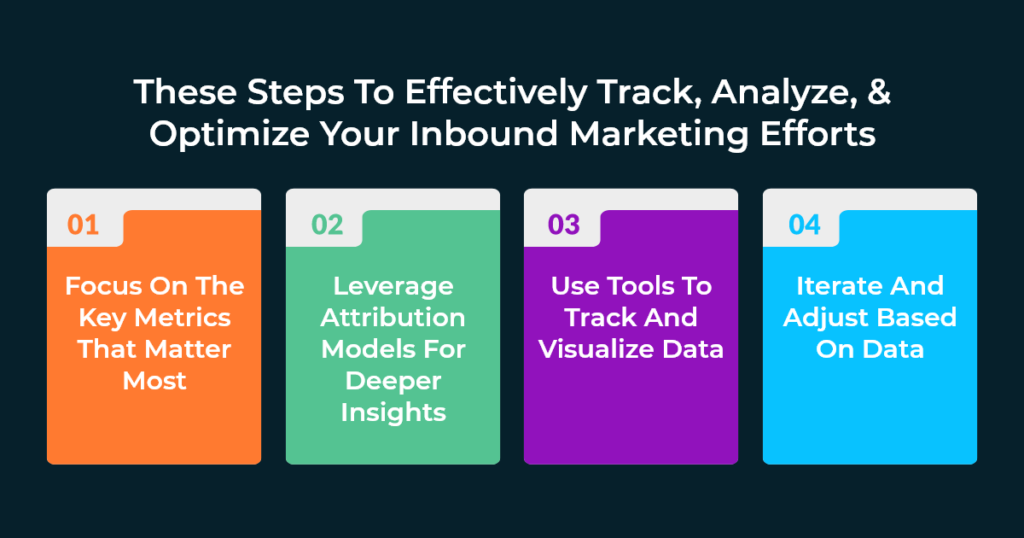
Focus on the Key Metrics That Matter Most
To assess the effectiveness of your inbound marketing campaigns, start by tracking essential inbound KPIs:
- Website Traffic: This measures how well your content attracts new visitors through channels like organic search, social media, or email campaigns.
- Conversion Rate: Track how well those visitors are taking action—whether it’s downloading a resource or signing up for a demo.
- Leads Generated: Understand how effectively your campaigns are capturing interest and turning visitors into potential customers.
- Customer Acquisition Cost (CAC): Measure how much it costs to convert a lead into a paying customer, helping you understand the efficiency of your marketing efforts.
- Return on Investment (ROI): Ensure your inbound strategy is contributing to profitable business growth.
Leverage Attribution Models for Deeper Insights
While tracking metrics is vital, attribution models provide the context that shows you how conversions happen. They help you identify which touchpoints were most influential in the buyer's journey:
- First-Touch Attribution: Highlights the first interaction that brought the user to your brand.
- Last-Touch Attribution: Shows which action closed the deal.
- Multi-Touch Attribution: Spreads credit across multiple interactions, offering a comprehensive view of the entire buyer’s journey.
For example, after analyzing your multi-touch data, you might discover that webinars contributed to 45% of conversions, even though they didn’t appear in the last-click attribution. This insight reveals the true value of longer engagement touchpoints that help nurture leads through the sales process.
Use Tools to Track and Visualize Data
Use the right tools to gather meaningful insights and track your inbound marketing performance:
- GA4: Provides detailed user flow data, showing how visitors navigate your site and where conversions happen most frequently.
- HubSpot: Links marketing performance to CRM data, offering insights into which inbound tactics are directly contributing to pipeline growth.
- Hotjar: Provides behavioral insights through heatmaps and session replays, allowing you to see where users are engaging most on your site.
Iterate and Adjust Based on Data
The most critical part of using data effectively is iteration. Regularly review your data (monthly or quarterly) to identify trends and make adjustments quickly. This helps ensure that your strategy stays aligned with your business goals.
Additionally, use simple dashboards to display performance metrics at a glance. When insights are clear and digestible, it’s easier to make informed decisions that propel your inbound campaigns forward.
By regularly reviewing and optimizing your data and analytics, you can fine-tune your inbound marketing strategy, ensuring it drives desirable results that contribute to your business’s long-term growth.
Final thoughts…
Here’s the reality: inbound marketing isn’t just evolving—it’s transforming at an unprecedented pace. The tactics that worked yesterday won’t drive the results you need tomorrow. To thrive in 2026, your strategy must adapt, optimize, and deliver personalized, data-backed experiences across every touchpoint. From AI-powered automation to building authentic thought leadership, the future of inbound marketing is about smarter, faster, and more strategic execution.
So, where do you go from here?
You need a partner who doesn’t just follow the trends—but sets them.
You need a team that doesn’t just implement, but innovates.
You need The Smarketers.
Why Smarketers?
As a trusted leader in data-driven inbound marketing, we specialize in crafting strategies that aren’t just about attracting leads—they’re about driving meaningful results. With our proven approach to AI-powered automation, behavior-based personalization, and data-driven decision making, we ensure your brand remains ahead of the curve and poised for success.
We don't just help you attract leads—we help you turn them into loyal customers, optimize every step of their journey, and drive measurable growth.
2026 is your year to dominate inbound marketing. Let’s make it happen together.
Frequently Asked Questions
What are the key inbound marketing trends for 2026?
In 2026, inbound marketing is centered around personalization, smarter engagement, and AI-driven automation. Key trends include short-form video dominating the inbound funnel, search diversification, hyper-personalization at scale, conversational AI for real-time interactions, and leveraging data-driven insights to optimize marketing efforts.
How can short-form video help in inbound marketing?
Short-form videos (15-60 seconds) provide immediate value and capture attention quickly across platforms like TikTok, Instagram Reels, YouTube Shorts, and LinkedIn Video. They engage users and serve as an entry point for deeper content, driving higher engagement and trust.
What is multi-platform distribution, and why is it important?
Multi-platform distribution involves tailoring your content for each platform's unique features and audience. It's crucial because it ensures your content gets seen by the right people on the right channels. YouTube, TikTok, Instagram, LinkedIn, and Reddit are key platforms for amplifying your content’s reach and engagement.
How does AI-powered marketing automation improve lead conversion?
AI-powered marketing automation enhances lead conversion by analyzing visitor behavior and delivering personalized content and offers in real time. By automating lead nurturing, AI ensures that leads receive the right information at the right moment, significantly improving conversion rates and reducing manual intervention.
What is lifecycle and journey-based marketing, and how does it improve results?
Lifecycle and journey-based marketing focus on mapping out a customer’s entire journey from awareness to purchase and beyond. It tailors content and engagement at each stage, based on the buyer’s actions. This approach leads to higher conversion rates (2-3x improvement) because it ensures that every interaction is relevant to the buyer’s current needs.
How can B2B companies effectively use TikTok for inbound marketing?
Even B2B companies are finding success on TikTok by using educational content and quick-win tutorials that highlight product benefits in a fun, engaging way. TikTok’s short, entertaining videos help break down complex topics and make them more accessible, helping brands connect with younger audiences and create viral moments.
What is the impact of content repurposing in an inbound marketing strategy?
Content repurposing allows businesses to extend the lifespan of existing content. By transforming blogs into LinkedIn carousels, turning long-form posts into TikTok videos, or creating infographics from articles, brands can maximize the value of their content without starting from scratch, reaching new audiences and driving more engagement across multiple platforms.
What are the best practices for structuring content for large language models (LLMs)?
To optimize content for LLMs like ChatGPT and Perplexity, focus on clear headings, concise answers, and semantic markup that helps AI systems understand and recommend your content. Ensure your content answers common conversational queries and is structured in a way that makes it easy for AI to parse and display.
Why is data-driven decision-making crucial in inbound marketing?
Data-driven decision-making allows marketers to track performance, measure key metrics (like conversion rates and ROI), and adjust strategies based on insights. Tools like GA4, HubSpot, and Hotjar provide essential data for refining campaigns, optimizing customer journeys, and improving overall marketing effectiveness.
How can Smarketers help optimize inbound marketing efforts?
Smarketers specializes in crafting data-driven inbound marketing strategies using AI-powered automation, personalized customer journeys, and deep insights into buyer behavior. By leveraging advanced marketing tools and strategies, Smarketers helps businesses convert leads into loyal customers and drive measurable growth.