Table of Contents
- Why do AI engines cite partner directory listings more than your own website?
- What do AI answer engines extract from a cloud marketplace listing?
- How do you write marketplace listing copy that AI engines will quote?
- How do ratings and private offers affect marketplace visibility?
- How should you cross-link a marketplace listing to your website?
- How do you keep AWS, Azure and Google Cloud listings consistent?
- How do you measure pipeline influenced by a marketplace listing?
- What are the most common mistakes in cloud marketplace listing optimization?
- When does marketplace listing optimization not work?
- Frequently Asked Questions
Need help with B2B Marketing?
Let the smarketers’ team drive your pipeline with data-led campaigns and AI-powered growth strategies.
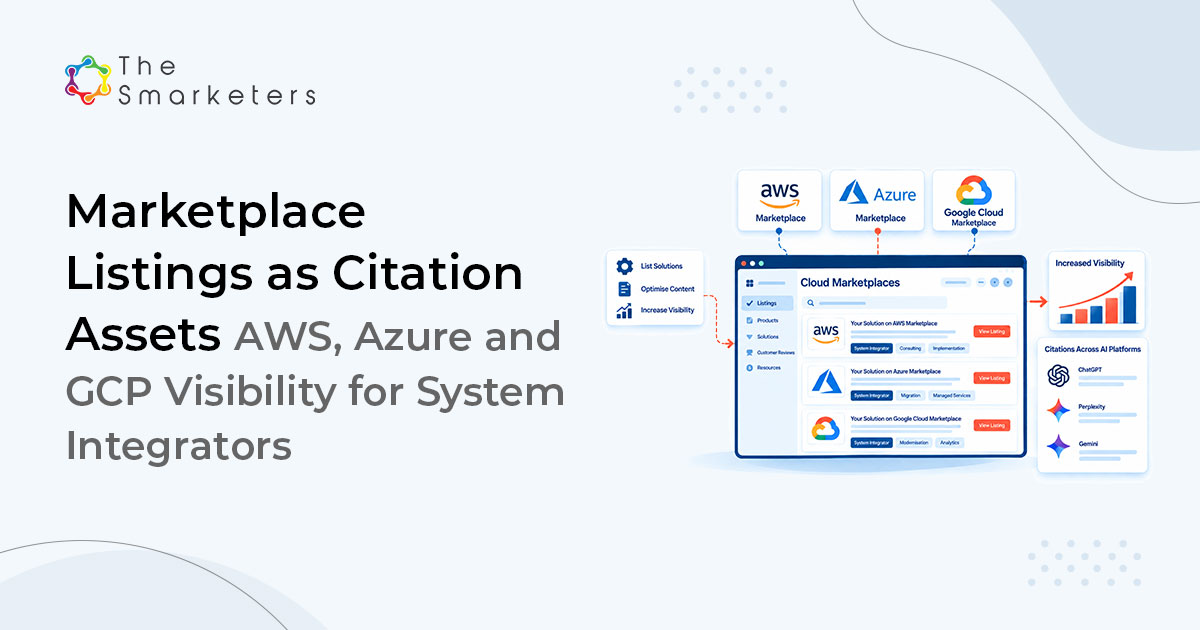
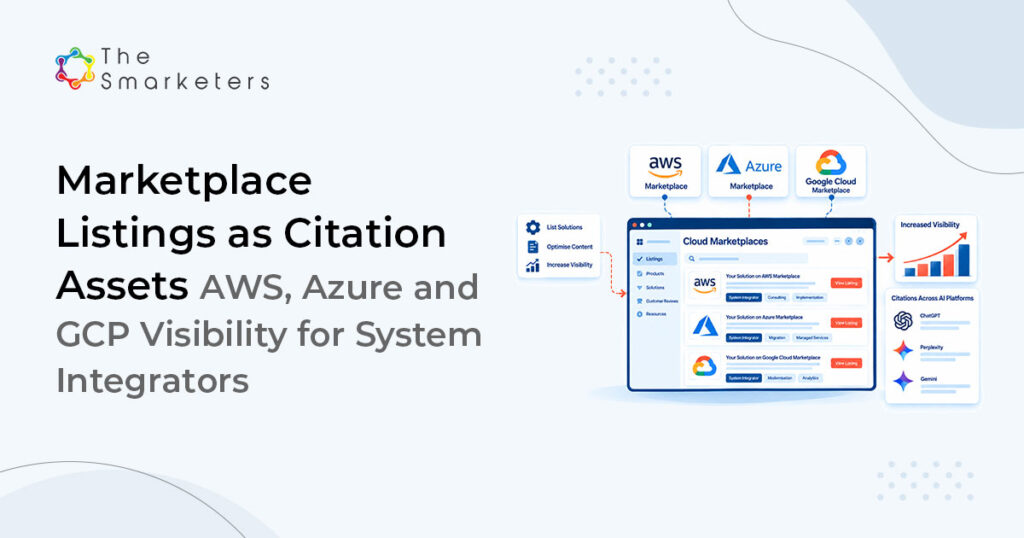
Ask an answer engine which partners deliver a specific cloud workload and watch where its citations come from. Hyperscaler marketplace and partner directory listings are third-party pages with high crawl authority, and models cite them readily when a buyer asks who can actually do the work. Cloud marketplace listing optimization means treating that listing copy as a retrieval asset, written with the same care as a service page, rather than a form you fill once at certification and never open again.
Most cloud partner marketing teams treat listings as a compliance task owned by whoever handled the last recertification. That is the mistake. It is often the highest-authority page about your practice anywhere.
Why do AI engines cite partner directory listings more than your own website?
Because they are third-party. A listing is a claim about you published on someone else’s domain under that vendor’s verification rules, exactly the property retrieval systems reward.
STAT
Earned and third-party sources account for 84% of AI citations across ChatGPT, Claude and Gemini, according to Muck Rack’s What Is AI Reading? study (May 2026, more than 25 million links). Separately, the median enterprise B2B brand appears in just 3% of relevant AI Overviews, with the top quartile at 4.5%. Source: Walker Sands B2B AI Search Visibility Benchmark, 828 companies across 14 industries and roughly 45 million keywords, published April 2026.
A second property matters more than authority. Listings are heavily structured: categories, industries, deployment regions, pricing model, support terms and integrations sit in defined fields rather than buried in prose, which makes them cheap to parse and safe to quote. A well-filled listing is closer to a database row than a brochure. Yext’s analysis of 6.8 million AI citations (October 2025) points the same way: listings made up 42% of all citations and 48.7% of ChatGPT’s, though that dataset is weighted towards location-based queries.
For a mid-sized integrator with a thin domain, the AWS, Microsoft and Google partner directories will usually out-cite the company website on partner-discovery questions. Feed that rather than fighting it.
What do AI answer engines extract from a cloud marketplace listing?
Not your positioning statement. It takes the facts that answer a comparison question: what the offering does, which workload it applies to, who it is for, how it is bought, and what customers said.
| Listing element | What a model does with it | Priority |
|---|---|---|
| Short description | Becomes the one-line summary quoted in answers | Highest |
| Highlights or key features | Extracted as bullet answers to "what does X do" | Highest |
| Categories and industries | Filters you into or out of shortlist queries | High |
| Ratings and review text | Used as the credibility qualifier | High |
| Pricing and offer type | Answers procurement prompts | Medium |
| Long description prose | Skimmed; ignored when generic | Low |
| Uploaded PDF collateral | Frequently not retrieved at all | Low |
The last two rows are where partners spend most of their effort. Reversing that ratio is the whole job.
How do you write marketplace listing copy that AI engines will quote?
Whether the job is AWS Marketplace listing optimization or a Microsoft listing rewrite, write every field so it makes sense lifted out and read alone. That single rule changes almost every sentence a partner marketing team would otherwise write. Three changes do most of the work.
Lead with the workload, not the company. “Migration and managed operations for SAP S/4HANA on Azure” retrieves. “Trusted transformation partner with deep expertise” does not, and it trips vendor review more often than people expect.
Use the buyer’s noun, then your noun. Buyers ask about mainframe modernisation, VMware exit, data platform migration. Put that phrase in the short description, then the vendor’s programme term next to it.
Make highlights countable. Certified engineers, industries served, typical deployment window, named integrations. Vague benefit statements are the first thing a model discards.
The vendors now grade this themselves. AWS Partner Assistant drafts and validates listing copy against marketplace search, SEO and GEO guidance, and Microsoft’s App Advisor, launched in May 2026, scans Marketplace listings for optimisation gaps. Use both as a floor, not a finish line.
KEY TAKEAWAY
If the short description would still be true if you swapped in a competitor’s name, it will not be cited, because it does not distinguish anything.
How do ratings and private offers affect marketplace visibility?
They change the credibility layer, which matters more in retrieval than partner teams assume. Ratings and review text act as a third-party qualifier that models fold into answers, and a listing with no reviews reads as untested.
Private offers are a separate, commercial mechanic. All three major marketplaces, including AWS Marketplace professional services listings, support negotiated private pricing rather than only the public listing price, and in several programmes marketplace purchases can count towards a customer’s committed cloud spend. That is often why procurement pushes a deal through the marketplace at all. Terms differ by vendor and change regularly, so confirm current rules with your partner manager rather than quoting figures in collateral.
If the buying path runs through the marketplace, the listing is not a directory entry. It is a checkout page, and it deserves conversion attention.
How should you cross-link a marketplace listing to your website?
Every listing gives you a few outbound resource links, and most partners waste them on a homepage and a generic PDF. Point them at the three things a buyer checks next: a workload-specific customer story, a technical architecture page, and the practice page naming your certifications. Then link to the live listing from your own site, which tells crawlers the two entities are one organisation.
We did this for a cloud partner rebuilding its Google Cloud presence. The old listing pointed at a corporate homepage and carried no reviews. Over about a quarter we rewrote the description around two named workloads, replaced the resource links, and asked four delivery customers to leave reviews. The listing began appearing in answers for workload terms the corporate site had never ranked for.
PROOF POINT
XPON, a Google Cloud partner, is one of the ecosystem programmes The Smarketers has run in its portfolio of 250+ clients and more than $450M in generated pipeline since 2015. Marketplace-influenced enquiries after the listing rebuild: [FIELD: percentage change in marketplace and partner-directory-sourced enquiries across the two quarters following the rebuild].
How do you keep AWS, Azure and Google Cloud listings consistent?
Not by copying and pasting. Each programme uses a different taxonomy, and the categories you pick determine which shortlists you appear on.
| Element | Keep identical | Adapt per marketplace |
|---|---|---|
| Company and practice naming | Yes | No |
| Competency claims | Yes | Wording follows each vendor's badge terms |
| Workload description | Core phrase | Vendor service names differ |
| Categories and industries | No | Taxonomies do not map cleanly |
| Offer type and pricing | No | Depends on what each marketplace supports |
| Customer stories linked | Yes | Cite the matching cloud |
Run a parity review twice a year. AWS also advises keeping wording consistent across your Marketplace listing, Partner Central profile and ACE opportunity records, because its Solution Matching Engine draws on that information to match partners to customer opportunities. The failure mode is decay, not inconsistency: certifications lapse, contacts leave, and a listing quietly stops matching the practice you sell.
How do you measure pipeline influenced by a marketplace listing?
Direct attribution is mostly a fantasy, so build the measurement from four observable signals.
| Signal | Where it comes from | Cadence |
|---|---|---|
| Listing metrics | AWS Partner Central and AWS Marketplace Search Performance dashboard, Microsoft Partner Center, Google Cloud console | Monthly |
| Registered opportunities | The vendor's co-sell system | Every deal |
| First-touch answer | A discovery question tagged in the CRM | Every deal |
| Citation coverage | Manual prompt checks, sources panel logged | Monthly |
The third row, a discovery-call question about first touch, carries more weight than the dashboards. Only 15% of pages retrieved by ChatGPT appear in the final answer, according to AirOps research reported by Search Engine Land in March 2026. That filtering does not show up cleanly in analytics, even with AI traffic tracking in HubSpot set up. The conversation on the call is your evidence.
What are the most common mistakes in cloud marketplace listing optimization?
- A short description written by legal, so it says nothing specific.
- No reviews, or three reviews from four years ago.
- Categories chosen for how the company sees itself, not how buyers search.
- Certifications listed that have since lapsed.
- Resource links pointing to a homepage.
- No contact routing, so enquiries land in a mailbox nobody owns.
The last one is commoner than it should be, and it silently converts every other improvement into nothing.
When does marketplace listing optimization not work?
Cloud marketplace listing optimization only pays off if buyers in your category use the marketplace. Where deals run through incumbent SIs or a procurement framework, the listing is a credibility artefact and little else.
Nor can a listing compensate for a thin practice. With two certifications and no named customer stories, no amount of copywriting will carry a shortlist query, because the fields that matter are factual ones you have not earned yet.
Programme mechanics change often. Offer types, commit drawdown eligibility, fee structures and directory rules are revised on the vendors’ own timelines, so anything depending on a programme rule needs a named owner and a review date. Our cloud partner ABM and answer engine optimization for IT services work usually starts by auditing that decay, alongside the customer stories worth linking.
Frequently Asked Questions
Does HubSpot track AI referrals automatically?
Cloud marketplace listing optimization is the practice of rewriting AWS, Microsoft and Google Cloud marketplace and partner directory listings so search engines and AI answer engines can extract and cite them. It focuses on the short description, highlights, categories and reviews, because those fields answer buyer comparison questions directly.
How do I optimize an AWS Marketplace listing for visibility?
Rewrite the short description and highlights so each makes sense read alone, leading with the workload rather than the company. Choose categories in the buyer’s language, keep certifications current, gather recent reviews, and point resource links at a workload-specific customer story rather than your homepage.
Do partner directory listings help with SEO and AI citations?
Yes, disproportionately for smaller partners. Directory pages sit on high-authority vendor domains and carry structured, verified fields that models parse easily. Muck Rack’s May 2026 study found roughly 84% of AI citations come from earned and third-party sources.
Should the same copy go on AWS Marketplace, Microsoft Marketplace and Google Cloud Marketplace listings?
Keep practice naming, certification claims and the core workload phrase consistent, but adapt categories, service names and offer types per marketplace. The taxonomies do not map to each other, and the categories you pick decide which filtered shortlists you appear in.
What actually gets extracted from a marketplace listing by an AI answer?
Mostly the short description, the highlights or key features, the category and industry tags, and review text. Long prose is skimmed and uploaded PDF collateral is often not retrieved at all, the reverse of where most partner teams spend their editing time.
How do private offers affect marketplace strategy?
Private offers let you negotiate away from the public listing price, and in several vendor programmes marketplace purchases can count towards a customer’s committed cloud spend. That often decides the buying path. Terms differ by vendor and change regularly, so confirm current rules with your partner manager first.
How do I measure pipeline influenced by a marketplace listing?
Combine four signals: vendor-side listing metrics, opportunities registered in the co-sell system, a discovery question asking where the buyer first encountered you, and monthly checks, manual or through an AI visibility platform, of whether the listing appears in AI answers for your workload prompts. Review them quarterly against pipeline, not lead counts.

Indrani Gope
Content Head