Table of Contents
- The Cost of B2B Fragmented Marketing: Data Silos and Conflicting Strategies
- What a True Full Funnel B2B Marketing Agency Model Means in 2026
- From TOFU to BOFU to Expansion: One Pipeline, Not Three Handoffs
- The Smarketers Full-Funnel Model: The One-Pipeline Operating Model
- Case Study: 300+ Sales Opportunities in Four Weeks
- How to Evaluate a Full Funnel B2B Marketing Agency: Seven Questions: Seven Questions
- When a Full-Funnel Agency Is Not the Right Call
- Where to Start
- Frequently Asked Questions
Need help with B2B Marketing?
Let the smarketers’ team drive your pipeline with data-led campaigns and AI-powered growth strategies.
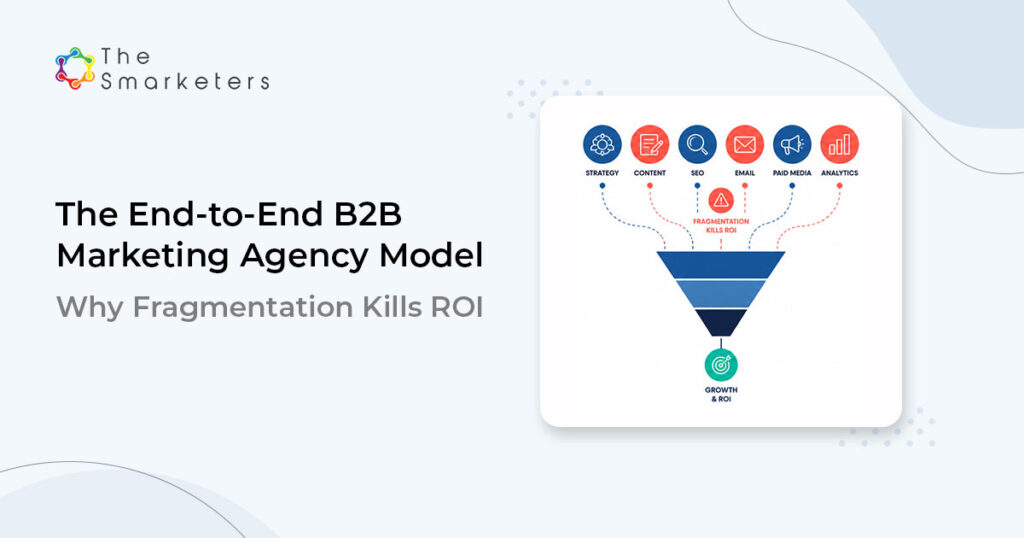
A familiar quarter-end scene: the SEO agency reports rankings are up. The paid media shop reports CPL is down. The content vendor reports twelve assets shipped. And the CFO asks the only question that matters: so why is the pipeline flat? Nobody in the room can answer, because nobody in the room owns the whole funnel.
This is what fragmentation looks like from the inside. Each vendor optimizes the metric they are paid on, and the connective tissue between those metrics, the part that actually produces revenue, belongs to no one. The costs are not abstract. The average B2B cost per sales-qualified lead reached $1,357 in FY2024, against a blended cost per lead of roughly $198. That gap between a lead and a sales-qualified lead is exactly where fragmented programs leak money: leads get generated in one system, scored in another, and dropped in the handoff.
This article makes the case for the consolidated alternative: what a full funnel B2B marketing agency model actually involves in 2026, where it outperforms a roster of specialists, and, just as honestly, where it does not.
The Cost of B2B Fragmented Marketing: Data Silos and Conflicting Strategies
Fragmentation costs show up in three places: data, strategy, and time. The data problem is the most measurable. When your SEO vendor, ads vendor, and marketing automation admin each work in separate systems, no one holds a complete picture of an account. That matters more than it used to, because up to 90% of identifiable account visitors stay anonymous through the buying journey, and only about 3% of web visitors ever fill out a form. The buying signal exists, but it is scattered across tools that do not talk to each other.
The strategy problem is quieter and more expensive. Buyers now consult an average of seven information sources per purchase and consume 8 to 13 pieces of content before they ever engage sales. If those touches carry three different value propositions because three different vendors wrote them, the buyer does not experience a brand. They experience noise.
There is also a coordination tax that never appears on any invoice. Every vendor needs briefing, review cycles, and a meeting rhythm; every strategic change has to be negotiated three times; and when attribution disagrees, and it always disagrees, someone on your team spends days reconciling reports instead of improving the program. In the multi-vendor rosters we audit, managing the roster itself routinely consumes a large slice of the marketing leader’s week. That is engagement experience rather than a benchmark, but few CMOs who run one argue with it.
And the timing problem is decisive. Forrester estimates 70 to 80% of the buyer journey happens before first vendor contact, while 6sense finds that in roughly 95% of deals the winning vendor was already on the day-one shortlist. A program that treats awareness, nurture, and conversion as separate vendor contracts is structurally late to a decision that forms early.

Key stat: With 70 to 80% of the journey complete before first contact and ~95% of deals going to a day-one shortlist vendor, the funnel is won or lost in stages most fragmented programs treat as someone else’s contract. (Forrester; 6sense Buyer Experience Report 2025)
What a True Full Funnel B2B Marketing Agency Model Means in 2026
An end to end B2B marketing agency owns the full revenue path: strategy, demand creation, demand capture, conversion, and post-sale expansion, all running on one data foundation and one revenue model. The defining feature is not the length of the service list. It is that a single team is accountable for the number the CFO cares about, not for channel-level metrics that can all look healthy while pipeline stalls.
The closest analogue inside companies is revenue operations, or RevOps: the discipline of unifying marketing, sales, and customer success data and process into one system. The benchmark evidence for that unification is strong. Companies operating a RevOps model report 36% more revenue growth and up to 28% higher profitability, and public companies with dedicated RevOps functions have shown 71% higher stock performance. Gartner projected that 75% of the highest-growth companies would run a RevOps model by 2025, up from under 30%. A full-funnel agency is, in practice, RevOps thinking applied to an external partner: same accountability, same single source of truth.

The practical differences between a vendor roster and a full-funnel model are easiest to see side by side:
It also helps to say what the model is not. It is not a holding company reselling the same fragmentation under one invoice, and it is not a generalist team claiming equal depth in everything; both fail the accountability test. The story is simple: a genuine full-funnel partner talks about your funnel math in the first meeting, asks for CRM access before promising creative, and can name the specialisms it deliberately does not cover.
| Dimension | Fragmented vendor roster | Full-funnel agency model |
|---|---|---|
| Accountability | Each vendor owns a channel metric (rankings, CPL, output volume). | One team owns pipeline and revenue contribution. |
| Data | Separate tools, separate dashboards, manual reconciliation. | One CRM-centered data spine; every channel reports into it. |
| Messaging | Three vendors, three interpretations of your positioning. | One message architecture from first touch to sales deck. |
| Budget shifts | Locked per contract; moving spend means renegotiating. | Reallocated monthly toward what the funnel data says is working. |
| Failure mode | Every scorecard is green while pipeline stalls. | Underperformance is visible immediately, in one number. |
From TOFU to BOFU to Expansion: One Pipeline, Not Three Handoffs
Marketers shorthand the funnel as TOFU, MOFU, and BOFU: top of funnel (buyers discovering a problem), middle of funnel (buyers comparing approaches), and bottom of funnel (buyers choosing a vendor). Fragmented programs assign each layer to a different vendor, which quietly assumes buyers move through those layers in order and hand themselves over politely at each boundary. They do not. The same 6sense research shows about 80% of buyers contact the vendor they already intend to buy from first, which means your TOFU content is doing BOFU work whether you planned it or not.
A single-pipeline model plans the layers together. Awareness assets are written knowing exactly which comparison pages and case studies they should feed. Capture campaigns retarget based on real content consumption, not channel-specific pixels. Conversion assets carry the same argument the buyer first met eight touches ago. And the funnel does not end at closed-won: expansion and advocacy plays turn the accounts you already serve into the cheapest pipeline source you have. Benchmarks put the median B2B conversion rate at 2.9%, with a typical website converting around 1.8%. The teams that beat those numbers rarely do it with a better channel. They do it with fewer seams.
Expansion deserves more attention than it gets in agency scopes. Winning a new enterprise logo typically costs far more than growing an existing one, yet the content that drives expansion, onboarding guides, adoption plays, executive business reviews, almost never appears in a fragmented vendor’s statement of work, because no channel metric rewards it. A full-funnel model puts expansion on the same revenue math as acquisition, which for many teams is the first time anyone has compared the two on cost.
The Smarketers Full-Funnel Model: The One-Pipeline Operating Model
How does an end to end B2B marketing agency actually run an engagement? At The Smarketers, every full-funnel program follows a framework we call the One-Pipeline Operating Model. Six moves, in a deliberate order: the data spine and revenue math come first because every later decision depends on them.
- One revenue math. Before any campaign, agree the funnel model: traffic to lead to MQL to SQL to opportunity to revenue, with target rates at each stage. Every channel, and every monthly report, plugs into this one model. Tools like a pipeline velocity calculator make the baseline explicit.
- One data spine. Standardize CRM properties, lifecycle stages, and attribution inside one system (for most of our clients, HubSpot) before spending on media. Fragmented programs skip this step, and it is the single most common reason their reporting cannot be trusted.
- One message architecture. A positioning document every asset inherits from: the same problem statement, the same proof, the same language, from a LinkedIn ad to the sales deck to onboarding emails.
- Full-funnel channel mix. Plan awareness, capture, and conversion channels as one portfolio with one budget, so spend can move to whichever stage the funnel data shows is the constraint this quarter.
- Sales-marketing operating rhythm. A weekly pipeline review where marketing and sales look at the same numbers, argue about the same accounts, and agree on the next experiments. Not two dashboards and a quarterly truce.
- Expansion loop. Post-sale content, review programs, and account-based plays for existing customers, feeding advocacy and expansion revenue back into the top of the model.

Smarketers insight: In our experience, consolidation pays for itself fastest in the reporting layer. When every channel reports into one revenue model, budget arguments shrink from weeks to minutes, because the data has already had the argument.
Case Study: 300+ Sales Opportunities in Four Weeks
Before: a Fortune 500 industrial automation company came to us with a classic fragmentation profile: multiple regional vendors, inconsistent messaging across markets, a high cost per lead, and no reliable view of which spend produced actual sales conversations.
Bridge: we replaced the patchwork with one integrated program built on the One-Pipeline Operating Model: a unified account list and data spine, one message architecture localized rather than reinvented per market, and a full-funnel channel mix with budget managed as a single portfolio against one revenue model.
Result: The program generated 300+ sales opportunities in four weeks while cutting cost per lead by 90%. (Smarketers client engagement; full story at thesmarketers.com/success-stories/)

The honest read on that result: the speed came from consolidation removing friction, not from any single channel outperforming. The offers and the audience already existed. What changed was that one team could see the whole funnel and move the budget daily instead of quarterly.
How to Evaluate a Full Funnel B2B Marketing Agency: Seven Questions: Seven Questions
If you are comparing agencies against this model, the brochure will not tell you much; every agency now claims full-funnel coverage. These questions separate the operating model from the positioning:
- Which single revenue number will you be accountable for, and how will we both see it weekly?
- Show us one live cross-channel reporting view from a current client, anonymized.
- Who owns our CRM data model during the engagement, and what happens to it if we part ways?
- How do you decide when to move budget between funnel stages, and how often did that actually happen last quarter?
- Which services do you deliberately not cover, and who do you bring in when a genuine specialism is needed?
- Walk us through a program that underperformed and what you changed.
- What does month one look like, and how much of it is data-spine work versus campaign launches?
Questions five and six are the revealing ones. An agency comfortable answering them is showing you the accountability culture the entire model depends on; an agency that dodges them is selling coverage, not ownership.
When a Full-Funnel Agency Is Not the Right Call
Consolidation is a strategy, not a law. There are three situations where we would advise against it:
- You have a strong in-house engine with one specific gap. If your team already runs a unified data spine and revenue model and simply lacks, say, paid media depth, a specialist bolted into your system will beat a full-funnel agency duplicating what you already do well.
- You are pre-product-market fit. A full-funnel model optimizes a motion that exists. If you are still discovering who buys and why, founder-led selling and cheap experiments will teach you more than an integrated funnel built on assumptions.
- You want consolidation for procurement convenience, not accountability. One invoice is not the point. If the agency you are consolidating into cannot show you a single revenue model it will be accountable to, you are buying a bigger silo, not fewer silos.
There is also a real switching cost: consolidating typically means one to two quarters of migration and baseline-setting before the compounding benefits show up. Teams that need a result inside eight weeks should fix the single most broken funnel stage first and consolidate after.
Where to Start
Run a one-afternoon audit: list every marketing vendor and tool, the metric each is accountable for, and where their data lives. If no single view connects spend to pipeline, fragmentation is costing you, and you now know exactly where.
If you want help building that single view, and the full-funnel program on top of it, explore our full-funnel demand generation services. We will start with your revenue math, not with a channel pitch.
Frequently Asked Questions
How long does it take to consolidate from multiple vendors to one full-funnel agency?
Plan for one to two quarters. The first four to six weeks typically go to the data spine: CRM cleanup, lifecycle stages, and attribution. Campaigns usually keep running through migration, but expect reporting to be messy until the single revenue model is live.
Is an end to end agency more expensive than hiring specialists?
Usually the retainer is comparable to or lower than the sum of three or four specialist contracts, because coordination overhead disappears. The bigger financial difference is in waste: with a $1,357 average cost per SQL, fixing handoff leakage matters more than fee differences.
What should we look for when evaluating a full-funnel agency?
Ask to see the revenue model they will hold themselves accountable to, a live example of one reporting view across channels, and proof they can operate your CRM, not just their own tools. If they pitch channels before they ask about your funnel math, keep looking.
Can we keep one existing specialist vendor alongside a full-funnel agency?
Yes, and it is often sensible for genuinely deep specialisms like PR or a niche technical channel. The condition is that the specialist reports into the same data spine and message architecture. One exception is manageable; three defeats the purpose.
What KPIs should a full-funnel engagement be measured on?
Pipeline contribution and cost per opportunity, supported by stage conversion rates across the funnel. Channel metrics like CPL and rankings still get tracked, but as diagnostics, not as the scoreboard.
Do we need RevOps in-house if we hire a full-funnel agency?
You need one internal owner with authority over the CRM and sales process; the agency can operate the system day to day. Without that internal counterpart, cross-team decisions stall and the model loses its main advantage.
How does a full-funnel model handle account-based marketing?
ABM becomes one motion inside the same pipeline rather than a separate program. Target account selection, intent data, and personalization plug into the shared data spine, which is exactly where fragmented setups usually break ABM.
What size of company benefits most from this model?
Mid-market and enterprise B2B teams with real acquisition budget across multiple channels see the largest gains, because they suffer the most fragmentation. Very early startups usually should not consolidate yet; see the section above on when this is not the right call.

Enoch Pakanati
CEO