
Table of Contents
- Key Takeaways
- Pay-Per-Lead vs. Retainer: What Each Pricing Model Actually Buys
- Does Either Pricing Model Guarantee Lead Quality?
- Pay-Per-Lead vs. Retainer Contracts: 7 Key Terms to Compare
- How to Write a Qualified Lead Definition Before Signing
- How to Set Lead Acceptance Criteria Before Launch
- What Internal Commitments Should the Contract Include?
- How to Use This Checklist to Compare Agency Proposals
- Frequently Asked Questions
Need help with B2B Marketing?
Let the smarketers’ team drive your pipeline with data-led campaigns and AI-powered growth strategies.
Imagine two agency proposals sitting on your desk. The first promises qualified leads at a flat rate per record. The second pitches a pipeline-focused engagement on a monthly retainer tied to an opportunity target.
The pay-per-lead option appears straightforward to track, while the pipeline model sounds more closely aligned with your revenue goals. Yet on their own, neither proposal guarantees you will actually generate more meaningful sales conversations.
In the pay-per-lead vs. retainer decision, the real differentiators do not sit in the billing structure. They live in the underlying contract terms. This guide walks through how to evaluate both agreements side by side.
Key Takeaways
- A pay-per-lead agency bills for each record that meets agreed criteria. A retainer agency bills monthly for a program measured on opportunities.
- Neither pricing model guarantees lead quality. The contract terms do.
- Compare seven terms: definition, acceptance, duplicates and exclusions, follow-up ownership, reporting cutoffs, your inputs and disputes.
- Every blank or vague term becomes a question to send back to the agency.
Pay-Per-Lead vs. Retainer: What Each Pricing Model Actually Buys
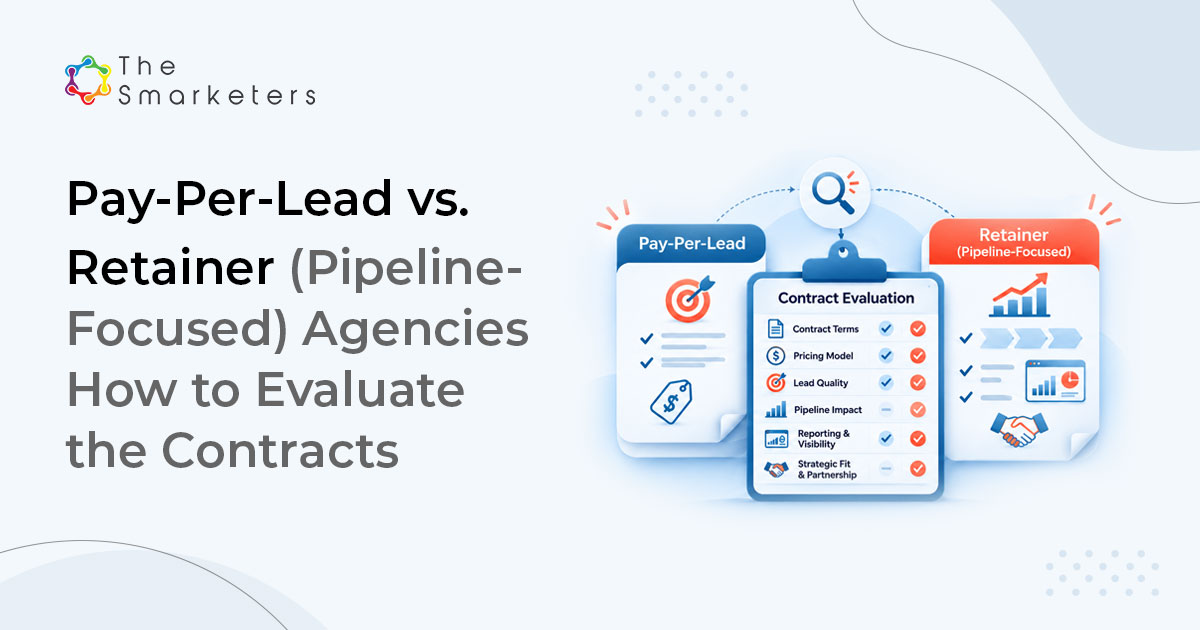
A pay-per-lead agency charges a fixed fee for each lead that meets agreed criteria, so you are buying contact records. A retainer (pipeline-focused) agency charges a monthly fee for an ongoing program measured against an opportunity target, so you are buying execution. In both cases, the contract terms, not the pricing label, decide lead quality.
A pay-per-lead model purchases contact records. You pay for every lead that satisfies a predefined set of criteria, such as a specific job title, employee headcount, geographic region, and a form submitted within the past 30 days. The agency’s sole responsibility is delivering records that meet those specifications; everything that follows falls on your team.
A pipeline-focused agreement purchases an ongoing program. Your fee covers a coordinated set of execution activities (campaigns, content creation, audience targeting, follow-up support, and performance reporting), all engineered to generate sales opportunities. The agency shoulders a larger share of the workflow, and its performance is evaluated further down the buyer journey.
In the pay-per-lead vs. retainer debate, neither structure is universally superior. Pay-per-lead can be effective when your sales representatives have open bandwidth, your internal qualification process is tight, and you simply need steady volume within a clearly defined market segment. A pipeline-focused engagement is the stronger fit when your primary challenge is building demand among accounts that are not actively shopping, or when no one internally owns the handoff between a form submission and an initial sales meeting.
What About Hybrid Pricing Models?
Many B2B lead generation pricing models now blend the two: a reduced monthly retainer plus a per-lead or per-opportunity fee for results above a target. This pay-for-performance layer splits risk between both sides, but it still needs every term in the checklist below. A hybrid contract with a vague lead definition carries the same disputes as a pay-per-lead one.
Does Either Pricing Model Guarantee Lead Quality?
No. Neither pay-per-lead nor retainer pricing guarantees lead quality on its own. A low cost per lead is not evidence of a high-value prospect. It simply confirms that a contact record met your baseline criteria. When that definition is overly broad, an agency can hit every contractual target while handing your sales team contacts they have no interest in pursuing.
Likewise, an opportunity target does not automatically ensure results. An external agency cannot dictate how quickly your reps follow up, whether your pricing aligns with a prospect’s expectations, or whether a buyer’s budget suddenly freezes. Every opportunity goal relies heavily on your internal inputs and on buyers deciding to engage, and any trustworthy proposal will state that openly.
Instead of judging proposals by their pricing label, evaluate the specific terms in each lead generation agency contract that govern quality.
Pay-Per-Lead vs. Retainer Contracts: 7 Key Terms to Compare
Pay-per-lead vs. retainer contract checklist: 7 terms to compare
| Contract Term | Pay-Per-Lead Contract | Pipeline-Focused Contract | Questions to Ask |
|---|---|---|---|
| Definition | Exact criteria for a billable lead | What qualifies as an opportunity, and at which pipeline stage | Is the wording specific enough that two reviewers would reach the same verdict on every record? |
| Acceptance | Who audits each lead and the review window allowed | Who validates an opportunity and what proof is required | Can sales reject a record, with a documented reason, before it is invoiced or credited? |
| Duplicates and exclusions | Whether current contacts, customers, and competitors are filtered out | Same exclusions, plus active open opportunities | Which suppression list is the agency checking against, and how frequently is it refreshed? |
| Follow-up ownership | Entirely yours upon delivery, unless explicitly stated otherwise | Often shared, such as agency-managed nurturing or SDR outreach | Who initiates first contact, within what timeframe, and who logs the outcome? |
| Reporting cutoffs | Lead volume tallied by delivery date | Opportunity volume tallied by stage date, accounting for deal progression lag | Which timestamp governs the reporting period, and when are monthly numbers finalized? |
| Your inputs | Target criteria and lead acceptance guidelines | Content sign-offs, sales bandwidth, CRM access, and target account lists | Which client deliverables does the target rely on, and what happens if one slips? |
| Disputes | Lead replacement or invoice credit for rejected records | Formal review process for contested opportunities | How are disagreements resolved, and what is the deadline for resolution? |
Map both proposals against this checklist, and pair it with our decision framework for choosing a demand generation agency. Any blank or ambiguous cell becomes a direct question to send back to the agency.
Comparing agency proposals right now? Talk to a demand gen strategist at The Smarketers, and we will walk through these contract terms with you.
How to Write a Qualified Lead Definition Before Signing
The highest-leverage step you can take prior to signing is sharpening the exact definition of a qualifying lead or opportunity.
Consider an illustrative contrast. A vague definition might read: “IT decision makers at mid-sized companies in North America.”
A rigorous definition looks far more specific: “An individual employed at a company with 200 to 2,000 employees, headquartered in the US or Canada, operating within one of our six priority industries, holding a manager-level or higher title in IT infrastructure, who has actively requested a demo or pricing consultation, excluding current customers, existing open opportunities, and competitors.”
That tighter standard is harder for an agency to meet, as it should be. More importantly, it makes approving or rejecting every record straightforward and dispute-free.
How to Set Lead Acceptance Criteria Before Launch
A workable acceptance workflow requires both a clear review timeframe and a standardized list of rejection reasons. For instance, you might give sales five business days to accept or decline a lead, requiring every rejection to cite a predefined reason such as incorrect company size, existing customer status, or lack of current need.
Without these guardrails, rejected records accumulate with no explanation attached. By the end of the quarter, reviews devolve into “these leads were unqualified” versus “your reps never followed up,” with neither party able to substantiate its claim.
Apply the exact same discipline to opportunities. Define in advance what evidence validates one, such as a completed discovery call with a named buyer and a CRM deal logged at an agreed pipeline stage.
What Internal Commitments Should the Contract Include?
Pipeline-focused engagements in particular hinge on timely contributions from your own team. Common dependencies include content approvals, available sales bandwidth to run meetings, CRM permissions, and a finalized target account list.
Document these obligations directly in the contract alongside firm due dates. If an internal deliverable is delayed, both parties should have a shared understanding of how that impacts the target. This is not about creating loopholes. It is about making the target realistic enough that missing it genuinely signals a performance issue.
How to Use This Checklist to Compare Agency Proposals
Plot both proposals into the comparison table and flag every term that is absent or loosely worded. Send those gaps back to each agency as clarifying questions before you shortlist a B2B lead generation agency. Their responses will reveal far more about how the partnership will function than the pricing model ever could.
If you are evaluating a pipeline-focused engagement and want to see how we structure these terms, our B2B demand generation services team can walk you through our approac
Frequently Asked Questions
What is the difference between pay-per-lead and retainer agencies?
A pay-per-lead agency charges a fixed fee for each lead that meets your agreed criteria, and follow-up usually falls to your team. A retainer agency charges a monthly fee for an ongoing program and is measured on opportunities further down the funnel.
Is pay-per-lead or retainer better for B2B companies?
Pay-per-lead suits teams with spare sales capacity, tight qualification and a clearly defined segment. A retainer suits teams that need to build demand among accounts not yet shopping, or that have no owner for the lead-to-meeting handoff.
What should a lead generation agency contract include?
At minimum: a precise lead or opportunity definition, acceptance rules with a review window, suppression lists, follow-up ownership, reporting cutoffs, client obligations with due dates and a dispute process.
Should accepted leads be refunded if they fail to convert?
No. That is outside the scope of a pay-per-lead agreement, and it is one of the clearest differences in any retainer vs. pay-per-lead comparison. You are paying for contact records that satisfy your agreed criteria, not for closed revenue. Paying solely for downstream sales outcomes requires a fundamentally different contract structure and pricing model. What you can reasonably negotiate is a fair review window paired with replacements or credits for leads rejected on valid grounds.
How should duplicate leads be managed?
Specify in writing exactly which suppression lists the agency must cross-check (such as existing CRM contacts, current clients, and open opportunities), along with how often those lists are updated. Any record matching those lists should be excluded from billing and reporting counts.
Can a pipeline-focused agency guarantee opportunities?
Approach unconditional guarantees with skepticism. Generating opportunities relies on your internal inputs, your sales team’s follow-up, and buyers choosing to engage, which are variables no agency fully controls. A clearly defined target backed by transparent conditions is far more credible than a blanket guarantee.

Siddharth Rampelli
Senior Growth Marketing Manager