
Table of Contents
- Key takeaways
- What Is a Revenue Data Contract?
- Why Don’t Sales and Marketing Numbers Match?
- What Should a Revenue Data Contract Include?
- How to Create a Revenue Data Contract in 6 Steps
- Example: Why HubSpot Attribution Shows Less Revenue Than Closed-Won
- Who Should Own a Revenue Data Contract?
- What Is the Difference Between Pipeline, Bookings, Recognized Revenue, and Attributed Revenue?
- What If the Numbers Still Don’t Reconcile?
- Take Action: Draft Your First Contract This Month
- Frequently Asked Questions
Need help with B2B Marketing?
Let the smarketers’ team drive your pipeline with data-led campaigns and AI-powered growth strategies.
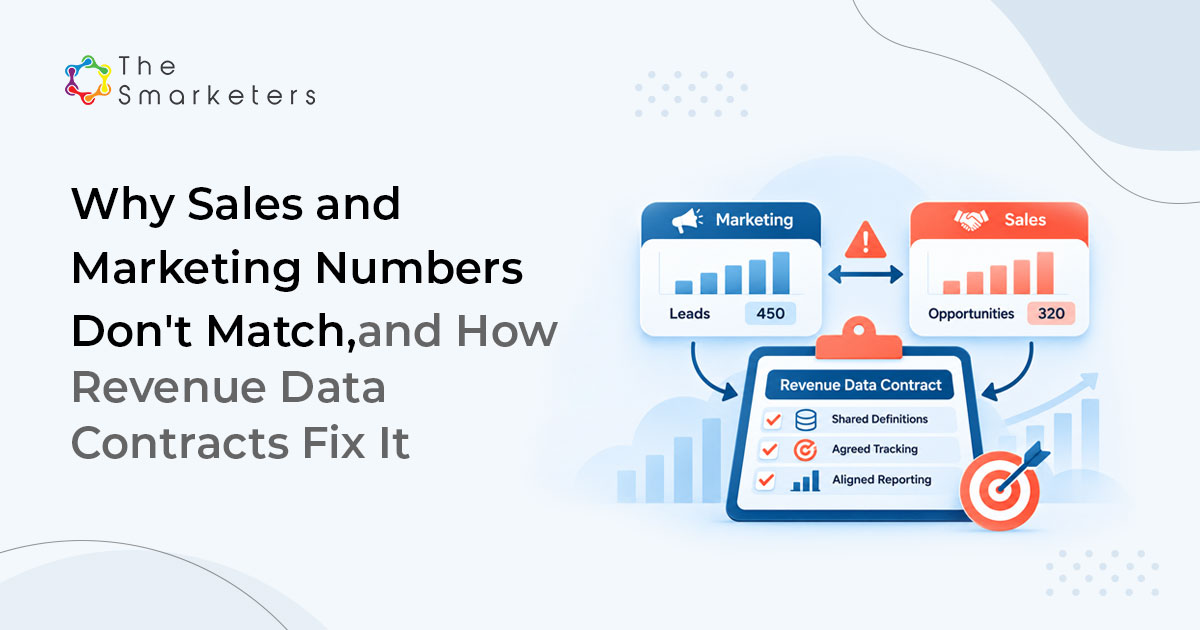
Imagine three leaders entering a quarterly business review, each presenting a different figure for the exact same metric.
Marketing reports $2.4 million in marketing-sourced pipeline. Sales states that new pipeline reached $3.1 million, crediting marketing with roughly half of that total. Meanwhile, Finance reports $1.9 million in bookings and does not even use the term “sourced.”
Each team’s calculations are internally accurate, and no one is technically wrong. The sales and marketing numbers don’t match, but the math behind each one holds up. Yet the next forty minutes are wasted debating which dashboard is trustworthy instead of making strategic business decisions.
Creating a single unified dashboard, a so-called single source of truth, so every department views the same figure seems like an obvious solution. While that offers temporary relief, the numbers inevitably diverge again the moment someone modifies a field, adjusts a filter, or alters an attribution model, leaving everyone unable to explain the shift.
A revenue data contract offers a far more sustainable approach and is one of the simplest building blocks of revenue operations. Rather than forcing disparate figures to match, it explicitly documents metric definitions, assigns clear ownership, and establishes a transparent method for explaining the variance between them.
Key takeaways
- Different revenue numbers often reflect different definitions, not errors.
- A revenue data contract documents one metric’s rules, source, owner, and change process.
- A reconciliation bridge itemizes every dollar between two reports.
- Agree on a tolerance for unexplained residuals with finance in advance.
What Is a Revenue Data Contract?
A revenue data contract is a one- to two-page written agreement that defines a single business metric: what it includes, which system it comes from, who owns it, and how changes get approved.
It is termed a “contract” because multiple departments depend on it, meaning no individual should alter it unilaterally. It is not a formal legal document; a one- or two-page reference stored in an accessible shared workspace is sufficient.
It should also not be confused with a field dictionary. A field dictionary defines an individual CRM property, covering its label, data type, and permitted values. By contrast, a data contract defines a broader business metric constructed from multiple properties, filters, and logic rules. For instance, “Pipeline created this quarter” relies on the deal creation date, monetary value, pipeline category, deal stage, currency, and specific exclusion criteria. The contract governs that entire calculation.
| Aspect | Field dictionary | Revenue data contract |
|---|---|---|
| Scope | One CRM property | One business metric built from multiple properties, filters, and logic rules |
| Example | Deal create date | Pipeline created this quarter |
| What it documents | Label, data type, and permitted values | Inclusion and exclusion rules, time and currency rules, owner, and change process |
Why Don’t Sales and Marketing Numbers Match?
Sales and marketing numbers usually don’t match because teams measure different milestones, use different date and currency rules, and rely on tools with hidden eligibility filters. In most cases, no one is wrong. Each number answers a different question.
Before drafting a contract, it is useful to understand the root causes of reporting discrepancies. Most variances fall into a few predictable categories:
- Measuring different milestones: Marketing might log pipeline the moment a deal is opened, whereas Sales might wait until the opportunity reaches a qualified stage. Finance, meanwhile, logs bookings upon contract signature and records recognized revenue even later. These represent distinct business events.
- Conflicting date and time rules: Does a deal qualify as “this quarter’s” pipeline based on its creation date or its projected close date? And how does the system classify a deal created at 11:00 PM on the final day of the quarter in a different time zone?
- Hidden eligibility criteria: Many reporting tools silently filter out specific records. HubSpot’s revenue attribution reports, for example, only count closed-won deals that have at least one associated contact along with populated values for amount, create date, and close date. HubSpot explicitly states that without an associated contact, revenue cannot be attributed to any interactions. Consequently, attributed revenue will naturally trail total closed-won revenue whenever deals lack linked contacts. This is a system rule rather than a bug, and the contract needs to document it, especially if you run a multi-touch revenue attribution dashboard in HubSpot.
- Retroactive configuration changes: According to Google, updating the reporting attribution model in GA4 alters both historical and future data. As a result, a report exported last month may no longer align with the exact same report generated today, even though actual business performance has not changed.
- Currency and exchange-rate timing: A deal logged in euros and converted using the exchange rate on its creation date will yield a different total than the same deal converted on its closing date.
- Underlying data hygiene issues: Duplicate entries, unassigned owners, deals placed in the wrong pipeline, and deleted records are genuine errors that require remediation through ongoing HubSpot CRM data hygiene, but they represent just one source of disagreement among many.
When sales and marketing numbers don’t match, the cause usually sits in the first five categories, none of which are actual errors. A data contract brings those structural differences into the open.
What Should a Revenue Data Contract Include?
Include the following ten elements in your contract, keeping every entry concise and unambiguous.
| Field | What to Document | Example |
|---|---|---|
| Metric name | The exact label displayed on dashboards | Pipeline created (new business) |
| Question it answers | A single plain-language sentence | How much new opportunity value did we generate this quarter? |
| Grain | What each individual row represents | One deal |
| Source system and object | The exact location of the underlying data | CRM, Deals object, New Business pipeline |
| Inclusion rules | Criteria required for a record to count | Deals opened during the period with a value greater than zero |
| Exclusion rules | Records omitted from the total, and why | Renewals, test records, and deals flagged as duplicates |
| Time rule | Which timestamp determines the reporting period and time zone | Deal create date, company reporting time zone |
| Currency rule | Standard reporting currency and conversion timing | USD, converted using the exchange rate on the create date |
| Owner | One specific individual rather than a department | RevOps lead |
| Change process | Approval workflow and documentation protocol | Owner drafts proposal; finance and sales leaders approve; logged with an effective date |
Include a version number and effective date at the top of the document. Whenever the contract is updated, archive the prior version so you can easily explain historical shifts if someone questions why last quarter’s figures changed.
How to Create a Revenue Data Contract in 6 Steps
Avoid the temptation to draft contracts for every company metric simultaneously. Instead, focus on the single report that sparks the most friction, typically pipeline creation or sourced revenue, and follow these six steps:
- Gather each department’s dataset: Have marketing, sales, and finance export the raw data supporting their numbers for the exact same timeframe. Preserve these exports as static snapshots so the data does not shift while you analyze it.
- Document each version’s logic: Map each report using the contract fields listed above. Frequently, the root cause of the conflict surfaces before you even inspect individual records, for example, discovering one department filters by create date while another uses close date.
- Independently verify each total: Have someone other than the original report creator reconstruct the final number from the raw export using solely the written rules. If they cannot replicate the figure, the documented rules are missing critical details.
- Build a pipeline reconciliation bridge: Start with one department’s total and itemize every adjustment required to arrive at the next department’s total, assigning a clear explanation and dollar amount to each line.
- Align on which metric serves which decision: Often, there is no single “correct” figure. In the bookings vs pipeline debate, both figures are accurate. They simply answer different business questions. Use the contract to specify which number guides which decision, such as whether marketing is measured on pipeline created or pipeline velocity.
- Assign ownership and formalize governance: Designate the metric owner, define the change-approval process, publish the contract in a central location, and link directly to it from the dashboard. Rename generic dashboard tiles to match the contract’s metric name, so “Pipeline” becomes “Marketing-sourced pipeline created” or “Sales-qualified open pipeline.”
Example: Why HubSpot Attribution Shows Less Revenue Than Closed-Won
Below is an illustrative reconciliation bridge using hypothetical numbers. It answers a common question: why does the HubSpot attribution report display less closed-won revenue than the CRM’s overall closed-won total for the quarter?
| Step | Value | Reason |
|---|---|---|
| Closed-won revenue in the CRM | $1,900,000 | All deals marked closed won during the quarter |
| Less: deals lacking an associated contact | minus $260,000 | Omitted from attribution per HubSpot's system rules |
| Less: deals missing a create or close date | minus $40,000 | Omitted; requires data cleanup |
| Less: deals converted using a different currency date | minus $15,000 | Discrepancy in currency conversion rules |
| Unexplained residual | minus $35,000 | Currently under review |
| Revenue in the attribution report | $1,550,000 |
In this breakdown, one adjustment stems from a system rule, one reflects a data hygiene gap, and one stems from a configuration difference. Only the residual remains genuinely unaccounted for, shifting the discussion away from “the attribution report is broken” toward productive troubleshooting.
Who Should Own a Revenue Data Contract?
Every data contract must be assigned to a single named individual, not a broad function like “RevOps” or “marketing ops.” While that owner does not need to make every decision unilaterally, they are accountable for logging agreements and keeping the contract accurate.
Any revision that alters how a metric is calculated requires sign-off from every department that depends on it, a practical form of sales and marketing alignment. Redefining “close date,” for instance, impacts sales forecasting, marketing’s sourced revenue, and finance’s bookings. All three stakeholders must approve the update, and the revision must carry a documented effective date.
Whenever a definition changes, explicitly decide whether to restate historical figures. In some cases, recalculating past quarters preserves trend continuity; in others, leaving historical data intact and annotating the transition point on charts is preferable. Both approaches are valid. Failing to make an intentional decision is what creates confusion.
What Is the Difference Between Pipeline, Bookings, Recognized Revenue, and Attributed Revenue?
One boundary merits special emphasis because it routinely causes friction.
CRM-attributed revenue is derived from deal records, typically reflecting the total value of closed-won deals. Recognized revenue, by contrast, follows finance’s formal accounting standards, meaning it may be amortized over a contract term, adjusted, or recorded on a completely different schedule.
These figures can be viewed alongside each other, provided it is done carefully. Always label them distinctly, detail how they connect within the contract, and avoid presenting attributed revenue as though it were an official financial figure. Have your finance partner sign off on this section in any contract referencing revenue.
Use the table below as a starting point, and confirm each row with your finance partner.
| Metric | Business event | Typical source | Best used for |
|---|---|---|---|
| Pipeline created | Deal opened | CRM | Demand generation performance |
| Bookings | Contract signed | CRM or finance system | Sales performance |
| Attributed revenue | Closed-won deal with linked contacts | Attribution tool | Channel and campaign credit |
| Recognized revenue | Accounting recognition | ERP or accounting system | Official financial reporting |
What If the Numbers Still Don’t Reconcile?
Reconciling every single dollar is rare, and that is completely normal.
Work with finance ahead of time to establish an acceptable tolerance threshold: the maximum unexplained variance you can live with while still relying on the report. Display the residual transparently in your bridge. If it exceeds that agreed threshold, investigate it prior to the next business review rather than quietly tweaking the figures.
A modest, transparently documented residual earns far more executive confidence than a neatly matching dashboard that no one can audit or reproduce.
Take Action: Draft Your First Contract This Month
If your sales and marketing numbers don’t match, identify the single report that generates the most debate, pull each department’s version for the same period, and draft a data contract for it. Construct the reconciliation bridge, align on which figure answers which business question, and designate an owner.
If you are tackling discrepancies between GA4 and your CRM, the same bridge method applies: start from CRM closed-won and itemize every gap. And if you need support implementing data contracts and RevOps reporting across systems, our RevOps as a Service team is ready to help, starting with a RevOps reporting audit.
Frequently Asked Questions
Is a revenue data contract the same as a CRM field dictionary?
No. A field dictionary documents individual CRM properties. A data contract governs a business metric built from multiple fields, combining inclusion criteria, date rules, currency conversions, and clear ownership. In practice, your contract will often reference specific entries in your field dictionary.
Can attributed deal revenue be compared with recognized revenue?
Only with caution, as they track distinct milestones under different accounting and reporting rules. Keep them separate, label each clearly, and document their relationship in the contract, ensuring your finance partner reviews and approves that explanation.
Who should approve a change to the close-date definition?
Every stakeholder whose reporting depends on it. This generally includes sales leadership, the marketing owner overseeing sourced revenue, and finance. Log the update with a clear effective date and document whether historical periods will be restated.
What should we do when the residual cannot be explained?
Report it openly, set an acceptable variance threshold with finance upfront, and investigate whenever it grows past that limit. Never hide an unexplained gap inside another line item just to force the bridge to balance.
How often should the reconciliation bridge be updated?
Monthly, aligned to finance’s close, so the bridge is ready before the leadership review rather than assembled during it.
What if we don't have a RevOps team?
Assign the contract to the person who already owns CRM reporting, usually marketing ops or sales ops, and have finance co-sign it.

Venugopal Mamidala
Director of MarTech